
About Oh Hell - names, rules and strategy
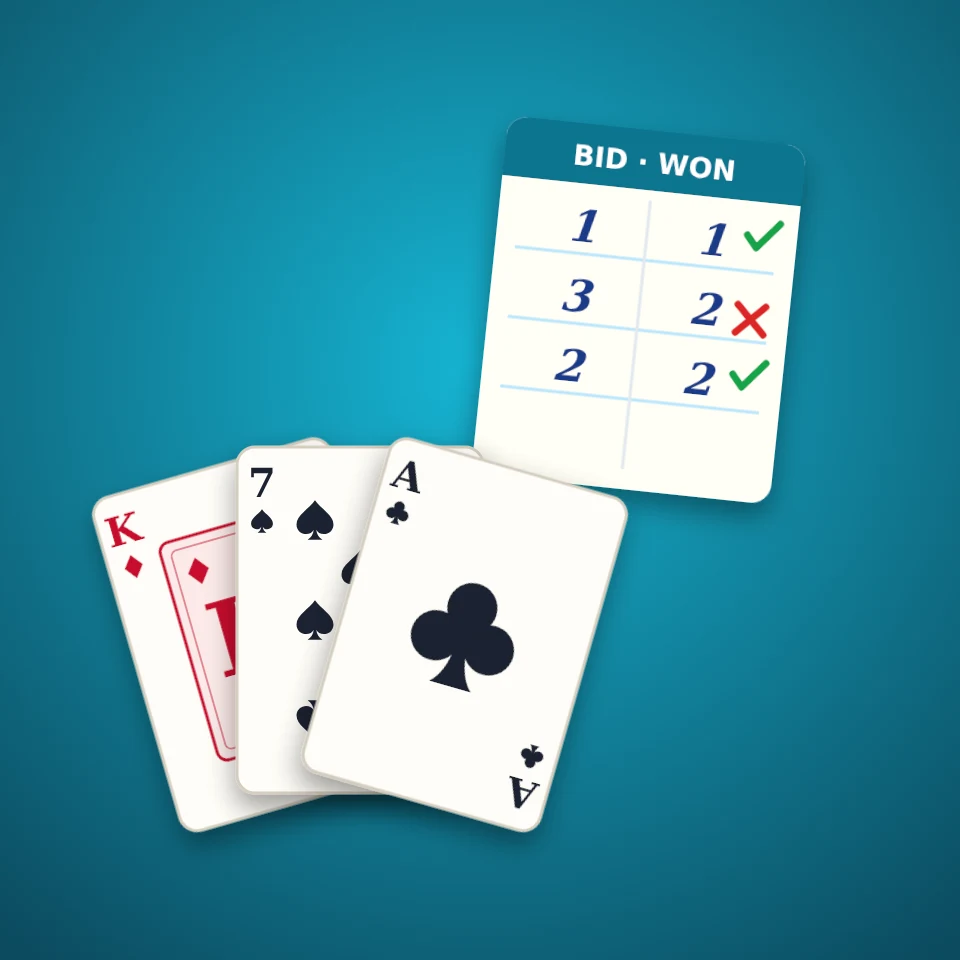
Oh Hell is a trick-taking game for three or more players in which each player bids exactly how many tricks they will take, and only an exact bid scores. This page covers its other names, how the hands grow and shrink, how bidding and play work, the hook rule, the common ways of scoring, and how to hit your bid.
What kind of game it is
Oh Hell belongs to the large Whist family of trick-taking games, the family of Bridge and Spades. Like Bridge it asks players to say in advance how many tricks they will take, but every player bids alone, there are no partners, and taking more tricks than you bid is as bad as taking fewer. Because the number of cards changes from hand to hand and the trump suit is turned up at random, no two hands play alike.
Other names
The game is known by many names. Oh Pshaw and Oh Well are politer versions of Oh Hell, a name usually explained as what players say when a bid goes wrong. Blackout is another common name, and Up and Down the River describes the way the hands grow and then shrink. In the Netherlands a version is called Boerenbridge. Wizard, a commercial card game sold with its own deck, is a close relative: it is played and scored on the same idea of bidding an exact number of tricks, with special Wizard and Jester cards added to the pack.
Dealing the hands
Oh Hell uses a standard 52-card pack and suits three to seven players. The number of cards dealt changes every hand. In the version called Up and Down the River, the first hand has one card each, the next two, and so on up to a largest hand, then back down to one; some tables play only up, or only down from the largest hand. The deal passes to the left. After the deal, the next card of the pack is turned face up and its suit is trump for that hand. When the whole pack has been dealt there is no card to turn, and the hand is played without trump.
Bidding and play
Starting with the player to the dealer's left, each player bids once: the number of tricks, from zero to the number of cards in the hand, that they intend to take. The bids are written down where everyone can see them. The player to the dealer's left then leads to the first trick. Everyone must follow the suit led if they can; a player who cannot may play a trump or any other card. The trick goes to the highest trump in it, or, if it holds no trump, to the highest card of the suit led, aces high. The winner of each trick leads to the next.
The hook rule
Many tables add the hook rule: the dealer, who bids last, may not make a bid that brings the total of all the bids to exactly the number of tricks in the hand. The bids then can never all come true, and at least one player must miss. The rule is a disadvantage for the dealer, but the deal moves round, so everyone takes a turn on the hook. Without the rule, players may bid whatever they like.
Scoring
Scoring varies from table to table, but an exact bid is always what counts. A common method gives a player who takes exactly the number of tricks bid 10 points plus the bid, and nothing to everyone else. Another gives one point for every trick taken and a bonus of 10 for an exact bid. Some tables also subtract points from a player who misses, such as one point for every trick over or under the bid. The game ends after the last hand of the agreed sequence, and the highest total wins. The game on PictorX scores 10 plus the bid for an exact bid, with a missed bid scoring 0 or, if you choose, losing the difference.
How to bid exactly
Count your likely winners: high trumps, aces, and kings that are guarded by another card of their suit. With more players, each card is less likely to win, because more trumps and higher cards are out. A bid of zero is often the best bid with a weak hand, especially in the small hands. Watch the total of the bids: when they add up to more than the tricks, the tricks will be fought over and high cards win less often; when they add up to fewer, other players will be trying to lose tricks, and you may be left with one you did not want. Once you have made your bid, get rid of your high cards when someone else is already winning a trick, and keep a low card to lose with at the end.
Frequently asked questions
Why is it called Oh Hell?
The name is usually explained as the exclamation of a player whose bid has just gone wrong, which happens often because an exact bid is hard to make. Players who prefer a politer name call it Oh Pshaw or Oh Well.
Is a bid of zero allowed?
Yes. Zero is a normal bid, and with the usual scoring a player who takes no tricks after bidding zero scores 10. In the first hand of one card each, zero is often the right bid for anyone without a high trump.
What is the difference between Oh Hell and Spades?
Both are trick-taking games in which players bid tricks. In Spades, spades are always trump, players usually play in fixed partnerships with 13 cards each, and taking extra tricks costs only a little. In Oh Hell every player plays alone, the trump suit and the hand size change every hand, and only an exact bid scores.
Is Wizard the same game as Oh Hell?
Not quite. Wizard is a commercial game sold with its own deck, which adds four Wizards and four Jesters to the ordinary cards: a Wizard beats every ordinary card and a Jester loses to them. Bidding an exact number of tricks and scoring for an exact bid work in the same spirit as Oh Hell.
How many people can play Oh Hell?
It is usually played by three to seven players. With more players the largest hand is smaller, since everyone must get the same number of cards from one pack. On PictorX you play against two to five computer players.
Related tools
Oh Hell
Play Oh Hell free in your browser against two to five computer players. Bid exactly how many tricks you will take, follow suit, watch the trump card and score 10 plus your bid when you hit it.
About Spades - history, rules and strategy
Where the card game Spades comes from, how a hand is bid, played and scored, what Nil and bags are, and how to play well with a partner.
About Hearts - history, rules and strategy
Where the card game Hearts comes from, from Reversis to Black Lady and the Hearts that came with Windows, how passing and scoring work, what shooting the moon is and how to play well.
About Crazy Eights - rules, variants and strategy
How Crazy Eights is played, how the eights and the stock work, how a round is scored, which variants are common, how it relates to Mau-Mau, Switch and Uno, and how to play it well.
About Solitaire - history and rules of Klondike
Where does Klondike solitaire come from? How the seven piles, stock and foundations work, why draw 3 is harder and how many deals can be won.
Ready to try it?
Open PictorX in your browser — no install, no credit card required to start.
Play Oh Hell