
Molecules and chemical bonds explained
Everything around you, from the water you drink to the DNA in your cells, is made of molecules: groups of atoms held together by shared electrons. A few simple rules decide which atoms can join, how many bonds each one forms and what shape the molecule takes. Here is how they work.
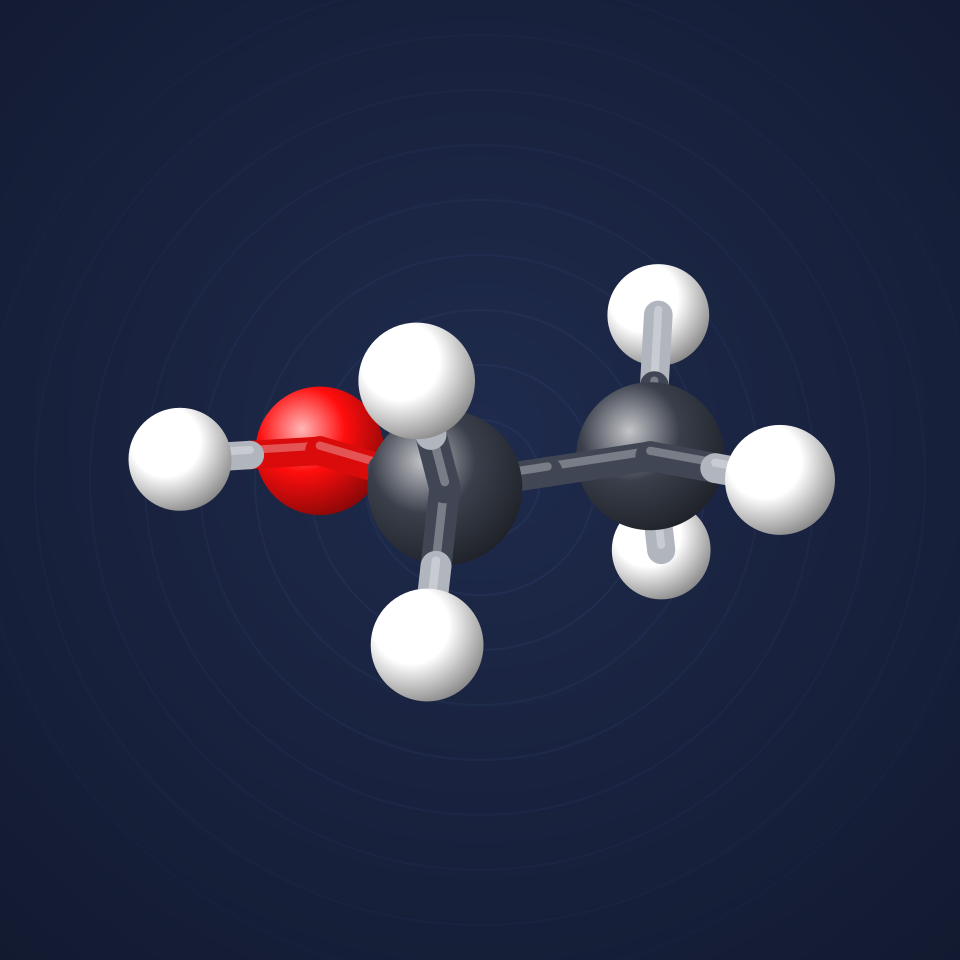
Atoms want a full outer shell
An atom's electrons sit in shells, and the outer shell decides how it reacts. Most atoms are most stable with eight electrons in that shell, hydrogen with two. Noble gases such as neon already have a full shell and hardly react. Other atoms get there by sharing electrons with their neighbours. Oxygen has six outer electrons, so it shares two more; carbon has four, so it shares four. The number of bonds an atom forms this way is its valence: 1 for hydrogen, 2 for oxygen, 3 for nitrogen and 4 for carbon.
Single, double and triple bonds
A covalent bond is a pair of electrons shared by two atoms. Two atoms can share one, two or three pairs: a single, double or triple bond. Each extra pair pulls the atoms closer and holds them more strongly: a carbon–carbon single bond is about 1.54 Å long, a double bond 1.34 Å and a triple bond 1.20 Å. A double bond counts as two of an atom's bonds, so in carbon dioxide, O=C=O, the carbon uses all four of its bonds on two oxygens. In nitrogen gas, N≡N, the two atoms share three pairs, one of the strongest bonds in chemistry, which is why the nitrogen in the air reacts so little.
Lone pairs
Outer electrons that an atom does not share stay with it in pairs, called lone pairs. Oxygen in water shares two of its six outer electrons and keeps the other four as two lone pairs; nitrogen in ammonia keeps one. Lone pairs do not hold atoms together, but they take up room around the atom and push the bonds closer together, and they let water and ammonia attract other molecules. In a Lewis structure they are drawn as pairs of dots, as in the builder.
Formula and molar mass
A molecular formula counts the atoms of each element: H₂O is two hydrogens and one oxygen. The usual order for organic compounds, the Hill system, puts carbon first, then hydrogen, then the other elements alphabetically, so ethanol is C₂H₆O. The molar mass is the mass of one mole of molecules, about 6.022 × 10²³ of them, in grams: the sum of the atomic weights. For water that is 2 × 1.008 + 15.999 ≈ 18.02 g/mol, so 18 grams of water hold one mole of molecules.
The shape of a molecule: VSEPR
Valence shell electron pair repulsion, VSEPR, predicts shapes from one idea: the electron pairs around an atom repel each other and spread out as far as they can. Two pairs sit opposite each other, 180° apart, as in linear carbon dioxide. Three spread to 120° in a flat triangle, as in formaldehyde. Four point to the corners of a tetrahedron, 109.5° apart, as in methane. Lone pairs count as pairs too, but they push a little harder, so ammonia with one lone pair is a pyramid with angles of about 107°, and water with two is bent at about 104.5°. Double and triple bonds count as one direction each.
Isomers
The same atoms can be joined in different ways. Ethanol, CH₃CH₂OH, and dimethyl ether, CH₃OCH₃, are both C₂H₆O, yet ethanol is a liquid that boils at 78 °C and dimethyl ether a gas that boils at −24 °C. Molecules like these, with the same formula but a different structure, are called isomers. Butane, C₄H₁₀, has two, and by the time you reach C₁₀H₂₂ there are 75. This is why chemists draw structures and do not just write formulas.
Try it
In the Molecule Builder, place an oxygen and two hydrogens, bond them and watch the formula become H₂O; then open 3D and see the bend the lone pairs cause. Build carbon dioxide with two double bonds and see it stay straight, or ethanol and dimethyl ether from the same atoms. Select any atom to read its bonds, lone pairs and shape, select a bond to see what kind it is, and turn on Challenges to build fifteen molecules for points.
Frequently asked questions
What is the difference between a covalent and an ionic bond?
In a covalent bond two atoms share electrons, as nonmetals such as carbon, oxygen and hydrogen do in molecules. In an ionic bond one atom gives electrons to another, and the charged ions that result attract each other, as sodium and chloride do in table salt. Salt does not form separate molecules but a crystal of ions, which is why the builder uses only covalent bonds.
What is the octet rule?
The rule of thumb that atoms bond until they have eight electrons in their outer shell, like a noble gas. It explains the valence of carbon, nitrogen, oxygen and the halogens. Hydrogen stops at two, and elements from the third row on, such as phosphorus and sulfur, can hold more than eight, as in phosphoric acid and sulfuric acid.
Why is water bent and carbon dioxide straight?
Carbon dioxide's carbon has two double bonds and no lone pairs, so its two directions point opposite ways, 180° apart. Water's oxygen has two single bonds and two lone pairs: four pairs that point roughly to the corners of a tetrahedron. Only two of them hold hydrogens, so the molecule looks bent, at about 104.5°.
Why are the atoms colored the way they are?
The colors follow the CPK convention used in chemistry models since the 1950s, named after Corey, Pauling and Koltun: white hydrogen, black carbon, blue nitrogen, red oxygen, yellow sulfur, green chlorine and orange phosphorus. They make it easy to read a model at a glance.
Related tools
Molecule builder
A free online molecule builder: join atoms with single, double and triple bonds, get the formula and molar mass, see the molecule's real shape in 3D, and solve chemistry challenges.
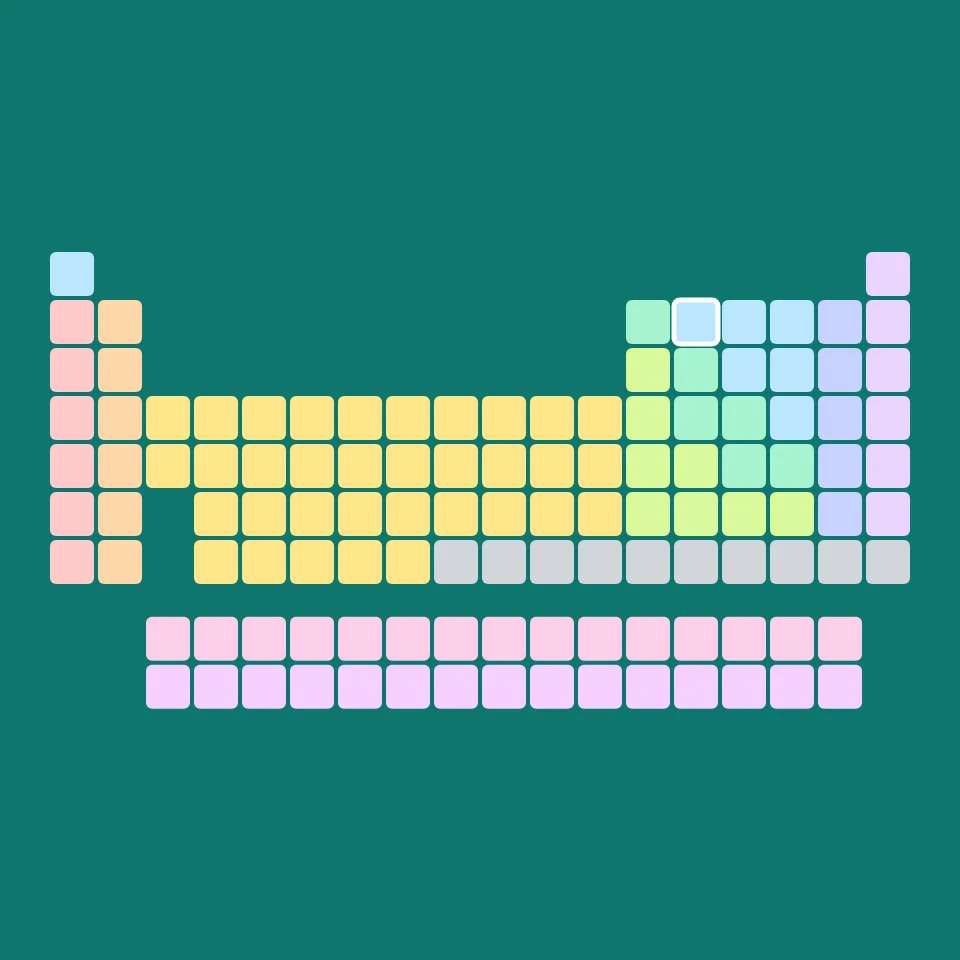
Interactive periodic table
An interactive periodic table of all 118 elements: color it by category, block, state or electronegativity, and click an element for its atomic weight, electron configuration and shells.
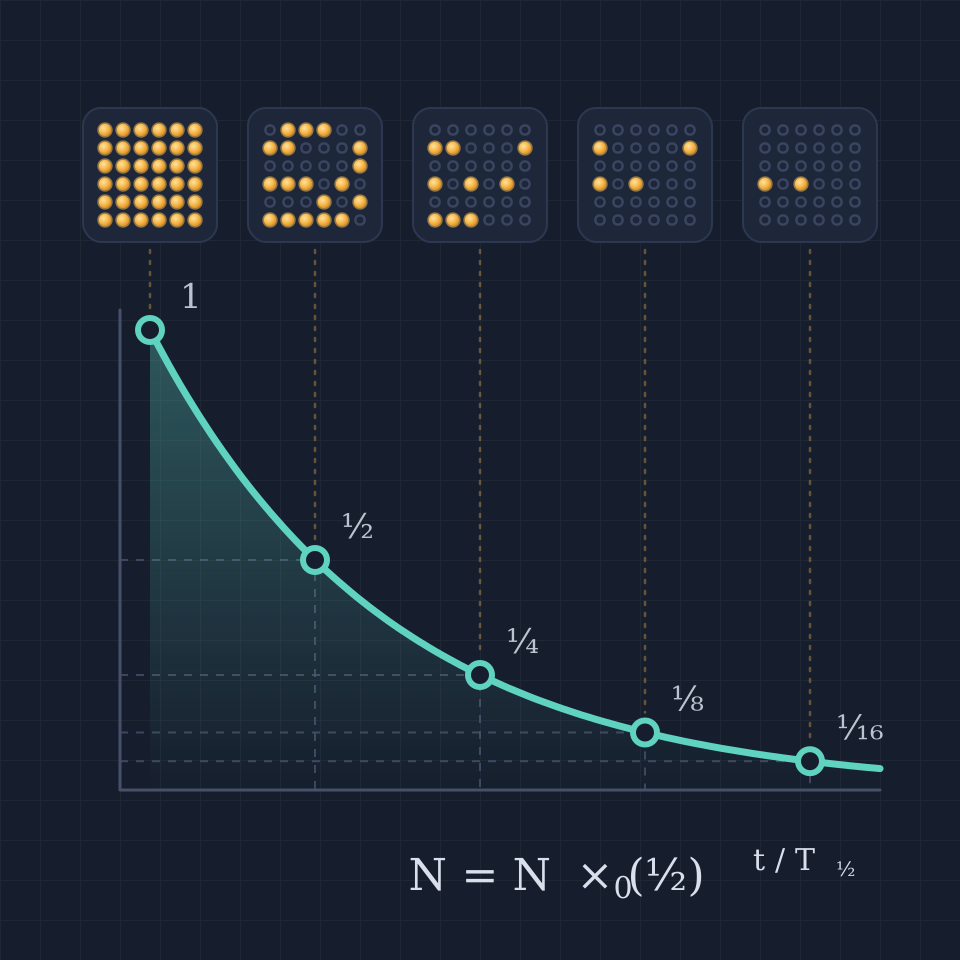
Half-life calculator
A free half-life calculator: work out the amount left, the initial amount, the elapsed time or the half-life of radioactive decay, with isotope presets, a decay curve and the calculation written out.
Ready to try it?
Open PictorX in your browser — no install, no credit card required to start.
Build a molecule