
The Bohr model explained
The Bohr model is the atom as most people picture it: a nucleus with electrons circling around it like planets. It lasted only about a dozen years as the best theory of the atom, yet it changed physics for good, because it was the first model to put quantum rules inside the atom. Here is what it says, what it got right, and what came after.
From Rutherford to Bohr
In 1911 Ernest Rutherford found that an atom's positive charge and nearly all its mass sit in a tiny nucleus, with the electrons somewhere around it. But a circling electron should radiate light, lose energy and spiral into the nucleus within a fraction of a second. Niels Bohr, a young Dane working with Rutherford in Manchester, solved this in 1913 by decree: electrons may only move on certain orbits, and on those they do not radiate at all.
The quantum rule
Bohr's allowed orbits are those where the electron's angular momentum is a whole number n times ħ, Planck's constant divided by 2π. For hydrogen this gives orbits whose radius grows as n², starting at the Bohr radius of 0.053 nm, and energies of −13.6 eV / n². The lowest orbit, n = 1, is the ground state; the energy needed to tear the electron away entirely is 13.6 eV, exactly what is measured.
Light from jumps
When an electron falls from orbit m to a lower orbit n, the atom emits one photon carrying the energy difference, 13.6 eV × (1/n² − 1/m²). Falling to n = 2 gives the visible Balmer lines of hydrogen, red, blue-green and violet, that Johann Balmer had fitted with a formula in 1885 without knowing why. Bohr's model derived the formula and the Rydberg constant from first principles, which convinced physicists that it was on to something.
Shells and the periodic table
Extended to bigger atoms, the orbits became shells, named K, L, M, N from the inside out, holding at most 2, 8, 18 and 32 electrons. Filling them one electron at a time, element by element, reproduces the rows of the periodic table: each row ends with a noble gas whose outer shell is full, and each new row starts with an alkali metal holding a single electron in a new shell. The order is not simply shell by shell; the fourth shell starts filling before the third is complete, which is why the transition metals appear.
Valence and bonding
Atoms react to reach a full outer shell. Sodium loses its one outer electron and chlorine gains one, forming Na⁺ and Cl⁻ ions that attract each other; carbon, with four, shares electrons with four neighbours, which lets it build the chains and rings of organic chemistry. Gilbert Lewis and Irving Langmuir turned these counts into the rules of chemical bonding that chemists still draw with dots and lines.
What was wrong
The Bohr model could not explain atoms with more than one electron, the different brightness of spectral lines, or why some lines split into several in a magnetic field. In 1925 and 1926 Werner Heisenberg and Erwin Schrödinger replaced it with quantum mechanics, in which an electron has no path at all, only a wave function that gives the probability of finding it. The orbits became orbitals: s, p, d and f clouds of different shapes. The shells and their energies survived, now as the principal quantum number n.
Why it is still taught
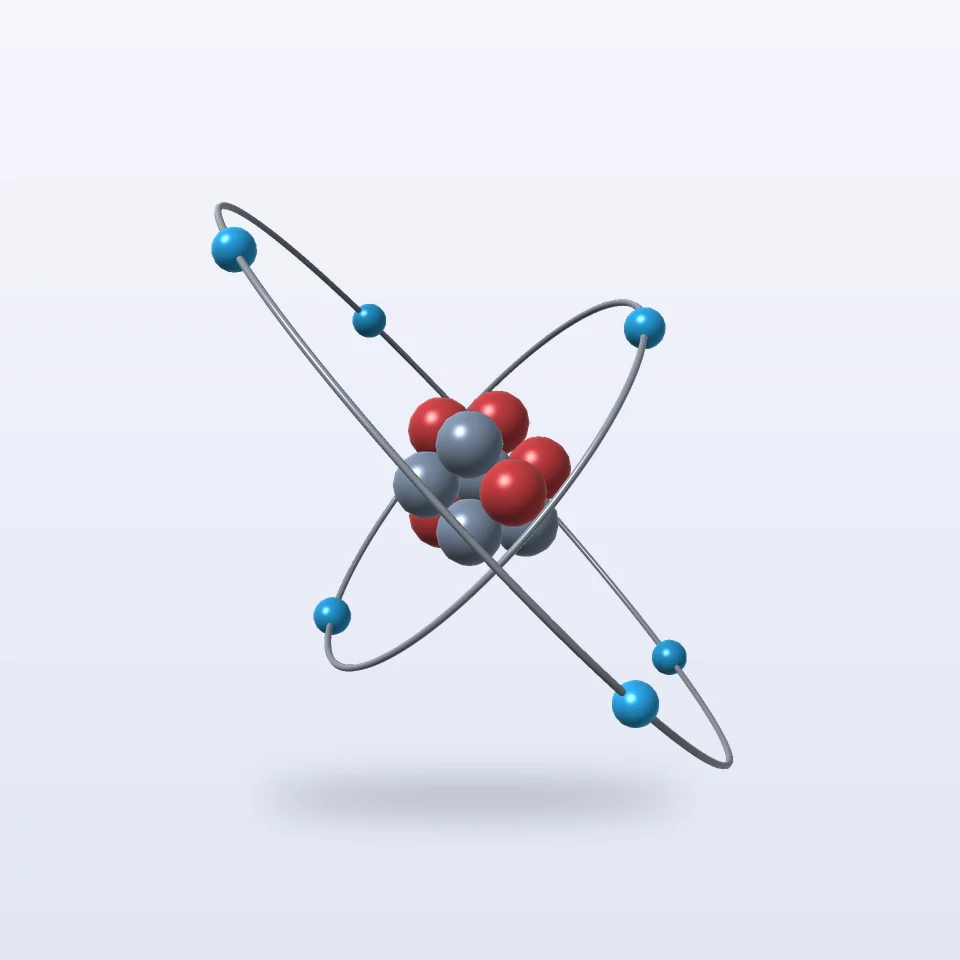
Because it gets the important numbers right with a picture anyone can draw: the electrons per shell, the valence electrons, the jumps between energy levels that make neon signs glow. The classic symbol of the atom, three tilted ellipses around a dot, comes from it, and so does the language of shells and levels used across chemistry and physics.
Explore it
Open the Bohr model, start with hydrogen and press Next element to add one proton at a time: watch the K shell fill at helium, the L shell at neon, and the M shell begin at sodium. Make ions with Charge, switch the orbits to one plane for a textbook diagram, and choose True ratio to see Bohr's n² spacing. The pencil opens the picture in the photo editor with the nucleus, every shell and the glow on layers of their own.
Frequently asked questions
Who was Niels Bohr?
A Danish physicist (1885–1962) who proposed his model of the atom in 1913, founded the Institute for Theoretical Physics in Copenhagen and received the Nobel Prize in Physics in 1922. His principle of complementarity shaped the interpretation of quantum mechanics, and element 107, bohrium, is named after him.
What is the Bohr radius?
The radius of the lowest orbit of hydrogen in Bohr's model, about 0.0529 nanometres. In quantum mechanics it is the most likely distance of the electron from the nucleus in hydrogen's ground state, and it is used as a unit of length in atomic physics.
What is the difference between a shell and an orbital?
A shell is a set of electrons with the same principal quantum number n, Bohr's orbit number. Within a shell there are orbitals of different shapes: one s orbital, three p, five d and seven f, each holding two electrons. Shell n has n² orbitals and so at most 2n² electrons.
Why does potassium have 2, 8, 8, 1 and not 2, 8, 9?
Because the 4s orbital has a lower energy than the 3d orbitals, so the fourth shell starts filling after the third has 8 electrons. The 3d orbitals fill later, from scandium to zinc, giving the transition metals. This order, the aufbau principle, is why the periodic table has its shape.
Does the electron really go round?
No. In quantum mechanics an electron in an atom has no definite path; it is spread over its orbital, and only the probability of finding it at a place is defined. The animation shows Bohr's picture, with each shell going round at a speed that falls with its number, as in his model.
Related tools
Bohr model of the atom
Build a Bohr model of any of the 118 elements in 3D: a nucleus of protons and neutrons with the electrons circling on their shells. Make ions, compare even spacing with Bohr's n² ratio, and read the electrons per shell and the valence electrons.
Interactive periodic table
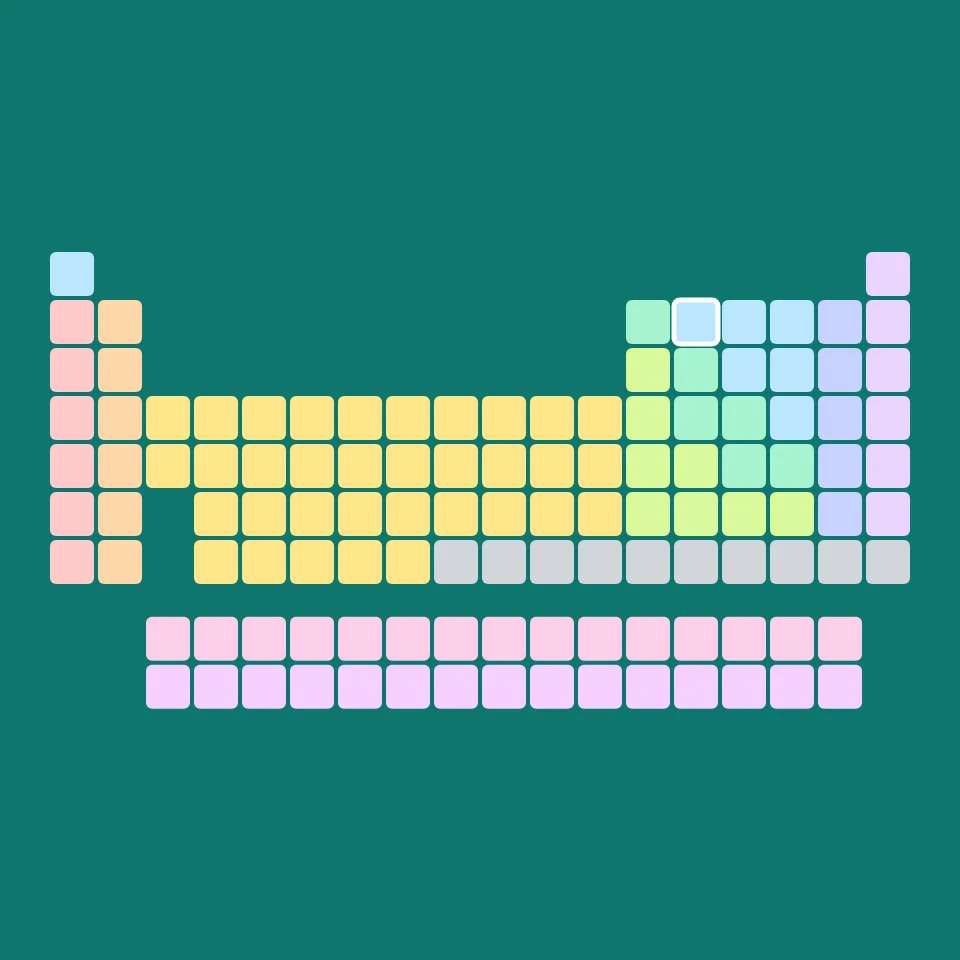
An interactive periodic table of all 118 elements: color it by category, block, state or electronegativity, and click an element for its atomic weight, electron configuration and shells.
Molecule builder
A free online molecule builder: join atoms with single, double and triple bonds, get the formula and molar mass, see the molecule's real shape in 3D, and solve chemistry challenges.
DNA double helix
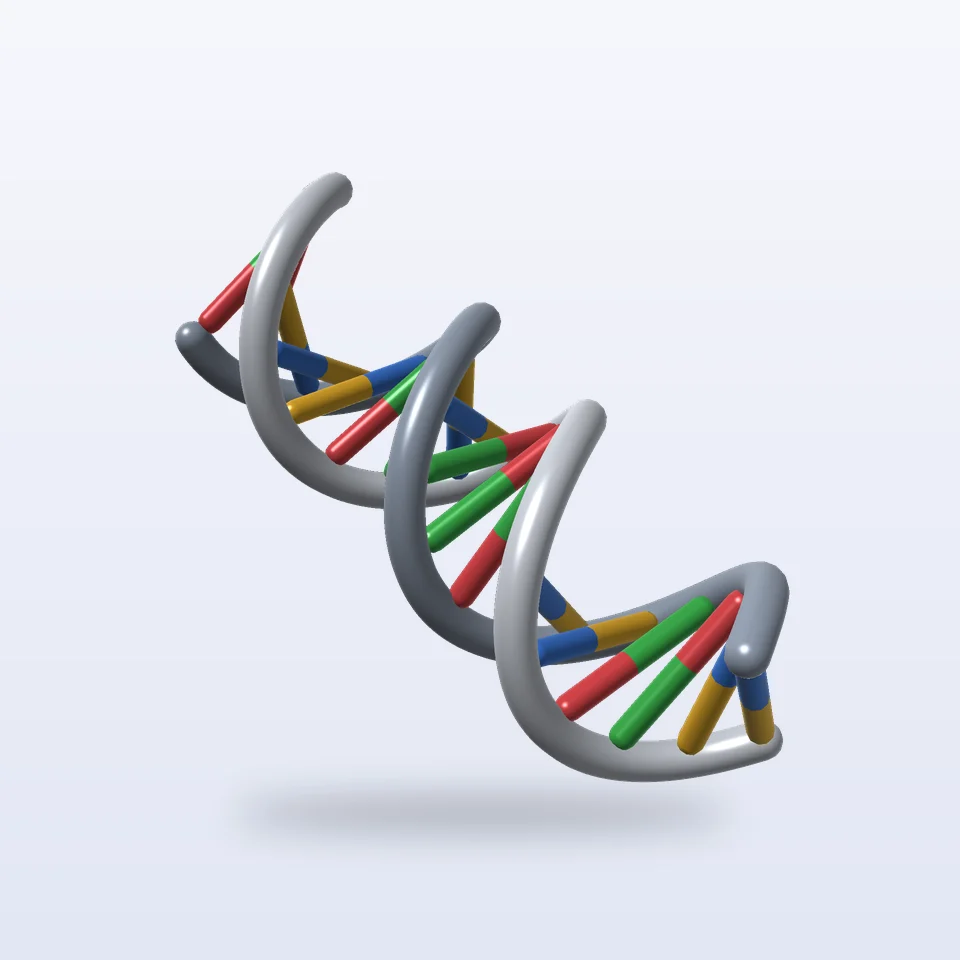
Type a DNA sequence and turn it as a double helix in 3D: the complementary strand fills in by base pairing, A with T and G with C. Compare B-, A- and Z-DNA, unzip the helix like a replication fork, and read the GC content, length and melting temperature.
Chemical equation balancer
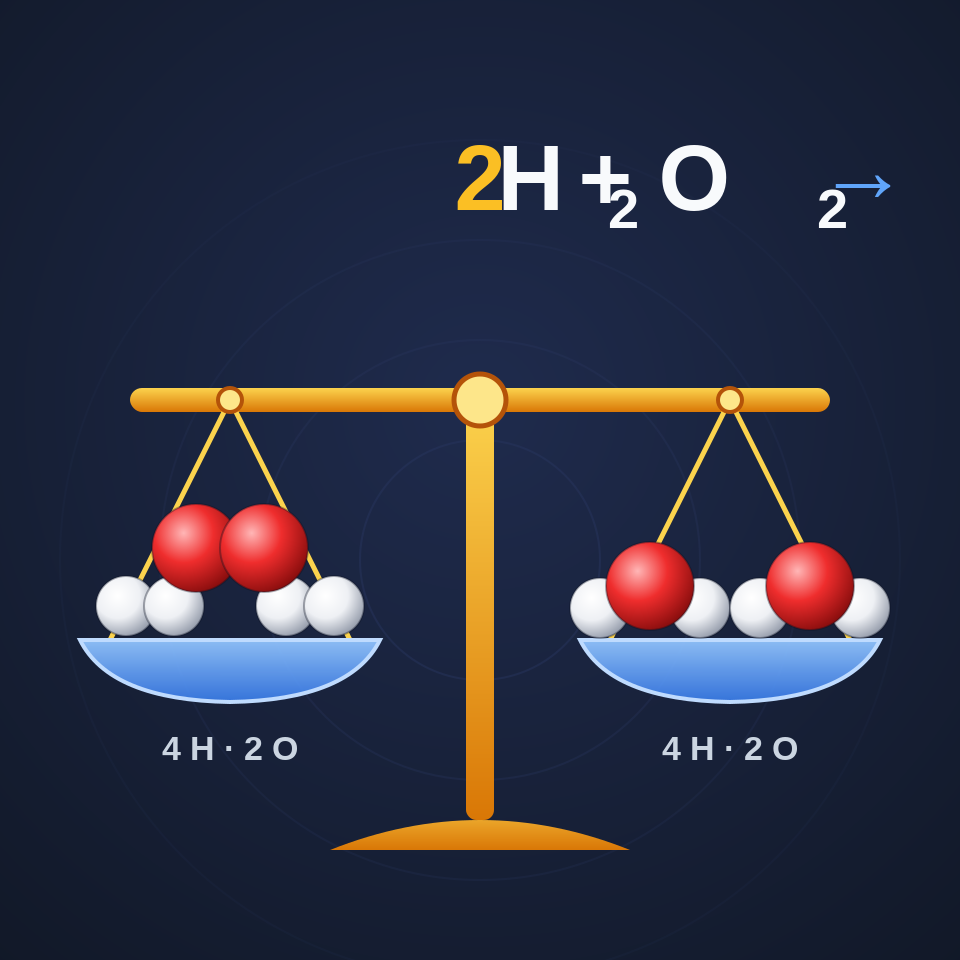
Balance any chemical equation instantly and exactly, ions, hydrates and redox reactions included. Count the atoms on both sides, see the oxidation numbers that change, and work out molar masses, the limiting reactant and the yield.
Ready to try it?
Open PictorX in your browser — no install, no credit card required to start.
Open the Bohr model