
The Möbius strip and the Klein bottle explained
The Möbius strip is the friendliest object in topology: anyone can make one from a strip of paper, and it immediately shows something surprising. Behind it lies one of the great results of nineteenth- and twentieth-century mathematics, the complete classification of surfaces, in which the Möbius strip, the Klein bottle and the projective plane are the building blocks of everything one-sided.
Möbius and Listing
In 1858 two German mathematicians, August Ferdinand Möbius and Johann Benedict Listing, independently described a band with half a twist and noticed that it has only one side. Listing published first; Möbius's name stuck. Both were studying what Listing had named topology: the properties of shapes that survive stretching and bending, but not cutting or gluing. Whether a surface has one side or two is such a property.
Orientability
Stand a small arrow on a surface and slide it around any loop. On a sphere, a plane or a torus it always comes back pointing the same way: the surface is orientable, and you can consistently call one side up. On a Möbius strip some loops bring it back reversed. Such a surface is non-orientable. For surfaces in ordinary space, being non-orientable is the same as having one side, which is what the walker in the app shows.
Cutting experiments
Cut a Möbius strip along its middle and it stays in one piece, twice as long, with two full twists and two sides. Cut that again and you get two such bands linked together. Cut the original a third of the way from its edge and you get a thin Möbius strip linked with a long two-sided band. These results are a favourite classroom surprise and follow from tracing what happens to the single edge.
The Klein bottle
Felix Klein described his surface in 1882 as a closed surface with no edge and no inside. Take a tube; instead of joining its ends into a doughnut, bend one end round, pass it through the tube's wall and join it from the inside. In three dimensions the passage through the wall is unavoidable, so a Klein bottle in our space is an immersion, a surface that crosses itself; in four dimensions it can be embedded without crossing. Cut a Klein bottle lengthwise in the right way and it falls into two Möbius strips.
The projective plane and Boy's surface
The real projective plane is the set of lines through a point in space, or a disc whose opposite edge points are glued together. It is closed and one-sided, and its Euler characteristic is 1. For a long time nobody could see it in three dimensions without singular points, until Werner Boy, a student of David Hilbert, found an immersion in 1901: Boy's surface, with three lobes and one triple point. Bernard Morin and Robert Bryant and Rob Kusner later gave it explicit formulas, which the app uses.
Classifying all surfaces
Every closed surface is a sphere with handles attached, or a sphere with cross-caps attached, a cross-cap being a Möbius strip sewn into a hole. The Euler characteristic and orientability decide which: a torus is a sphere with one handle, the projective plane a sphere with one cross-cap, the Klein bottle a sphere with two. This classification, completed in the early twentieth century, means that the Möbius strip is the essential ingredient of every one-sided surface.
Möbius strips in the world
Conveyor belts and typewriter ribbons have been made as Möbius strips so that both faces wear evenly. The recycling symbol's three arrows were drawn as a Möbius strip by Gary Anderson in 1970. M. C. Escher drew ants walking around one in his woodcut Möbius Strip II. Chemists have made molecules shaped like Möbius strips, and some resistors and electronic components use the twist.
Explore it
Open the Möbius strip and Klein bottle, colour the two sides and find the seam where they meet, then press Walk once round and watch the walker come back on the other face. Change the half twists from 1 to 2 and see the strip become two-sided, switch to the Klein bottle and Boy's surface, and compare their Euler characteristics in the tiles. The pencil opens the picture in the photo editor with the surface, the grid, the path and the walker on layers of their own.
Frequently asked questions
Does a Möbius strip really have only one side?
Yes. You can go from any point to the point directly behind it on the paper by sliding along the surface, without crossing an edge. That is why a pencil line along the middle covers both faces of the paper and meets itself.
Can you buy a real Klein bottle?
You can buy glass models, and they are beautiful, but every one passes through its own wall, because a true Klein bottle without self-crossing cannot exist in three dimensions. Mathematically, the glass model is an immersion of the Klein bottle, not an embedding.
What is the difference between a Klein bottle and a torus?
Both are closed surfaces with Euler characteristic 0 and both can be made from a tube by joining its ends. For a torus the ends are joined directly and the surface has an inside and an outside; for a Klein bottle one end is reversed first, making it one-sided.
How many sides does a strip with two half twists have?
Two, and two edges, like a plain band. Its edges, however, are linked once around each other. Every even number of half twists gives a two-sided band, every odd number a one-sided Möbius strip.
Is the Möbius strip used in physics?
In several places: the phase of some electron wave functions behaves like a Möbius strip, so that going once around a loop flips its sign, and topological insulators and Möbius-shaped molecules show effects that depend on this twist. It is one of the simplest examples of a topological property mattering in nature.
Related tools
Möbius strip and Klein bottle
Turn one-sided surfaces in 3D: the Möbius strip with any number of half twists, the Klein bottle and Boy's surface. Colour the two sides and watch them meet, send a walker once round to come back on the other face, and read the sides, edges and Euler characteristic.
Torus knot
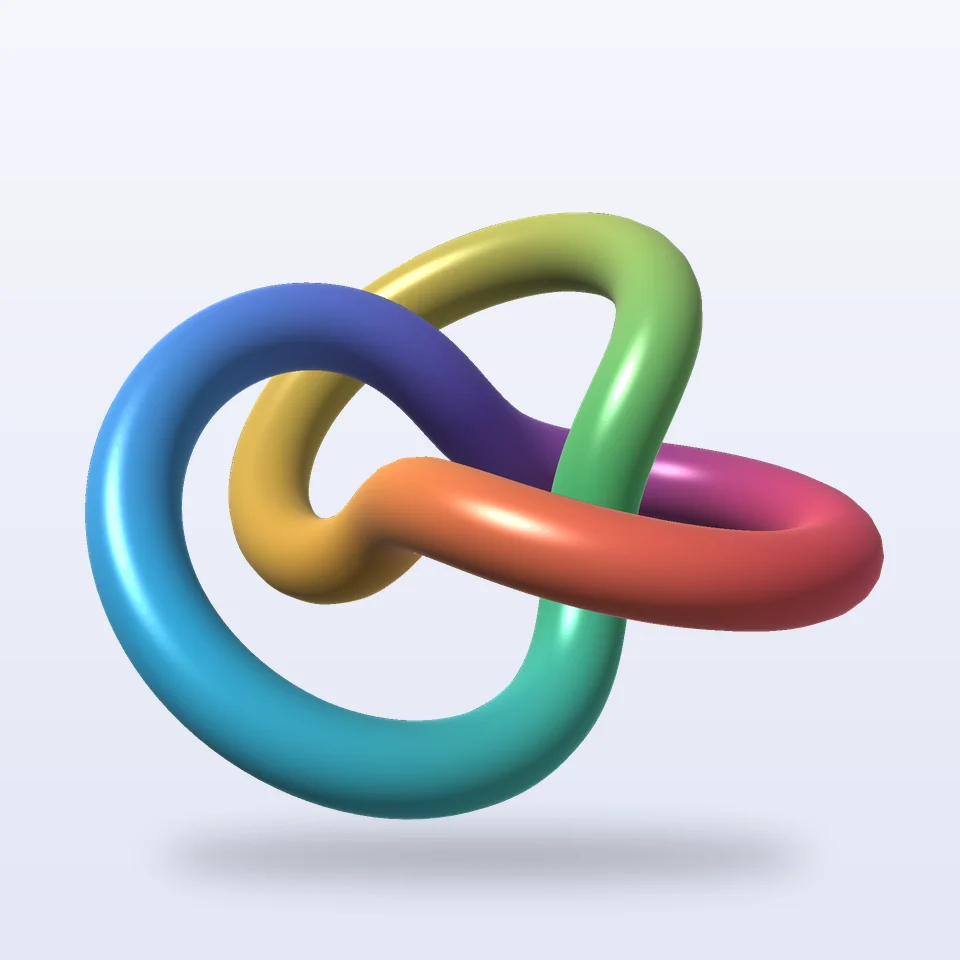
Turn any (p, q) torus knot in 3D: the trefoil, the cinquefoil, the Hopf link and Solomon's link. Trace how the knot winds around the torus, colour it in flowing gradients or stripes, and read its crossing, unknotting and linking numbers.
Platonic and Archimedean solids
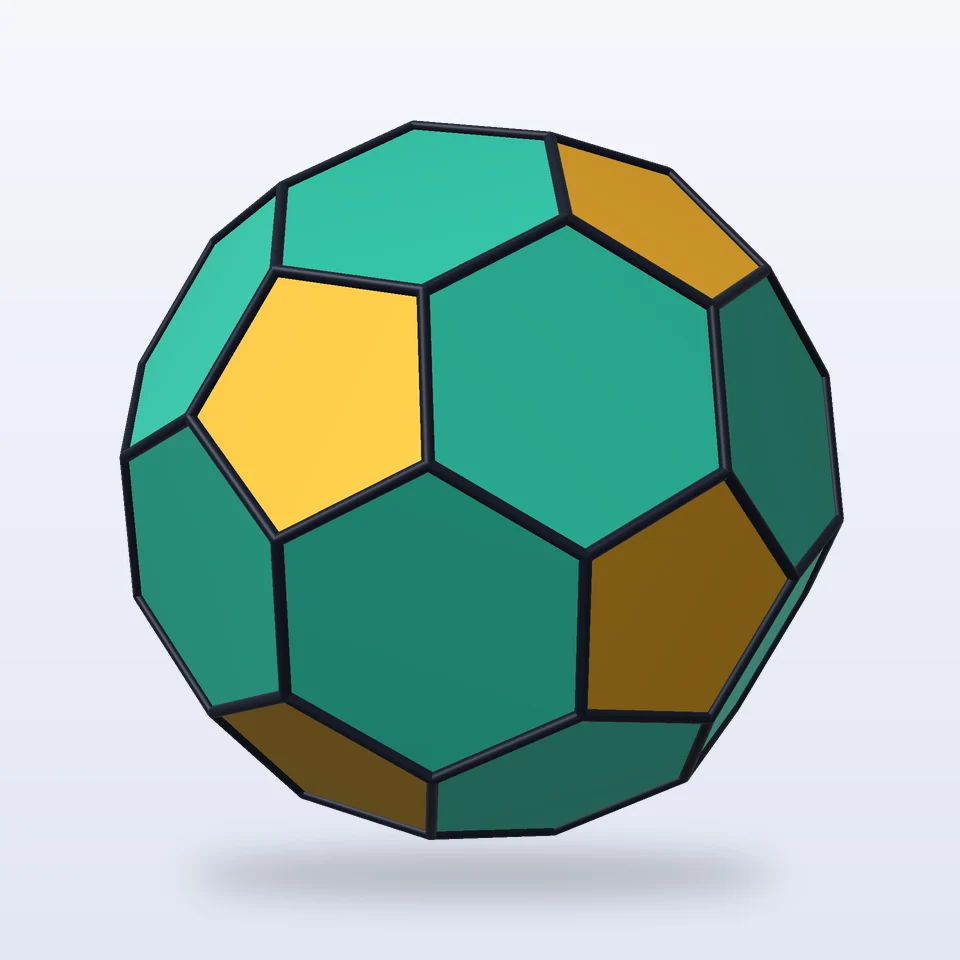
Turn all five Platonic solids and the thirteen Archimedean solids in 3D, from the tetrahedron to the truncated icosahedron soccer ball. Show their duals, colour the faces by kind, and read the faces, edges, vertices, Euler's formula and dihedral angles.
Function plotter
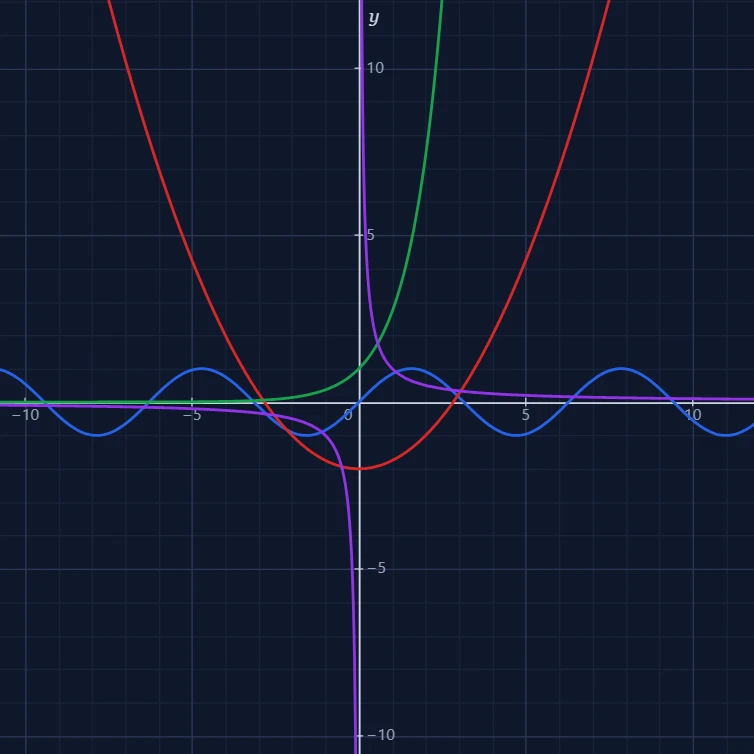
A free online function plotter: draw x², sin x, ln x, 1/x and your own formulas on an interactive grid. Pan, zoom, trace x and y, and save the graph as a PNG.

M.C. Escher tessellation maker
Make M.C. Escher-style tessellations online: interlocking lizards, birds, fish, Pegasus and more. Reshape the motif, recolour it and save PNG or SVG.
Ready to try it?
Open PictorX in your browser — no install, no credit card required to start.
Open the Möbius strip and Klein bottle