
Indra's Pearls: limit sets of Kleinian groups
Take two transformations of the plane that send circles to circles, and apply them and their inverses in every possible order. The points where all those combinations pile up form the limit set: a chain of kissing circles, a crinkled necklace, a dragon or a spray of dust. Drag the two traces and watch the necklace change shape, or nest four circles inside each other like pearls inside pearls. Two transformations of the plane, a and b, and their inverses A and B are applied in every possible order, and the points they pile up on form the limit set: a necklace of circles, a crinkled curve, a dragon or a spray of dust. With Two traces, drag the handles a and b in the small plane, or use the sliders, to set the traces of a and b; the picture follows at once and sharpens when you stop. Both traces at 2 give the Apollonian gasket. With Schottky circles, four circles are paired by a and b and their images nest inside each other like pearls. Animate swings the first trace out and back, New necklace picks random traces that give a clean picture, and Reset fits the picture again. Drag the picture to move it, use the wheel or a pinch to zoom, double-click to fit it. The colours show the first letter of each word.
How it works
- Pick a preset such as the Apollonian gasket, the spiral or the dragon, or switch the group to Schottky circles.
- Drag the handles a and b in the trace plane, or move the sliders, and watch the limit set follow.
- Press Animate to swing the first trace out and back, or New necklace for random traces that give a clean picture.
- Colour by first letter, by word length or in one colour, zoom into the curls, then save a PNG or open the layers in the editor.
Words that never end
a and b are Möbius transformations, maps z ↦ (az + b) / (cz + d) that send circles to circles, and A and B undo them. Writing the four letters one after another, such as abAAB, never a letter next to its inverse, gives a word, and every word is again such a map. Follow a point through longer and longer words and it is pushed onto the limit set, the place where every orbit ends up. The app walks through the words depth first, from the right-most branch to the left-most, so the points come out in order along the curve and can be joined into one line.
Two traces
The trace of a map, the sum of the diagonal of its matrix, says how it moves points: 2 means a parabolic map with a single fixed point, a real number above 2 a map that pushes points from one fixed point to the other, and a complex number one that also spirals. From the traces of a and b the app builds the pair so that the commutator abAB has trace −2, and that one condition makes the pieces of the limit set touch. With both traces 2 the limit set is the Apollonian gasket; move them into the complex plane and the circles crinkle into curls, spirals and dragons.
Schottky circles and dust
Draw four circles that do not touch. Let a send the outside of the left circle onto the inside of the right one, and b the outside of the bottom circle onto the inside of the top one. Every word sends the circles into smaller circles nested inside each other, pearls inside pearls, and the limit set is the dust they shrink to, a Cantor set. Grow the circles until they kiss and the dust closes up into a curve; give them a twist and the pearls turn as they shrink.
Frequently asked questions
What is a Kleinian group?
A group of Möbius transformations of the complex plane that is discrete: no sequence of its maps creeps ever closer to doing nothing at all. Felix Klein and Henri Poincaré studied these groups in the 1880s. Their maps send circles to circles, which is why the limit sets are built from circles and look like lace.
Why is it called Indra's pearls?
In a Buddhist image, the net of the god Indra has a pearl at every knot, and each pearl reflects all the others. The nested circles of these groups, each reflecting the whole pattern on a smaller scale, look much like it. The name was made popular by the 2002 book Indra's Pearls by David Mumford, Caroline Series and David Wright, which is about these pictures.
Why do both traces 2 give the Apollonian gasket?
With both traces 2, a and b are parabolic, and together with the parabolic commutator they are symmetries of a packing of tangent circles. The limit set is exactly the Apollonian gasket inside the unit circle, with its two largest circles left and right. The app's tests check that no point of the limit set falls inside the largest circles of the gasket.
What does the Unfinished tile mean?
It is the share of branches where the search reached its limit of 160 letters before the word's points came close together. For a discrete group almost every branch finishes, apart from a few near the points where pieces touch. When the traces leave the region where the group is discrete, the words stop shrinking, the picture turns into a tangle and the share rises. It is an estimate, not a proof.
What is the commutator abAB?
The word a · b · A · B: apply a, then b, then undo a, then undo b. If a and b commuted, it would do nothing. Its trace measures how the two maps interlock. At −2 it is parabolic: the pieces of the limit set touch at its fixed point, and the picture is one connected curve or a packing of circles.
Can I use the pictures in a design?
Yes. Save gives a PNG, and the pencil opens the picture in the PictorX photo editor with the background, the glow, the circles and the limit set on layers of their own: one per first letter a, b, A and B when it is coloured that way. In the editor itself it is under Apps ▸ Fractals ▸ Indra's Pearls. Everything is drawn in your browser.
Indra's Pearls: how do I record a video?
Press the red Record button in the playback bar: it films what the stage shows. Press it again to stop, and the video is saved to your device. Recording is free; you only need to sign in. Without a subscription the video carries a small PictorX logo in a corner. The button beside Record opens the video options: the shape (as shown, square, story 9:16 or wide 16:9), the length (until you stop, or 5, 10, 15 or 30 seconds for social media) and the file: MP4, WebM or an animated GIF. You can add one of three music tracks: calm, bright or beat.
Related tools
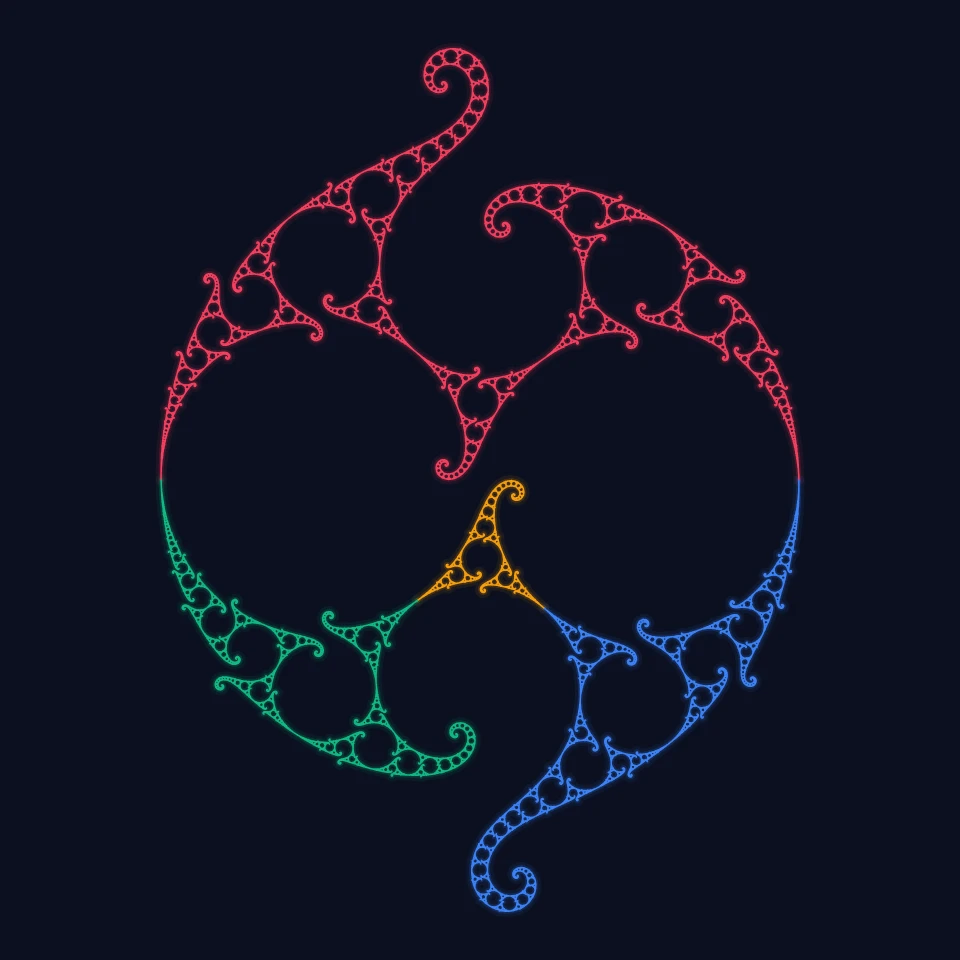
Indra's pearls explained
How two Möbius transformations make a Kleinian group, what traces and fixed points say about a map, how the limit set is drawn, why Schottky groups give dust and why a parabolic commutator gives the Apollonian gasket.
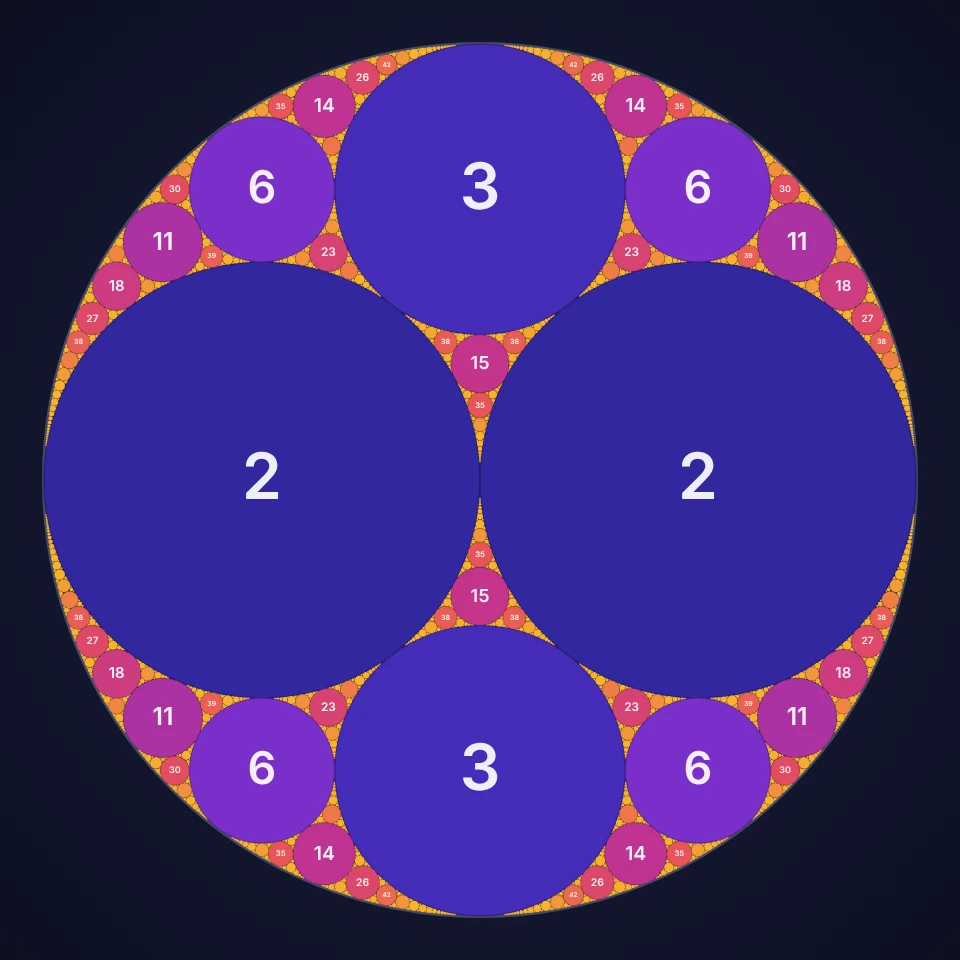
Apollonian gasket generator
Fill the gaps between touching circles with ever smaller circles, generation by generation. Pick a starting quadruple like (−1, 2, 2, 3), see whole-number curvatures in every circle, and check Descartes' circle theorem by tapping one.
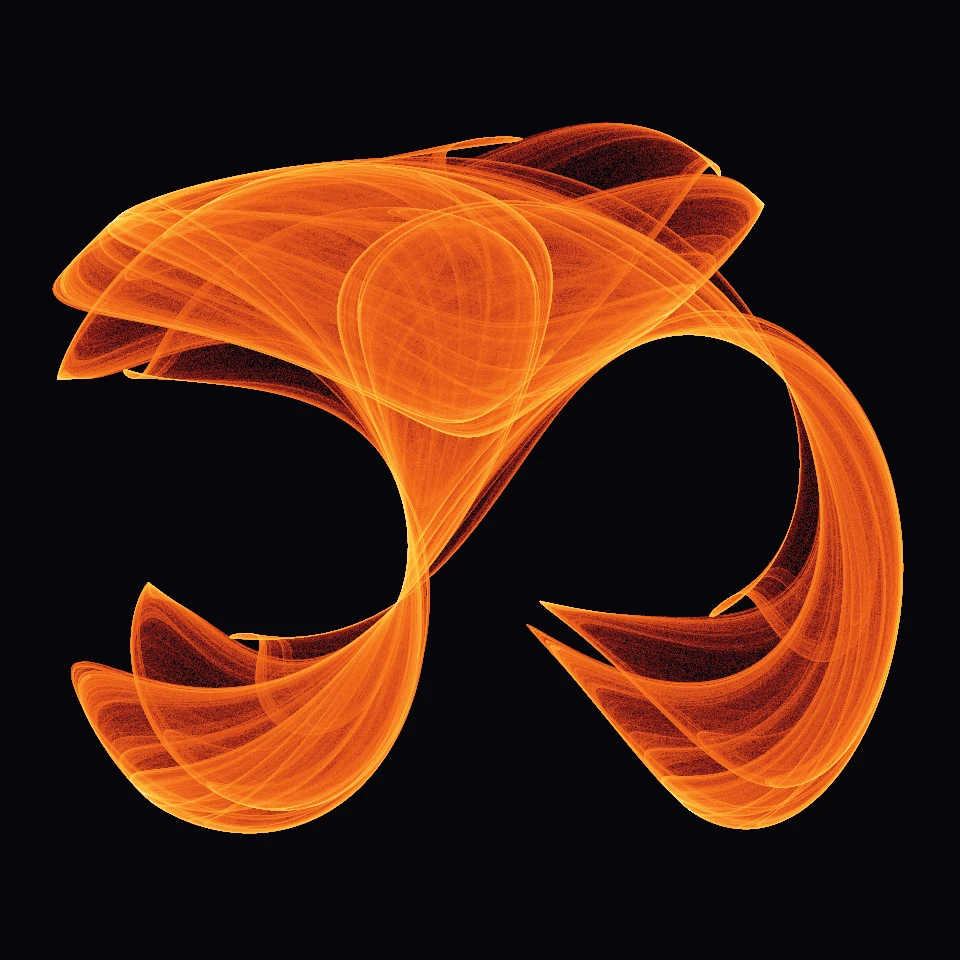
Strange attractor generator
Draw strange attractors from millions of points: the Clifford, Peter de Jong, Hénon, Ikeda, Gumowski–Mira and Tinkerbell maps. Drag to change the numbers, find new attractors at random, and read the Lyapunov exponent and fractal dimension.
Fractal generator: zoom into Mandelbrot, Julia and Newton fractals
Free online fractal generator: zoom about 5 trillion times into the Mandelbrot set, Julia and Newton fractals, jump to 64 famous spots and save a PNG.
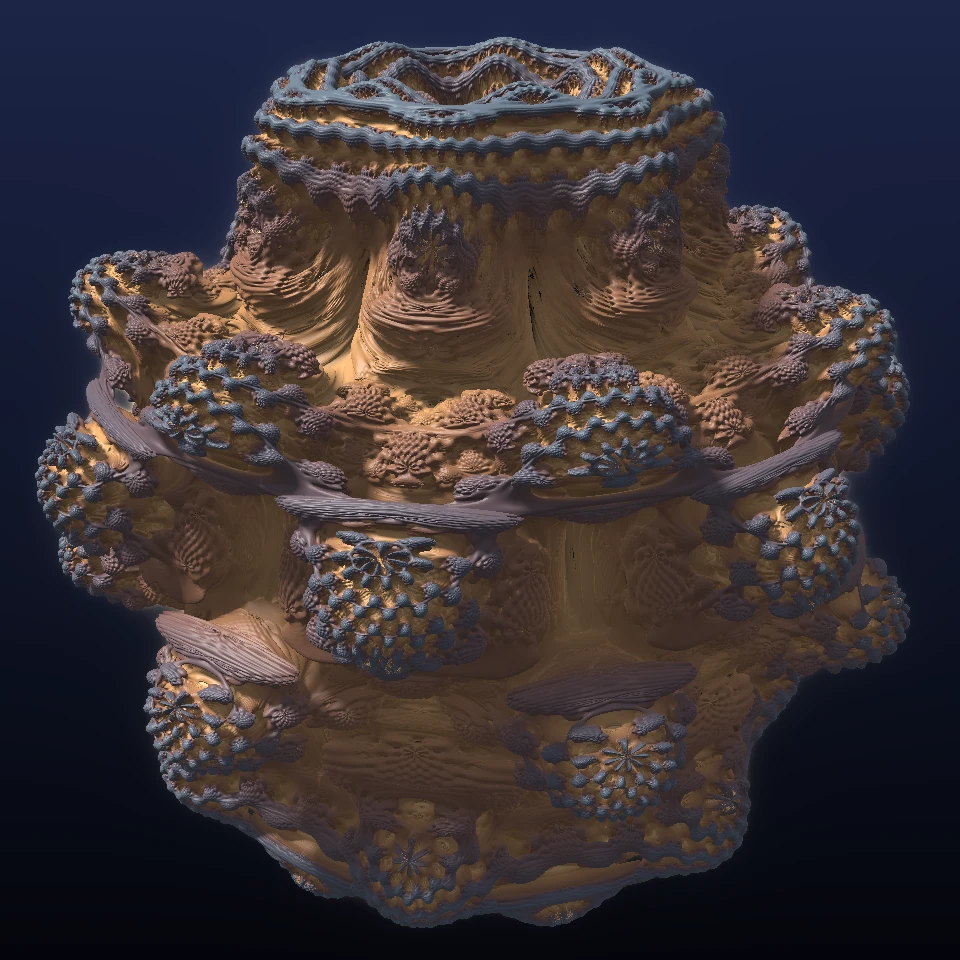
Mandelbulb 3D explorer
Fly around the Mandelbulb, the Mandelbox and quaternion Julia sets, ray-marched live by your graphics card. Turn them, change the power, light and colour them, and zoom into their folds.
Fractals
What is a fractal? How the Mandelbrot set, Julia sets, Newton fractals (including Newton⁴) and Nova fractals are made, and why zooming never runs out of detail.
Ready to try it?
Open PictorX in your browser — no install, no credit card required to start.
Go to Editor