
Indra's pearls explained
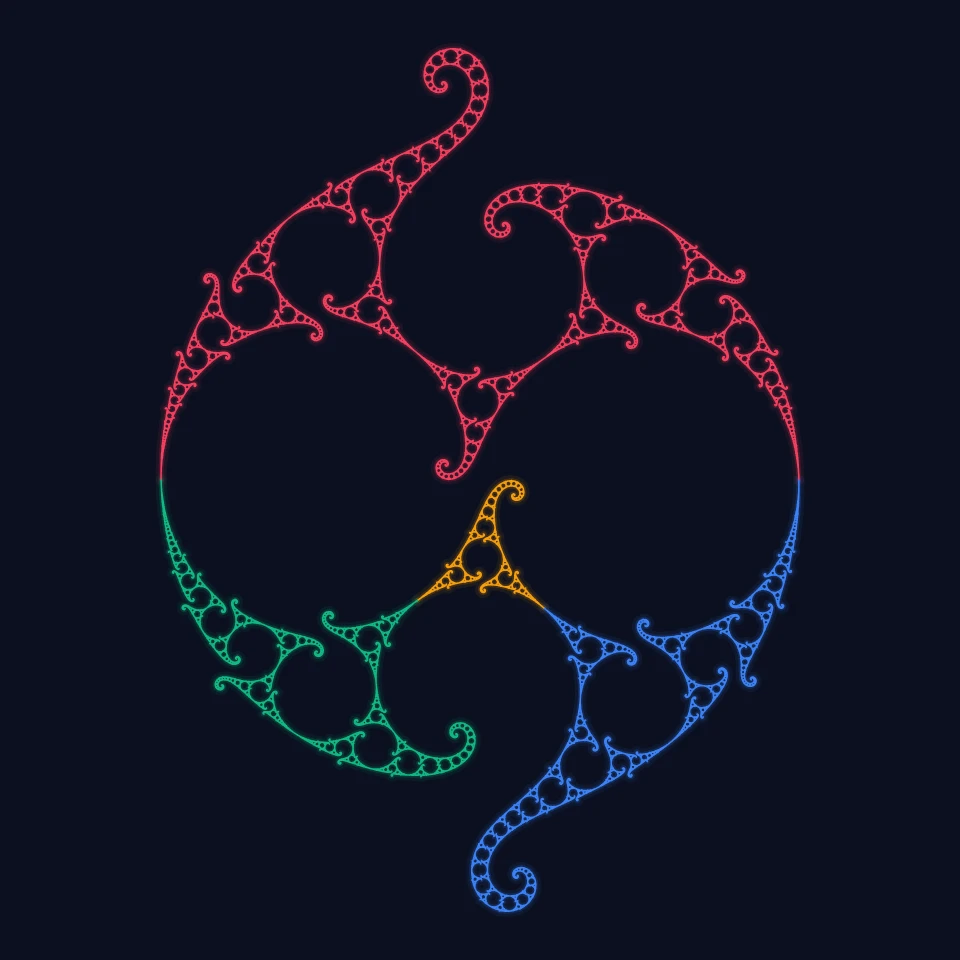
Two maps of the plane that send circles to circles, repeated in every possible order, are enough to draw some of the most intricate pictures in mathematics. Their limit sets look like strings of pearls, lace, spirals or dust, and behind them lies a century of work on groups, geometry and three-dimensional space.
Möbius transformations
A Möbius transformation sends a point z of the complex plane to (az + b) / (cz + d), where a, b, c and d are complex numbers with ad − bc ≠ 0. Every such map is built from moves, turns, scalings and a single inversion in a circle, and that gives it a remarkable property: it sends every circle to a circle, counting straight lines as circles through infinity. Written as a 2 × 2 matrix, doing one map after another is multiplying their matrices.
Fixed points and traces
Most Möbius maps have two fixed points: points flow away from one and towards the other. The trace, the sum a + d of the matrix scaled to determinant 1, sorts the maps. A trace of exactly 2 or −2 means a parabolic map with one fixed point, a real trace between −2 and 2 a rotation, and every other value a map that pushes points from one fixed point to the other, spiralling when the trace is not real.
Groups and words
Take two maps a and b and their inverses A and B. All the ways of doing them one after another form a group, and each element is a word such as abAB or bbaB. A word of n letters can be spelled in 4 · 3ⁿ⁻¹ ways, because a letter is never followed by its inverse, so the words branch like a tree. When the group is discrete, no word but the empty one comes arbitrarily close to doing nothing; such groups are called Kleinian.
The limit set
Pick any point and apply longer and longer words to it. The images crowd towards a set that does not depend on the starting point: the limit set. It is where the group acts chaotically, and the rest of the plane is where it acts tamely. Every infinite word picks out one point of the limit set. To draw it, follow the tree of words and stop a branch once its images are smaller than a pixel.
Schottky groups
The simplest Kleinian groups are made from circles. Take four circles that do not touch, let a send the outside of one onto the inside of its partner, and let b do the same for the other two. Every word sends the circles to smaller circles nested inside the originals, and the limit set is the dust at the bottom of this nesting, a Cantor set. When the circles touch, the dust closes up into a curve.
Touching pieces and the gasket
When the commutator abAB is parabolic, with trace −2, the pieces of the limit set meet at its fixed points. Choosing the traces of a and b then fixes the group up to a change of coordinates. Real traces above 2 give a crinkled quasi-circle, both traces 2 give the Apollonian gasket, and complex traces bend it into curls and spirals. At the edge of the region where these groups are discrete lie the strangest limit sets, some of which fill whole regions of the plane.
A short history
Felix Klein and Henri Poincaré studied these groups in the 1880s, and Klein's pictures of nested circles were drawn by hand. A century later computers made the limit sets visible in detail, and work by Bernard Maskit, Robert Riley, Troels Jørgensen and William Thurston tied them to the geometry of three-dimensional spaces. In 2002 David Mumford, Caroline Series and David Wright gathered the pictures and the mathematics behind them in their book Indra's Pearls.
Frequently asked questions
Is the limit set always a fractal?
No. For some groups it is a circle or a straight line, and for others it is the whole plane. For most groups made from two maps it is a fractal curve or a dust, with a fractal dimension between 0 and 2.
How do Schottky circles differ from two traces?
A Schottky group starts from circles that do not touch, so its limit set is a dust. The two traces family keeps the commutator parabolic, which forces the pieces of the limit set to touch, so its limit sets are connected curves or packings of circles.
Why do the pictures look like lace?
Because every map of the group sends circles to circles, the same structure repeats on every scale, circles inside circles. Near a parabolic fixed point the circles line up in chains that shrink like 1/n², which gives the beaded look.
What happens outside the discrete region?
The words stop shrinking, so points do not settle onto a limit set but wander all over. The search then runs into its limit on many branches, the Unfinished tile rises, and the picture becomes a tangle that is not a true limit set.
Related tools
Indra's Pearls: limit sets of Kleinian groups
Draw the limit sets of Kleinian groups: two Möbius transformations, applied in every order, string circles into necklaces, spirals and dragons. Drag the traces, nest Schottky circles and save the layers.
Apollonian gasket generator
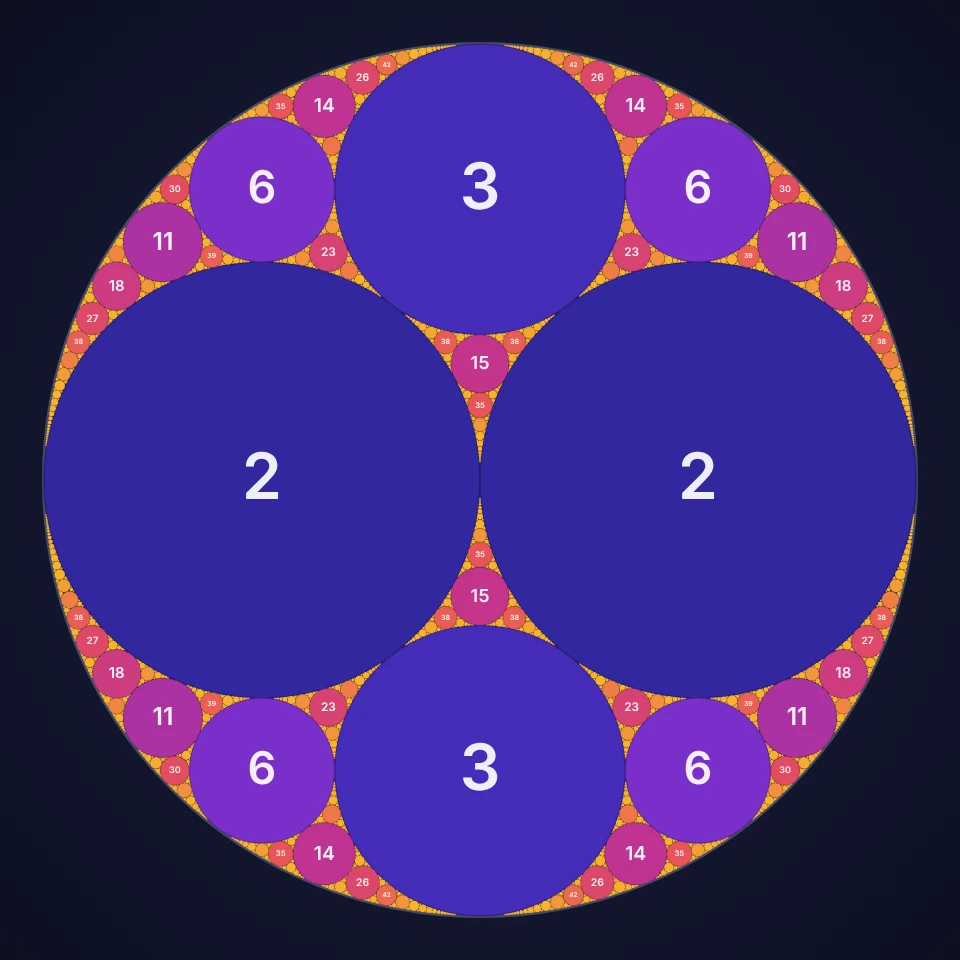
Fill the gaps between touching circles with ever smaller circles, generation by generation. Pick a starting quadruple like (−1, 2, 2, 3), see whole-number curvatures in every circle, and check Descartes' circle theorem by tapping one.
Strange attractor generator
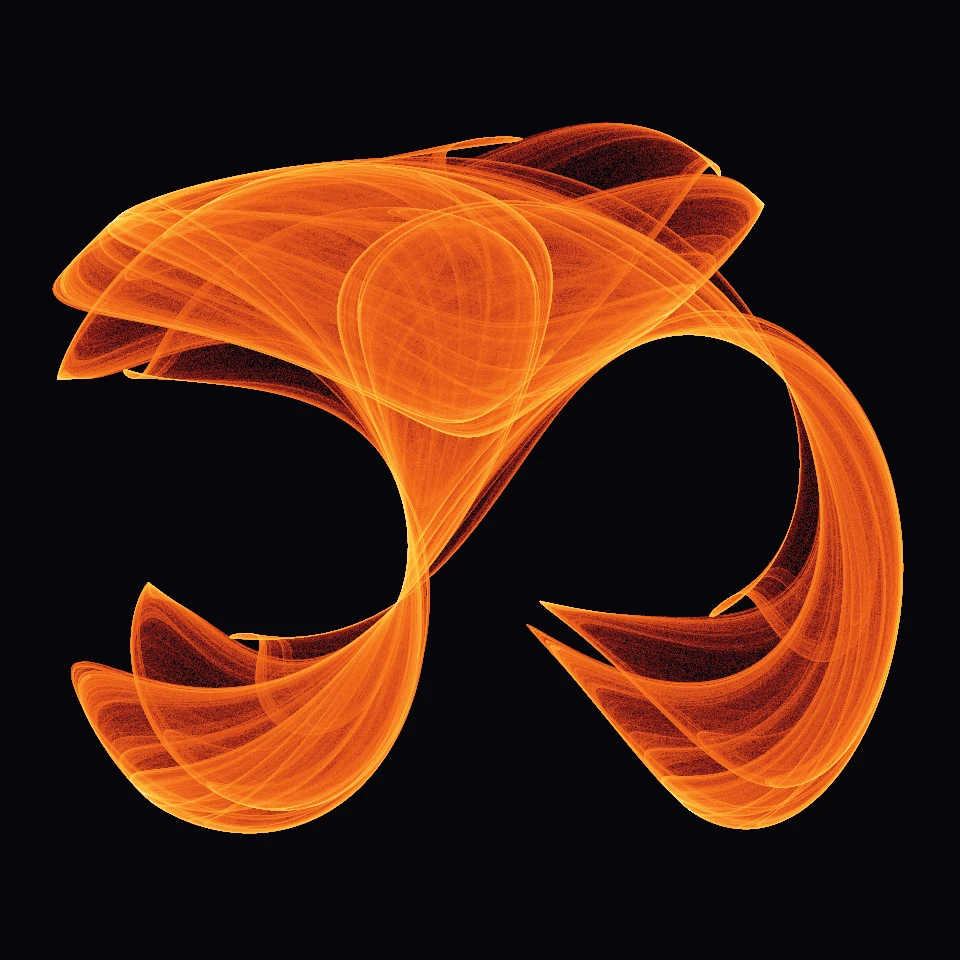
Draw strange attractors from millions of points: the Clifford, Peter de Jong, Hénon, Ikeda, Gumowski–Mira and Tinkerbell maps. Drag to change the numbers, find new attractors at random, and read the Lyapunov exponent and fractal dimension.
Fractal generator: zoom into Mandelbrot, Julia and Newton fractals
Free online fractal generator: zoom about 5 trillion times into the Mandelbrot set, Julia and Newton fractals, jump to 64 famous spots and save a PNG.
Sierpiński triangle builder
Build the Sierpiński triangle by removing middles, by the chaos game or from Pascal's triangle mod 2. Try other corners, jumps and rules, and see area, triangles and the fractal dimension 1.585.
Ready to try it?
Open PictorX in your browser — no install, no credit card required to start.
Open Indra's pearls