
Flake fractal builder
Take a square, cut it into nine and throw away the middle. Do the same with the eight squares that are left, and with the 64 after them, and the Sierpiński carpet appears: a square full of holes at every scale. Build it and its relatives level by level, the cross of the Vicsek fractal, the dust of Cantor, the snowflake of hexagons and the flower of pentagons, or tick the cells of a 3 × 3, 4 × 4 or 5 × 5 grid and invent a fractal of your own. Its fractal dimension appears the moment you change a cell. Replace a shape by smaller copies of itself, then every copy, level by level. Press Build to grow the flake from the starting shape, Next level to add one level, or drag Level. Choose the Sierpiński carpet, the Vicsek fractal and its saltire, Cantor dust, the hexaflake, the pentaflake or the T-square. For the square shapes the grid in the panel shows which cells of the square are kept; tick and untick cells to invent a carpet of your own, on a 3 × 3, 4 × 4 or 5 × 5 grid, and read its fractal dimension at once. Twist turns every copy a little further, so the flake curls into a spiral. Show every level to see each step in its own colour.
How it works
- Press Build to grow the flake from the starting shape one level at a time, or Next level to add a single level; drag Level to jump to any level.
- Choose the Sierpiński carpet, the Vicsek fractal, the Vicsek saltire, Cantor dust, the hexaflake, the pentaflake or the T-square.
- Tick and untick cells of the grid to make your own rule on a 3 × 3, 4 × 4 or 5 × 5 grid, and turn up Twist to curl the copies into a spiral.
- Read the number of pieces, the area left, the fractal dimension and the size of the smallest piece in the tiles, and show every level in its own colour.
Copies of copies
Every flake follows one rule: replace the shape by k smaller copies of itself, each 1/n as large, and then do the same with every copy. The carpet keeps 8 of the 9 squares of a 3 × 3 grid, the Vicsek fractal 5 in a cross, Cantor dust only the 4 corners. The hexaflake replaces a hexagon by 7 hexagons a third as large, one in the middle and one at each corner, and the pentaflake a pentagon by 6 pentagons. After n levels there are kⁿ pieces: the carpet at level 6 has 262,144 squares, each 1/729 of the side of the first.
Fractal dimension in one line
Cut a line into 3 equal parts and you need 3 copies to rebuild it; a filled square needs 9, a cube 27. That is 3¹, 3² and 3³, and the exponent is the dimension. A flake made of k copies at 1/n has the dimension d for which nᵈ = k, so d = log k / log n. The carpet gets log 8 / log 3 ≈ 1.8928, the Vicsek fractal log 5 / log 3 ≈ 1.4650, Cantor dust log 4 / log 3 ≈ 1.2619 and the hexaflake log 7 / log 3 ≈ 1.7712. Keep every cell and you get 2, a filled square; keep one cell in each row and column and you get 1.
Your own rule
Any choice of cells in a grid is a fractal. Tick the cells to keep and the builder repeats the pattern inside every kept cell, level after level. A ring of cells gives a carpet, a diagonal a line of dust, a letter a fractal of that letter. The dimension depends only on how many cells you keep and the size of the grid, not on where they are: 12 cells of a 4 × 4 grid always give log 12 / log 4 ≈ 1.79, however you arrange them. Where they are decides what the fractal looks like, and whether it hangs together or falls apart into dust.
Frequently asked questions
What is the Sierpiński carpet?
A fractal made by dividing a square into a 3 × 3 grid, removing the middle square, and repeating that on each of the 8 squares that remain, for ever. Wacław Sierpiński described it in 1916. It has an area of zero, since 8/9 of the area survives each step, but its fractal dimension is log 8 / log 3 ≈ 1.8928, much closer to a surface than to a line.
How do I calculate the fractal dimension of a flake?
Count the copies k and the scale 1/n of each copy, then take log k / log n. The Vicsek fractal keeps 5 of 9 squares, so its dimension is log 5 / log 3 ≈ 1.465. For the pentaflake each of the 6 copies is 1/(1 + φ) as large, where φ is the golden ratio, so its dimension is log 6 / log (1 + φ) ≈ 1.8617. The Fractal dimension tile shows the value and the formula for every shape and rule.
What is the difference between the Vicsek fractal and the saltire?
Both keep 5 of the 9 cells of a 3 × 3 grid and have the same dimension, log 5 / log 3. The Vicsek fractal keeps the middle and the four sides, a plus sign, and grows into a cross of crosses. The saltire keeps the middle and the four corners, an X, and grows into a diagonal pattern. Same numbers, different shapes.
Why does the T-square have dimension 2?
Because it grows instead of shrinking. It starts with one square and puts a square half as large on each corner of every square, level after level. The squares overlap, and together they fill the whole frame: each level covers three quarters of what is still empty, so after n levels 1 − (3/4)ⁿ⁺¹ of the frame is covered. Its boundary is a fractal, but the shape itself fills an area.
What does Twist do?
It turns every copy a little further than its parent, by the angle you choose. The turns add up from level to level, so the flake curls into spirals while it keeps the same number of pieces and the same dimension. With a twist the copies may overlap, so the Area left tile then shows the area the rule would leave without it.
Can I use the flake in a design?
Yes. Save gives a PNG, and the pencil opens the flake in the PictorX photo editor, with the flake on one layer or, when you show every level, each level on a layer of its own to recolour or hide. In the editor itself it is under Apps ▸ Fractals ▸ Flake Fractals. Everything is drawn in your browser.
Flake Fractal Builder: how do I record a video?
Press the red Record button in the playback bar: it films what the stage shows. Press it again to stop, and the video is saved to your device. Recording is free; you only need to sign in. Without a subscription the video carries a small PictorX logo in a corner. The button beside Record opens the video options: the shape (as shown, square, story 9:16 or wide 16:9), the length (until you stop, or 5, 10, 15 or 30 seconds for social media) and the file: MP4, WebM or an animated GIF. You can add one of three music tracks: calm, bright or beat.
Related tools
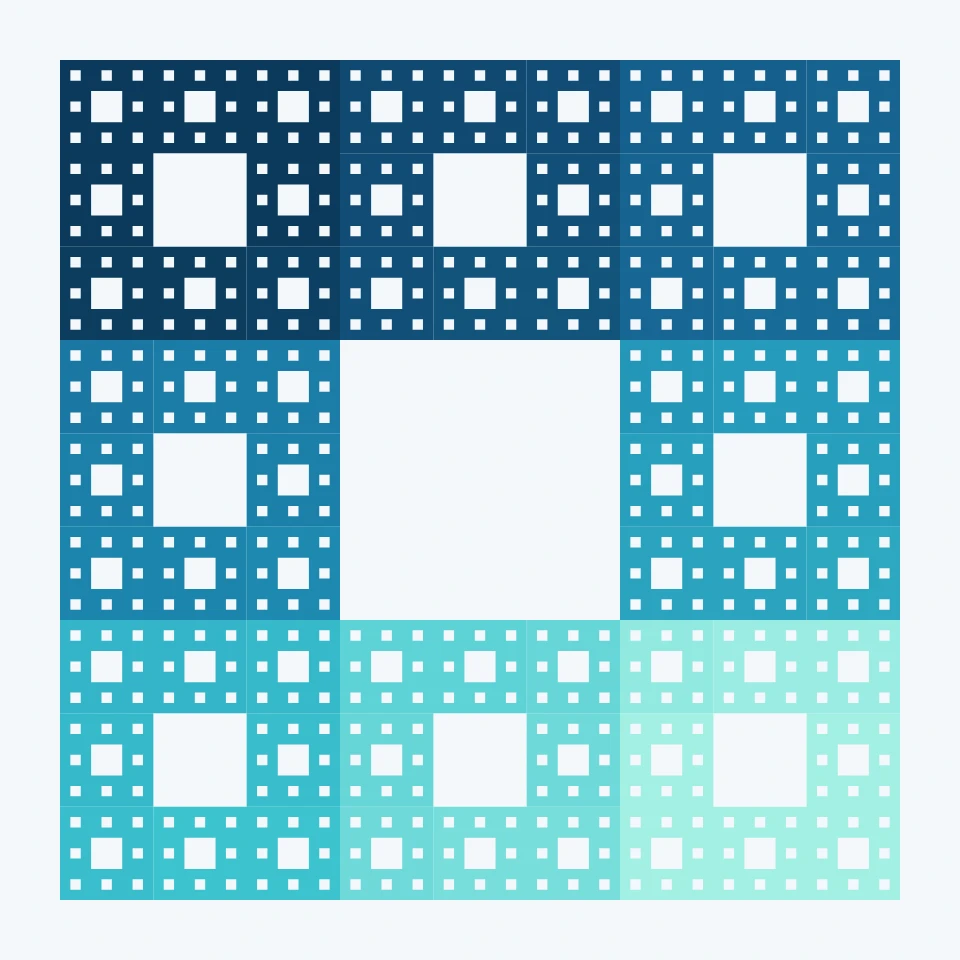
Flake fractals explained
How the Sierpiński carpet, the Vicsek fractal, Cantor dust, the hexaflake, the pentaflake and the T-square are built from copies of themselves, why their dimension is log k / log n, and what the carpet hides.
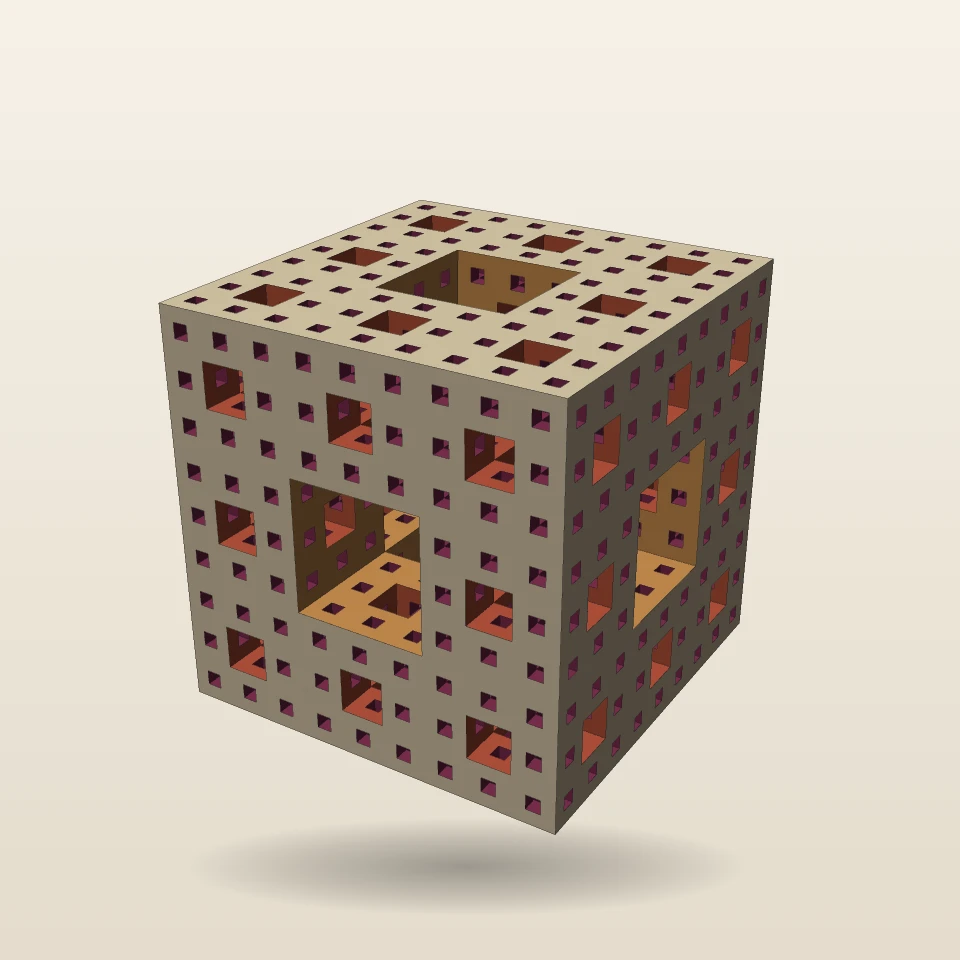
Menger sponge in 3D
Drill the Menger sponge level by level and turn it in 3D. Compare the Jerusalem cube, the Sierpiński tetrahedron, the Mosely snowflake and Cantor dust, slice through them, and watch the volume vanish while the surface grows.
Sierpiński triangle builder
Build the Sierpiński triangle by removing middles, by the chaos game or from Pascal's triangle mod 2. Try other corners, jumps and rules, and see area, triangles and the fractal dimension 1.585.
Koch snowflake generator
Grow the Koch snowflake level by level and see its perimeter grow by 4/3 each time while the area settles at 8/5. Try the anti-snowflake, Cesàro angles, square bumps and the Minkowski sausage.
Dragon curve generator
Fold a strip of paper again and again and watch it unfold into the Heighway dragon. Grow it level by level, try the twin dragon, the terdragon and the Lévy C curve, and see a curve that fills an area without crossing itself.
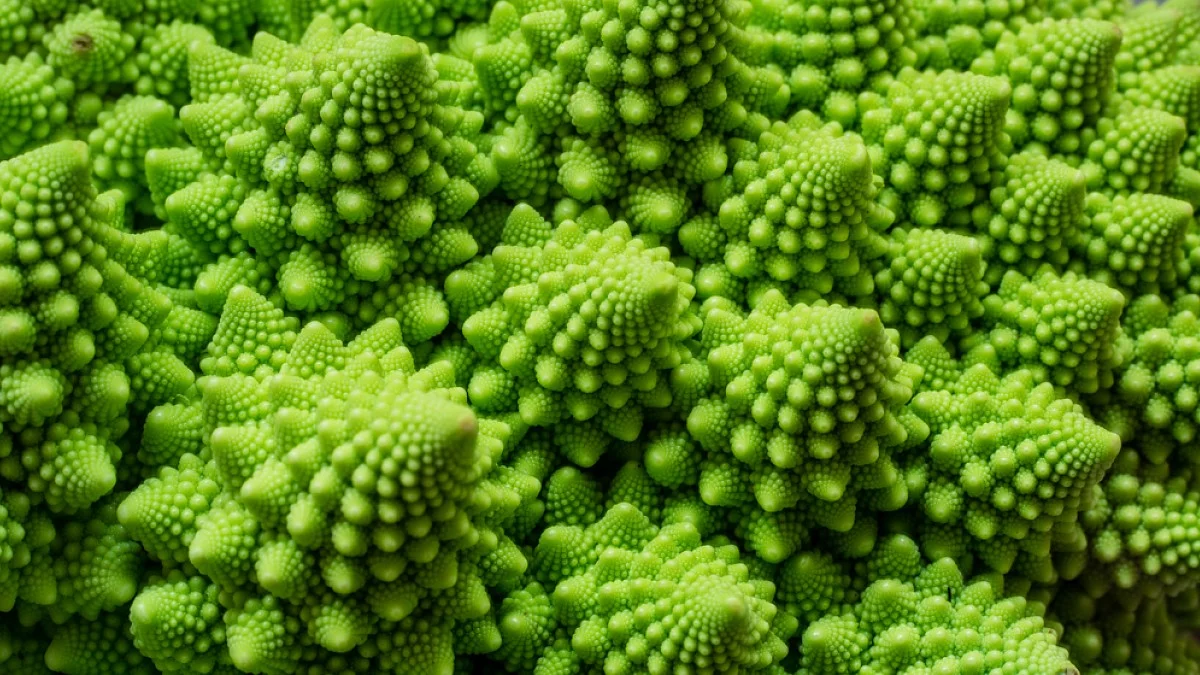
Fractals
What is a fractal? How the Mandelbrot set, Julia sets, Newton fractals (including Newton⁴) and Nova fractals are made, and why zooming never runs out of detail.
Ready to try it?
Open PictorX in your browser — no install, no credit card required to start.
Go to Editor