
Flake fractals explained
A flake fractal is a shape made of smaller copies of itself, each made of still smaller copies, all the way down. One rule, applied again and again, turns a square into a carpet full of holes, a cross of crosses or a cloud of dust, and a hexagon into a snowflake. These shapes are the clearest way to see what a fractal dimension is.
One rule, applied for ever
Every flake starts with one shape and one rule: replace the shape by a few smaller copies of itself placed in a fixed pattern. Then apply the same rule to each copy, and to each of their copies, without end. After one step there are k pieces, after two k², after n steps kⁿ, each 1/n of the previous size again. The finished fractal is what is left in the limit, and every part of it, magnified by the right factor, looks exactly like the whole. That is self-similarity in its purest form.
The Sierpiński carpet
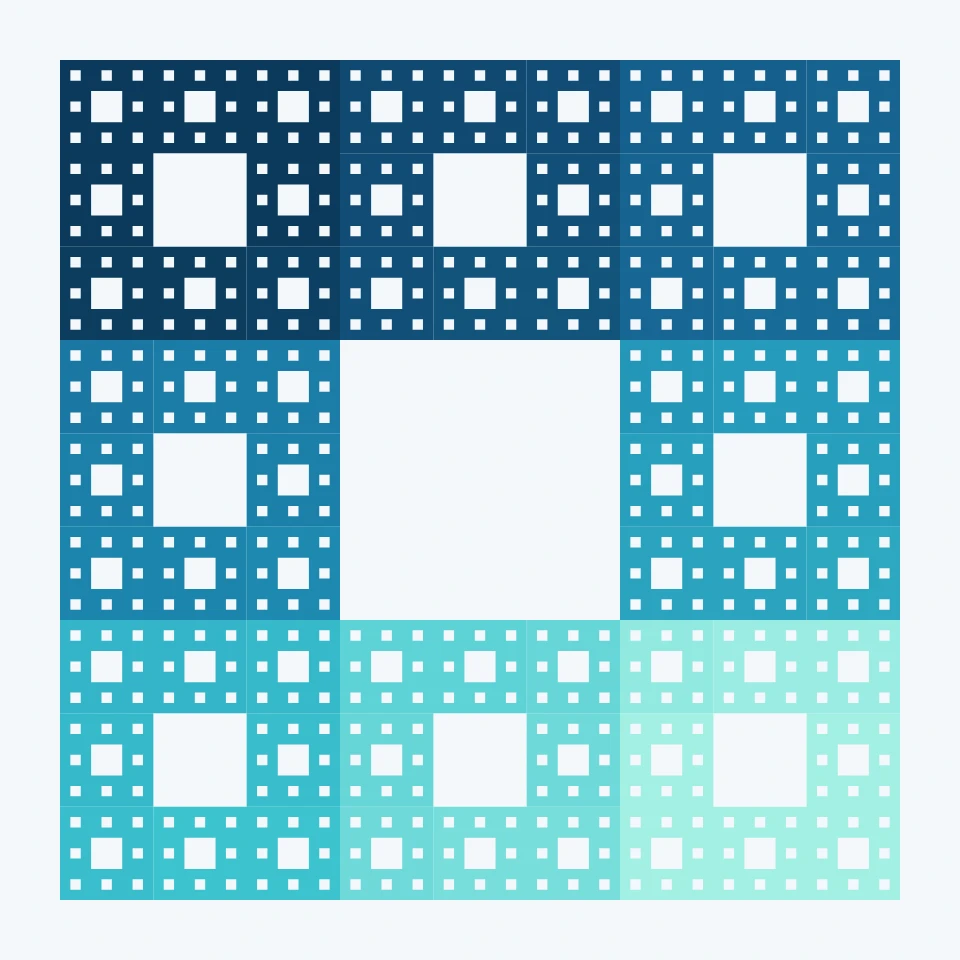
Cut a square into nine and remove the middle one; repeat on the eight squares that remain. Wacław Sierpiński described this carpet in 1916, three years after his triangle. Each step keeps 8/9 of the area, so after n steps (8/9)ⁿ is left, and in the limit nothing: the carpet has area zero. Yet it is not a thin curve either. Sierpiński proved that it contains a copy of every curve that can be drawn in the plane, however tangled, which is why it is called a universal plane curve.
The Vicsek fractal and its saltire
Keep only 5 of the 9 squares and the picture changes completely. With the middle and the four sides you get the Vicsek fractal, named after the Hungarian physicist Tamás Vicsek, who described it in his work on fractal growth in the 1980s: a cross whose arms are crosses, whose arms are crosses again. With the middle and the four corners you get the saltire, an X of X's. Both have the same dimension, log 5 / log 3 ≈ 1.465, and both are a tree: any two points of them are joined by exactly one path.
Cantor dust
Keep only the four corners and the pieces never touch: the result is Cantor dust, the two-dimensional version of Georg Cantor's set, which removes the middle third of a line again and again. It is a cloud of infinitely many points, none connected to another, and still it has as many points as the whole square. Its dimension is log 4 / log 3 ≈ 1.2619, twice that of the Cantor set on a line, log 2 / log 3.
Hexaflake and pentaflake
The same idea works with other shapes. The hexaflake replaces a hexagon by seven hexagons a third as large, one in the middle and one at each corner, and grows into a snowflake with holes at every scale; its dimension is log 7 / log 3 ≈ 1.7712. The pentaflake replaces a pentagon by six pentagons, five at the corners and one in the middle standing on its head. To fit, each must be 1/(1 + φ) as large, where φ ≈ 1.618 is the golden ratio, and its dimension is log 6 / log (1 + φ) ≈ 1.8617.
What a fractal dimension measures
Magnify a line three times and you need 3 copies of the original to cover it; magnify a square three times and you need 9; a cube needs 27. The exponent in 3¹, 3² and 3³ is the dimension. A flake made of k copies at scale 1/n needs exactly k copies when magnified n times, so its dimension d satisfies nᵈ = k, which gives d = log k / log n. For these exactly self-similar shapes this similarity dimension equals the Hausdorff dimension that mathematicians use for any set, as long as the copies do not overlap.
The T-square: a fractal that fills
Not every fractal shrinks. The T-square starts with one square and puts a square half as large centred on each of its corners, then does the same on every new square. The squares overlap their parents, and together they spread out until they fill the whole frame. Each level covers three quarters of the area that is still empty, so after n levels 1 − (3/4)ⁿ⁺¹ of the frame is covered and the dimension is 2. Its outline, the edge between squares and gaps, is a fractal curve.
Inventing your own
Any set of cells in a grid defines a flake, and its dimension depends only on how many cells are kept and how large the grid is. Keep 12 cells of a 4 × 4 grid and the dimension is log 12 / log 4 ≈ 1.792 whatever their pattern. The pattern decides what the fractal looks like and whether it hangs together: cells that touch along an edge make a connected fractal, cells that only touch at corners a fragile one, and cells that do not touch at all a dust. Keeping every cell gives back the solid square, dimension 2.
Flakes in the real world
The carpet and its relatives are more than curiosities. Their self-similar shapes work as fractal antennas, which receive many frequencies at once in a small space, and the Sierpiński carpet is one of the classic designs for them. The three-dimensional carpet, the Menger sponge, has been built from business cards by thousands of volunteers, and physicists use these shapes as test cases for diffusion and vibration on rough materials.
Frequently asked questions
Who invented the Sierpiński carpet?
The Polish mathematician Wacław Sierpiński described it in 1916, three years after the Sierpiński triangle. He showed that it contains a copy of every curve that can be drawn in a plane.
Does the Sierpiński carpet have an area?
No. Each step keeps 8/9 of the area, so after n steps (8/9)ⁿ is left, which tends to zero. The carpet still contains uncountably many points and has a fractal dimension of about 1.8928.
What is the formula for the dimension of a self-similar fractal?
If a shape is made of k non-overlapping copies of itself, each scaled by 1/n, its similarity dimension is log k / log n. The Sierpiński carpet (8 copies at 1/3) has log 8 / log 3 ≈ 1.8928.
What is the 3D version of the Sierpiński carpet?
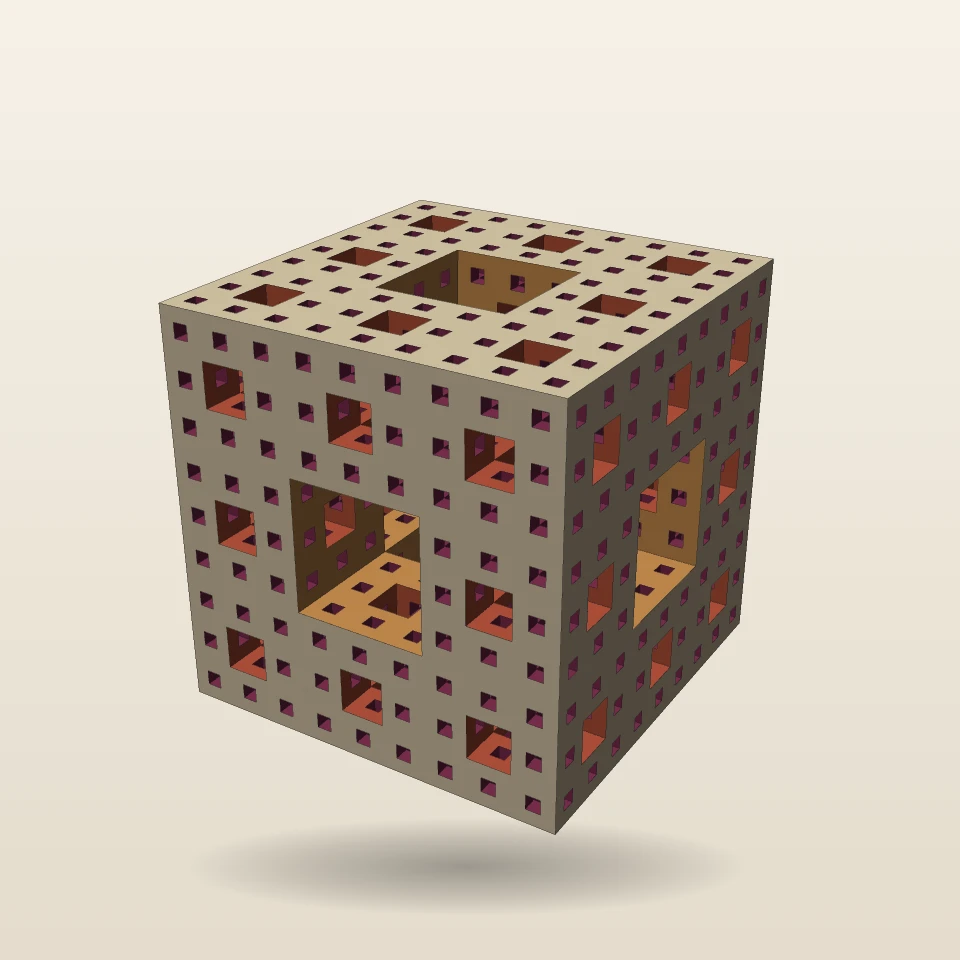
The Menger sponge. It divides a cube into 27 smaller cubes and removes the middle one and the six in the middle of each face, keeping 20. Its dimension is log 20 / log 3 ≈ 2.7268, and every face of it is a Sierpiński carpet.
Why is the pentaflake scaled by 1/(1 + φ)?
Five pentagons at the corners of a pentagon touch each other only when their size is 1/(1 + φ) of the original, where φ = (1 + √5)/2 is the golden ratio. The golden ratio appears because it is the ratio of a regular pentagon's diagonal to its side.
Related tools
Flake fractal builder
Build the Sierpiński carpet, the Vicsek fractal, Cantor dust, the hexaflake, the pentaflake and the T-square level by level, or tick the cells of a grid to invent your own fractal and read its dimension at once.
Menger sponge in 3D
Drill the Menger sponge level by level and turn it in 3D. Compare the Jerusalem cube, the Sierpiński tetrahedron, the Mosely snowflake and Cantor dust, slice through them, and watch the volume vanish while the surface grows.
Sierpiński triangle builder
Build the Sierpiński triangle by removing middles, by the chaos game or from Pascal's triangle mod 2. Try other corners, jumps and rules, and see area, triangles and the fractal dimension 1.585.
Koch snowflake generator
Grow the Koch snowflake level by level and see its perimeter grow by 4/3 each time while the area settles at 8/5. Try the anti-snowflake, Cesàro angles, square bumps and the Minkowski sausage.
Fractal generator: zoom into Mandelbrot, Julia and Newton fractals
Free online fractal generator: zoom about 5 trillion times into the Mandelbrot set, Julia and Newton fractals, jump to 64 famous spots and save a PNG.
Ready to try it?
Open PictorX in your browser — no install, no credit card required to start.
Open the flake fractal builder