
Koch snowflake generator
Take a triangle. Cut every side into three, and raise a smaller triangle on the middle third. Do the same to every one of the twelve new sides, and again, and again. The result is the Koch snowflake: a shape with a finite area inside a border of infinite length. Grow it one level at a time and watch each bump fold up out of its segment, then bend the rules: point the bumps inwards, change their angle, or use squares instead of triangles, and see how the length, the area and the fractal dimension respond. Every round replaces each straight segment with a bent copy of the generator. Press Play to grow the snowflake level by level and watch each new bump fold up out of the segment beneath it, or Step to grow one level. Change the generator, the starting shape and the direction of the bumps, and set the angle of the bump to turn the snowflake into a Cesàro curve. The tiles give the number of segments, the length, the area and the fractal dimension.
How it works
- Press Play to grow the snowflake one level at a time, or Step to add a single level; drag Level to jump to any level.
- Choose a generator, a starting shape and whether the bumps point outwards or inwards, and set the angle of the triangle bump.
- Read the number of segments, the length, the area and the fractal dimension in the tiles.
Infinite border, finite area
Every round turns each segment into 4 segments, each a third as long, so the perimeter is multiplied by 4/3. After 10 rounds it is more than 17 times the triangle's, after 50 rounds more than 1.7 million times, and it never stops growing. The area grows too, but by less and less: each round adds 4/9 as much as the round before, and the total settles at exactly 8/5 of the starting triangle. The whole snowflake fits inside the circle through the triangle's corners, however long its border becomes.
Fractal dimension
Shrink the Koch curve to a third and you need 4 copies to rebuild it. A line would need 3 and a square 9, or 3¹ and 3²; the exponent is the dimension. For the Koch curve 3^d = 4, so d = log 4 / log 3 ≈ 1.262: more than a line, much less than a surface. Raise the angle of the bump and the pieces get longer, so fewer are needed to fill a larger part of the plane: at 85° the dimension is about 1.8. The square bump gives log 5 / log 3 ≈ 1.465 and the Minkowski sausage exactly 1.5.
Frequently asked questions
How can a shape have an infinite perimeter but a finite area?
The perimeter is a sum of lengths that are multiplied by 4/3 every round, so it grows without limit. The area is a sum of ever smaller triangles: each round adds 4/9 of what the round before added, and such a sum stops at a finite total, here 8/5 of the starting triangle. The border becomes ever more crinkled without ever moving far from where it started.
What is the anti-snowflake?
The same construction with every bump pointing inwards. Each round now takes area away instead of adding it, and the area settles at 2/5 of the triangle, while the perimeter grows by 4/3 every round exactly as before. The shape pinches into chains of ever smaller snowflakes that run out to the three corners of the triangle.
What does the angle of the bump do?
At 60° the four pieces are equal thirds and the bump is an equilateral triangle: the classic Koch curve. A smaller angle gives a flatter bump and a dimension closer to 1; a larger angle makes the pieces longer and the curve crowds more of the plane, with a dimension of log 4 / log(2 + 2 cos θ). Ernesto Cesàro studied these curves in 1905. At 90° the pieces would be half the segment and the curve would fill a triangle completely.
Why does the Minkowski sausage keep the same area?
Its generator goes up by a square and then down by an equal square, so every round adds exactly as much area on one side of each segment as it removes on the other. The border doubles in length every round, but the area inside stays the same as the square it started from.
Is anything sent to a server?
No. Everything is drawn in your browser, and your last settings stay in this browser's local storage.
Related tools
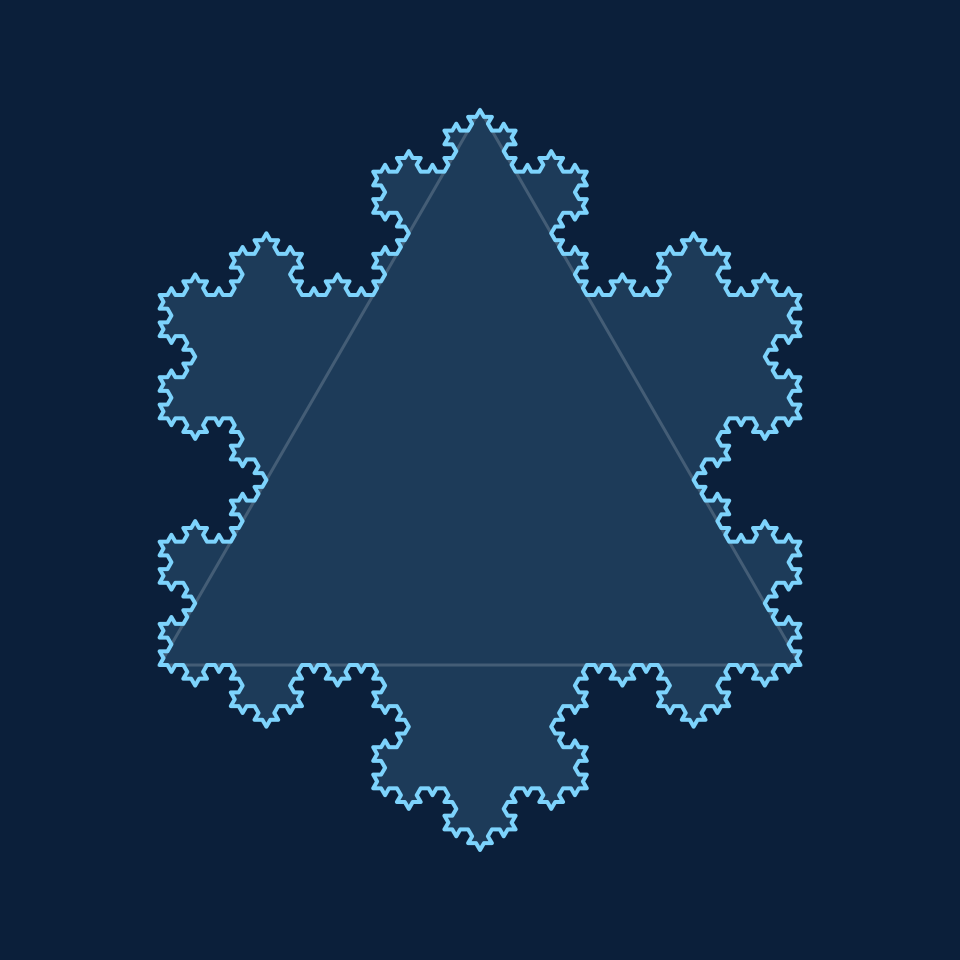
The Koch snowflake explained
How the Koch snowflake is built, why its perimeter grows without limit while its area stays below 8/5 of the triangle, what fractal dimension 1.262 means, and how it led to the coastline paradox.
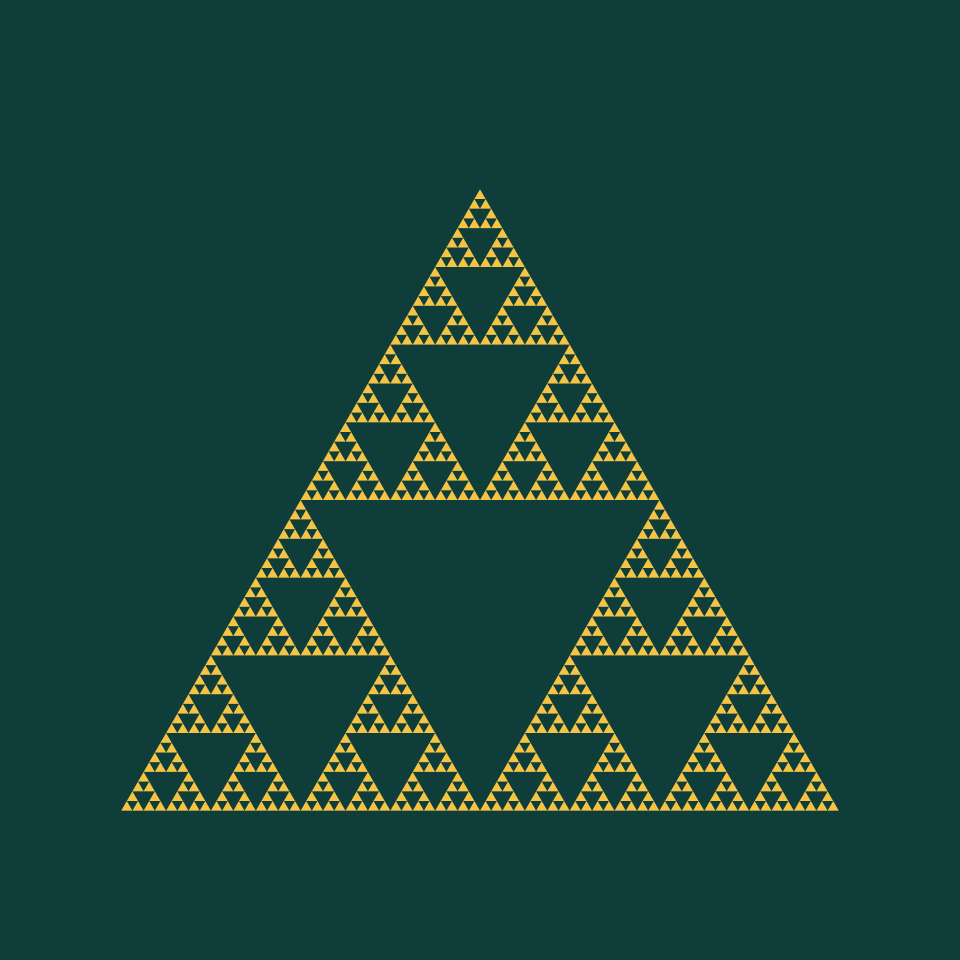
Sierpiński triangle builder
Build the Sierpiński triangle by removing middles, by the chaos game or from Pascal's triangle mod 2. Try other corners, jumps and rules, and see area, triangles and the fractal dimension 1.585.

Barnsley Fern
Grow the Barnsley Fern in your browser. Watch the chaos game, zoom into any leaflet, and compare the black spleenwort with mutant varieties.
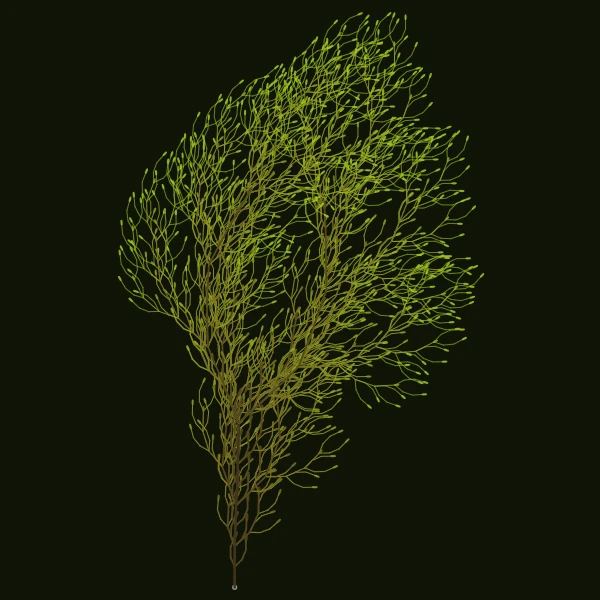
Nature Generator
Grow trees, ferns, coral, and ice crystals from L-system DNA. Pause, randomize, and save a PNG in your browser.
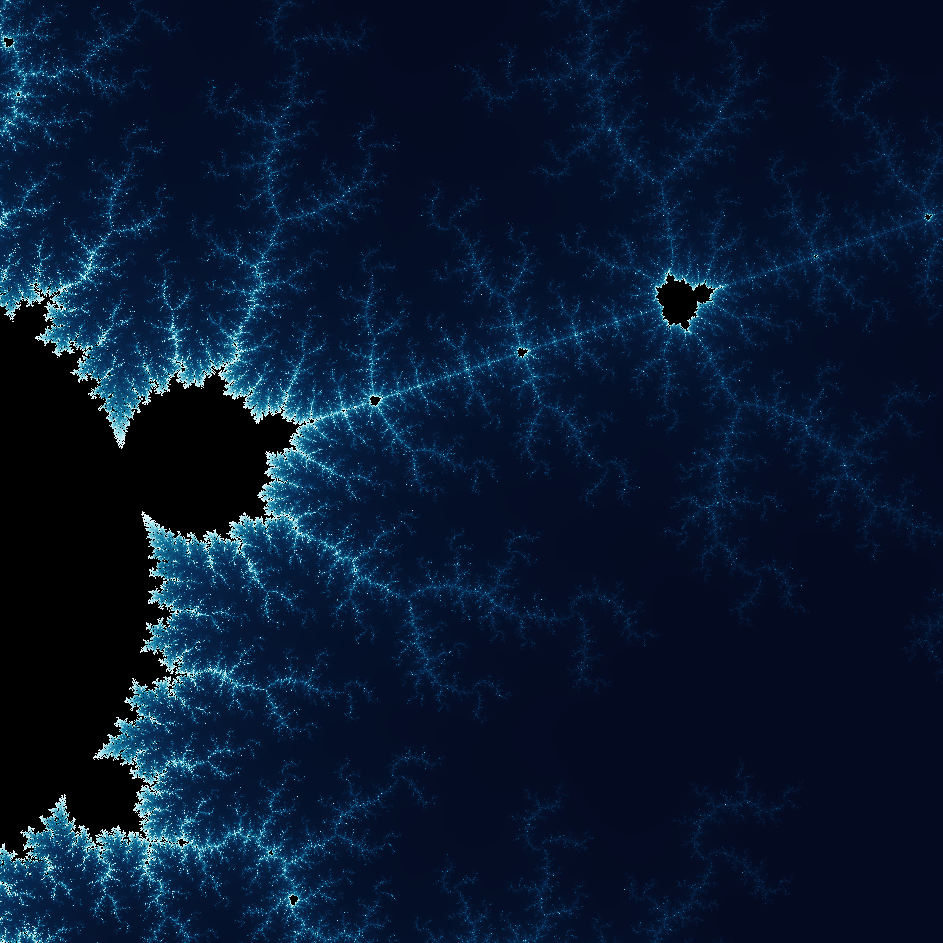
Fractal generator: zoom into Mandelbrot, Julia and Newton fractals
Free online fractal generator: zoom about 5 trillion times into the Mandelbrot set, Julia and Newton fractals, jump to 64 famous spots and save a PNG.
Zeno's paradoxes
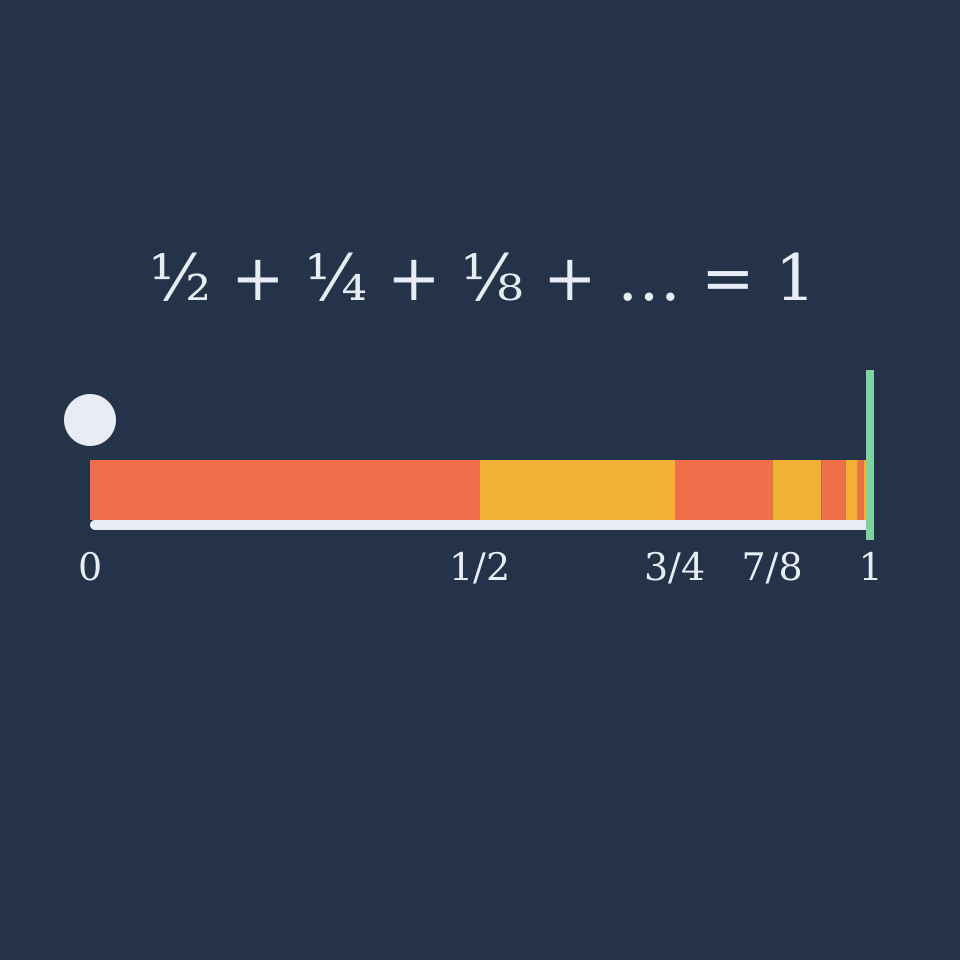
Step through Zeno's dichotomy, race Achilles against the tortoise and freeze the flying arrow. See infinitely many steps add up to a finite total, and speed emerge as a limit.
Ready to try it?
Open PictorX in your browser — no install, no credit card required to start.
Go to Editor