
Compass and straightedge constructions: Euclid's geometry step by step
For more than two thousand years geometry was done with two tools: a straightedge without marks to draw lines and a compass to draw circles. With them you can bisect any segment or angle, drop perpendiculars, draw parallels, build regular hexagons and pentagons and construct lengths such as √2 and the golden ratio. Watch each construction drawn one line or circle at a time, drag the given points and see it stay true, then try it yourself. Watch a construction: pick one under Construction and press Play. Step and Back go one line or circle at a time, and the caption says what is drawn. Drag a given point (the ones with a ring) and the whole construction follows, because every point is defined by the lines and circles that make it. To draw your own, choose a tool above the picture: Point; Line, Segment (tap two points); Circle (the centre, then a point it passes through); Compass (two points to set the opening, then the centre: a rigid compass that carries a length); Delete (an object and everything built on it); Move drags points. A tap near the crossing of two lines or circles puts the point exactly there, and a tap on a line or circle puts it on it. Undo and Redo are in the toolbar. In Challenge mode, construct the goal shown dashed in as few moves as you can: every line and circle is a move. It is checked exactly, and again with the givens nudged, so a point placed by eye does not count. Save the picture, record a video of the construction, or open it in the photo editor with the pencil: the circles, the lines, the result, the points, the labels and the caption come as layers of their own.
How it works
- Pick a construction, such as the perpendicular bisector, the regular pentagon or the golden ratio, and press Play to watch it drawn one line or circle at a time, with a caption for each step.
- Use Step and Back to go through it at your own pace, and drag a given point: every point is built from lines and circles, so the construction follows and stays exact.
- Switch to Free drawing and use the tools above the picture: points, lines, segments, circles and a compass that carries a length, with intersections snapped exactly.
- Try a Challenge: construct the goal in as few moves as you can, then save the picture, record a video or edit it in the photo editor.
The rules of the game
A construction may use only two instruments. The straightedge draws the line through two points you already have; it has no marks, so it cannot measure. The compass draws a circle with a given centre through a given point. New points arise only where lines and circles cross. Everything else, every length and every angle, must follow from these moves, so a construction is both a proof that the figure exists and a recipe for drawing it exactly.
Euclid's first proposition
Book I of Euclid's Elements, written around 300 BC, opens with this problem: on a given segment AB, construct an equilateral triangle. Draw the circle with centre A through B and the circle with centre B through A. They cross at C, and since AC and BC are radii of circles whose radius is AB, all three sides are equal. The same two circles also give the perpendicular bisector of AB: the line through both crossing points cuts AB at its midpoint, at right angles.
From hexagons to pentagons
Six circles of the same radius fit round a circle, so a regular hexagon is stepped off with the compass at its opening. The regular pentagon is harder: it needs the golden ratio φ = (1 + √5)/2. In the classic method used here, the circle whose centre is the midpoint of a radius and which passes through the top point cuts the diameter at a point whose distance to the top is exactly the pentagon's side. Gauss proved in 1796 that the regular 17-gon is constructible too, while the heptagon and the nonagon are not.
What cannot be constructed
Compass and straightedge can only add, subtract, multiply, divide and take square roots of the lengths they already have. In 1837 Pierre Wantzel showed that this rules out trisecting a general angle and doubling the cube, which need cube roots. In 1882 Ferdinand von Lindemann proved that π is transcendental, so the circle cannot be squared either. Some angles, such as 90° or 45°, can still be trisected; it is a method for every angle that cannot exist.
Frequently asked questions
How do you construct a perpendicular bisector with compass and straightedge?
Draw a circle with centre A through B and another with centre B through A. They meet at two points C and D. The line CD is the perpendicular bisector of AB, and it crosses AB at the midpoint M. It works because C and D are each equally far from A and B, and the points equally far from A and B form exactly that line.
How do you bisect an angle?
With the vertex O as centre, draw a circle that cuts both arms, at A and C. Circles with centres A and C and the same radius meet at a point D inside the angle. The line OD bisects the angle, because the triangles OAD and OCD have three equal sides.
What is the difference between a collapsing compass and a modern compass?
Euclid's compass is assumed to fold up when it is lifted from the page: it draws a circle with a given centre through a given point, but cannot carry a distance elsewhere. A modern compass keeps its opening. Euclid's second proposition shows how to transfer a length with the collapsing compass alone, so both construct exactly the same figures. The app has both: Circle and Compass.
Why is trisecting an angle impossible?
Trisecting a 60° angle would construct the length cos 20°, a root of the cubic equation 8x³ − 6x − 1 = 0, which cannot be built from square roots. Since compass and straightedge only produce lengths made from rational numbers with +, −, ×, ÷ and square roots, a general trisection cannot exist, as Pierre Wantzel proved in 1837. With a marked ruler or by folding paper, angles can be trisected.
How does the challenge count moves?
Every line, segment and circle you draw is one move; points are free. A goal counts only when it is exact: the app checks it with the given points where they are and again with them nudged, so a point placed by eye does not count. Par is the number of moves of a reference solution, and some puzzles can be beaten.
Can I use the picture?
Yes. Save gives a PNG at the size you choose, Record films the construction step by step with its sound, and the pencil opens the picture in the PictorX photo editor with the background, the construction circles, the construction lines, the result, the points and the labels on layers of their own and the caption as editable text. In the editor itself it is under Apps ▸ Science ▸ Mathematics ▸ Compass & Straightedge Constructions. Everything runs in your browser.
Compass & Straightedge Constructions: how do I record a video?
Press the red Record button in the playback bar: it films what the stage shows. Press it again to stop, and the video is saved to your device. Recording is free; you only need to sign in. Without a subscription the video carries a small PictorX logo in a corner. The button beside Record opens the video options: the shape (as shown, square, story 9:16 or wide 16:9), the length (until you stop, or 5, 10, 15 or 30 seconds for social media) and the file: MP4, WebM or an animated GIF. For the sound, choose the app's own sounds or one of three music tracks: calm, bright or beat.
Related tools
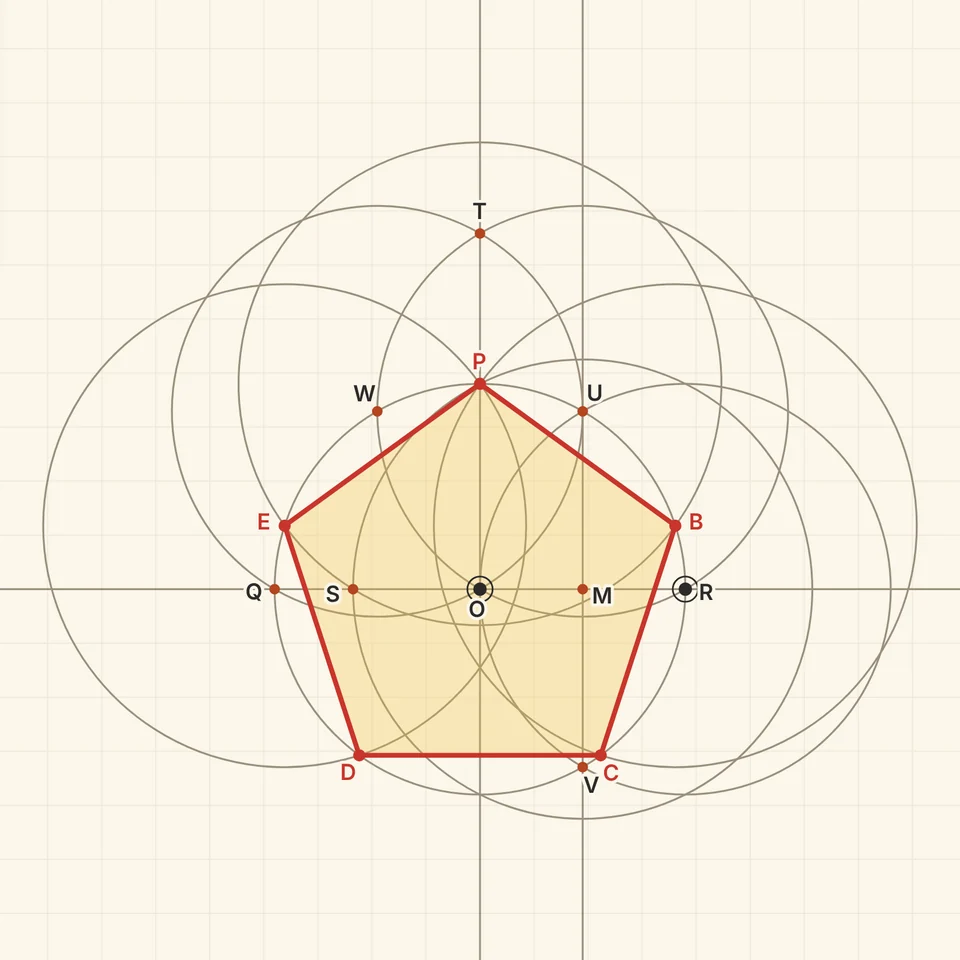
Compass and straightedge constructions explained
How geometry is done with only a compass and a straightedge: Euclid's postulates and the collapsing compass, the classic constructions of bisectors, perpendiculars, parallels and regular polygons, constructible lengths such as √2 and the golden ratio, Gauss's 17-gon, and why angle trisection, doubling the cube and squaring the circle are impossible.
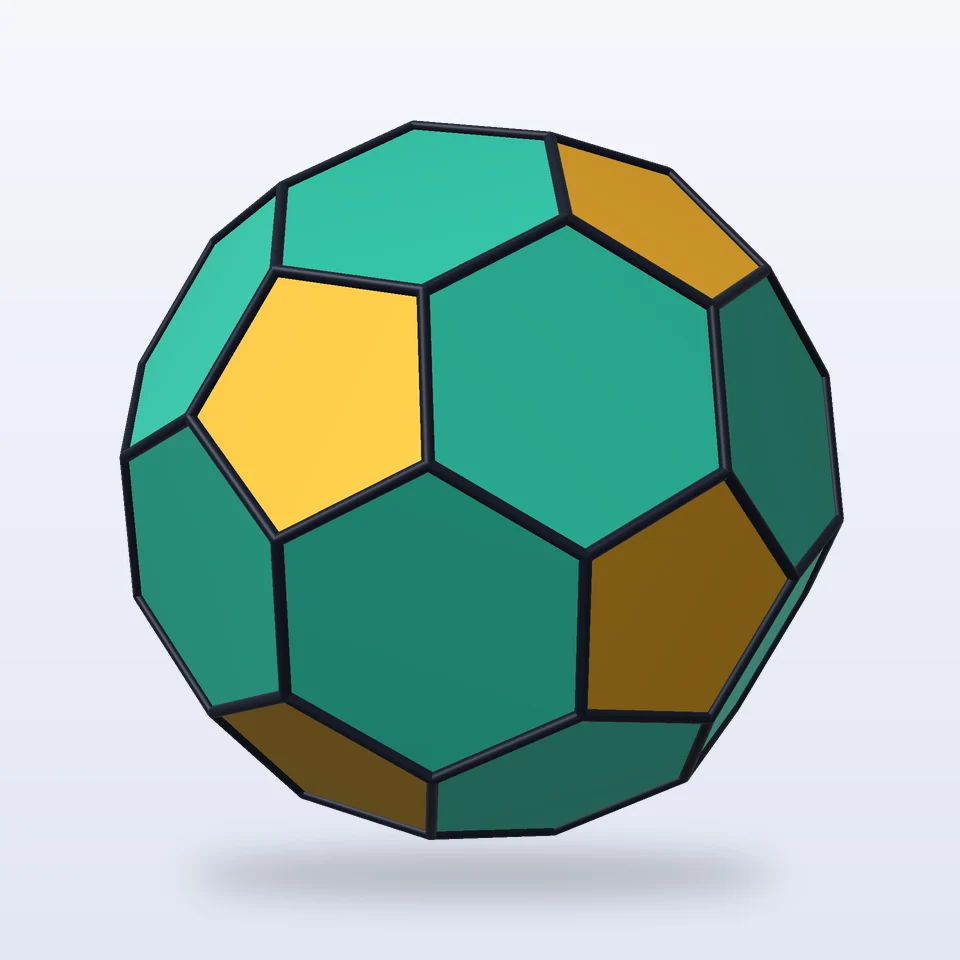
Platonic and Archimedean solids
Turn all five Platonic solids and the thirteen Archimedean solids in 3D, from the tetrahedron to the truncated icosahedron soccer ball. Show their duals, colour the faces by kind, and read the faces, edges, vertices, Euler's formula and dihedral angles.
Fourier Epicycles
Draw any shape and watch rotating circles trace it: Fourier epicycles online. Pick a heart, star or butterfly, type a word, choose how many circles turn and save a PNG or SVG.
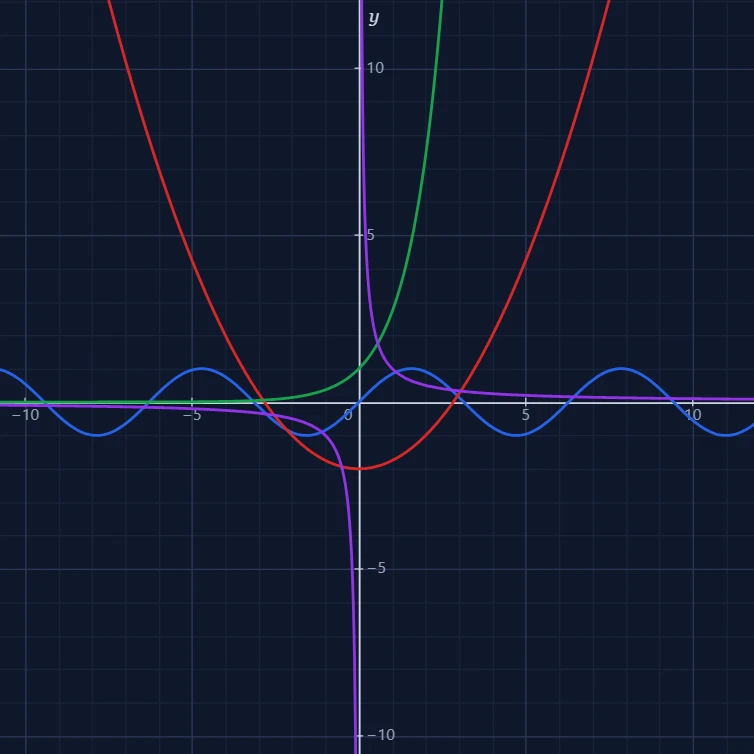
Function plotter
A free online function plotter: draw x², sin x, ln x, 1/x and your own formulas on an interactive grid. Pan, zoom, trace x and y, and save the graph as a PNG.
Ready to try it?
Open PictorX in your browser — no install, no credit card required to start.
Go to Editor