
Compass and straightedge constructions explained
A compass, a straightedge and a pencil are all that classical geometry allows. This page explains the rules Euclid set out, how the classic constructions work and why they are exact, which lengths and regular polygons can be built this way, and the three famous problems that took more than two thousand years to prove impossible.
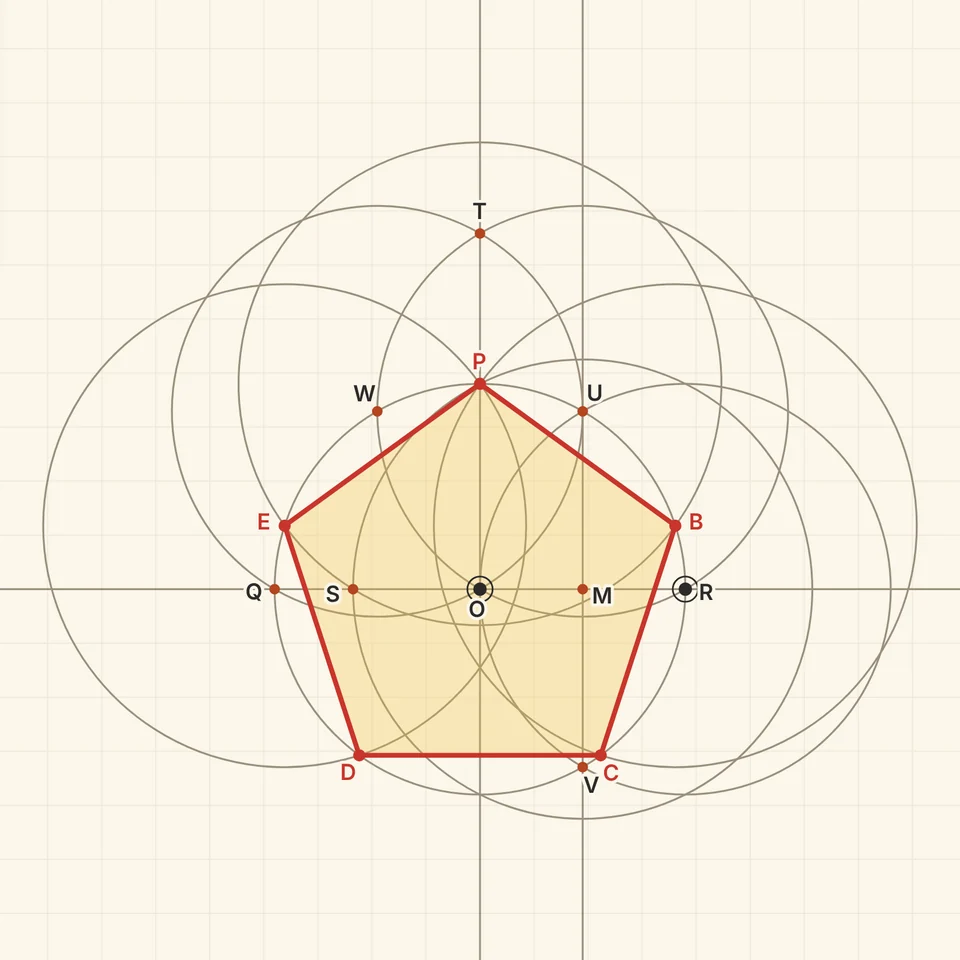
Two instruments and five postulates
Euclid's Elements, written in Alexandria around 300 BC, begins with postulates that amount to the rules of construction: a straight line can be drawn from any point to any point, a line can be extended, and a circle can be drawn with any centre and any radius. Points come from the crossings of lines and circles. Euclid's figures are not drawn by measuring: each is proved to exist by a sequence of such moves, and the sequence is also a way of drawing it exactly.
The collapsing compass
Euclid's compass draws a circle with a given centre through a given point and is not supposed to keep its opening when it is lifted. His second proposition shows that this is no real limit: with a few circles a segment can be copied to any other point. A rigid compass, which carries a length, therefore constructs nothing new, and the app offers both. Later results went further: Mohr (1672) and Mascheroni (1797) showed that every construction can be done with the compass alone, and Poncelet and Steiner that a straightedge and one circle with its centre are enough.
Bisectors, perpendiculars and parallels
Most constructions rest on one fact: the points equally far from A and B form the perpendicular bisector of AB, so two circles of equal radius centred at A and B cross on it. Bisecting an angle, dropping a perpendicular from a point to a line and raising one at a point all come down to it. A parallel through a point P can be built as a rhombus: four equal sides force the opposite sides to be parallel. Another route is Thales' theorem: an angle inscribed in a semicircle is a right angle.
Triangles and their circles
The perpendicular bisectors of a triangle's three sides meet in one point, the circumcentre, equally far from all three corners: the centre of the circle through them. The three angle bisectors meet in the incentre, equally far from all three sides: the centre of the circle that touches them. Two bisectors are enough to find each centre; the third passes through it anyway, which is a theorem, not a coincidence. A tangent from an outside point P touches the circle where the circle on the diameter OP crosses it, again by Thales.
Lengths that can be constructed
Given a unit length, compass and straightedge can add, subtract, multiply and divide lengths (with similar triangles) and take square roots: in a semicircle on a diameter of 1 + n, the perpendicular at the join has height √n, the geometric mean. The diagonal of a unit square is √2. Repeating these steps gives every constructible number, and nothing else: a constructible length lies in a tower of field extensions of degree 2, so the degree of its minimal polynomial is a power of 2.
Regular polygons and the golden ratio
The hexagon is easy because its side equals the radius. The pentagon needs cos 72° = (√5 − 1)/4, which is tied to the golden ratio φ = (1 + √5)/2 ≈ 1.618: the ratio in which a point divides a segment so that the whole is to the larger part as the larger part is to the smaller. Euclid divides a segment this way in Book II and builds the pentagon in Book IV. In 1796 the 18-year-old Gauss found that the regular 17-gon is constructible, and the Gauss–Wantzel theorem says exactly which polygons are: the number of sides must be a power of 2 times distinct Fermat primes 3, 5, 17, 257 and 65537.
Three problems that cannot be solved
Greek geometers searched for constructions to trisect any angle, to double the cube (the side of a cube with twice the volume, ∛2 times the side) and to square the circle (a square with the area of a given circle, side √π times the radius). All three are impossible. Trisection and doubling lead to cubic equations whose roots are not constructible, as Pierre Wantzel proved in 1837. Squaring the circle needs √π, and Ferdinand von Lindemann proved in 1882 that π is transcendental: it solves no polynomial equation with integer coefficients at all.
How the app works
A construction is stored as a list in which each object refers only to earlier ones: free points, points on a line or circle, intersections, lines, segments, rays and circles. Intersections are solved exactly (line with line, line with circle by the quadratic formula, circle with circle by their common chord), and each keeps which of its two roots it is by its place along the line or its side of the line between the centres, so the whole picture is redrawn at once when a point is dragged. A challenge's goal is compared with the construction to a millionth of a unit, and again with the givens moved, so only a true construction passes.
Frequently asked questions
Is a ruler the same as a straightedge?
Not in geometry. A straightedge only draws straight lines through points you already have; a ruler has marks for measuring. With a marked ruler, as Archimedes knew, an angle can be trisected by a neusis construction, sliding the ruler until a marked length fits between two curves. Classical constructions do not allow this.
Which regular polygons can be constructed?
A regular polygon with n sides is constructible exactly when n is a power of 2 times a product of distinct Fermat primes: 3, 4, 5, 6, 8, 10, 12, 15, 16, 17, 20 and so on. The 7, 9, 11, 13, 14, 18 and 19-gons are not. Only five Fermat primes are known: 3, 5, 17, 257 and 65537.
Why is the golden ratio constructible?
Because φ = (1 + √5)/2 involves only a square root. √5 is the hypotenuse of a right triangle with legs 1 and 2, and adding 1 and halving are construction steps too. In the app's construction a right triangle with legs AB and AB/2 has the hypotenuse √5/2 · AB, and two circles then cut AB at the golden section.
Can an angle of 1° be constructed?
No. An angle of 3° can, because cos 3° can be written with square roots (it is the difference of the constructible 18° and 15°), but 1° would trisect 3°, which leads to a cubic equation with no constructible root. The whole-degree angles that can be constructed are exactly the multiples of 3°.
Related tools
Compass and straightedge constructions: Euclid's geometry step by step
Construct with only a compass and a straightedge, as Euclid did: watch the perpendicular bisector, angle bisector, equilateral triangle, square, regular hexagon and pentagon, √2, the golden ratio, tangents and the circumcircle drawn step by step, draw your own with exact intersections, and solve construction puzzles in as few moves as you can.
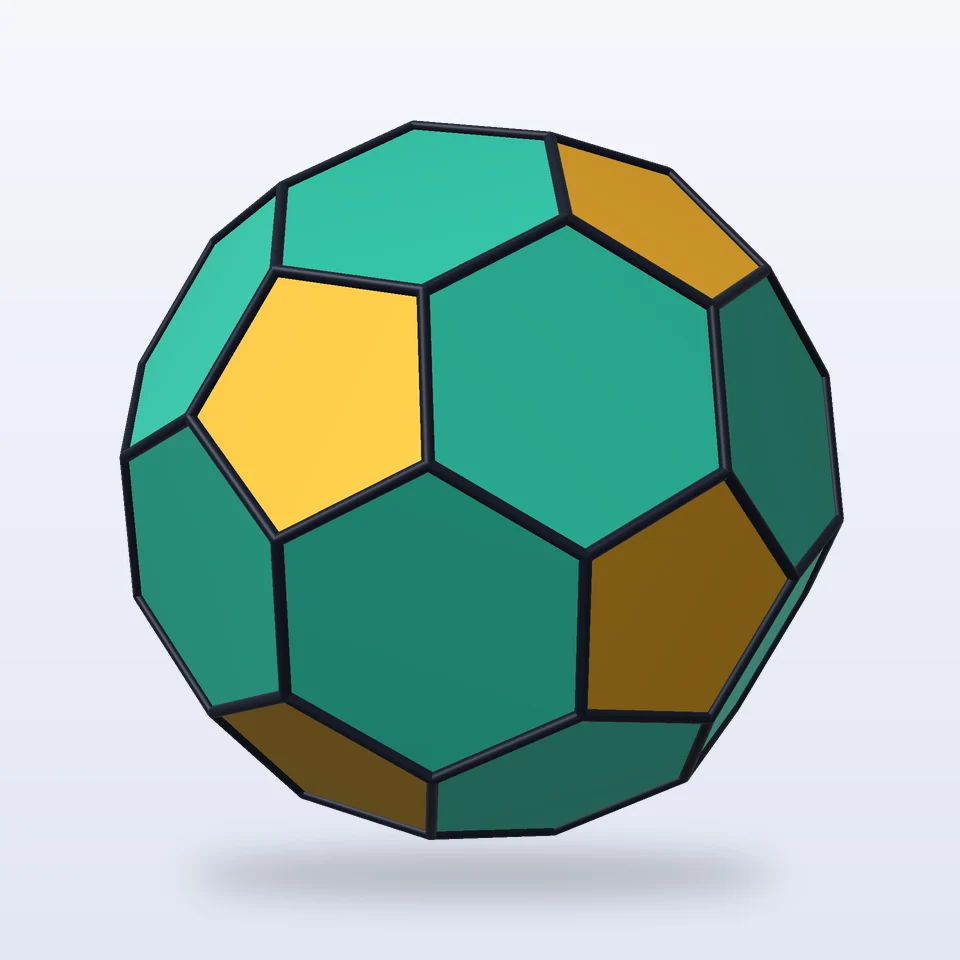
Platonic and Archimedean solids explained
Why there are exactly five Platonic solids, how the thirteen Archimedean solids follow by cutting corners, what duals and Catalan solids are, why vertices − edges + faces = 2, and where these shapes appear in chemistry, viruses and games.
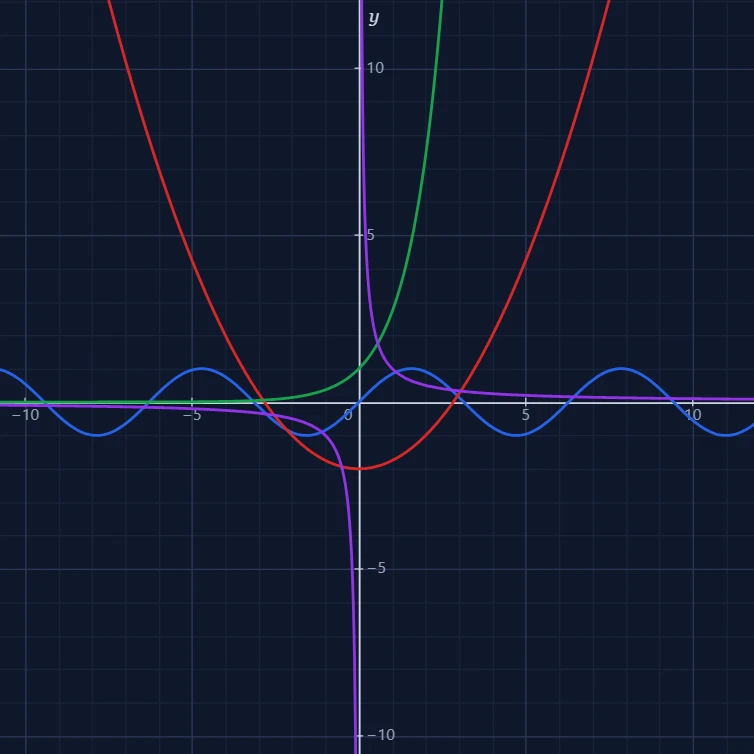
Functions, graphs and coordinate systems
What is a mathematical function? How a coordinate system turns a formula into a graph, how René Descartes joined algebra and geometry, and other systems.
Fourier Epicycles
Draw any shape and watch rotating circles trace it: Fourier epicycles online. Pick a heart, star or butterfly, type a word, choose how many circles turn and save a PNG or SVG.
Ready to try it?
Open PictorX in your browser — no install, no credit card required to start.
Open the constructions app