
Ballistic Trajectory & Projectile Motion
Once a thrown stone, a kicked ball or a missile with its engines burnt out is on its way, only gravity and the air steer it. That path is a ballistic trajectory. Without air it is a perfect parabola, because the horizontal and the vertical motion go on independently. With air it gets lopsided, and over thousands of kilometres it turns into part of an ellipse around the centre of the Earth. Pick a scene. In Projectile, drag on the picture to aim and let go to launch, or set the speed and angle and press Launch. Turn on air resistance to see the parabola bend. In Ballistic missile the Earth is round, and the path through space is part of an ellipse.
How it works
- In Projectile, drag on the picture to aim and let go to launch, or set the speed, angle and height and press Launch.
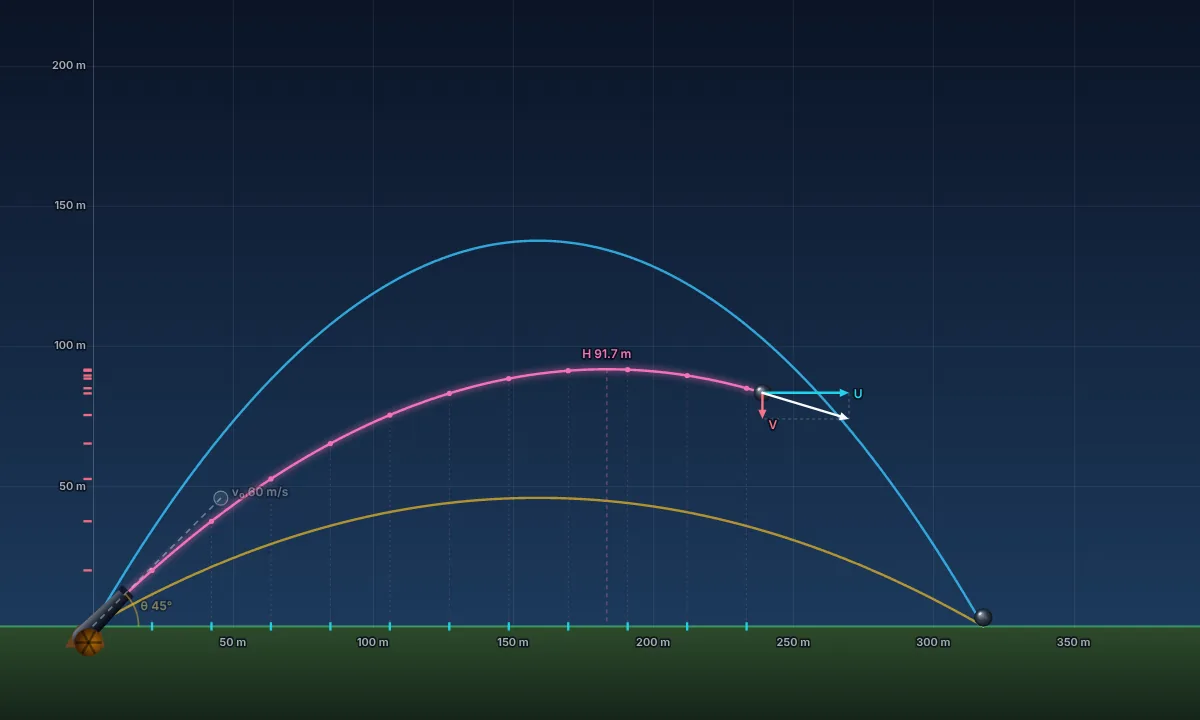
- Turn on air resistance and pick an object: the dashed parabola shows where it would have flown without air.
- In Launch angles, fire several angles at once and see which goes furthest. In Ballistic missile, follow the boost, mid-course and terminal phases around the round Earth.
Two motions in one
Galileo saw that a projectile does two things at once. Sideways nothing pushes or pulls it, so its horizontal speed U stays the same for the whole flight. Up and down, gravity pulls it at about 9.8 m/s², so its vertical speed V shrinks to zero at the highest point and then grows again as it falls. Turn on Velocity vectors and Time marks: the marks are evenly spaced across the ground but bunch up near the top.
The formulas
Launched at speed v₀ and angle θ on level ground, the projectile is at x = v₀ cos θ · t and y = v₀ sin θ · t − ½ g t² after t seconds. It reaches a maximum height H = (v₀ sin θ)² / 2g and lands at a range R = v₀² sin 2θ / g. Because sin 2θ is largest when 2θ is 90°, the longest throw is at 45°, and angles that add up to 90°, such as 30° and 60°, land at the same spot.
Air resistance
Air pushes against a moving ball with a force that grows with the square of its speed. A light, large ball such as a ping-pong ball feels it most: its path rises gently and then drops almost straight down. A cannonball is heavy for its size and flies nearly as in a vacuum. With air the best launch angle is lower than 45°, as the Launch angles scene shows.
From footballs to missiles
Over a football pitch the Earth is flat and gravity is the same everywhere. Over thousands of kilometres neither is true. A ballistic missile burns its engines in the boost phase, coasts through space in the mid-course phase, and falls back into the atmosphere in the terminal phase. In space its path is part of an ellipse with the centre of the Earth at one focus, the same kind of orbit a satellite follows.
Frequently asked questions
What is a ballistic trajectory?
The path of an object that moves only because of the speed it was given at the start, steered by gravity and air resistance alone. A thrown stone, a kicked ball and a missile after its engines stop all fly on ballistic trajectories.
Why is 45° the best launch angle?
On level ground and without air, the range is R = v₀² sin 2θ / g. sin 2θ is largest when 2θ = 90°, so θ = 45°. A steeper throw stays up longer but moves sideways more slowly; a flatter one moves sideways faster but lands sooner.
Why does air resistance make the path lopsided?
Drag slows the ball all the time, most of all when it is fast. On the way up it still has much of its launch speed and covers a lot of ground. On the way down it has lost horizontal speed, so it falls more steeply. The highest point moves past the middle, toward the landing point.
Why is a missile's path an ellipse and not a parabola?
The parabola assumes that gravity always points straight down with the same strength. Over long distances gravity points toward the centre of the Earth and gets weaker with height. An object moving under such gravity alone follows an ellipse, as long as it is slower than escape speed. If the ellipse misses the ground, the object is in orbit.
Does this upload anything?
No. Everything is calculated and drawn on a canvas in your browser. Save downloads a PNG. Edit opens that image in the PictorX editor.
Related tools
Ballistic trajectory
What is a ballistic trajectory? Why a thrown object flies on a parabola, range and height formulas, how air bends the path and a missile's three phases.
Solar System
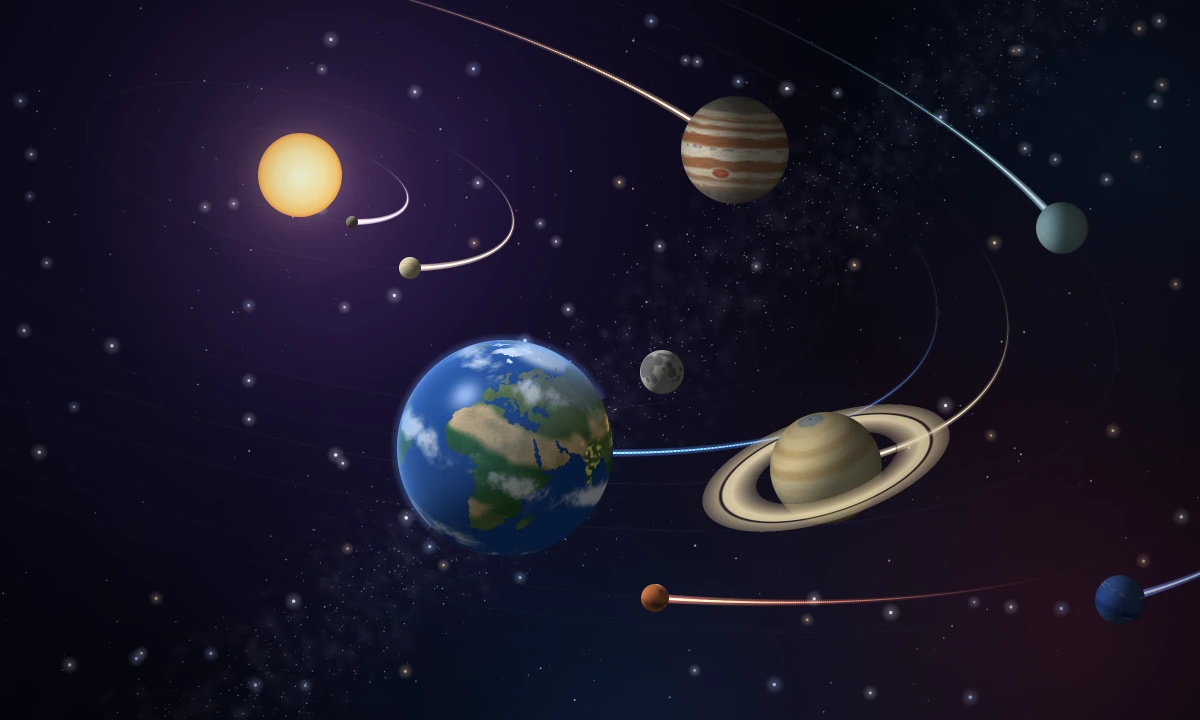
Fly through the solar system in 3D in your browser. The sun, eight planets, their largest moons, the dwarf planets, and the Kuiper belt move on their real, tilted orbits under Newton's gravity.

N-Body System
Watch Newton's gravity move stars, planets, and moons in 3D in your browser. Turn the view, and see stable orbits, resonances, slingshots, Trojans, and a chaotic cluster.
Brachistochrone race
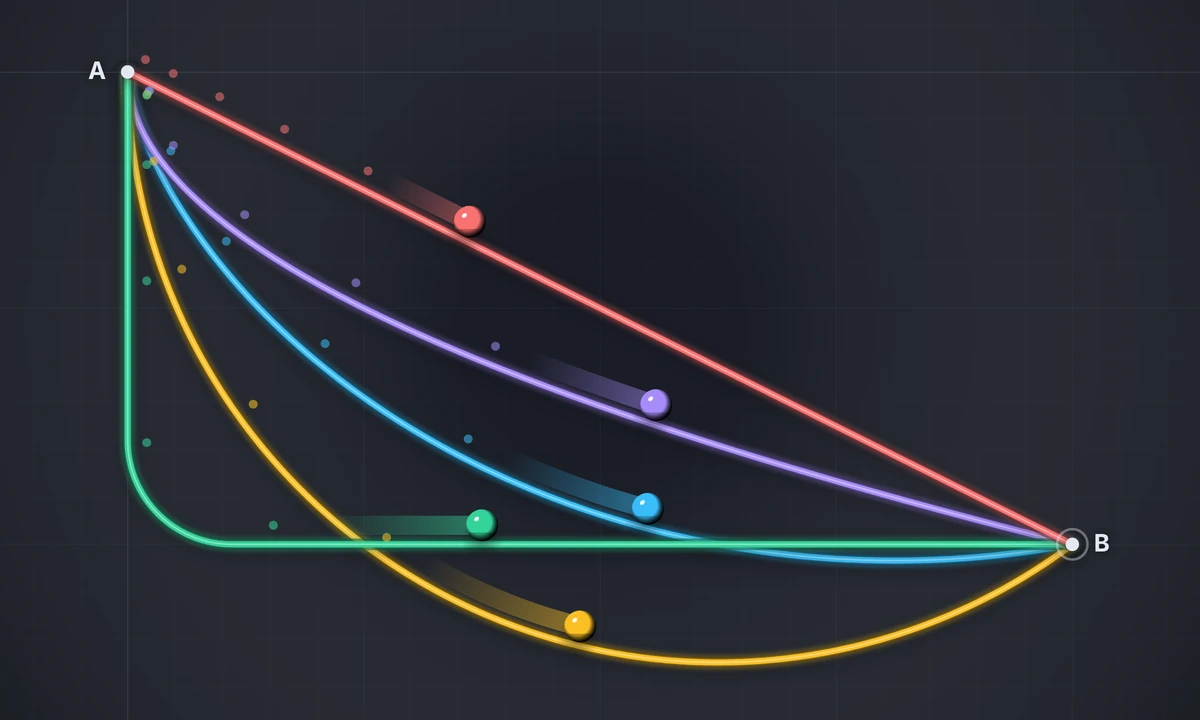
Race balls from A to B on a straight ramp, a circle, a parabola, and a cycloid. The cycloid always wins, even when it dips below the finish. Draw your own track.
Newton's cradle
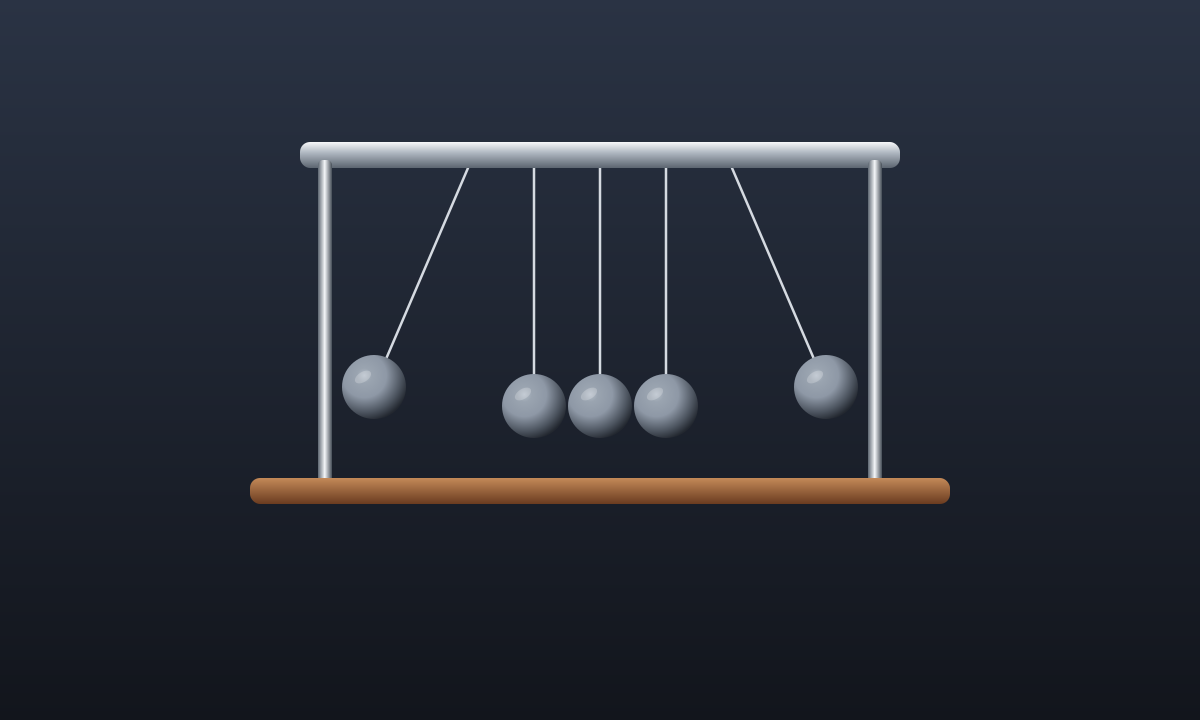
Lift a steel ball and let it fall. The click sends that motion out the other side. Watch height turn into motion as the cradle swings.
Galton board
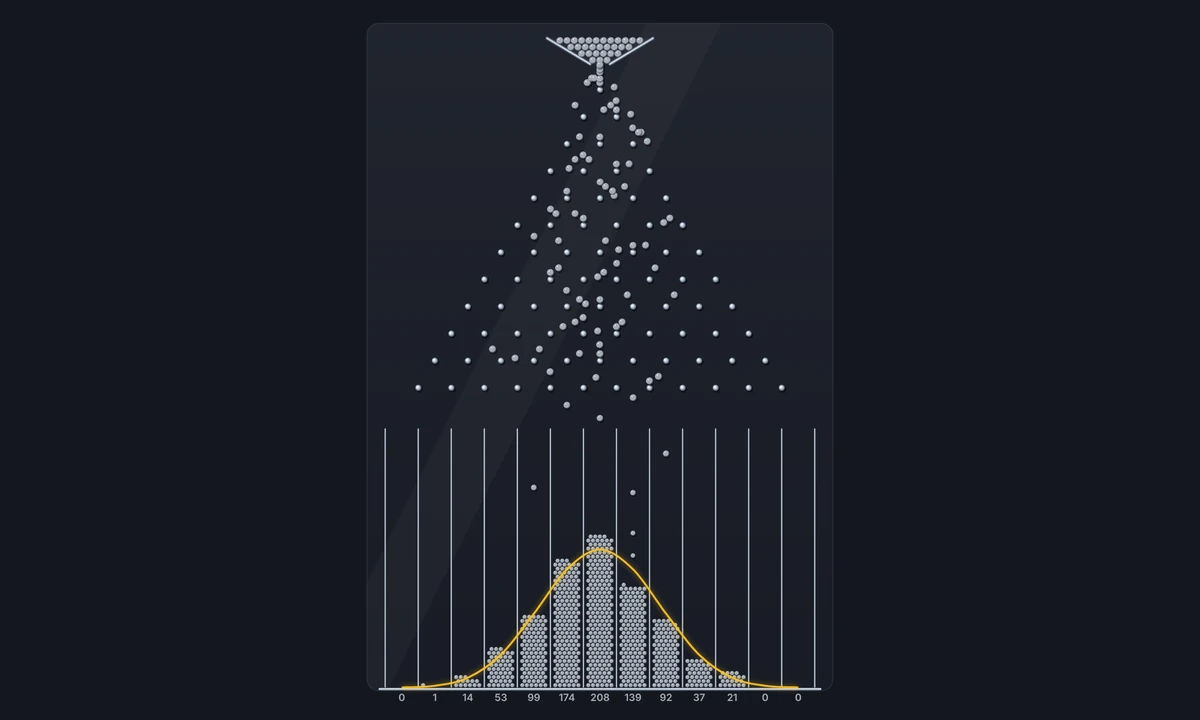
Drop balls through rows of pegs and watch a bell curve fill the bins. Change the rows, the bias, and the number of balls, and compare mean and spread with theory.
Ready to try it?
Open PictorX in your browser — no install, no credit card required to start.
Go to Editor