
Titration and pH explained
A titration measures how much acid or base a solution contains by adding a second solution of known concentration, drop by drop, until the two have exactly neutralised each other. This page explains what pH measures, how strong and weak acids and bases differ, how the pH of a mixture can be calculated exactly, why the titration curve has its shape, what buffers and indicators do, and how the result gives a concentration.
What pH measures
In water, acids release hydrogen ions (more exactly, they give protons to water molecules, forming H₃O⁺) and bases take them up or release hydroxide ions. Because these concentrations span many powers of ten, chemists use their negative logarithm: pH = −log₁₀[H⁺], with the concentration in moles per litre. Water itself always contains a little of both: H₂O ⇌ H⁺ + OH⁻, with [H⁺][OH⁻] = Kw = 1.0 × 10⁻¹⁴ at 25 °C, the ionic product of water. In pure water both are 10⁻⁷ mol/L, pH 7; in acidic solutions [H⁺] is larger and the pH lower, in basic ones the reverse, and pH + pOH = 14 at 25 °C. Each pH unit is a factor of ten: a solution of pH 3 has a hundred times more hydrogen ions than one of pH 5. Strictly, pH is defined by the hydrogen ion's activity, which in concentrated solutions is somewhat lower than its concentration; in dilute solutions the two are close.
Strong and weak acids and bases
A strong acid, such as hydrochloric or nitric acid, dissociates completely in water: 0.1 mol/L HCl contains 0.1 mol/L H⁺ and has pH 1.0. Strong bases such as sodium and potassium hydroxide dissociate completely too. A weak acid HA reacts only partly, HA ⇌ H⁺ + A⁻, and reaches an equilibrium described by its acid dissociation constant Ka = [H⁺][A⁻]/[HA], usually given as pKa = −log₁₀ Ka. The smaller the pKa, the stronger the acid: hydrofluoric acid 3.17, formic acid 3.75, acetic acid 4.76, the ammonium ion 9.25. A 0.1 mol/L solution of acetic acid has pH 2.88, so only about 1.3 % of its molecules have given up their proton. A weak base such as ammonia takes protons from water, NH₃ + H₂O ⇌ NH₄⁺ + OH⁻; its strength is usually given by the pKa of its conjugate acid, and pKa + pKb = 14.
Calculating the pH exactly
School formulas such as pH = ½(pKa − log c) for a weak acid are approximations: they assume that the acid dissociates only a little and that water's own ions can be ignored. They fail for very dilute acids, for fairly strong weak acids such as the first proton of phosphoric acid, near equivalence points and in mixtures. The exact way is to write down all the conditions at once. The total amount of each acid–base system is fixed (the mass balance), each system's species are related by its Ka values, water obeys Kw, and the solution is electrically neutral: the positive charges add up to the negative charges (the charge balance). For a system with pKa values pKa₁, pKa₂, ... the share of each species follows from [H⁺] alone, so the charge balance becomes one equation in [H⁺]. It always has exactly one solution, which a computer finds in a fraction of a millisecond. The simulator does this for every point of the curve; it gives, for example, pH 6.98 for 10⁻⁸ mol/L hydrochloric acid, where pH = −log c would give 8, an absurd basic pH for an acid.
The titration curve
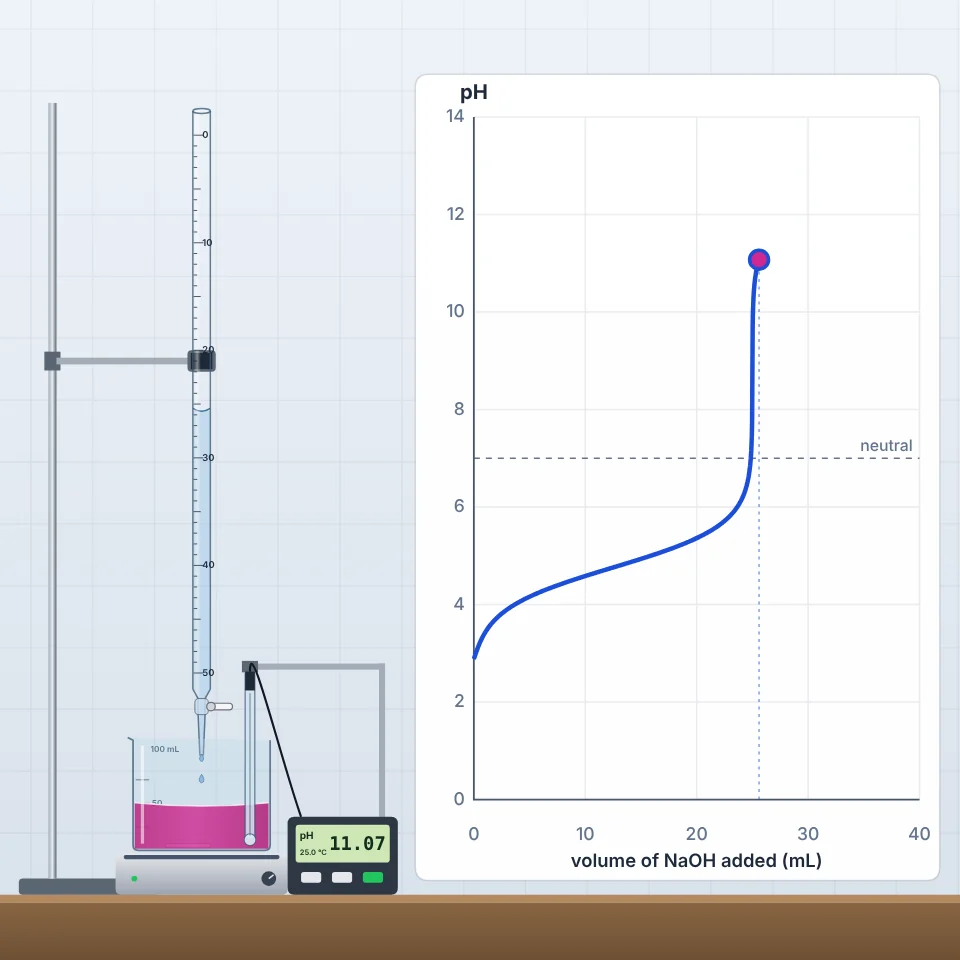
In an acid–base titration a known volume of the analyte, measured with a pipette, is placed in a flask or beaker, and the titrant of known concentration is added from a burette, a long graduated tube with a tap at the bottom, read to 0.05 mL. Plotting the pH against the volume added gives the titration curve. For a strong acid titrated with a strong base the pH stays low and rises only slowly while acid remains in excess; close to the equivalence point so little acid is left that a single drop of base changes the pH from about 4 to about 10; after that the pH approaches that of the titrant. At the equivalence point the moles of base added equal the moles of acid originally present. The steep part is the inflection point of the curve, where its slope is largest, which is how the equivalence point is found in a titration followed with a pH meter.
Weak acids, buffers and the half-equivalence point
With a weak acid the curve starts higher, rises quickly at first and then flattens: once some base has been added, the beaker holds a mixture of the acid HA and its conjugate base A⁻, a buffer. Its pH is given by the Henderson–Hasselbalch equation, pH = pKa + log₁₀([A⁻]/[HA]), and changes little when acid or base is added, because each added hydroxide ion simply turns some HA into A⁻. Halfway to the equivalence point [A⁻] = [HA], the logarithm is zero and pH = pKa: reading the pH at half the equivalence volume is a classic way to measure a pKa. A buffer is useful within about one pH unit of its pKa, the flat buffer region of the curve. At the equivalence point the solution contains the salt of the weak acid, and since A⁻ is a base the pH there is above 7: 8.73 for acetic acid titrated to 0.05 mol/L sodium acetate. The jump is smaller than for a strong acid and shrinks further for weaker or more dilute acids; acids with a pKa above about 9 cannot be titrated accurately in water. A weak base titrated with a strong acid gives the mirror image, with an acidic equivalence point.
Polyprotic acids: phosphoric acid and carbonate
Acids with more than one acidic proton give them up one at a time, each with its own pKa: phosphoric acid H₃PO₄ has pKa values of 2.15, 7.20 and 12.35, carbonic acid 6.35 and 10.33, citric acid 3.13, 4.76 and 6.40. When the pKa values are about four units apart or more, the curve shows a separate jump for each proton. Phosphoric acid titrated with sodium hydroxide shows two clear jumps, at the first equivalence point (NaH₂PO₄, pH about 4.7) and the second (Na₂HPO₄, pH about 9.7), but not the third, because phosphate is so basic that the pH hardly changes there. Sodium carbonate titrated with hydrochloric acid shows the same in reverse: carbonate takes a first proton to become hydrogencarbonate (pH about 8.3, the phenolphthalein end point) and a second to become carbonic acid (pH about 4, the methyl orange end point). In real titrations some carbonic acid escapes as carbon dioxide, so chemists often boil the solution briefly before the second end point to sharpen the jump. Citric acid's pKa values are so close that its three protons titrate as one.
Indicators: how they change colour
An acid–base indicator is itself a weak acid HIn whose acid form and base form have different colours, because losing the proton changes the molecule's system of alternating double bonds and so the light it absorbs. The ratio of the two forms follows the Henderson–Hasselbalch equation with the indicator's own pKa: one unit below it about 91 % is in the acid form, one unit above it about 91 % in the base form. The eye sees the colour change over roughly two pH units: methyl orange from red to yellow between pH 3.1 and 4.4, methyl red from red to yellow between 4.4 and 6.2, bromothymol blue from yellow through green to blue between 6.0 and 7.6, and phenolphthalein from colourless to pink between 8.2 and 10.0. Phenolphthalein's acid form is colourless, so its first faint pink is easy to see. A universal indicator is a mixture of several indicators that passes from red through orange, yellow and green to blue and violet over the whole pH scale; it shows the approximate pH but no sharp end point. The simulator mixes the colours of the two forms by the share of each, as light passes through the liquid.
Choosing an indicator and finding a concentration
An indicator works when its colour change lies on the steep part of the titration curve, so that the end point, the colour change, falls within a drop of the equivalence point. For a strong acid and a strong base the jump spans pH 4 to 10 at 0.1 mol/L, and methyl red, bromothymol blue and phenolphthalein all work. For a weak acid titrated with a strong base the equivalence point is basic and phenolphthalein is the usual choice; methyl orange would change far too early, while most of the acid is still unreacted. For a weak base titrated with a strong acid, methyl red or methyl orange are right. A weak acid and a weak base give such a small jump that no indicator gives a sharp end point. From the titre, the volume at the end point, the concentration follows from the stoichiometry: moles of titrant = c × V, moles of analyte = moles of titrant divided by the number of protons exchanged, and c(analyte) = moles / V(analyte). In practice the titration is repeated until two titres agree within about 0.1 mL, and the burette is read at the bottom of the meniscus at eye level.
Frequently asked questions
Why is the pH scale usually given as 0 to 14?
Because in water at 25 °C Kw = 10⁻¹⁴, so a solution with 1 mol/L of hydrogen ions has pH 0 and one with 1 mol/L of hydroxide ions has pH 14. These are not hard limits: concentrated hydrochloric acid has a negative pH and concentrated sodium hydroxide a pH above 14, although at such concentrations activities differ greatly from concentrations. Kw also depends on temperature: at 37 °C neutral water has pH 6.8, at 100 °C pH 6.1.
What is a buffer used for?
Buffers keep the pH nearly constant when acids or bases are added. Blood is buffered at pH 7.4 mainly by carbonic acid and hydrogencarbonate, and inside cells phosphate buffers help; laboratories use buffers to calibrate pH meters and to keep enzymes and reactions at the right pH. A buffer is a mixture of a weak acid and its conjugate base in comparable amounts, which is exactly what the beaker holds halfway to the equivalence point of a weak acid titration.
How does a pH meter work?
A pH meter measures the voltage between a glass electrode and a reference electrode dipped into the solution. The thin glass membrane at the tip develops a potential that depends on the hydrogen ion activity outside it, about 59 millivolts per pH unit at 25 °C (the Nernst equation). The meter is calibrated with two or three buffer solutions of known pH before use and corrects for the temperature.
Why is the titrant in the burette and not the analyte?
Because the titrant's concentration is known and its volume is what is measured: the burette reads the volume delivered to 0.05 mL or better. The analyte is measured once with a pipette into the flask, the indicator is added, and the titrant is run in until the colour changes. Titrating the other way round works too, as long as you know which volume to measure; sodium carbonate, for example, is titrated with hydrochloric acid from the burette.
Related tools
Acid–base titration: watch the pH jump
Titrate acids and bases drop by drop with a burette, a stirrer, a pH meter and indicators that change colour: the titration curve with its equivalence points, the half-equivalence point where pH = pKa and the buffer region, for HCl, acetic acid, ammonia, phosphoric acid and sodium carbonate, with the pH solved exactly.
Molecule builder
A free online molecule builder: join atoms with single, double and triple bonds, get the formula and molar mass, see the molecule's real shape in 3D, and solve chemistry challenges.
Molecules and chemical bonds explained
How atoms join into molecules: valence and full shells, single, double and triple bonds, lone pairs, molecular formulas and molar mass, VSEPR shapes from linear to tetrahedral, and isomers.
Chemical equation balancer
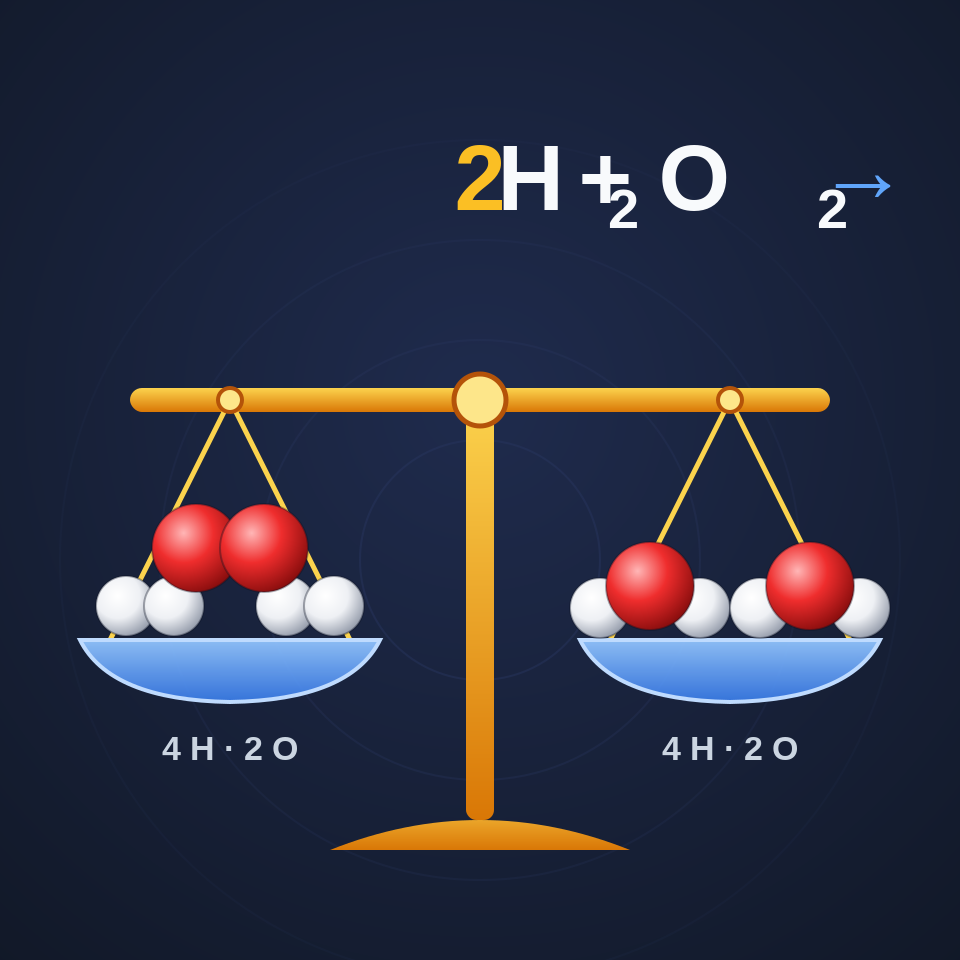
Balance any chemical equation instantly and exactly, ions, hydrates and redox reactions included. Count the atoms on both sides, see the oxidation numbers that change, and work out molar masses, the limiting reactant and the yield.
Ready to try it?
Open PictorX in your browser — no install, no credit card required to start.
Open the titration simulator