
Strange attractors explained
A strange attractor is what chaos looks like when you watch it long enough. A point hops from place to place by a fixed rule, never repeating and never settling, yet always staying within the same intricate shape of threads and folds. Those shapes come from formulas a line long, and they are both a tool of science and a favourite of generative art.
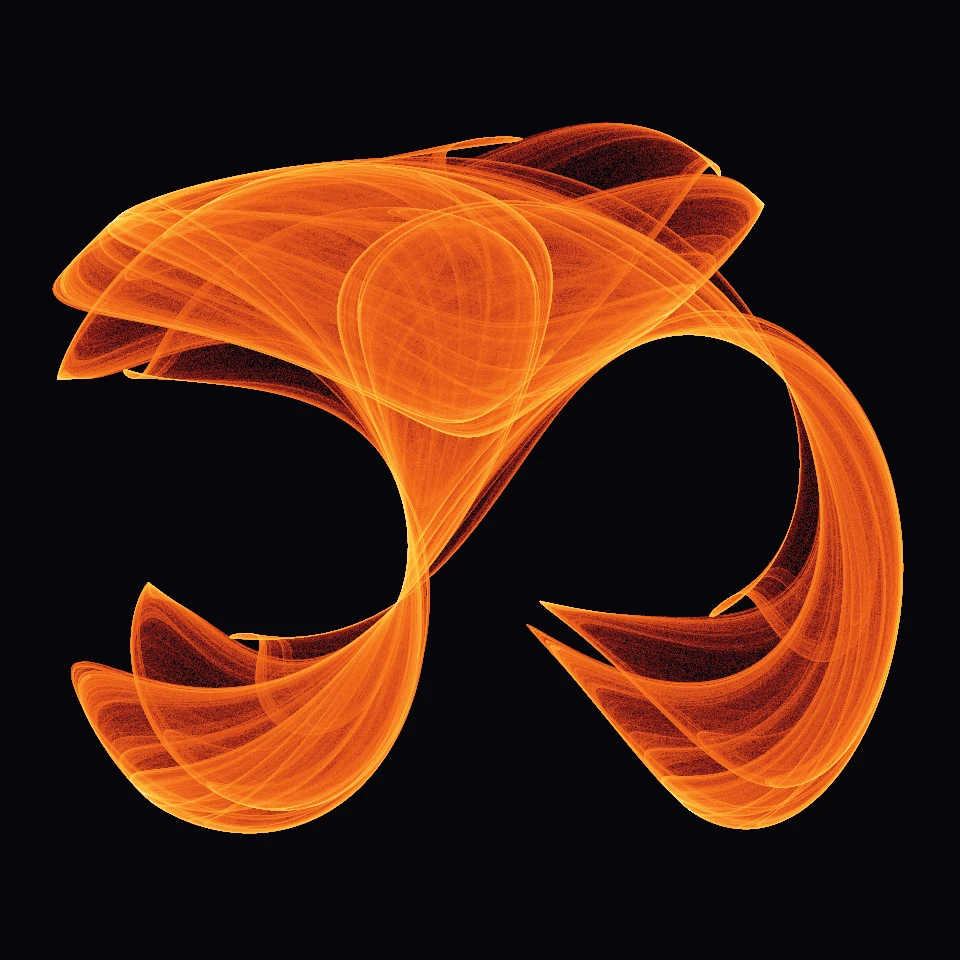
Attractors
Let a system run and it usually ends up doing one thing. A swinging pendulum with friction comes to rest: its attractor is a point. A clock settles into a steady rhythm: its attractor is a loop. An attractor is the set that the motion approaches from a whole range of starting points and then stays on. Points and loops are the simple kinds, and for centuries they were thought to be the only ones.
Strange attractors
In 1963 Edward Lorenz found a weather model whose motion never settled on a point or a loop. It circled one lobe, then the other, in an order that never repeated, yet it always stayed on the same butterfly-shaped surface. David Ruelle and Floris Takens called such a set a strange attractor in 1971: an attractor on which the motion is chaotic and whose structure is fractal, with finer and finer layers at every magnification.
Maps instead of flows
The Lorenz system flows continuously in three dimensions. In 1976 Michel Hénon looked for the simplest system that behaves the same way, and found it in two dimensions with discrete steps: x′ = 1 − a x² + y, y′ = b x. With a = 1.4 and b = 0.3 a single point, iterated, traces a thin boomerang that turns out to consist of infinitely many parallel lines. Such maps are fast to compute, which is why a few million points can be drawn in a second.
Stretching and folding
How can motion stay in a bounded region and still separate nearby points? By stretching and folding, like a baker kneading dough. Each step pulls the attractor out in one direction, which separates close points, then folds it back onto itself, which keeps it bounded. Repeat this forever and the result is a layered structure, with each layer made of thinner layers: a fractal. Stephen Smale's horseshoe map of 1967 is the cleanest picture of this mechanism.
Lyapunov exponents
The rate of stretching is measured by the Lyapunov exponent: the average logarithm, per step, of how much a tiny distance between two orbits grows. A positive exponent means that errors grow exponentially and long-term prediction is impossible, the butterfly effect. A two-dimensional map has two exponents, one for the stretching direction and one for the squeezing direction. For the Hénon attractor they are about 0.42 and −1.62; their sum, ln 0.3, is how much each step shrinks areas.
Fractal dimension
James Kaplan and James Yorke proposed in 1979 to estimate an attractor's dimension from its exponents: one whole dimension along the stretching direction plus a fraction λ₁ / |λ₂| across it. The Hénon attractor gets 1 + 0.42 / 1.62 ≈ 1.26, close to the value measured by counting boxes. When a map does not shrink areas on average, as many sine maps do not, the estimate is 2 and the attractor fills patches of the plane.
A gallery of maps
Kensuke Ikeda's map of 1979 describes light circling in a ring cavity with a nonlinear medium; its attractor curls into a spiral. Igor Gumowski and Christian Mira studied their nearly area-preserving map around 1980 for particle accelerators, and its orbits draw flowers, starfish and butterflies. The Tinkerbell map is a quadratic map named after its fairy-like trail. The sine maps of Clifford Pickover and Peter de Jong, popularised by Paul Bourke, give the silk and smoke shapes that turned strange attractors into an art form.
Explore them
Open the strange attractor generator, pick a map and a preset, and watch the picture build up from millions of points. Drag across it to change the first two numbers and see how quickly an attractor can change shape, collapse into a few dots or fly apart. Find new attractor searches random numbers for a chaotic orbit, and the tiles show its Lyapunov exponent and Kaplan–Yorke dimension. The pencil opens the picture in the photo editor with the background and the attractor on separate layers.
Frequently asked questions
What makes an attractor strange?
Two things: the motion on it is chaotic, so nearby orbits separate exponentially, and the set itself is a fractal, with structure at every scale. A point or a loop is an ordinary attractor; the Lorenz butterfly and the Hénon boomerang are strange ones.
Is a strange attractor random?
No. Every point follows from the previous one by an exact formula, and the same start always gives the same orbit. It only looks random because tiny differences grow so fast that the orbit cannot be predicted far ahead in practice.
Why does the same picture appear from different starting points?
Because the attractor attracts: orbits from a wide region are drawn onto it within a few steps, and then spread over it in the same proportions. Where each orbit is at a given moment differs completely, but the density of the points, which is what the picture shows, is the same.
What is the Lyapunov exponent of the Hénon attractor?
About 0.42 per step, for a = 1.4 and b = 0.3. The second exponent is about −1.62, and the two add up to ln 0.3, because each step multiplies areas by b = 0.3. The Kaplan–Yorke dimension that follows from them is about 1.26.
How is a strange attractor related to the Lorenz attractor?
The Lorenz attractor is the first strange attractor that was found, in a continuous three-dimensional flow. Hénon built his two-dimensional map to mimic a slice through it, and the maps in the generator are all discrete cousins that show the same stretching and folding with far less computation.
Related tools
Strange attractor generator
Draw strange attractors from millions of points: the Clifford, Peter de Jong, Hénon, Ikeda, Gumowski–Mira and Tinkerbell maps. Drag to change the numbers, find new attractors at random, and read the Lyapunov exponent and fractal dimension.
Lorenz Attractor
Interactive Lorenz attractor: tune a, b, f, rotate in 3D, try neon/ink/smoke looks, and save a PNG.
Lyapunov Fractal
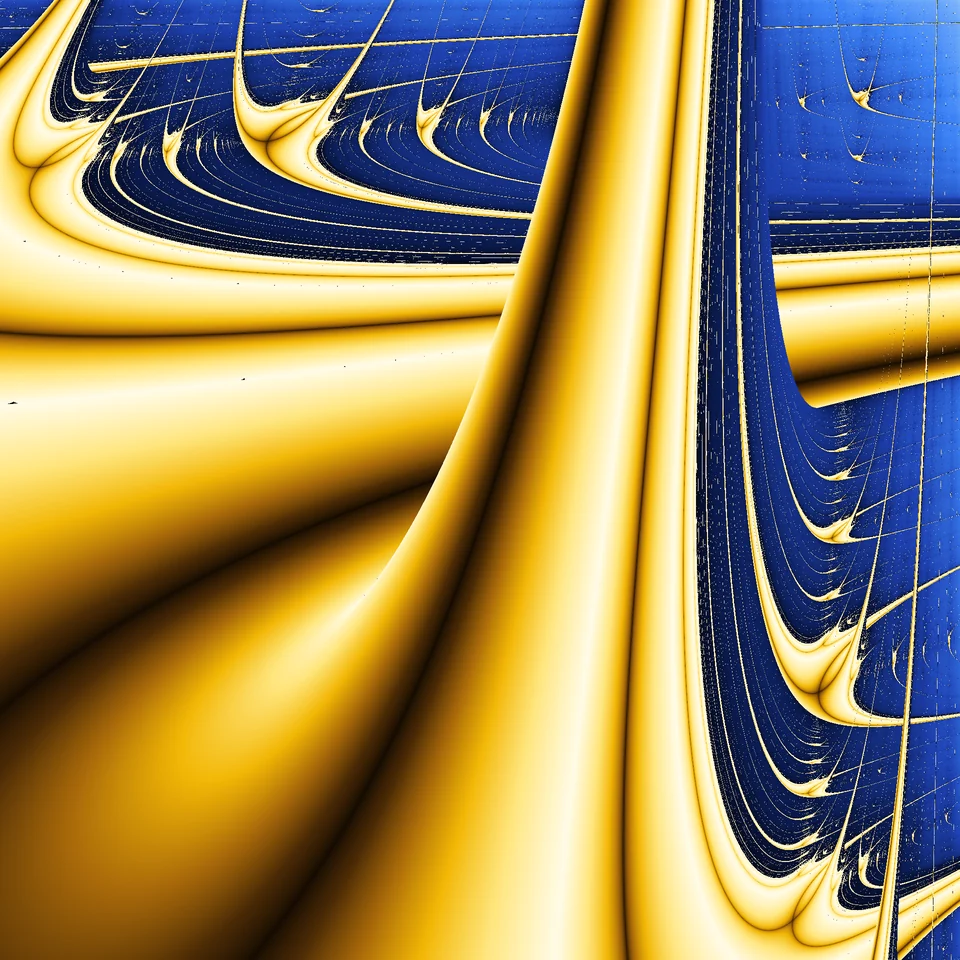
Draw Lyapunov fractals in your browser: type a sequence such as AB or BBBBBBAAAAAA, zoom into the swallows of Zircon Zity, and see where the logistic map is stable and where it is chaotic.
Double Pendulum
Simulate a classical double pendulum in your browser. Paint chaotic tip trails, long-exposure paths, or distort a soft field—then save a PNG.
Fractal generator: zoom into Mandelbrot, Julia and Newton fractals
Free online fractal generator: zoom about 5 trillion times into the Mandelbrot set, Julia and Newton fractals, jump to 64 famous spots and save a PNG.
Ready to try it?
Open PictorX in your browser — no install, no credit card required to start.
Open the strange attractor generator