
The night sky and the constellations
On a clear night far from city lights you can see about 3000 stars at once, set in patterns that have hardly changed since the first astronomers named them. Yet the sky is never still: it turns once a day, shifts a little every night with the seasons, and the Moon and the planets wander through it. This page explains what you see: the celestial sphere and its coordinates, why the sky looks different from every latitude, sidereal time, how bright and how hot the stars are, how the 88 constellations came about, the slow wobble of the Earth's axis, and how the star map works it all out.
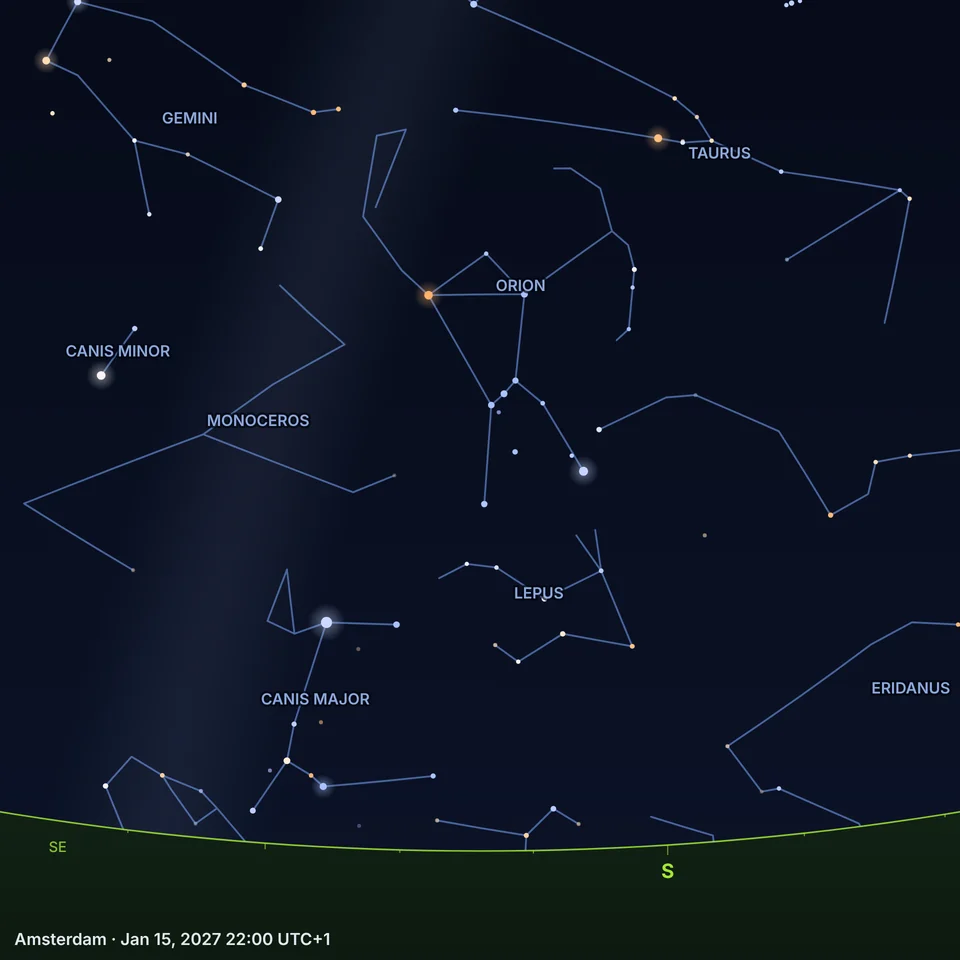
The celestial sphere
Astronomers picture the sky as a great sphere with the Earth at its centre, on which the stars are fixed. It is not real, the stars are at very different distances, but it describes what we see: every star has a direction, and directions are all that a map of the sky needs. The Earth's axis points to the north and south celestial poles, and the celestial equator lies above the Earth's equator. The half of the sphere above your horizon is the sky you can see; the point straight overhead is the zenith, and the meridian runs from the north point of the horizon through the zenith to the south point.
Altitude and azimuth, right ascension and declination
A star's place in your sky is given by its altitude, the angle above the horizon, and its azimuth, the direction measured from north through east: a star in the south-west halfway up has an altitude of 45° and an azimuth of 225°. These change all the time as the sky turns. A star's place on the sphere itself is given by declination, its angle north or south of the celestial equator, like a latitude, and right ascension, measured eastwards along the equator in hours from the point where the Sun crosses it in March. The app converts one into the other with the hour angle, the local sidereal time minus the right ascension.
Why the sky depends on your latitude
The celestial pole stands as high above your horizon as your latitude: 52° in Amsterdam, 34° above the southern horizon in Sydney, overhead at the North Pole and on the horizon at the equator. Stars closer to the pole than that never set and circle it all night, the circumpolar stars, such as the Big Dipper from Europe; stars as close to the other pole never rise. So the Southern Cross can never be seen from Amsterdam, and Polaris never from Sydney. At the equator every star rises and sets, and in the course of a year the whole sky passes overhead.
Sidereal time
The Earth turns once relative to the stars in 23 h 56 min 4.1 s, the sidereal day. The solar day is about four minutes longer, because in a day the Earth moves about 1° along its orbit and must turn a little further to bring the Sun back to the meridian. The local sidereal time is the angle the Earth has turned since the March equinox point crossed your meridian, written in hours: the right ascension of the stars on the meridian now. Greenwich sidereal time grows by 24 h 3 min 57 s each solar day, and the local sidereal time adds the longitude; the app uses the standard formula of the International Astronomical Union.
Brightness: the magnitude scale
Hipparchus sorted the stars into six classes, the brightest of the first magnitude and the faintest of the sixth. In 1856 Norman Pogson made it exact: five magnitudes are a factor of 100 in brightness, so one magnitude is a factor of 2.512, and m = −2.5 log₁₀(F/F₀). The brightest stars came out below zero: Sirius −1.46, Canopus −0.74. This apparent magnitude depends on distance; the absolute magnitude is how bright a star would look from 32.6 light years. Rigel looks a little fainter than Sirius but gives out about 5,000 times more light, because it is a hundred times farther away.
The colours of the stars
A star shines roughly like a hot body: the hotter it is, the bluer its light. Astronomers measure the colour by the difference between a star's magnitude through a blue filter and through a yellow-green one, the B−V colour index. Hot stars of 20,000 K and more, such as Spica, have B−V around −0.2; Vega, at 9,600 K, is close to 0 by definition; the Sun, 5,800 K, is 0.65; Arcturus, 4,300 K, is 1.23; and cool red supergiants such as Antares and Betelgeuse, 3,500 K, are near 1.8. To the eye only the brightest stars show colour, because faint light is seen by the rods of the eye, which do not see colour.
Constellations and asterisms
The 88 constellations of the IAU cover the sky like countries, each with borders drawn by Eugène Delporte in 1930 along lines of right ascension and declination of the year 1875. Forty-eight come from Ptolemy's Almagest, among them the twelve of the zodiac; the rest were added from the 16th to the 18th century, many by Petrus Plancius, Johannes Hevelius and Nicolas-Louis de Lacaille, who named southern ones after instruments such as the Telescope and the Air Pump. Well-known patterns that are not constellations are asterisms: the Big Dipper is part of Ursa Major, and the Summer Triangle joins Vega, Deneb and Altair in three constellations.
The slowly moving sky
The constellations are not quite fixed. The Earth's axis swings round like a spinning top's in about 25,800 years, the precession found by Hipparchus, so the celestial poles and the equinox points drift: Polaris is the pole star only now, about 5000 years ago it was Thuban in Draco, and in 12,000 years it will be Vega. The coordinates of every star change by up to about 50″ a year, which the app corrects for. The stars also move themselves: in 50,000 years the Big Dipper will have lost its shape. And the Moon and the planets move along the ecliptic, which is tilted 23.44° to the celestial equator.
How the star map works
The stars are the 1095 brightest of the Yale Bright Star Catalogue (to magnitude 4.6, with the fainter stars of the figures), with their J2000 positions, magnitudes and B−V indices; close pairs are merged. For the moment chosen the app precesses the positions to the date with the IAU 1976 formulas, works out the Greenwich and local sidereal time, and turns every direction into altitude and azimuth. The Sun and the planets come from NASA JPL's approximate Keplerian elements, valid from 1800 to 2050, and the Moon from the main terms of Jean Meeus' lunar series with its parallax; they are accurate to a few arcminutes for the planets and about 0.2° for the Moon. The whole sky is drawn in a stereographic projection, which keeps the shapes of the constellations, as on a planisphere; refraction near the horizon is left out.
Frequently asked questions
What is the difference between a constellation and an asterism?
A constellation is one of the 88 areas into which the IAU divides the sky, with official borders, so every star belongs to exactly one. An asterism is any recognisable pattern of stars, inside one constellation or across several: the Big Dipper or Plough in Ursa Major, Orion's Belt, the Teapot in Sagittarius, or the Summer Triangle of Vega, Deneb and Altair.
Why can't I see the Southern Cross from Europe?
Because it lies about 60° south of the celestial equator, and stars that close to the south celestial pole stay below the horizon for anyone north of about 27° north. From Amsterdam the south pole of the sky is 52° below the horizon, so every star within 52° of it never rises. Choose Southern Cross from Sydney in the app and then move the latitude north to watch it sink.
Is Polaris the brightest star?
No, it is only the 48th brightest, magnitude 2.0. It is famous because it lies within 0.7° of the north celestial pole, so it hardly moves while the rest of the sky turns round it, and its altitude tells you your latitude. The brightest star of the night sky is Sirius, magnitude −1.46, in Canis Major. The south celestial pole has no bright star: Sigma Octantis, magnitude 5.4, is the nearest one you can see.
Why do the planets not twinkle?
Twinkling comes from turbulence in the air bending the light of a star, which arrives as a single point. A planet shows a tiny disc, and the flickers from different parts of the disc average out, so it shines steadily unless it is low over the horizon. That and their slow motion against the stars from night to night are the easiest ways to tell a planet from a star.
Related tools
Star map and constellations
See the night sky for any place, date and time: the bright stars, the 88 constellations with their lines and names, the Moon and its phase, the planets and the Milky Way. Watch the sky turn, tap a star for its name and distance, and compare the sky from the North Pole, the equator and Sydney.
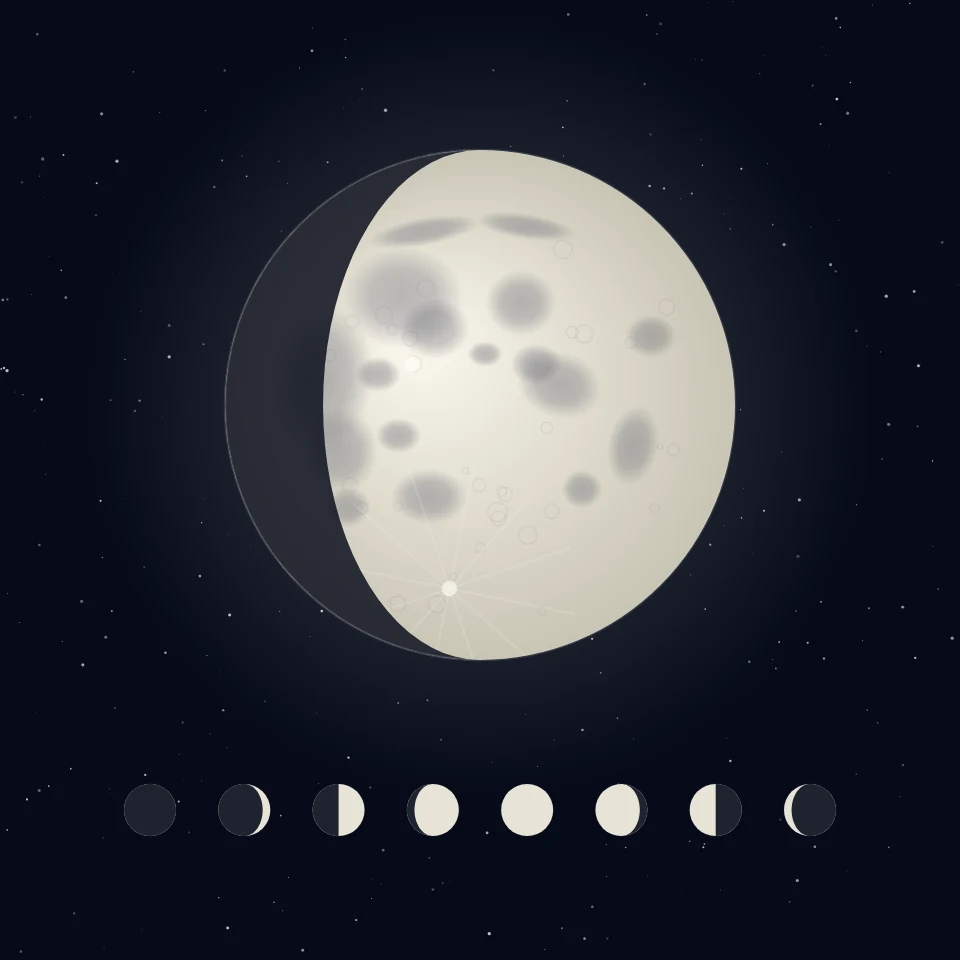
Moon phases for any date
See tonight's Moon or the Moon on any date: the phase and its name, how much is lit, the Moon's age, moonrise and the next full and new moon. An interactive Sun–Earth–Moon model shows why the Moon has phases, the synodic and sidereal month and when eclipses happen.
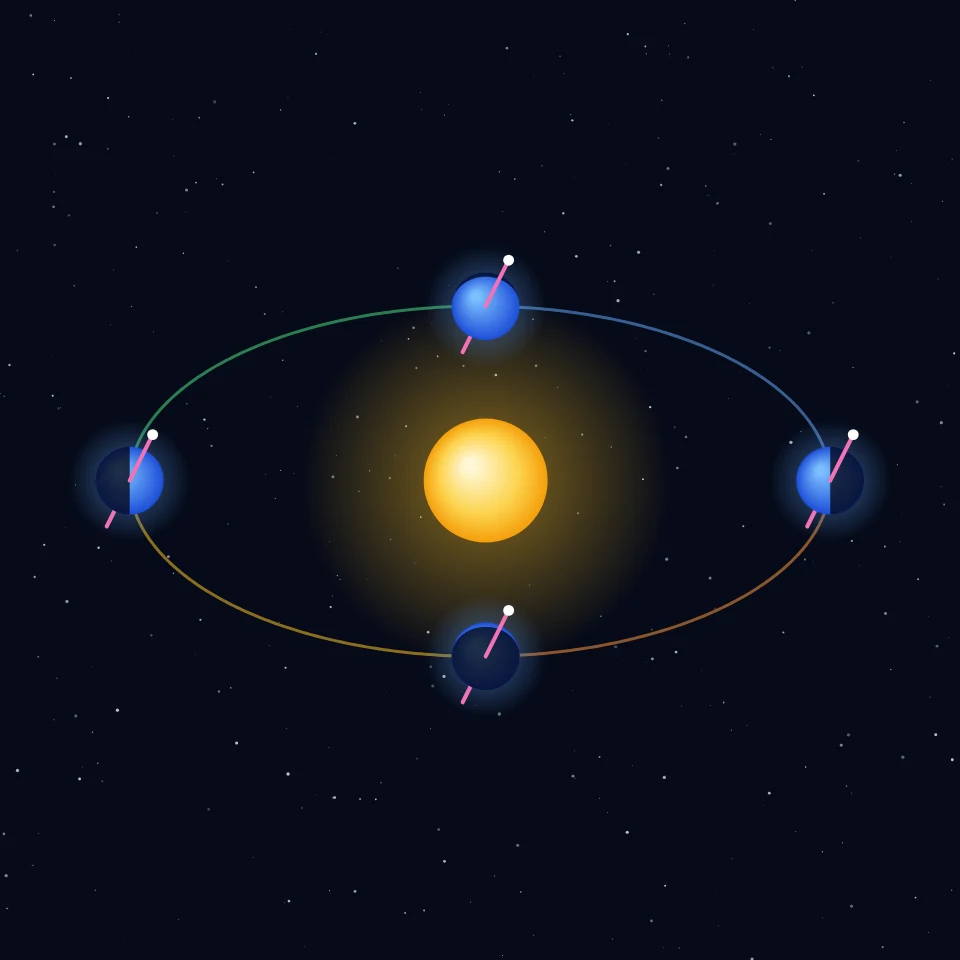
Seasons and Earth's tilt
Why does the Earth have seasons? Watch the Earth go round the Sun with its 23.44° tilt, see the day length, the noon Sun's height and the sunlight at any latitude through the year, the solstices and equinoxes, polar day and night, and what would happen with no tilt or a tilt like Uranus.
The phases of the Moon explained
Why the Moon has phases, the eight phases and the shape of the terminator, how much of the Moon is lit, the synodic and sidereal month, when the Moon rises and sets, why it is upside down in the southern hemisphere, earthshine, eclipses and how the phase is computed for any date.
Ready to try it?
Open PictorX in your browser — no install, no credit card required to start.
Open the star map