
Moon phases for any date
Half of the Moon is always lit by the Sun; what changes over a month is how much of that lit half we see from Earth. Here you can watch it happen: the Sun, the Earth and the Moon seen from far above the North Pole, and beside them the Moon exactly as it looks from Earth on the date you pick, computed from the real positions of the Sun and the Moon. Run the days, drag the Moon round its orbit, turn the picture over for the southern hemisphere and find out why there is not an eclipse every month. Pick an example, or a date and a time (UTC), and press Play to run the days by. The big picture shows the Sun, the Earth and the Moon from far above the North Pole: the Sun's light comes from the left, so the Moon's half that faces it is always lit, and the Moon goes round counterclockwise. Beside it is the Moon as it looks from Earth, with its name, how much of it is lit, its age and roughly when it rises and sets. Step and Back move by a day, Reset goes back to your date, and you can drag the Moon round its orbit, or tap a day of the lunar month at the bottom. The small moons round the orbit show each phase as seen from Earth. Choose the southern hemisphere to see the Moon upside down. The purple arrow points to the same distant star all month: the Moon gets back to it after 27.3 days, the sidereal month, but needs 29.5 days to catch up with the Sun again, the synodic month from new moon to new moon. With Eclipses on, the pink line of nodes and the side view show why there is no eclipse every month: only when a new or full moon happens near a node. Try the eclipse examples. With Sound on a soft chime rings at each new moon, quarter and full moon; Record films it with the sound.
How it works
- Pick an example, such as Tonight or the next full moon, or set a date and a time, and press Play to run the days by.
- Watch the top view: sunlight comes from the left, so the half of the Moon facing the Sun is always lit, and the phase depends on where the Moon is on its orbit.
- Read the tiles and the view from Earth: the phase and its name, the lit percentage, the Moon's age, roughly when it rises and sets, and the next full and new moon with any eclipse.
- Drag the Moon round its orbit, switch to the southern hemisphere, and try the eclipse examples to see the line of nodes and the side view; switch Sound on to hear a chime at each phase and record a video.
Why the Moon has phases
The Moon makes no light of its own; it reflects sunlight, and the Sun always lights the half of the Moon that faces it. As the Moon travels round the Earth, we see that lit half from different angles. At new moon the Moon is between the Earth and the Sun and its lit half faces away from us; at full moon it is on the far side of the Earth and we see the whole lit half; at the quarters we see half of the lit half, so the Moon looks half lit. The phases have nothing to do with the Earth's shadow, which reaches the Moon only during a lunar eclipse.
The eight phases and the terminator
The cycle runs new moon, waxing crescent, first quarter, waxing gibbous, full moon, waning gibbous, last quarter and waning crescent. The line between day and night on the Moon, the terminator, is a half circle seen at an angle, so it always looks like half an ellipse: bulging towards the dark side for a crescent and towards the lit side for a gibbous moon. The share of the disc that is lit is (1 − cos E)/2, where E is the angle between the Moon and the Sun seen from Earth: 0 at new moon, 50 % at the quarters, 100 % at full moon.
Synodic and sidereal month
The Moon goes once round the Earth, back to the same stars, in 27.32 days: the sidereal month. But in that time the Earth has moved about 27° along its orbit round the Sun, so the Moon needs about 2.2 more days to get back to the same place relative to the Sun. The cycle of phases, from new moon to new moon, takes 29.53 days on average: the synodic month. The two are linked by 1/29.53 = 1/27.32 − 1/365.26. Because the Moon's orbit is an ellipse and the Earth's speed changes too, single lunations vary between about 29.3 and 29.8 days.
Moonrise, the hemispheres and eclipses
The Moon moves about 12° a day eastwards against the Sun, so it rises about 50 minutes later every day: a new moon rises with the Sun, a first quarter at noon, a full moon at sunset and a last quarter at midnight. From the southern hemisphere the Moon is seen upside down, so a waxing Moon is lit on the left. The Moon's orbit is tilted 5.1° to the Earth's, so most new and full moons pass above or below the Sun or the Earth's shadow. Eclipses happen only when a new or full moon falls near one of the two nodes, where the orbits cross, in eclipse seasons about every six months.
Frequently asked questions
What is the Moon's phase today?
Choose Tonight: the app works out the positions of the Sun and the Moon for this evening and shows the phase, its name, the percentage that is lit, the Moon's age in days since the last new moon and the dates of the next full and new moon. Pick any other date and time to see the Moon then; the positions come from the standard astronomical formulas, so the phases agree with almanacs to within a few minutes.
Why does the Moon have phases?
Because the Sun always lights one half of the Moon, and as the Moon goes round the Earth we see different amounts of that lit half. When the Moon is roughly between us and the Sun we see its dark side (new moon); when it is on the far side of the Earth we see the whole lit side (full moon). The Earth's shadow plays no part, except in a lunar eclipse.
How long is a lunar month?
From new moon to new moon takes 29.53 days on average, the synodic month. The Moon goes once round the Earth relative to the stars in only 27.32 days, the sidereal month, but because the Earth moves round the Sun meanwhile, the Moon needs about two more days to line up with the Sun again. The purple arrow in the app points to a fixed star and shows the difference.
Why is the Moon upside down in the southern hemisphere?
People in the southern hemisphere look north to see the Moon, while people in the north look south, so each sees it turned through 180° compared with the other. A waxing Moon is lit on the right in the north and on the left in the south. Choose Southern in the app to turn the view over, seas and craters included.
Why isn't there an eclipse every month?
The Moon's orbit is tilted by about 5.1° to the plane of the Earth's orbit, so at most new moons the Moon passes a little above or below the Sun, and at most full moons above or below the Earth's shadow. Only when a new or full moon happens close to one of the two nodes, where the Moon crosses the plane, is there an eclipse. This happens in two eclipse seasons a year; the side view and the line of nodes in the app show it.
Can I use the picture?
Yes. Save gives a PNG at the size you choose, and the pencil opens the picture in the PictorX photo editor with the background, the sunlight, the Moon's orbit, the star direction, the Earth, the ring of phases, the Moon, the view from Earth, the side view, the lunar month and the labels on layers of their own, and the date and the phase's name as editable text. In the editor itself it is under Apps ▸ Science ▸ Space & Earth ▸ Moon Phases. Everything runs in your browser.
Moon Phases: how do I record a video?
Press the red Record button in the playback bar: it films what the stage shows. Press it again to stop, and the video is saved to your device. Recording is free; you only need to sign in. Without a subscription the video carries a small PictorX logo in a corner. The button beside Record opens the video options: the shape (as shown, square, story 9:16 or wide 16:9), the length (until you stop, or 5, 10, 15 or 30 seconds for social media) and the file: MP4, WebM or an animated GIF. For the sound, choose the app's own sounds or one of three music tracks: calm, bright or beat.
Related tools
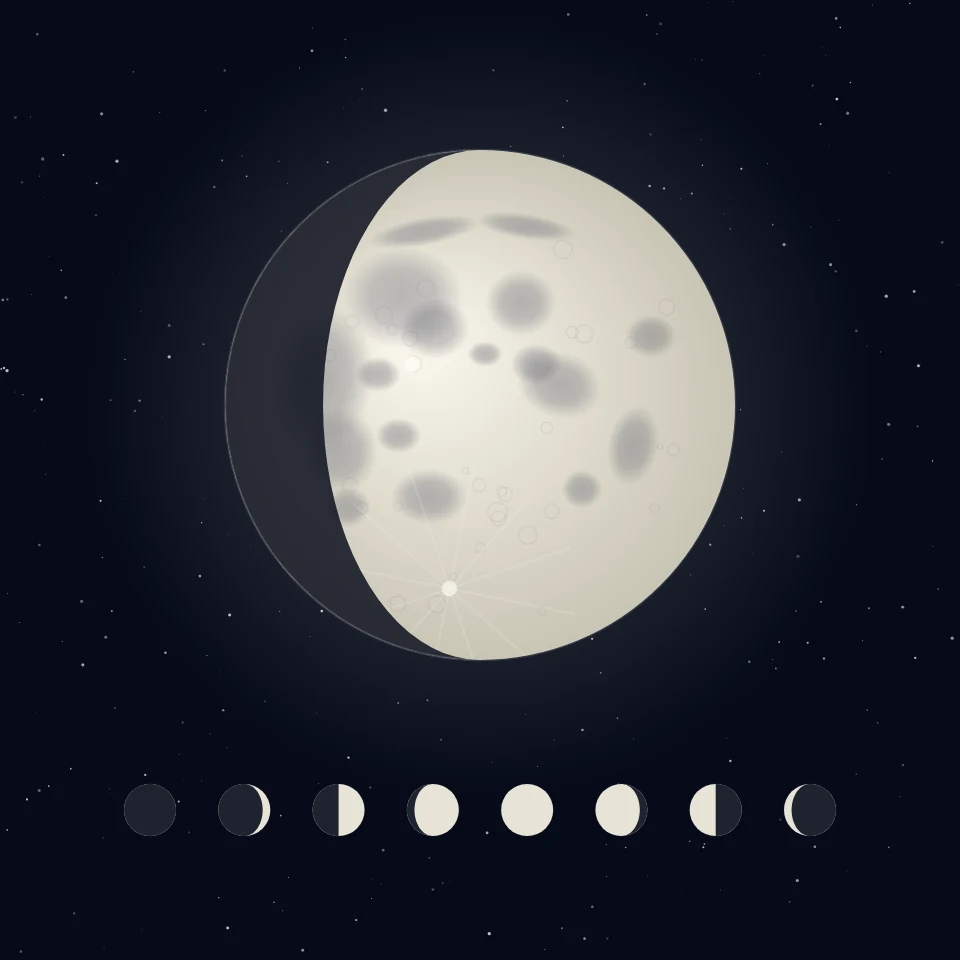
The phases of the Moon explained
Why the Moon has phases, the eight phases and the shape of the terminator, how much of the Moon is lit, the synodic and sidereal month, when the Moon rises and sets, why it is upside down in the southern hemisphere, earthshine, eclipses and how the phase is computed for any date.
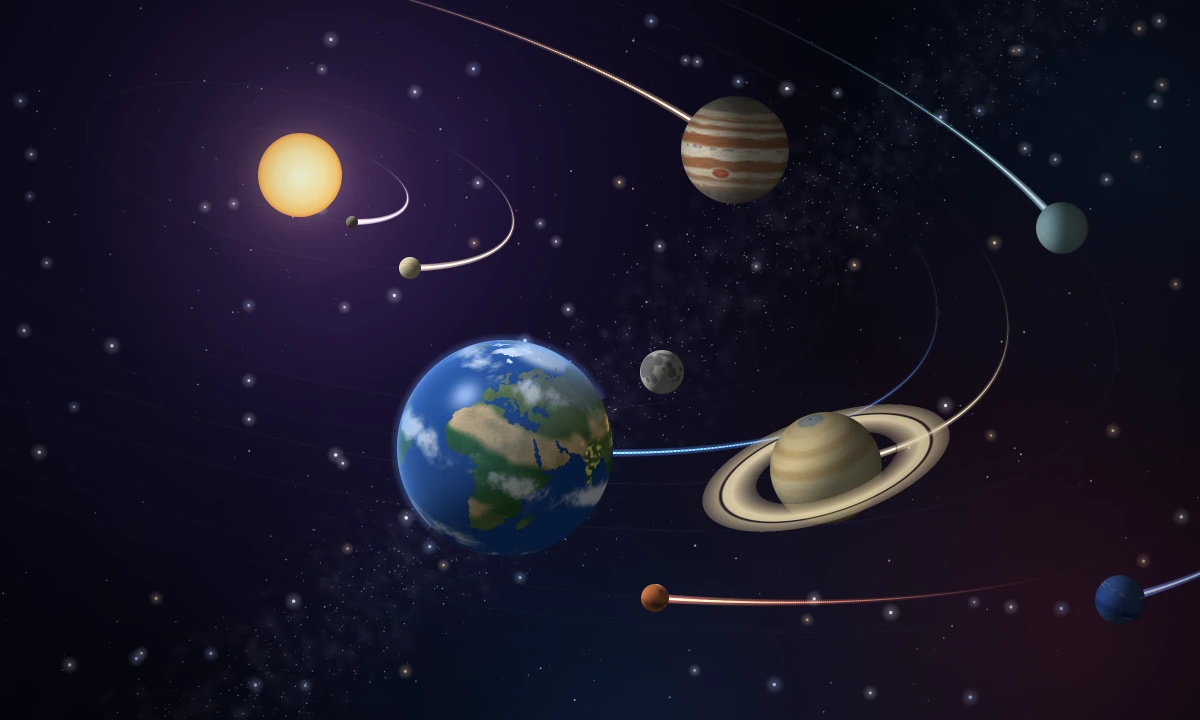
Solar System
Fly through the solar system in 3D in your browser. The sun, eight planets, their largest moons, the dwarf planets, and the Kuiper belt move on their real, tilted orbits under Newton's gravity.
N-Body System
Watch Newton's gravity move stars, planets, and moons in 3D in your browser. Turn the view, and see stable orbits, resonances, slingshots, Trojans, and a chaotic cluster.
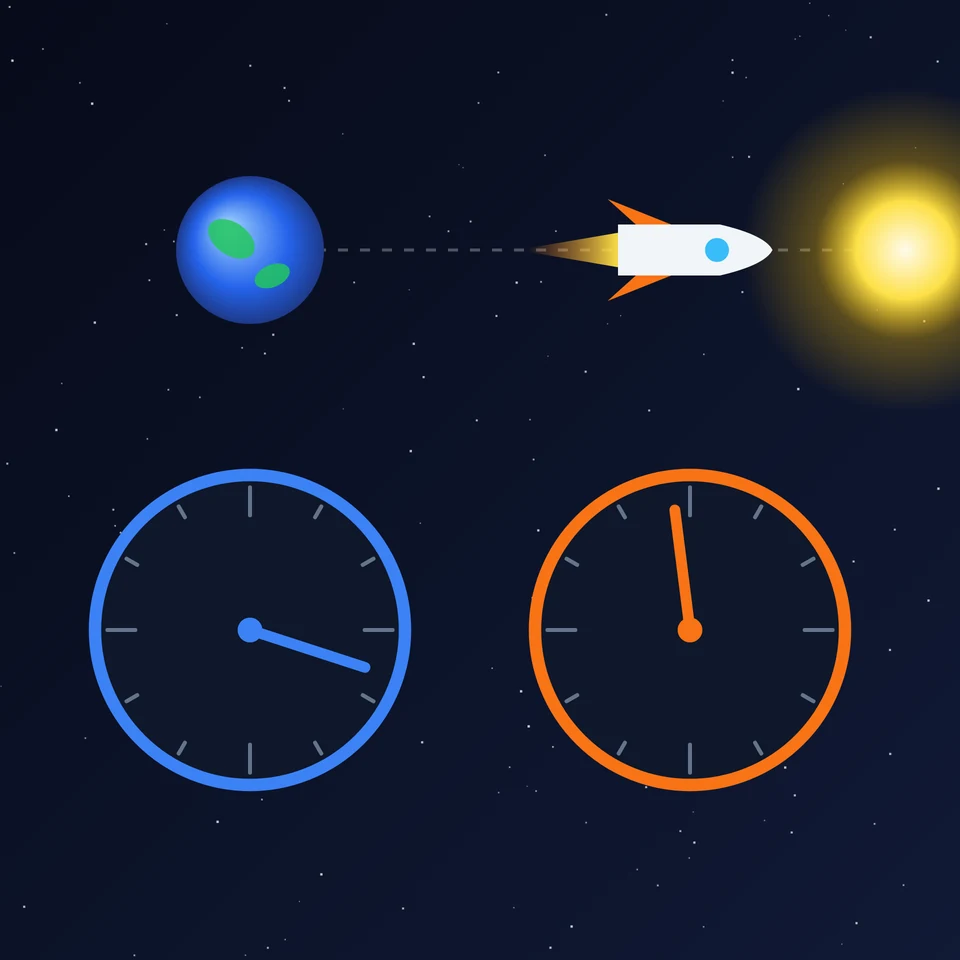
Time dilation and the twin paradox
Send a twin to Alpha Centauri at 0.8c and watch the traveller come home younger. An interactive twin paradox with the Lorentz factor, a Minkowski spacetime diagram, light signals and lines of simultaneity, a light clock, muons that reach the ground and GPS satellite clocks.
Ready to try it?
Open PictorX in your browser — no install, no credit card required to start.
Go to Editor