
Seasons and Earth's tilt
The seasons do not come from the Earth's distance to the Sun: the Earth is closest in early January, in the middle of the northern winter. They come from its tilt. The Earth's axis leans 23.44° and keeps pointing the same way as the Earth goes round the Sun, so for half the year the northern hemisphere leans towards the Sun, with long days and a high Sun, and for the other half the southern one does. Here you can watch it happen for any place on Earth, see the day length and the sunlight change through the year and try a planet with no tilt, or one lying on its side like Uranus. Pick a place, or drag the yellow marker on the globe to any latitude, and press Play to run the year. The big picture shows the Earth going round the Sun, seen from above at an angle: its axis (pink) is tilted and keeps pointing the same way all year, so the North Pole leans towards the Sun in June and away from it in December. The orbit is coloured by the seasons of your hemisphere. The globe shows the Earth with sunlight from the left: the circle of your latitude is yellow by day and blue by night, so you can see how long the day is. The panel beside it shows the noon Sun: the same beam of sunlight lands on more ground when the Sun is low, which is why winter is cold. The chart below gives the day length over the year (or the noon Sun's height, or the sunlight per m²). Step and Back move by a day or a week, Reset goes back to your date, and you can drag the Earth along its orbit or tap a day in the chart. Notice that the Earth is closest to the Sun in early January, in the northern winter: distance is not the reason for the seasons. Try a planet without tilt, or tilted like Uranus, with the Axial tilt slider.
How it works
- Pick a place, such as Amsterdam, Sydney or Tromsø, or drag the marker on the globe to your own latitude, and press Play to run the year.
- Watch the orbit: the Earth's axis keeps pointing the same way, so the North Pole leans towards the Sun in June and away from it in December, and the colours of the orbit show your seasons.
- Read the globe, the noon Sun and the tiles: how much of your circle of latitude is in daylight, how high the Sun gets, how far its beam spreads over the ground and how much sunlight a square metre gets.
- Switch the chart between day length, the Sun's height and sunlight, and move the Axial tilt slider to 0° or 90°, or choose Tilted like Uranus, to see the seasons disappear or become extreme; record a video of the year.
Tilt, not distance
The Earth's orbit is almost a circle: its distance from the Sun varies only from 147.1 million km at perihelion in early January to 152.1 million km at aphelion in early July, about 3 %, which changes the sunlight by about 7 %. If distance made the seasons, both hemispheres would have summer in January. Instead the northern hemisphere has winter then and the southern hemisphere summer. The cause is the tilt of the Earth's axis, 23.44° from the perpendicular to its orbit. The axis keeps pointing to the same place among the stars, near the Pole Star, all year, so in June the northern half leans towards the Sun and in December the southern half does.
Solstices and equinoxes
At the June solstice, around 21 June, the Sun stands overhead at noon on the Tropic of Cancer, 23.44° north, and the northern hemisphere has its longest day; at the December solstice, around 21 December, the Sun is overhead on the Tropic of Capricorn and the south has its longest day. At the equinoxes, around 20 March and 22 or 23 September, the Sun is overhead at the equator and day and night are almost equally long everywhere. The latitude where the Sun is overhead is the Sun's declination, δ = asin(sin 23.44° × sin λ), where λ is the Sun's longitude along its yearly path. The dates shift by a few hours from year to year because a year lasts about 365.24 days.
Day length and the noon Sun
Your circle of latitude turns through daylight and darkness once a day; when the axis leans towards the Sun, more of it is on the day side, so the day is longer. The sunrise equation gives the half-day H₀ from cos H₀ = (sin h₀ − sin φ sin δ) / (cos φ cos δ), with h₀ = −0.833° because the air bends sunlight over the horizon and the Sun has a radius: in Amsterdam the day lasts 16 h 48 min at the June solstice and 7 h 40 min in December. At noon the Sun stands 90° − |φ − δ| high: 61° in Amsterdam in June, only 14° in December.
Why a low Sun warms less
A beam of sunlight one square metre across falls on more than a square metre of ground when the Sun is low: on 1 / sin h square metres, where h is the Sun's height. At 61° the beam spreads over 1.14 m², at 14° over 4.1 m², so each square metre gets a quarter of the light. With the short days on top, a square metre in Amsterdam receives about seven times less sunlight in December than in June. Low sunlight also passes through more air, which scatters and absorbs more of it.
Polar day, polar night and other planets
North of the Arctic Circle, at 66.56°, the Sun does not set for at least a day around the June solstice and does not rise around the December solstice: in Tromsø the midnight Sun lasts from about 18 May to 25 July and the polar night from 28 November to 14 January. At the poles there is half a year of day and half a year of night. With no tilt every place would have the same day length all year and no seasons; Uranus, tilted 98°, points each pole almost straight at the Sun in turn, giving decades of continuous day and night.
Frequently asked questions
Why do we have seasons?
Because the Earth's axis is tilted 23.44° and keeps pointing the same way in space as the Earth orbits the Sun. For half the year the northern hemisphere leans towards the Sun: the Sun rises higher, the days are longer and each square metre gets more sunlight, so it is summer there and winter in the south. Half a year later it is the other way round.
Is the Earth closer to the Sun in summer?
No. The Earth is closest to the Sun, about 147.1 million km away, around 3 January, and farthest, about 152.1 million km, in early July. So the northern hemisphere has its summer when the Earth is farthest away. The difference of about 3 % in distance changes the sunlight by about 7 %, much less than the effect of the tilt. The app marks perihelion and aphelion on the orbit.
When are the solstices and equinoxes?
Around 20 March and 22 or 23 September (the equinoxes) and 20 or 21 June and 21 or 22 December (the solstices), at a moment that is the same everywhere on Earth. The app works them out for this year from the Sun's position, to within a few minutes of the published times, and shows them on the orbit and the chart.
Why is the day at the equator a little longer than 12 hours?
Because sunrise and sunset are counted when the top of the Sun's disc touches the horizon, and the air bends sunlight around the horizon by about half a degree. Together the Sun's centre is 0.833° below the horizon at sunrise and sunset, which adds about 7 minutes: at the equinox even the equator has about 12 h 7 min of daylight. The app uses this standard correction.
What would happen if the Earth had no tilt?
There would be almost no seasons: every place would have about 12 hours of daylight all year, the Sun would reach the same height at noon every day, and only the small change in distance would make the sunlight vary by a few per cent. Choose No tilt in the app and compare it with the dashed curve of the real Earth. With a tilt of 90° or more, like Uranus, each pole would face the Sun for months on end.
Can I use the picture?
Yes. Save gives a PNG at the size you choose, and the pencil opens the picture in the PictorX photo editor with the background, the orbit, the Sun, the Earth, the globe, the night side, the latitude, the noon Sun, the chart and the labels on layers of their own, and the date with the season as editable text. In the editor itself it is under Apps ▸ Science ▸ Space & Earth ▸ Seasons & Earth's Tilt. Everything runs in your browser.
Seasons & Earth's Tilt: how do I record a video?
Press the red Record button in the playback bar: it films what the stage shows. Press it again to stop, and the video is saved to your device. Recording is free; you only need to sign in. Without a subscription the video carries a small PictorX logo in a corner. The button beside Record opens the video options: the shape (as shown, square, story 9:16 or wide 16:9), the length (until you stop, or 5, 10, 15 or 30 seconds for social media) and the file: MP4, WebM or an animated GIF. You can add one of three music tracks: calm, bright or beat.
Related tools
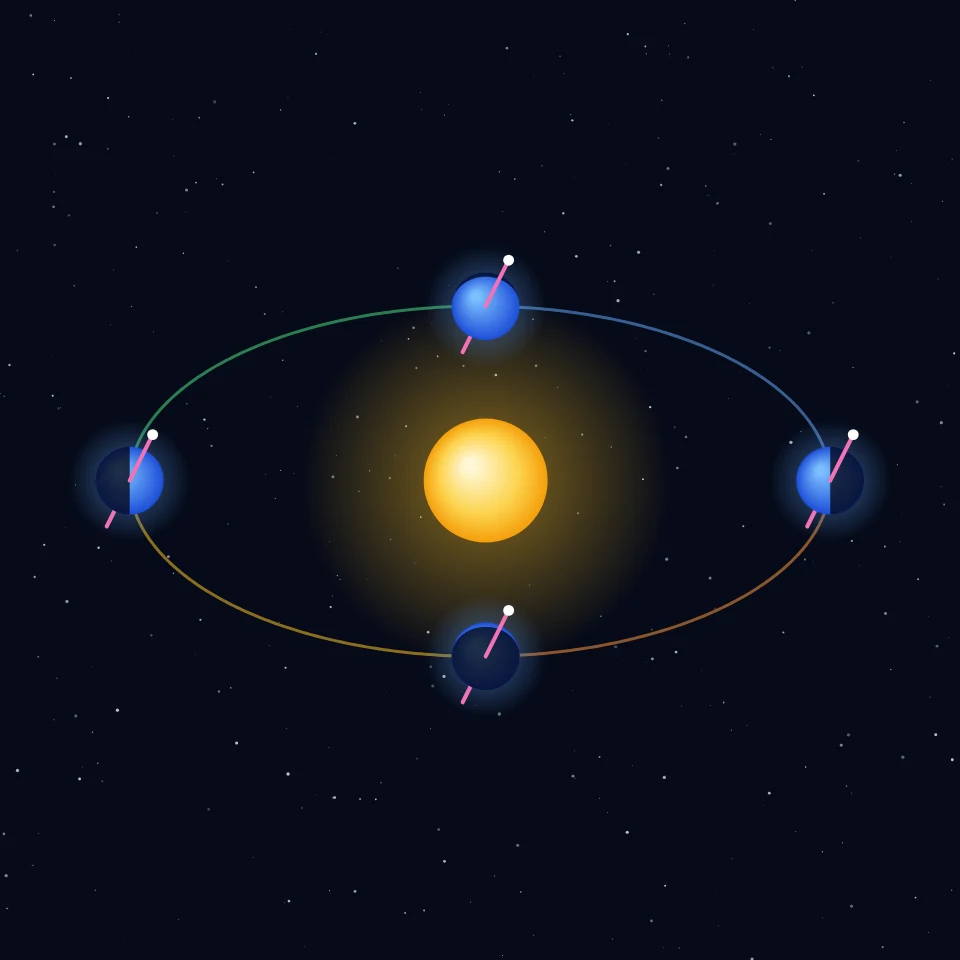
Why the Earth has seasons
Why the Earth has seasons and why distance is not the cause, the tilted axis and the Sun's declination, solstices and equinoxes, day length and the sunrise equation, the angle of sunlight, polar day and night, the seasonal lag, other planets and the ice ages.
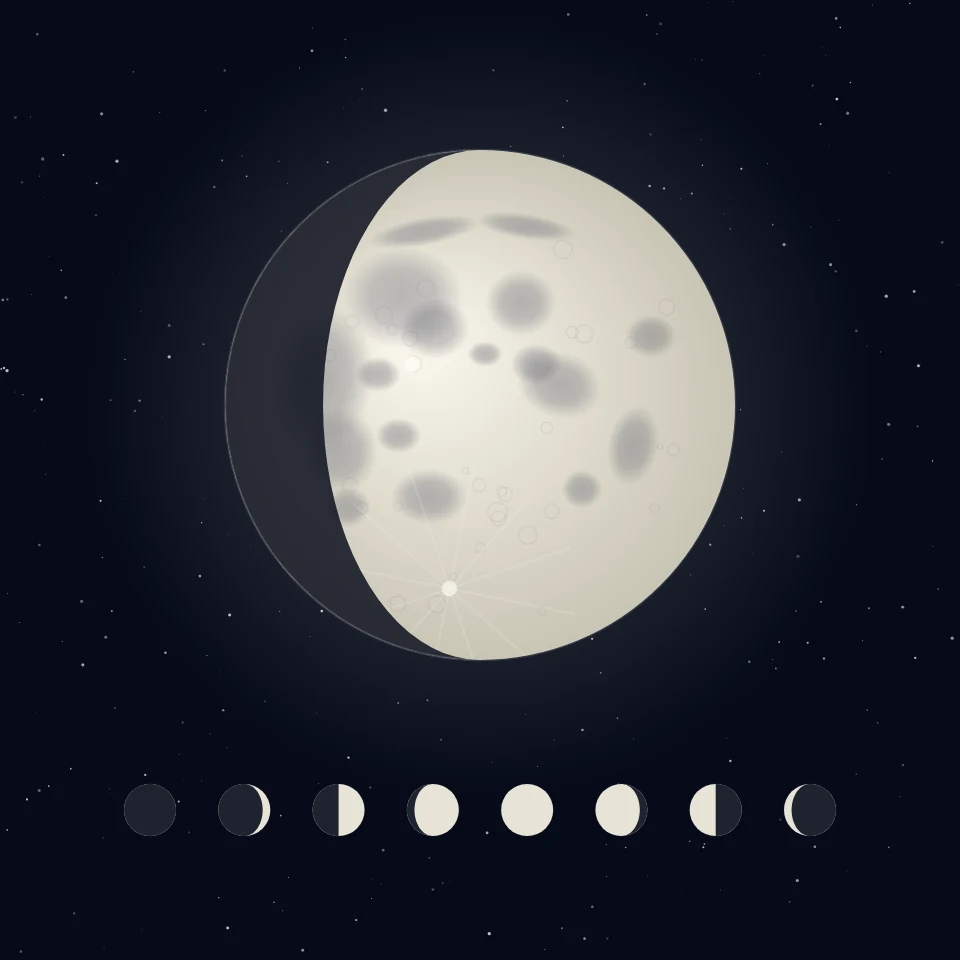
Moon phases for any date
See tonight's Moon or the Moon on any date: the phase and its name, how much is lit, the Moon's age, moonrise and the next full and new moon. An interactive Sun–Earth–Moon model shows why the Moon has phases, the synodic and sidereal month and when eclipses happen.
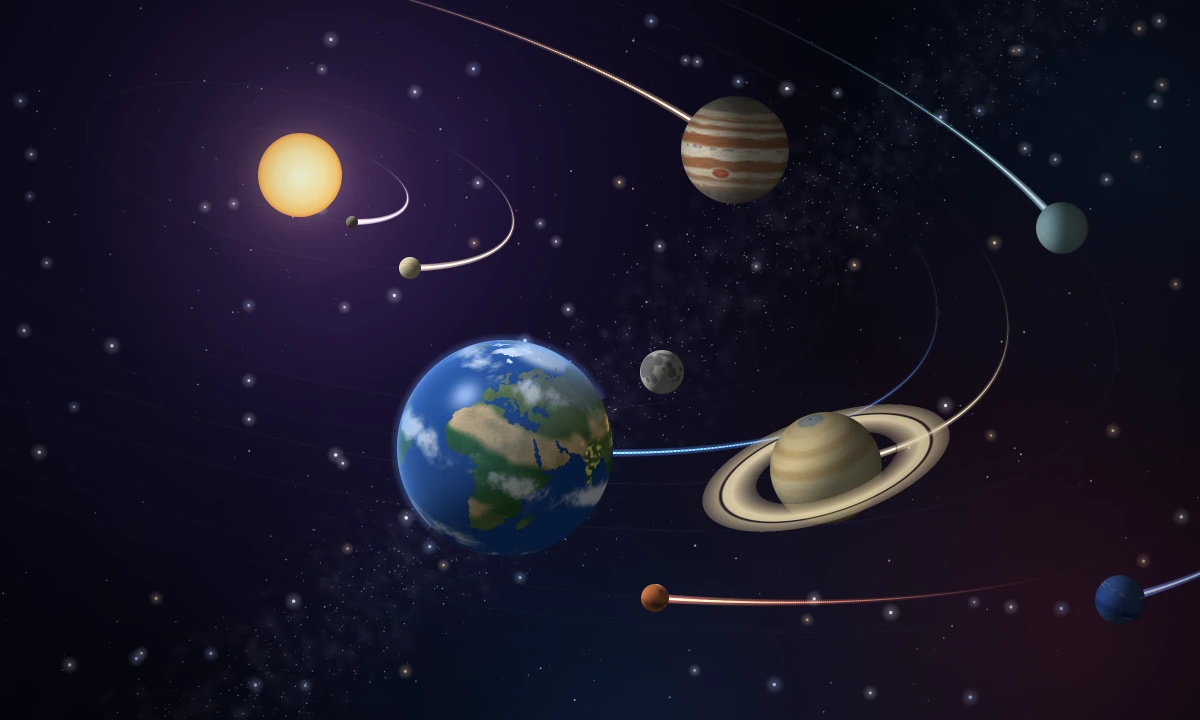
Solar System
Fly through the solar system in 3D in your browser. The sun, eight planets, their largest moons, the dwarf planets, and the Kuiper belt move on their real, tilted orbits under Newton's gravity.
N-Body System
Watch Newton's gravity move stars, planets, and moons in 3D in your browser. Turn the view, and see stable orbits, resonances, slingshots, Trojans, and a chaotic cluster.
Ready to try it?
Open PictorX in your browser — no install, no credit card required to start.
Go to Editor