
The phases of the Moon explained
Every month the Moon grows from a thin crescent to a full disc and shrinks back again. People have kept time by it for thousands of years, and many calendars still follow it. Yet the Moon itself does not change: half of it is always lit by the Sun. This page explains what we see instead, why the cycle lasts 29.5 days and not 27.3, when the Moon rises, why it looks different from the southern hemisphere, what earthshine is, why eclipses are rare and how the phase of the Moon is worked out for any date.
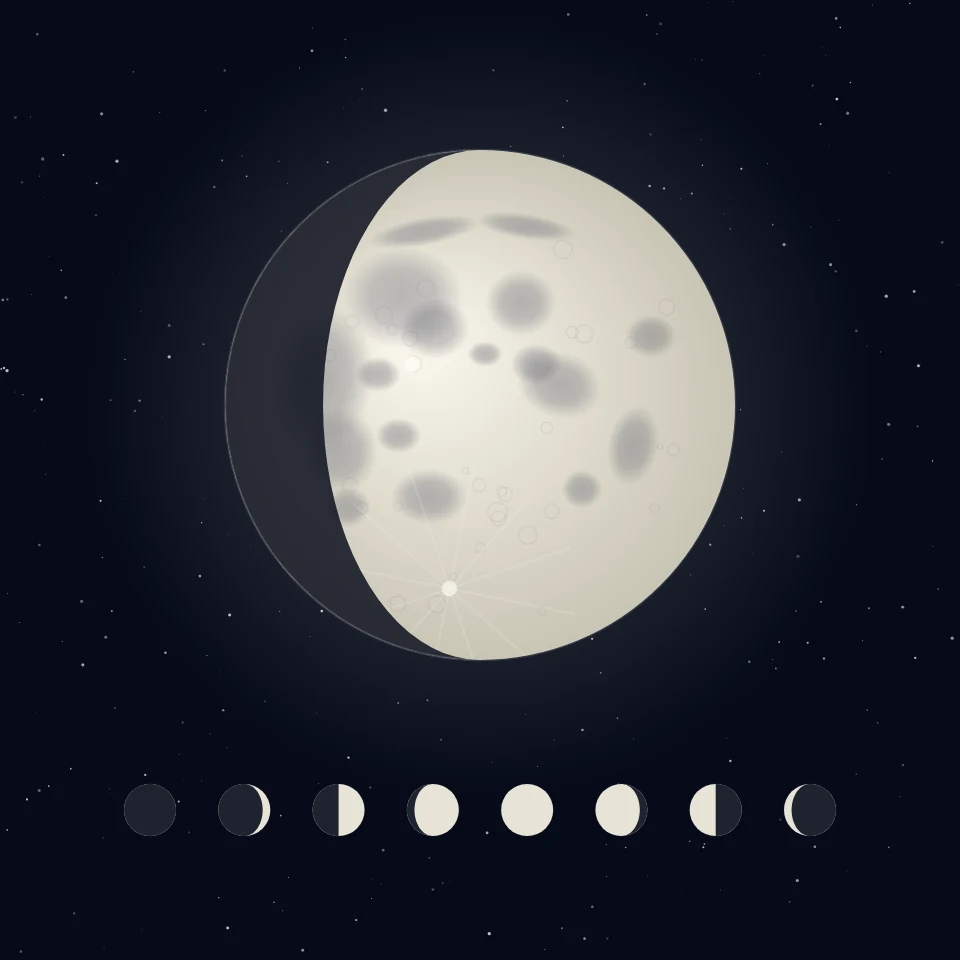
Half of the Moon is always lit
The Moon shines only by reflected sunlight, and at any moment the Sun lights exactly one half of it, the half that faces the Sun. The Moon takes about a month to go round the Earth, and as it does, we look at that lit half from a changing angle. Lined up between the Earth and the Sun, the Moon turns its dark half towards us: new moon. A quarter of the way round we see half of the lit half from the side, and on the far side of the Earth we face the whole lit half: full moon. A common mistake is to think that the Earth's shadow causes the phases; it reaches the Moon only during a lunar eclipse, and only at full moon.
Eight phases and the shape of the terminator
Astronomers define the four principal phases by the difference in ecliptic longitude between the Moon and the Sun: new moon at 0°, first quarter at 90°, full moon at 180°, last quarter at 270°. Each is a moment, not a day; between them come the waxing crescent, the waxing gibbous, the waning gibbous and the waning crescent. The line between the lit and dark parts, the terminator, is a great circle on a sphere seen at an angle, so it always looks like half an ellipse. Its width is the Moon's radius times cos E, where E is the elongation, so the lit part of the disc covers (1 − cos E)/2 of it.
How much of the Moon is lit
Strictly, the lit fraction is k = (1 + cos i)/2, where i is the phase angle at the Moon between the directions to the Sun and to the Earth. Because the Sun is about 390 times farther away than the Moon, i is almost exactly 180° minus the elongation, which gives (1 − cos E)/2. The quarters are 50 % lit, but the Moon looks less than half as bright as it does when full: a full moon is about ten times brighter than a quarter moon, because the shadows of craters and hills vanish when the Sun shines straight down on them (the opposition effect).
Synodic and sidereal month
The Moon circles the Earth relative to the stars in 27.32 days, the sidereal month. While it does, the Earth carries it about 27° further along its orbit round the Sun, so the Sun appears to move on, and the Moon needs about 2.2 more days to catch up with it. The cycle of phases, the synodic month or lunation, therefore lasts 29.53 days on average: 1/29.53 = 1/27.32 − 1/365.26. Real lunations vary from about 29.27 to 29.83 days, because the Moon moves fastest near perigee and the Earth fastest in January. Calendars based on the Moon, such as the Islamic and Hebrew calendars, have months of 29 or 30 days.
When the Moon rises and sets
The Earth turns once a day, but the Moon moves about 12° a day eastwards relative to the Sun, so it rises on average about 50 minutes later each day. A new moon rises and sets with the Sun and is lost in its glare; a waxing crescent appears in the west after sunset; a first quarter rises around noon and is highest at sunset; a full moon rises at sunset and is up all night; a last quarter rises around midnight and is seen in the morning sky. Real times also depend on your latitude, the season and the Moon's height above or below the celestial equator.
The Moon seen from the southern hemisphere
Observers in the northern hemisphere see the Moon in the southern part of the sky, and observers in the southern hemisphere see it in the north, facing the other way. The Moon therefore appears rotated by 180°: in Australia, Argentina or South Africa a waxing Moon is lit on the left and the familiar face of the Moon is upside down. Near the equator the Moon passes almost overhead and a crescent lies on its back like a smile or a boat. The phase, the lit fraction and the moments of the principal phases are the same everywhere on Earth.
Earthshine
A few days before or after new moon you can often see the dark part of the Moon glowing faintly, as if the crescent held the rest of the disc in its arms. Leonardo da Vinci explained it around 1510: it is sunlight reflected from the Earth onto the Moon and back. Seen from the Moon, the Earth shows the opposite phase, so a thin crescent Moon sees an almost full Earth, nearly four times wider than the Moon looks from here and much brighter. Earthshine is brightest when the Earth has a lot of cloud, and its brightness is used to measure how much sunlight the Earth reflects.
Eclipses and the line of nodes
The Moon's orbit is tilted 5.1° to the plane of the Earth's orbit. The two orbits cross along the line of nodes; at most new moons the Moon passes up to 5° above or below the Sun, and at most full moons above or below the Earth's shadow. Only when the Sun is near the line of nodes, in an eclipse season that comes about every 173 days, can a new moon cover the Sun (a solar eclipse: total if the Moon looks larger than the Sun, annular if smaller) or a full moon enter the shadow (a lunar eclipse, when the Moon often turns copper red, lit only by sunlight bent through the Earth's atmosphere). Eclipses repeat after a saros of 18 years 11 days.
Working out the phase for any date
The simplest method counts mean synodic months of 29.530589 days from a known new moon, such as 6 January 2000 at 18:14 UTC; it can be off by more than half a day, because the Moon's speed varies. The simulator instead computes where the Sun and the Moon really are, with the series from Jean Meeus' Astronomical Algorithms: the Moon's longitude, latitude and distance from the main periodic terms of its motion, the Sun's from the Earth's elliptical orbit. The phase moments are then found by solving for the elongation 0°, 90°, 180° and 270°, and they agree with published tables to within a few minutes; the same positions tell whether a new or full moon is an eclipse.
Frequently asked questions
Is the Moon's phase the same everywhere on Earth?
Yes. The phase depends on where the Moon is relative to the Sun and the Earth, so everyone sees the same lit fraction at the same moment. What differs is the orientation, upside down in the other hemisphere, the local time of the principal phase and whether the Moon is above your horizon at all.
What is a blue moon?
Usually the second full moon in a calendar month, which happens about every two and a half to three years because a lunation is shorter than most months. An older definition is the third full moon of a season that has four. The Moon does not look blue; it only does so rarely, after large volcanic eruptions or forest fires put particles of the right size into the air.
Can you see the Moon in the daytime?
Yes, on most days. Except near new moon, when it is too close to the Sun, the Moon is above the horizon during part of the day: in the afternoon in the first half of the month and in the morning in the second half. It is bright enough to see easily in a blue sky, especially around the quarters.
What is a supermoon?
A full moon close to perigee, the point of the Moon's elliptical orbit nearest the Earth, about 357,000 km away against 406,000 km at apogee. It looks up to 14 % wider and about 30 % brighter than a full moon at apogee. The app shows the Moon's distance in Save as JSON, and its size changes the type of a solar eclipse: total near perigee, annular near apogee.
Related tools
Moon phases for any date
See tonight's Moon or the Moon on any date: the phase and its name, how much is lit, the Moon's age, moonrise and the next full and new moon. An interactive Sun–Earth–Moon model shows why the Moon has phases, the synodic and sidereal month and when eclipses happen.
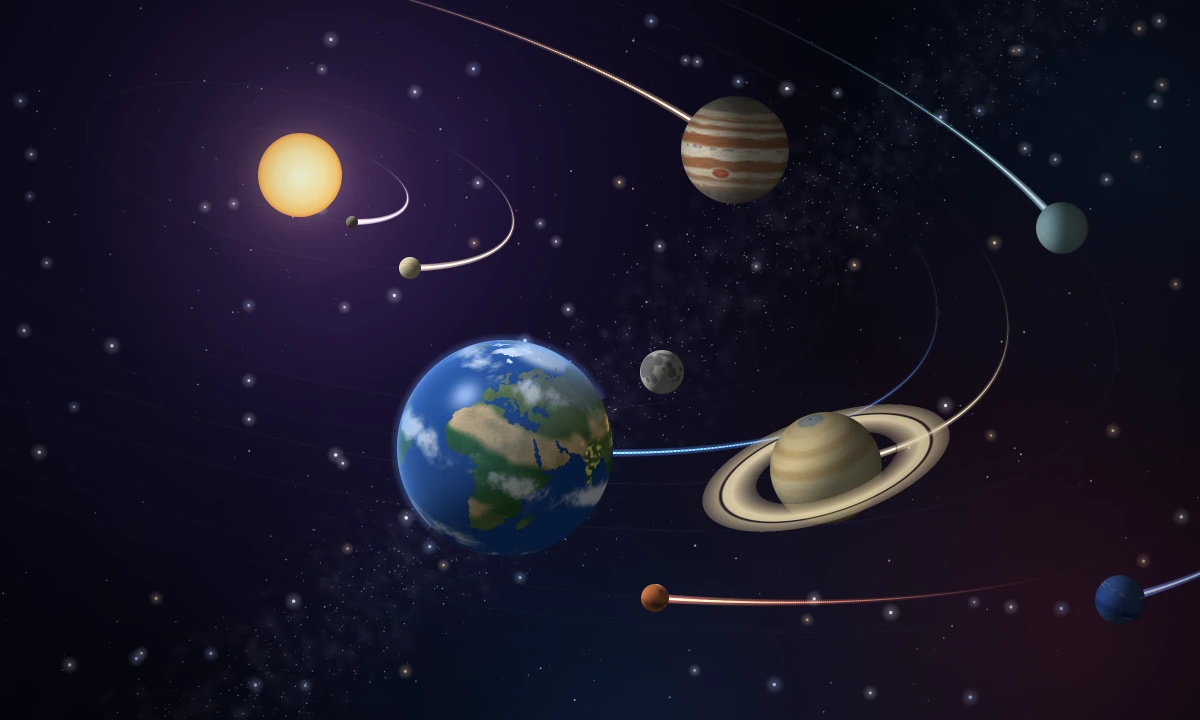
Solar System
Fly through the solar system in 3D in your browser. The sun, eight planets, their largest moons, the dwarf planets, and the Kuiper belt move on their real, tilted orbits under Newton's gravity.
Gravity shapes the solar system
How does gravity shape the solar system? Eight planets and their moons on tilted orbits, the dwarf planets and Kuiper belt, and Jupiter's Galilean moons.
N-Body System
Watch Newton's gravity move stars, planets, and moons in 3D in your browser. Turn the view, and see stable orbits, resonances, slingshots, Trojans, and a chaotic cluster.
Ready to try it?
Open PictorX in your browser — no install, no credit card required to start.
Open the moon phases simulator