
Why the Earth has seasons
Every year the days grow long and short again, the noon Sun climbs and sinks, and summer and winter take turns between the hemispheres. Many people think the Earth is simply closer to the Sun in summer, but the Earth is closest in January. This page explains what really happens: the tilt of the Earth's axis, the Sun's yearly path between the tropics, how long the day is at any latitude, why a low Sun warms so little, the midnight Sun and the polar night, why the warmest weeks come after the longest day, and how seasons would look on a planet with another tilt.
The tilted axis
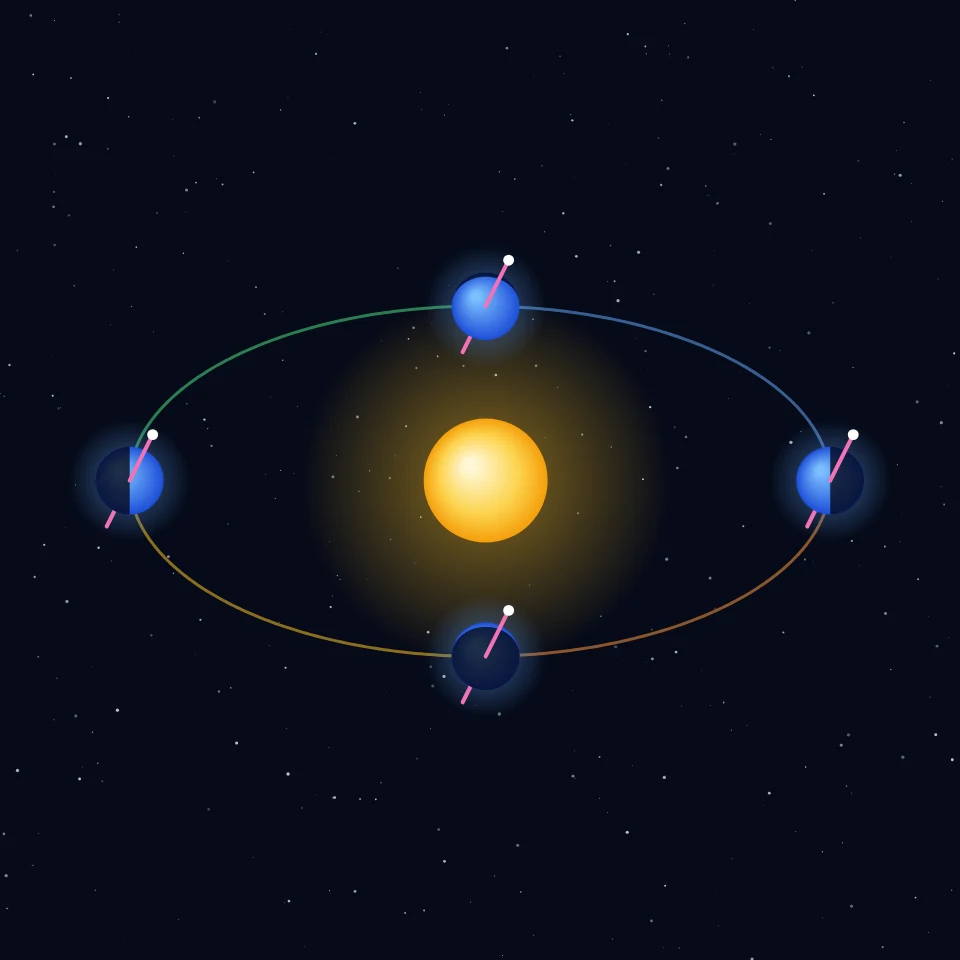
The Earth spins about an axis that is tilted 23.44° from the perpendicular to the plane of its orbit, the ecliptic. Like a spinning top or a gyroscope, the axis keeps pointing in the same direction in space, towards Polaris, the Pole Star, while the Earth goes round the Sun. So on one side of the orbit the North Pole leans towards the Sun and on the other side away from it. Between the two, at the equinoxes, the axis leans sideways, along the orbit, and neither pole is favoured.
Distance is not the cause
The Earth's orbit is an ellipse with an eccentricity of only 0.0167. At perihelion, around 3 January, the Earth is 147.1 million km from the Sun; at aphelion, in early July, 152.1 million km. The sunlight is about 7 % stronger in January, but that is the middle of the northern winter, and the southern hemisphere, which has summer then, is not much warmer for it because it is mostly ocean. The distance does have one visible effect: by Kepler's second law the Earth moves fastest near perihelion, so the northern winter is the shortest season, about 89 days, and the northern summer the longest, about 94 days.
The Sun's yearly path
Seen from the Earth, the Sun moves once a year round the sky along the ecliptic. Because of the tilt, the ecliptic is inclined 23.44° to the celestial equator, so the Sun's declination, the latitude where it stands overhead at noon, swings between 23.44° north and 23.44° south: δ = asin(sin ε sin λ), with the tilt ε and the Sun's ecliptic longitude λ. The Sun is overhead at the Tropic of Cancer at the June solstice, at the equator at the equinoxes and at the Tropic of Capricorn at the December solstice. The point where it is overhead, the subsolar point, wanders between the tropics and never leaves them.
Day length at any latitude
A place at latitude φ turns once a day round the axis, through daylight and darkness. The share of its circle of latitude on the day side depends on δ: the half-day H₀ follows from cos H₀ = −tan φ tan δ for the centre of the Sun on the horizon. Sunrise and sunset are defined by the Sun's upper edge, and the atmosphere bends its light about 34′ over the horizon, so the standard sunrise equation uses the Sun's centre 0.833° below it: cos H₀ = (sin(−0.833°) − sin φ sin δ) / (cos φ cos δ), and the day lasts 2H₀/15° hours. At the equator the day is about 12 h 7 min all year; at 52° north it ranges from 7 h 40 min to 16 h 48 min.
The angle of sunlight
The higher the Sun, the more energy each square metre of ground receives. A beam one square metre in cross-section spreads over 1 / sin h square metres of level ground, where h is the Sun's height, a rule known as Lambert's cosine law. At noon the Sun stands 90° − |φ − δ| high. Averaged over a whole day, the sunlight at the top of the atmosphere is Q = (S₀ / π)(d̄/d)² (H sin φ sin δ + cos φ cos δ sin H), with the solar constant S₀ = 1361 W/m² and the half-day H. At the June solstice the North Pole receives about 524 W/m², more than the equator at any time of year, because the Sun shines for 24 hours, even though it never stands higher than 23.44°.
Polar day and polar night
Poleward of the Arctic and Antarctic Circles, at 66.56°, there is at least one day a year when the Sun does not set and one when it does not rise. The farther towards the pole, the longer these periods last: in Tromsø, at 69.6° north, the midnight Sun shines from about 18 May to 25 July and the Sun stays below the horizon from about 28 November to 14 January. At the poles the Sun rises once and sets once a year. The circles move with the tilt: they lie at 90° minus the tilt, and the tropics at the tilt itself.
The seasonal lag
The longest day is around 21 June, but in most of Europe and North America the warmest weeks come in July and August, and the coldest weeks a month or more after the December solstice. Land, and above all the oceans, store heat: as long as a place receives more energy from the Sun than it radiates away, it keeps warming. Meteorologists therefore count the seasons in whole months, with summer from June to August in the north, while astronomical seasons start at the solstices and equinoxes.
Other tilts and the ice ages
Mars is tilted 25.2°, close to the Earth, but its orbit is far more elliptical, so its southern summers are short and hot and its northern ones long and mild. Jupiter's tilt is only 3°, so it hardly has seasons, while Uranus lies on its side at 97.8°, with each pole facing the Sun for about 21 years of its 84-year orbit. The Earth's own tilt changes slowly between 22.1° and 24.5° over about 41,000 years, and the date of perihelion moves through the year over about 21,000 years. These Milankovitch cycles change how strong the seasons are and pace the ice ages.
How the simulator works
The simulator computes the Sun's position for every day of the current year with the formulas of Jean Meeus' Astronomical Algorithms: the Sun's mean longitude and mean anomaly, and the true anomaly from Kepler's equation for the orbit's eccentricity. The equinoxes and solstices are the moments when the Sun's longitude is 0°, 90°, 180° and 270°, found by Newton's method; they agree with the published times to within a few minutes. From the Sun's longitude and the chosen tilt follows its declination, and from the declination and the latitude the day length, the noon height and the daily sunlight. Change the tilt or the eccentricity to see seasons on another world.
Frequently asked questions
What is the difference between astronomical and meteorological seasons?
Astronomical seasons begin at the solstices and equinoxes, so northern summer starts around 21 June. Meteorological seasons use whole months that match the temperature cycle better: in the northern hemisphere spring is March to May, summer June to August, autumn September to November and winter December to February, and the other way round in the south.
Why are the hottest days weeks after the longest day?
Because the Earth's surface, and especially the oceans, take time to warm up and cool down. After the solstice the days are still long and the Sun still high, so each day brings more heat than the night takes away, until the balance tips in late July or August. The same lag makes January and February the coldest months in the north.
Does the Earth's tilt change?
Yes, slowly. The tilt varies between about 22.1° and 24.5° over a cycle of about 41,000 years; at present it is 23.44° and shrinking by about 0.47″ a year. The axis also wobbles round once in about 26,000 years (precession), so in some 13,000 years the northern summer will fall near perihelion. The Moon keeps these changes small.
Why is the northern summer longer than the winter?
Because the Earth moves faster along its orbit when it is closer to the Sun (Kepler's second law), and it is closest in January. The stretch from the September equinox through the December solstice to the March equinox is therefore covered quickly: astronomical northern winter lasts about 89 days, summer about 94.
Related tools
Seasons and Earth's tilt
Why does the Earth have seasons? Watch the Earth go round the Sun with its 23.44° tilt, see the day length, the noon Sun's height and the sunlight at any latitude through the year, the solstices and equinoxes, polar day and night, and what would happen with no tilt or a tilt like Uranus.
Moon phases for any date
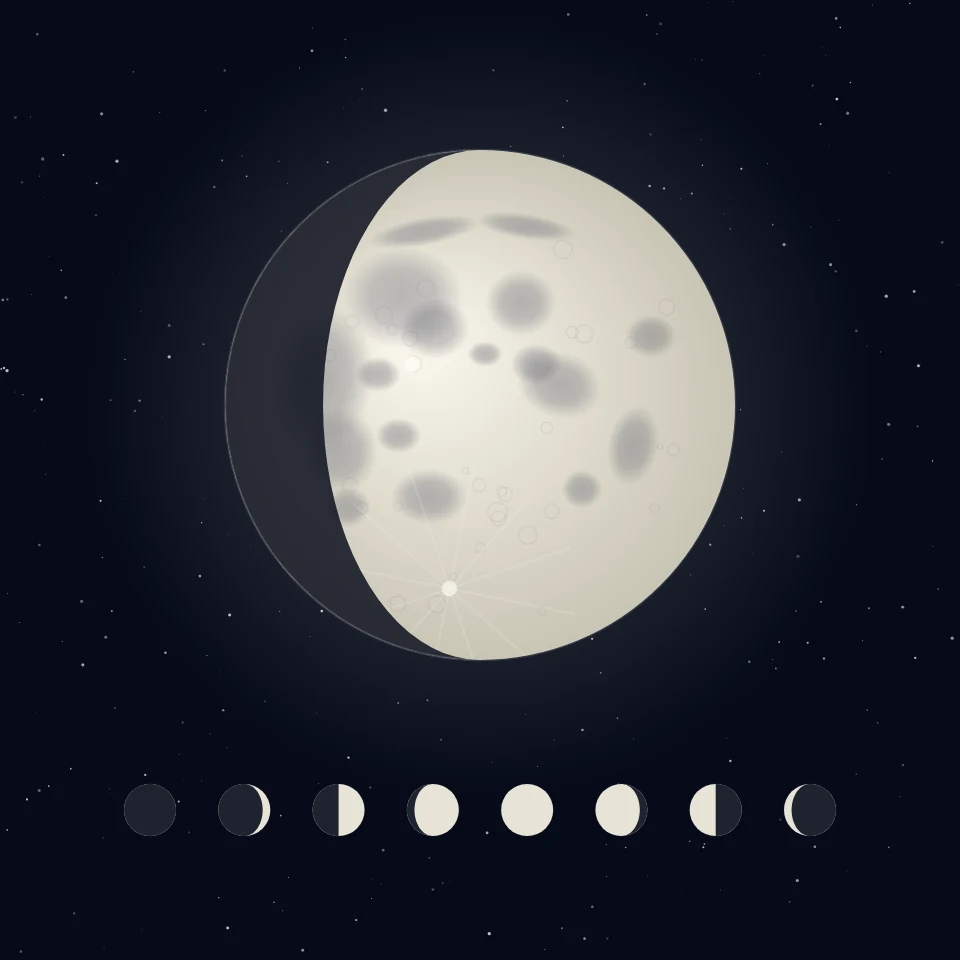
See tonight's Moon or the Moon on any date: the phase and its name, how much is lit, the Moon's age, moonrise and the next full and new moon. An interactive Sun–Earth–Moon model shows why the Moon has phases, the synodic and sidereal month and when eclipses happen.
The phases of the Moon explained
Why the Moon has phases, the eight phases and the shape of the terminator, how much of the Moon is lit, the synodic and sidereal month, when the Moon rises and sets, why it is upside down in the southern hemisphere, earthshine, eclipses and how the phase is computed for any date.
Solar System
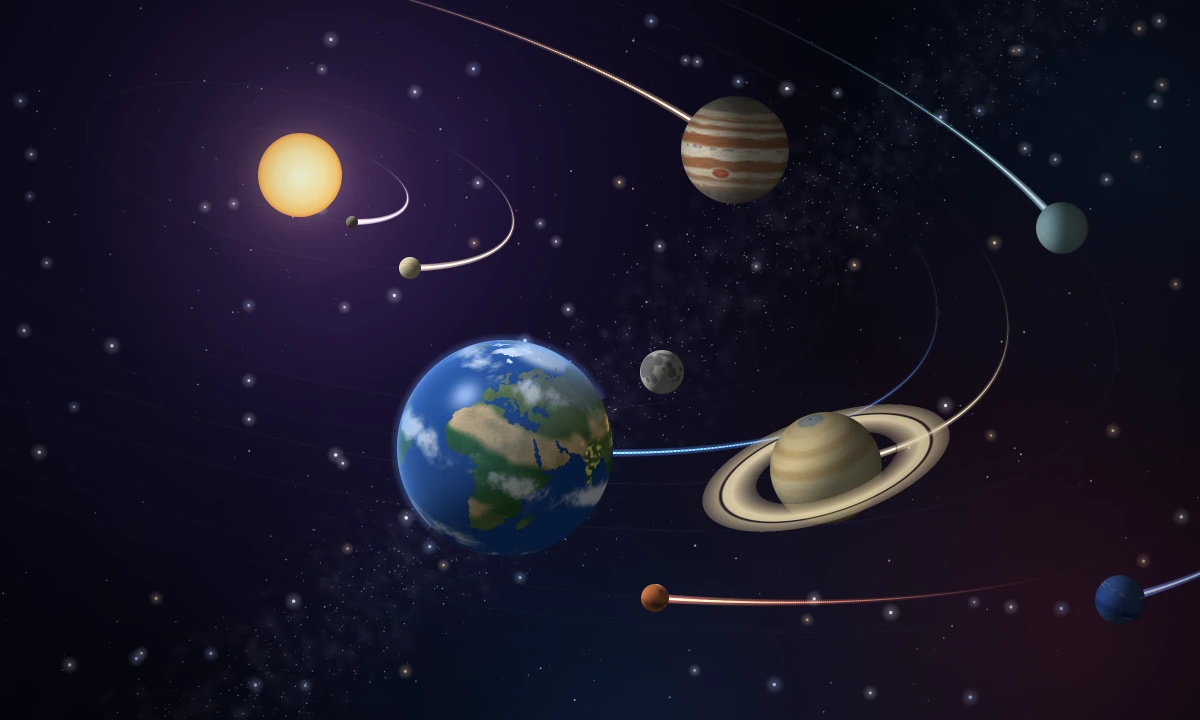
Fly through the solar system in 3D in your browser. The sun, eight planets, their largest moons, the dwarf planets, and the Kuiper belt move on their real, tilted orbits under Newton's gravity.
Ready to try it?
Open PictorX in your browser — no install, no credit card required to start.
Open the seasons simulator