
Prisms and rainbows explained
A glass prism on a sunny windowsill throws a strip of colours on the wall, and after a shower a rainbow arches across the sky. Both come from the same fact: glass and water bend each colour of light by a slightly different amount. This page explains refraction and dispersion, how a prism bends light and when it bends it least, what Newton learned from his prisms, why lens makers combine two kinds of glass, how a spectroscope reads the light of lamps and stars, how raindrops make the primary and secondary rainbows, and why rainbows are circles that only you can see.
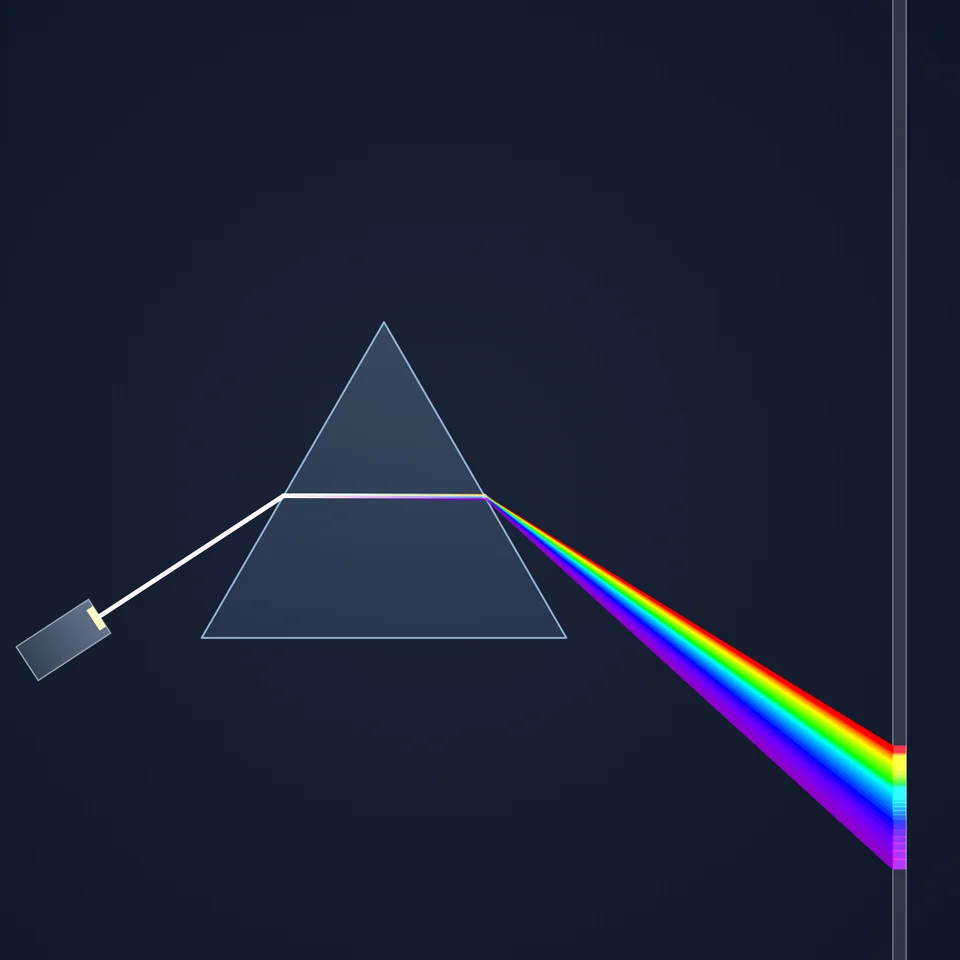
White light and its colours
Sunlight looks white, but it is a mixture of light of every wavelength we can see, from about 400 nanometres (violet) to 700 nanometres (red), with blue, green, yellow and orange in between. Our eyes have three kinds of colour receptors, and when all of them are stimulated in about the proportions sunlight gives, we see white. Anything that sends the wavelengths in different directions, such as a prism, a raindrop or the grooves of a CD, separates white light into a spectrum.
Refraction and dispersion
Light travels more slowly in glass or water than in air, and the refractive index n is the ratio of the speeds: about 1.33 for water, 1.52 for crown glass and 2.42 for diamond. Where light crosses a surface at a slant it changes direction according to Snell's law, n₁ sin θ₁ = n₂ sin θ₂. The index is a little larger for short wavelengths than for long ones: water's is 1.331 for red and 1.344 for violet. This variation is dispersion. Opticians describe it with the Sellmeier equation, a formula fitted to measurements of each material, or with the Abbe number V = (n_d − 1) / (n_F − n_C): about 64 for crown glass, 36 for flint glass and 26 for dense flint, the smaller the number the stronger the dispersion.
How a prism bends light
A prism has two flat faces that meet at the apex angle A. A ray is bent towards the base at the first face and again at the second, and the total angle between the ray that comes in and the ray that goes out is the deviation, δ = θ₁ + θ₂ − A. Turning the prism changes δ, and there is one angle of incidence where it is smallest: the minimum deviation, when the ray inside runs parallel to the base and enters and leaves at the same angle. There n = sin((A + δmin) / 2) / sin(A / 2), the formula used to measure refractive indices with a spectrometer. If the ray meets the second face at more than the critical angle, sin θc = 1/n, it cannot leave at all and is totally reflected, which is how prisms in binoculars and periscopes work as mirrors.
Newton's experiments
In 1666 Isaac Newton let a narrow beam of sunlight through a hole in his shutter into a dark room and through a prism. The spectrum on the far wall was five times longer than it was wide, which the old idea, that the prism added colour to white light, could not explain. In his experimentum crucis he picked out one colour with a second hole and sent it through a second prism: it was bent again by its own fixed amount but did not change colour. With a lens or an inverted prism he put the colours back together into white. He published the results in 1672 and in his book Opticks in 1704, and gave us the seven names of the colours of the rainbow.
Lenses, glasses and spectroscopes
Dispersion is a nuisance in lenses: a simple lens brings blue light to a focus closer than red, so images get coloured fringes, called chromatic aberration. Newton thought it could not be cured and built a reflecting telescope instead, but in the 1730s Chester Moor Hall, and in 1758 John Dollond, combined a converging lens of crown glass with a weaker diverging lens of flint glass, whose dispersions cancel while the bending does not: the achromatic doublet found in every good camera and binocular. Dispersion is also put to use. In 1814 Joseph von Fraunhofer saw hundreds of dark lines in the Sun's spectrum, and in 1859 Gustav Kirchhoff and Robert Bunsen showed that every element emits and absorbs its own lines: hydrogen glows at 656, 486, 434 and 410 nanometres, sodium at 589. With a prism or a grating, astronomers read what stars are made of.
How a raindrop makes a rainbow
Sunlight that enters a spherical raindrop is refracted, reflected from the back of the drop and refracted again on the way out. Where it comes out depends on how far from the centre it went in, its height b. Measured from the antisolar point, the point in the sky opposite the Sun, the outgoing ray's angle is θ = 4r − 2i, where i is the angle of incidence and r the angle of refraction. As b grows, θ rises to a maximum of about 42° and falls again, and near the maximum a wide range of heights leaves at almost the same angle, so the light is concentrated there. René Descartes worked this out in 1637 by tracing thousands of rays; the ray at the maximum is called Descartes' ray. About 300 years earlier Theodoric of Freiberg had studied glass globes filled with water and seen that each colour of the bow comes from different drops.
Two bows and a dark band
Light that reflects twice inside the drops leaves at no less than about 51°, giving the secondary rainbow outside the primary. It is fainter, because some light escapes at each reflection, and its colours are reversed: violet outside, red inside. Single reflections send light only inside 42° and double reflections only outside 51°, so between the bows the sky is noticeably darker, Alexander's dark band, described by Alexander of Aphrodisias around 200 AD, while the sky inside the primary bow is brighter. Look closely just inside the primary and you may see faint pink and green fringes: supernumerary bows, which ray optics cannot explain. Thomas Young saw in 1803 that they come from light waves interfering, and George Airy calculated them in 1838 for drops of each size.
Why a rainbow is a circle
All the drops that send you their brightest light lie 42° from the antisolar point, which is where the shadow of your head points. Those drops form a cone around the line from the Sun through your eye, so the rainbow is a circle centred on your shadow. The ground usually hides the lower part; the lower the Sun, the higher the bow, and when the Sun is higher than 42° there is no primary bow at all. Because the bow is a direction rather than a place, everyone sees their own rainbow made by different drops, and you can never reach its end. The light of the rainbow is also strongly polarised, along the bow, because it is reflected inside the drops near the angle at which reflection polarises light.
Halos and other bows
Rainbows need sunlight and drops of water, but other particles make other bows. Hexagonal ice crystals in thin high clouds act as prisms with an apex angle of 60°; ice has n ≈ 1.31, so their minimum deviation is about 22°, and the light concentrated there forms the 22° halo round the Sun or the Moon, reddish on the inside. Tiny fog droplets give a broad white fogbow, because diffraction smears out the colours. And a cut diamond, with its high index and strong dispersion, sends the colours of white light in slightly different directions from each facet: its fire.
Frequently asked questions
Is the spectrum of a prism the same as a rainbow?
Both spread white light by wavelength, from red to violet, through dispersion. A prism spreads the colours more evenly and can be turned to any angle, while a rainbow is formed by millions of drops at a fixed angle of about 42° and its colours overlap more, because the Sun is half a degree wide and each drop sends a range of angles. That is why a rainbow's colours look softer and why it is not a pure spectrum.
How many colours does a rainbow have?
A rainbow is a continuous spectrum with no sharp boundaries, so the number of colours is a matter of naming. Newton chose seven, red, orange, yellow, green, blue, indigo and violet, partly by analogy with the seven notes of the musical scale. Many people today would say six, without indigo, and other languages divide the spectrum differently.
Why is the sky brighter inside a rainbow?
Every drop sends light out at all angles up to 42° after one reflection, not only at 42°. The bow itself is where that light is concentrated, but the rest still reaches you from inside the circle and makes the sky there brighter. Outside the bow no singly reflected light can arrive, and until 51°, where the secondary bow begins, no doubly reflected light either, which is why the band between the bows looks dark.
Why do diamonds sparkle with colours?
Diamond has a very high refractive index, 2.42, and therefore a small critical angle of 24.4°, so light that enters the top of a well-cut stone is totally reflected inside and comes back out through the top. Its dispersion is also strong: the index differs by about 0.044 between the blue and red ends of the spectrum, against 0.013 for crown glass, so each facet sends the colours out at slightly different angles. Jewellers call these flashes of colour fire.
Related tools
Prisms and rainbows: white light split into its colours
Split white light into a spectrum with a glass prism, find the angle of minimum deviation, trap light by total internal reflection and recombine the colours with Newton's second prism. Follow sunlight through a raindrop and see why the primary rainbow sits at 42° and the secondary at 51°, with Alexander's dark band.
Snell's Law & Light Refraction
See why light bends. Race a lifeguard across sand and sea, shine a laser from air into water, glass, or diamond, and watch light through thin layers trace the brachistochrone.
Snell's law of refraction
What is Snell's law? Ibn Sahl, Snellius, Descartes, Fermat's principle of least time, the lifeguard problem, total internal reflection, the brachistochrone.
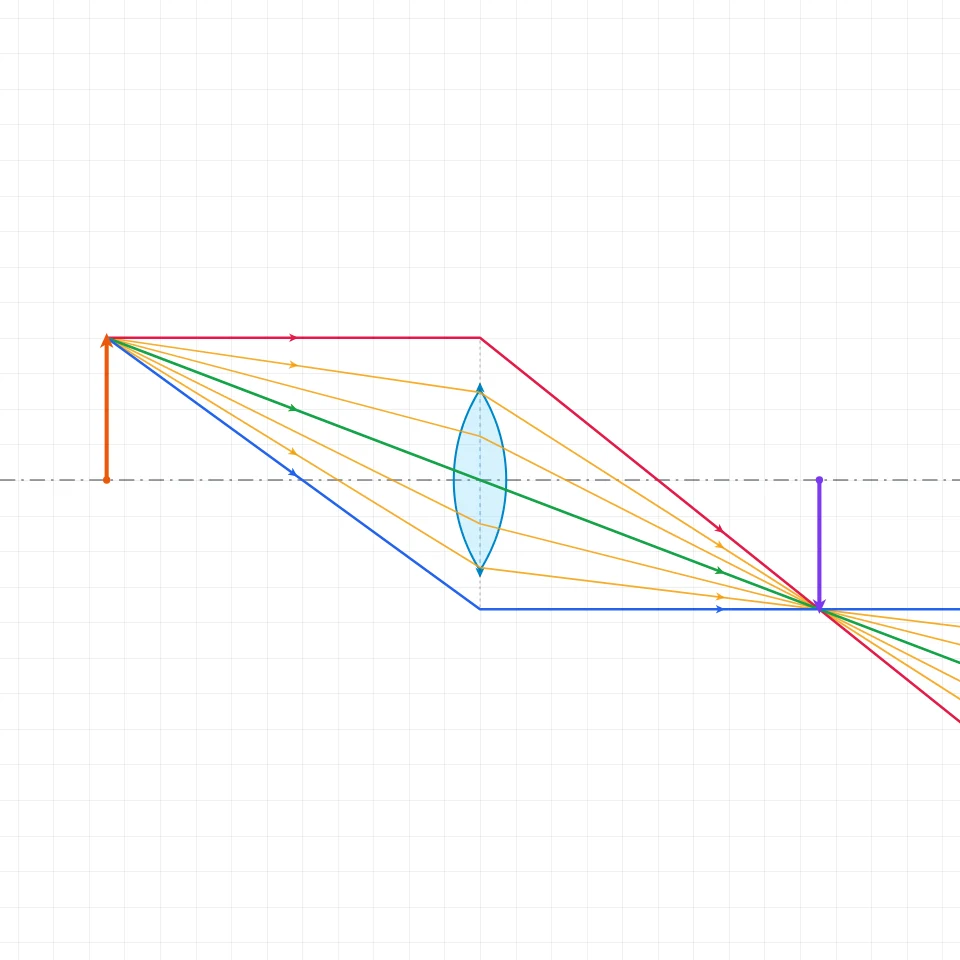
Lenses and mirrors explained
How lenses and mirrors make images: light rays and the law of reflection, refraction and Snell's law, focal points, ray diagrams, the thin lens and mirror equations and their sign conventions, magnification, the eye and the camera, telescopes, microscopes and aberrations.
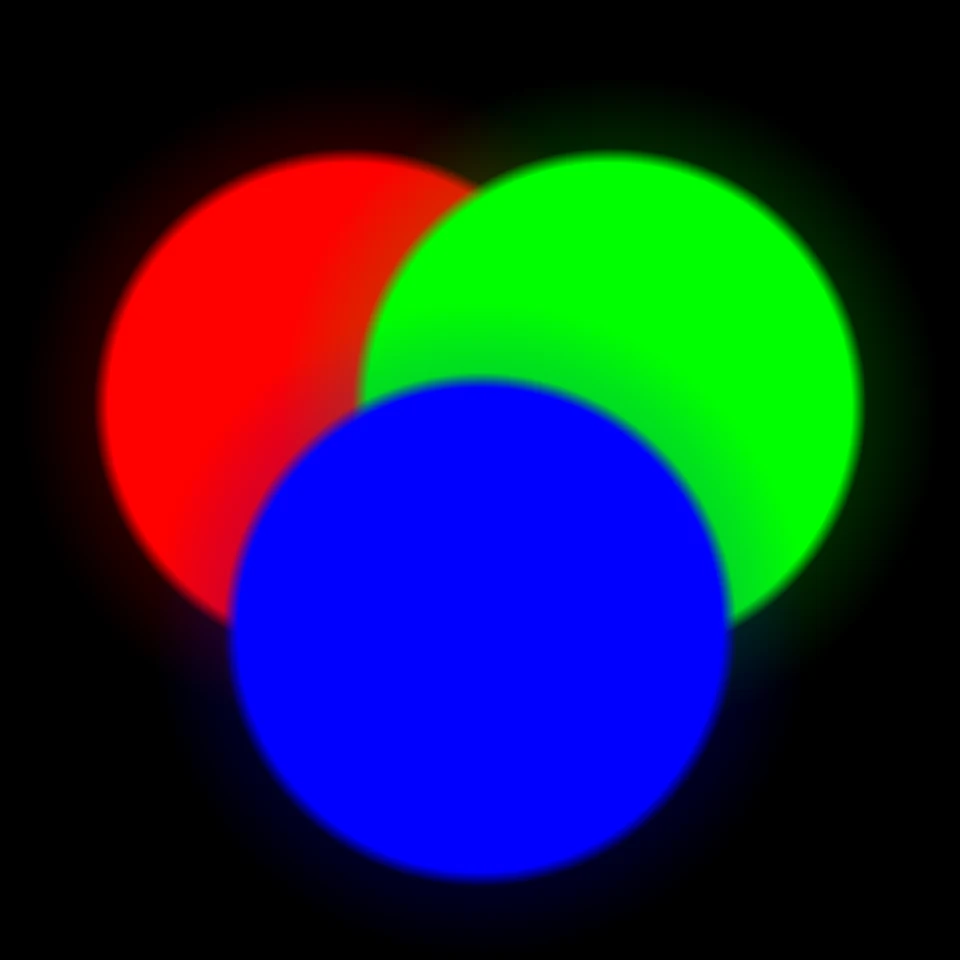
Colour mixing explained
How colours mix: white light and the spectrum, Newton's prism, the eye's three cones and trichromacy, additive mixing of light on screens, subtractive mixing with filters and inks, complementary colours, metamers, printing with CMYK, why paint mixes differently and colour blindness.
Ready to try it?
Open PictorX in your browser — no install, no credit card required to start.
Open the prism and rainbow simulator