
Lenses and mirrors explained
Glasses, cameras, projectors, telescopes, microscopes and the human eye all work by bending or reflecting light so that the rays from each point of an object meet again at one point of an image. This page explains the ray model of light, reflection and refraction, how a lens focuses, how to draw a ray diagram, the thin lens and mirror equations with their sign conventions, how mirrors make images, how the eye and the camera work, how telescopes and microscopes magnify, and why real lenses are never perfect.
Light as rays
In empty space and in clear glass, light travels in straight lines, and for most purposes it can be drawn as rays: arrows that show which way the light goes. Greek geometers such as Euclid used rays around 300 BC, but they thought the rays came out of the eye. Around 1021 the Arab scholar Ibn al-Haytham showed in his Book of Optics that light travels from objects into the eye, and he studied mirrors, lenses and the camera obscura. The ray picture works whenever the things the light passes are much larger than its wavelength, 0.4 to 0.7 micrometres for visible light; for smaller details, light behaves as a wave and spreads out.
Reflection and refraction
When a ray meets a mirror it bounces off at the same angle as it arrived, measured from the line at right angles to the surface: the law of reflection. When it passes from one transparent material into another it changes direction, because light travels more slowly in glass or water than in air. The amount follows Snell's law, n₁ sin θ₁ = n₂ sin θ₂, where n is the refractive index: 1 for vacuum, about 1.0003 for air, 1.33 for water and 1.5 for ordinary glass. Ibn Sahl described the law in 984, Willebrord Snell found it again in 1621, and René Descartes published it in 1637.
How a lens focuses light
A lens is a piece of glass with curved faces. A convex lens, thicker in the middle, bends rays towards the axis: rays arriving parallel to the axis meet at its focal point, at the focal length f behind it. A concave lens, thinner in the middle, spreads them out as if they came from a focal point in front of it, so its focal length counts as negative. For a thin lens the lensmaker's equation gives f from the radii of its faces, 1/f = (n − 1)(1/R₁ − 1/R₂). Opticians give a lens's power in dioptres, 1/f with f in metres: reading glasses of +2 dioptres have a focal length of 50 cm.
Drawing a ray diagram
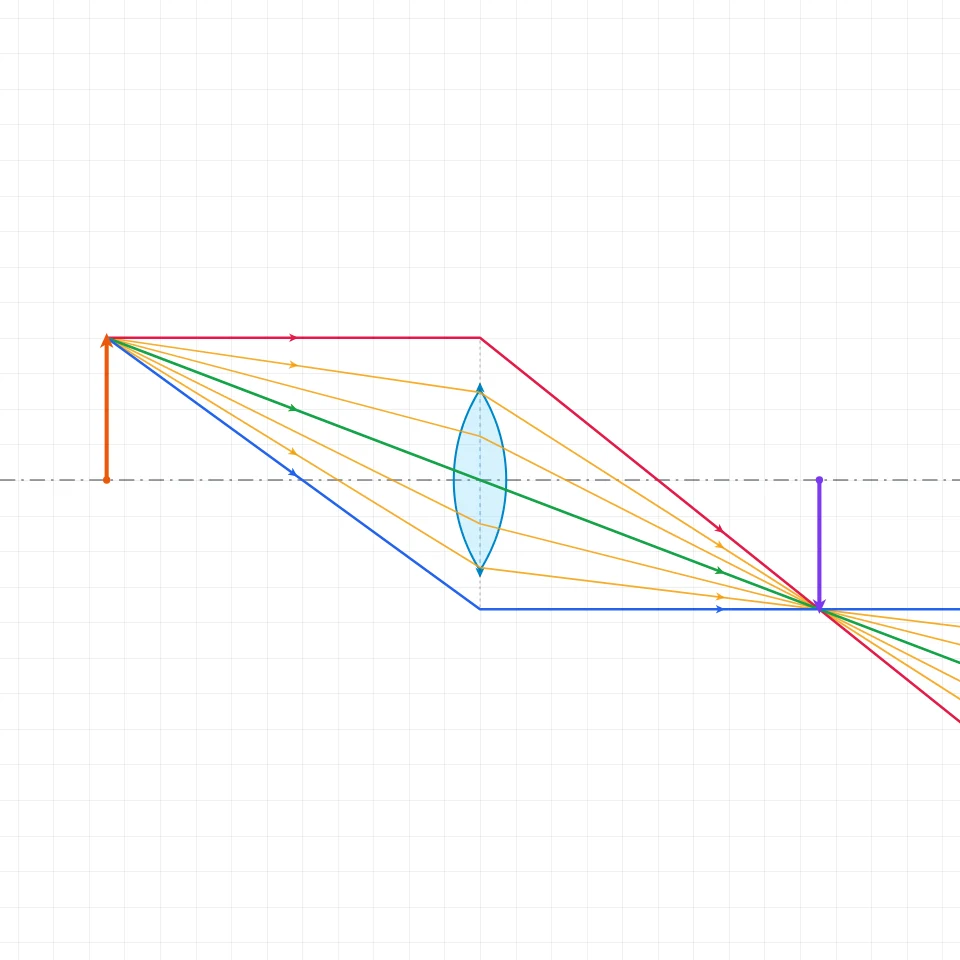
Every ray from one point of an object that passes through a lens goes to the same point of the image, so two rays are enough to find it. Three are easy to draw: a ray parallel to the axis leaves through the far focal point, a ray through the centre of the lens goes straight on, and a ray through the near focal point leaves parallel to the axis. Where they cross is the image. If the rays leaving the lens spread out instead, extend them backwards: they seem to come from a virtual image on the object's side. For a mirror the same idea works, with a fourth easy ray through the centre of curvature that comes straight back.
The thin lens and mirror equations
The ray diagram turns into one formula, the Gaussian lens equation 1/f = 1/dₒ + 1/dᵢ, where dₒ is the distance of the object and dᵢ that of the image, and the magnification m = −dᵢ/dₒ. Signs matter. In the real-is-positive convention, used by the app and many school books, real objects and real images have positive distances, virtual images negative ones, and converging lenses and concave mirrors positive focal lengths. University optics often uses the Cartesian convention instead, with distances to the left of the lens negative, which writes the formula as 1/f = 1/v − 1/u. Isaac Newton's form, xₒxᵢ = f², measures the distances from the focal points instead.
Mirrors
A plane mirror makes a virtual image as far behind it as the object is in front, upright and the same size. A concave mirror, curved like the inside of a spoon, focuses parallel light at its focal point, halfway between the mirror and its centre of curvature: f = R/2. It makes real, inverted images of distant things, used in telescopes and solar furnaces, and a magnified virtual image of a face close to it, as in a make-up or shaving mirror. A convex mirror makes a small, upright virtual image of a wide view, as on a car or at a blind corner. A spherical mirror focuses only the rays near its axis well; a parabolic mirror brings every ray parallel to its axis to one point, which is why telescope mirrors and satellite dishes are parabolic.
The eye and the camera
In the eye the cornea and the lens together have a power of about 60 dioptres and form a real, inverted image on the retina, about 1.7 cm behind; the brain turns it the right way up. To focus on near things, muscles make the lens rounder and stronger: accommodation. A young eye can focus as close as about 10 cm, and 25 cm is taken as the standard near point. A short-sighted eye focuses distant light in front of the retina and is helped by diverging glasses; a long-sighted eye focuses behind it and needs converging ones. A camera does the same with a lens and a sensor, but it focuses by moving the lens, and its aperture, given as the f-number f/D, controls how much light gets in and how much of the scene is sharp.
Telescopes and microscopes
The telescope appeared in the Netherlands in 1608, when the spectacle maker Hans Lipperhey applied for a patent. Galileo built his own in 1609 with a diverging eyepiece, which keeps the view upright, and found the moons of Jupiter. In 1611 Johannes Kepler proposed two converging lenses: the image is inverted, but the field of view is wider, and astronomers adopted it. A telescope focused on infinity has its lenses f₁ + f₂ apart and magnifies f₁/f₂ times. In 1668 Isaac Newton built a telescope with a concave mirror instead of a lens. The compound microscope, also from the Netherlands around 1600, uses a short objective to make a large real image and an eyepiece to magnify it again; Robert Hooke's Micrographia of 1665 showed what it could reveal, while Antonie van Leeuwenhoek saw bacteria through tiny single lenses that magnified up to about 270 times.
Why lenses are never perfect
The simple formulas hold for rays close to the axis, the paraxial rays. Rays through the edge of a spherical lens or mirror are bent a little too much and cross closer to it: spherical aberration, which blurs the image of a point into a small disc. Glass also bends blue light more than red, so a single lens has a slightly different focal point for each colour: chromatic aberration, which puts coloured fringes round bright edges. In 1758 John Dollond patented the achromatic lens, a convex and a concave lens of different glasses cemented together, whose colour errors cancel. Even a tiny error matters: the Hubble Space Telescope's main mirror, launched in 1990, was too flat at the edge by about 2 micrometres, and its pictures were blurred until corrective optics were installed in 1993.
Frequently asked questions
Why is the image in a camera or in the eye upside down?
The rays from the top of an object pass through the lens and carry on downwards, and those from the bottom carry on upwards, so they cross: every real image formed by a single converging lens is inverted. A camera's electronics or a slide projector's upside-down slide put it right, and in the eye the brain simply interprets the inverted image on the retina as the right way up. Babies learn this without noticing.
What are dioptres?
A dioptre is the unit of the power of a lens, 1 divided by the focal length in metres. A lens with f = 0.5 m has a power of +2 dioptres, a diverging lens with f = −25 cm has −4 dioptres. Powers of thin lenses placed together simply add up, which is why opticians prefer them to focal lengths. A glasses prescription of −2.5 means diverging lenses of −2.5 dioptres to correct short sight.
Why does a mirror swap left and right but not up and down?
It swaps neither: it swaps front and back. Each point of you is reflected straight through the mirror, so your right hand stays on the right side of the picture and your head at the top, but the image faces the other way. Because we picture ourselves turning round to face us, we read the image as having its left and right swapped. Lie on your side in front of a mirror and the 'swap' seems to become up and down.
Why are big telescopes made with mirrors rather than lenses?
A lens has to be held at its edge, so a big glass lens sags under its own weight, and the light passes through the glass, which absorbs some of it and brings each colour to a slightly different focus. A mirror reflects every colour the same way and can be supported from behind across its whole back. The largest lens telescope, at Yerkes Observatory, has a lens 1.02 m across and was finished in 1897; today's largest telescopes have mirrors 8 to 10 m across, made of many segments or thin glass held in shape by motors.
Related tools
Ray diagrams for lenses and mirrors
Draw ray diagrams for convex and concave lenses and mirrors online: drag the object and see the principal rays and the real or virtual image, with the thin lens equation 1/f = 1/dₒ + 1/dᵢ and the magnification. Build a camera, a projector, two telescopes and a microscope.
Snell's Law & Light Refraction
See why light bends. Race a lifeguard across sand and sea, shine a laser from air into water, glass, or diamond, and watch light through thin layers trace the brachistochrone.
Snell's law of refraction
What is Snell's law? Ibn Sahl, Snellius, Descartes, Fermat's principle of least time, the lifeguard problem, total internal reflection, the brachistochrone.
Wave interference explained
How waves interfere: the principle of superposition, constructive and destructive interference, path difference and nodal lines, the ripple tank, Young's double slit and its fringe spacing, Huygens' principle and single-slit diffraction, gratings, phased arrays and noise-cancelling headphones.
Ready to try it?
Open PictorX in your browser — no install, no credit card required to start.
Open the ray optics simulator