
Colour mixing explained
Every colour on a screen is made of red, green and blue light, and every colour in a magazine of cyan, magenta, yellow and black ink. This page explains why: what white light is made of, how the eye turns light into colour with only three kinds of cone, why light mixes by adding and filters and inks by taking away, what complementary colours and metamers are, and how paint, printing and colour blindness fit in.
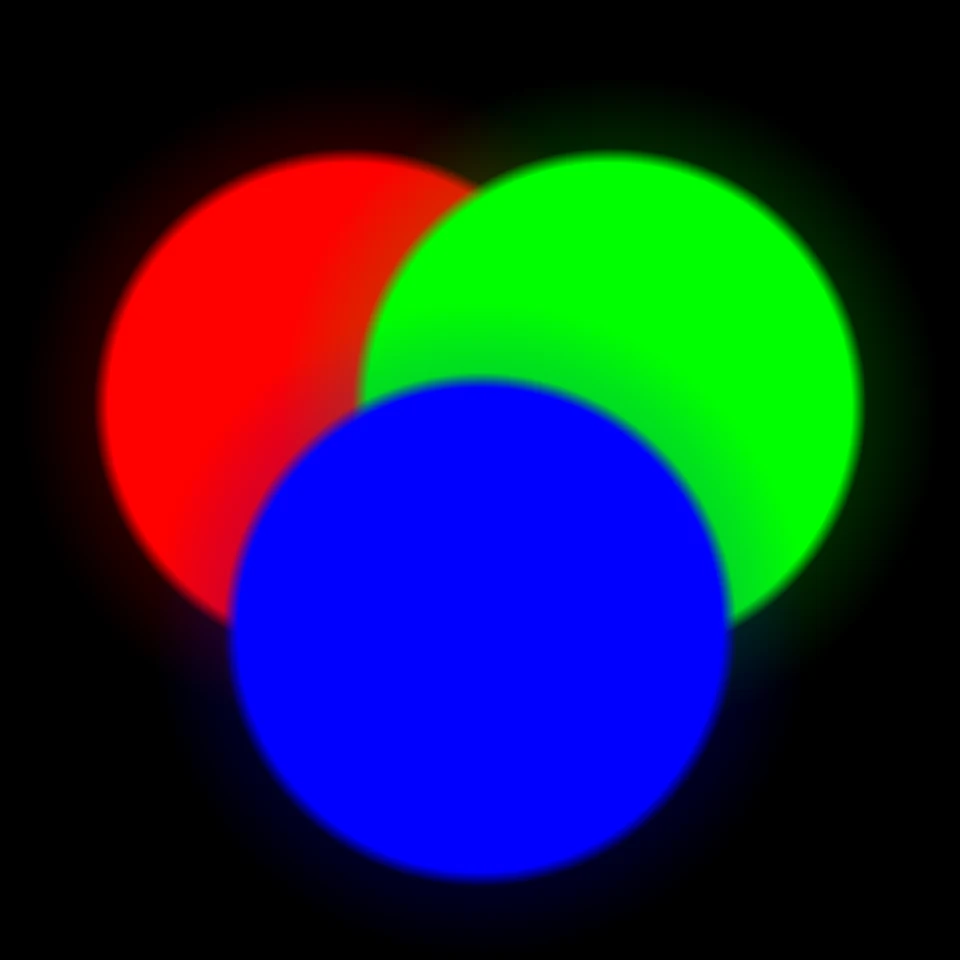
White light and the spectrum
In 1666 Isaac Newton let a beam of sunlight through a prism and spread it into a band of colours, from red through orange, yellow, green and blue to violet. With a second prism he put the colours back together into white, showing that white light is a mixture, not the purest light. Light is an electromagnetic wave, and its colour goes with its wavelength: the eye sees from about 380 nm (violet) to 750 nm (deep red), a range of less than one octave. A light's spectrum tells how much power it carries at each wavelength.
Three kinds of cone
The retina has rods for dim light and three kinds of cone for colour. Each cone holds a pigment that absorbs a broad band of wavelengths: L cones peak near 564 nm, M cones near 534 nm and S cones near 420 nm. A cone cannot tell which wavelength it caught, only how much light it absorbed, so the whole spectrum is reduced to three numbers. Thomas Young proposed three receptors in 1802, Hermann von Helmholtz developed the idea in the 1850s, and the pigments were measured in single cones in 1964. This trichromacy is why three primaries are enough.
Additive mixing
When lights shine on the same spot, their light adds up. Red, green and blue are the additive primaries because each mainly stirs one kind of cone: red and green make yellow, green and blue cyan, blue and red magenta, and all three white. James Clerk Maxwell used this in 1861 for the first colour photograph, a tartan ribbon photographed three times through red, green and blue filters and projected through the same filters on top of each other. Every screen works the same way: each pixel is three tiny lights, and a colour code such as #FF8000 says how bright each one is, here full red, half green and no blue.
Subtractive mixing
A filter, a transparent ink or a dye takes light away. A cyan filter absorbs red and passes green and blue, magenta absorbs green, and yellow absorbs blue. When light passes through two filters, the second lets through its share of what the first let through, so their transmissions multiply: cyan and yellow leave only green, and all three leave black. Cyan, magenta and yellow are the subtractive primaries because each removes one of the eye's three bands. Printers add black ink, the K of CMYK, because three real inks together make a dull dark brown, cost more and take longer to dry than one black.
Complementary colours and metamers
Two colours are complementary when their lights add up to white: red and cyan, green and magenta, blue and yellow. A filter's colour is the complement of the light it absorbs, which is why the regions on the light and filter sides of the app are always complementary. Light with different spectra can look identical when it excites the three cones equally: such metamers let a screen show yellow without any yellow light. Metamers can also part ways: two fabrics that match under the lamps of a shop may differ in daylight, because their spectra differ.
Paint, pigments and printing
Paints do not mix as simply as filters. Their pigment grains absorb some wavelengths and scatter the rest back towards you, so mixtures usually come out darker and duller; the Kubelka–Munk theory of 1931 describes how. Printers avoid mixing inks altogether: they print tiny dots of cyan, magenta, yellow and black in a halftone pattern, and where the dots sit side by side the eye blends them from a distance. Painters long taught red, yellow and blue as the primaries, but those cannot mix a bright magenta or cyan, which is why colour printing settled on cyan, magenta and yellow.
When colour vision differs
About 8% of men and 0.5% of women of northern European descent have red–green colour vision deficiency, usually because the L or M pigment is missing or shifted; the genes for both sit on the X chromosome, which is why men are affected far more often. Someone with only two kinds of cone confuses colours that differ only in how they excite the missing one. A few women may have a fourth kind of cone. Many animals see differently: most mammals have two kinds of cone, while birds, reptiles and many fish have four and also see ultraviolet.
Frequently asked questions
Are black and white colours?
In light, black is the absence of light and white is light containing all wavelengths in roughly equal strength. On paper, white is the paper reflecting nearly all the light and black is ink absorbing nearly all of it. Neither has a hue, so they sit outside the colour wheel, at the ends of the grey scale, but the eye sees them, and in everyday language they count as colours.
Why is the sky blue and the sunset red?
Air molecules scatter short wavelengths much more than long ones (Rayleigh scattering, in proportion to 1/λ⁴), so the blue in sunlight is scattered across the whole sky. At sunset the light crosses so much air that most of the blue is scattered away before it reaches you, and what remains is orange and red. The sky is not violet because sunlight contains less violet and our eyes are less sensitive to it.
Why is there no magenta in the rainbow?
A rainbow spreads the wavelengths out in order, and each colour in it is light of one wavelength. Magenta is red and blue light together without the green in between. No single wavelength excites the three kinds of cone in that proportion, so magenta exists only as a mixture: the brain closes the colour wheel by joining its two ends.
How many colours can a screen show?
With 256 levels for each of red, green and blue, a screen can address 256³ = 16,777,216 colours. It cannot show every colour the eye can see, though: the mixtures of three primaries fill a triangle, the gamut, inside the range of visible colours, and the most saturated cyans, greens and violets fall outside it. People can tell apart somewhere between one and ten million colours.
Related tools
Mix light and filters: additive and subtractive colour
Mix coloured light and colour filters online: red, green and blue light add up to white, while cyan, magenta and yellow filters multiply to black. Drag the circles, read hex, RGB, CMYK and HSL, see the spectrum and how the eye's three cones respond, and match a target colour.
Colors
How does color work on screens and in print? Light and mixing, RGB, CMYK, HSL and HSV, hex codes, the color wheel, gradients, contrast and accessibility.
Ray diagrams for lenses and mirrors
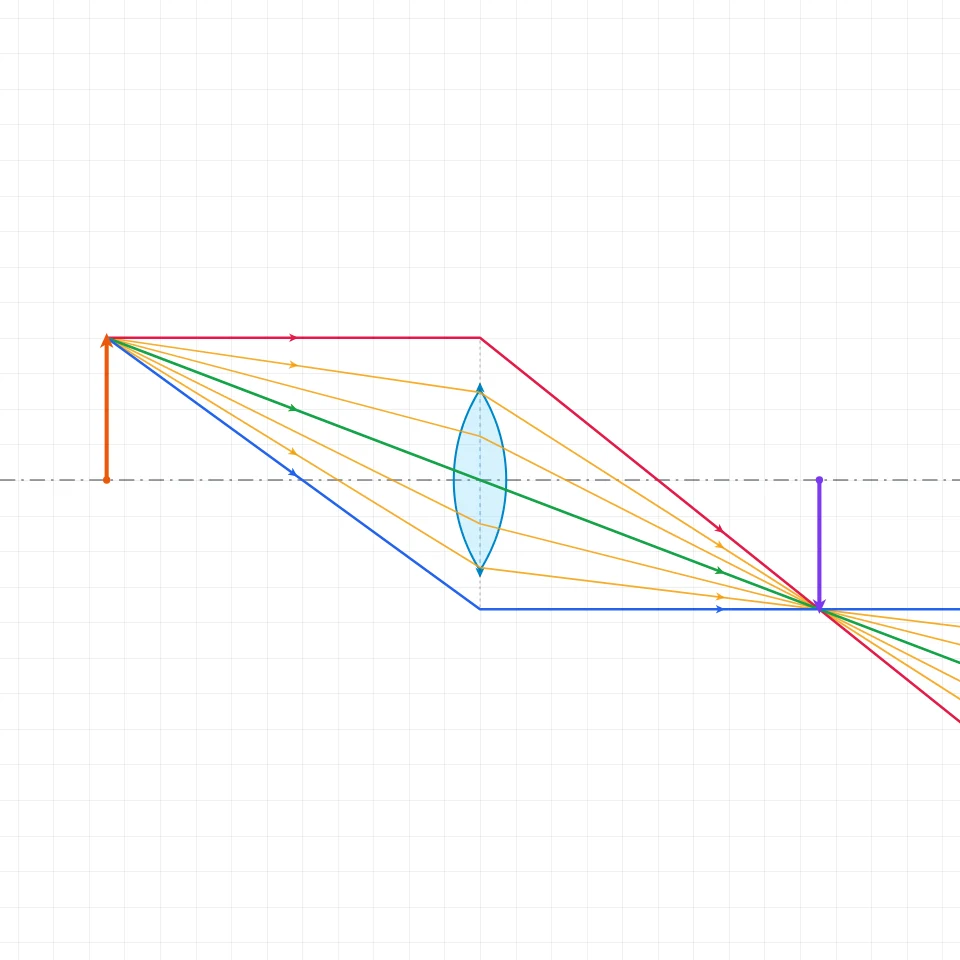
Draw ray diagrams for convex and concave lenses and mirrors online: drag the object and see the principal rays and the real or virtual image, with the thin lens equation 1/f = 1/dₒ + 1/dᵢ and the magnification. Build a camera, a projector, two telescopes and a microscope.
Snell's law of refraction
What is Snell's law? Ibn Sahl, Snellius, Descartes, Fermat's principle of least time, the lifeguard problem, total internal reflection, the brachistochrone.
Ready to try it?
Open PictorX in your browser — no install, no credit card required to start.
Open the colour mixing simulator