
Exoplanet transits explained
Since 1995 astronomers have found more than five thousand planets around other stars, and three out of four of them were found the same way: by a star that dims a little, at regular intervals, as a planet passes in front of it. This page explains what such a transit looks like and why, how the size, orbit and temperature of a planet are read from a few hours of starlight, what a grazing transit and limb darkening are, how faint dips are pulled out of the noise, and how the radial velocity of the star adds the planet's mass.
A shadow we cannot see
No telescope can see a planet in front of a distant star: the star itself is far too small to show as a disc. What we can measure is its brightness. When a planet passes between the star and us, it covers a part of the star's disc and the total light drops by the share of the disc it covers. The first transit of an exoplanet, HD 209458 b, was measured in 1999 by David Charbonneau and Gregory Henry: a 1.5 % dip lasting three hours, every 3.5 days. Since then the CoRoT, Kepler and TESS space telescopes have watched hundreds of thousands of stars for such dips.
Transit depth and the size of the planet
If the star were equally bright all over, the depth of the dip would be exactly the ratio of the two areas, δ = (Rp/R★)². A planet the size of Jupiter, a tenth of the Sun's radius, makes a 1 % dip; the Earth, 1/109 of the Sun's radius, only 0.0084 %, 84 parts per million. The radius of the planet is therefore R★ √δ, and the star's radius comes from its spectrum, its brightness and its distance. Small stars make small planets easy to find: the Earth-sized planets of TRAPPIST-1, a star only 12 % as wide as the Sun, dim it by almost 1 %.
Four contacts: ingress, flat bottom and egress
A transit has four moments of contact. At the first the planet's disc touches the star's edge from outside, at the second it is fully on the star, at the third it touches the far edge from inside and at the fourth it has left. Between the first and second contact, the ingress, the light falls; between the third and fourth, the egress, it rises again. The total duration for a circular orbit is T₁₄ = (P/π) asin(√((1 + k)² − b²) / ((a/R★) sin i)), where k = Rp/R★. The Earth crosses the Sun in about 13 hours, a hot Jupiter its star in two or three, the innermost planet of TRAPPIST-1 its star in 36 minutes.
Impact parameter, inclination and grazing transits
The path of the planet across the star is set by the impact parameter b = a cos i / R★, the closest distance of the planet's centre from the star's centre, in star radii. With b = 0 the planet crosses the middle and the transit is longest; with larger b the chord is shorter and the transit briefer. Between b = 1 − k and 1 + k the planet only clips the edge: the dip is grazing, short and V-shaped, without a flat bottom, and its depth no longer gives the size directly. Beyond 1 + k there is no transit at all. Because i must be within a fraction of a degree of 90° for a distant planet, only a small share of planets transit: the chance is about R★/a, 0.5 % for the Earth seen from far away and about 10 % for a hot Jupiter.
Limb darkening
A star looks darker and redder towards its edge, its limb. At the centre of the disc we look straight down into the hot, deep layers of the star; near the limb our line of sight passes through the cooler upper layers at a slant. Astronomers describe this with a law for the brightness I at an angle θ from the centre, μ = cos θ; the quadratic law I(μ) = I₀ (1 − u₁(1 − μ) − u₂(1 − μ)²) fits most stars well, with coefficients that depend on the temperature and the colour of the light. Limb darkening rounds the bottom of the light curve and makes the dip deepest in the middle, a little deeper than (Rp/R★)². The simulator integrates the hidden light ring by ring over the part of the star the planet covers, which is what the formulas of Mandel and Agol (2002) do in closed form.
Kepler's third law and the size of the orbit
The time between transits is the planet's orbital period P. Kepler's third law in Newton's form, a³ = G (M★ + Mp) P² / 4π², turns the period and the star's mass into the radius of the orbit a: the Earth's year of 365.26 days around one solar mass gives 1 AU, the 3.52 days of HD 209458 b give 0.047 AU, eight times closer than Mercury. The duration and the shape of the transit also give a/R★ on their own, and from it the star's mean density, a check on the star's radius and mass.
Temperature and the habitable zone
A planet at a distance a from a star of luminosity L receives the instellation S = L / a², in units of what the Earth receives from the Sun. If it absorbs a share (1 − A) of that light, A being its albedo, and spreads the heat round itself, it settles at the equilibrium temperature Teq = T★ √(R★ / 2a) (1 − A)^¼: 255 K for the Earth, 33 K below its real average because of the greenhouse effect. The habitable zone is the range of instellation in which a rocky planet with an atmosphere could keep liquid water on its surface. In the conservative zone of Kopparapu and colleagues (2014) it runs from the runaway greenhouse limit, about 1.1 times the Earth's instellation for a Sun-like star, to the maximum greenhouse limit, about 0.36. Cooler stars shift both limits to lower instellation, because more of their light is infrared and is absorbed more easily.
Noise, binning and folding
A real light curve is a series of measurements, each with its own error: photon noise, the star's own flicker and the instrument. Kepler reached about 30 parts per million in six and a half hours for a bright Sun-like star, not enough to see the 84 ppm of an Earth in a single point. Averaging N points with independent errors lowers the noise by √N, so astronomers bin neighbouring points and fold the light curve on the period, laying every transit on top of the others. The signal-to-noise ratio of a transit grows as depth / σ × √(number of points in transit). Kepler-37b, a planet barely larger than the Moon with a 13 ppm dip, could only be seen after three years of transits had been folded together.
Radial velocity: the second method
Star and planet orbit their common centre of mass, so the star moves in a small orbit of its own. Seen edge-on, it comes towards us and moves away again once per orbit, and its spectral lines shift by the Doppler effect. The semi-amplitude of that radial velocity is K = (2πG / P)^⅓ Mp sin i / (M★ + Mp)^⅔: 12.5 m/s for Jupiter tugging the Sun, 9 cm/s for the Earth, 85 m/s for HD 209458 b. The first planet around a Sun-like star, 51 Pegasi b, was found this way in 1995. A transiting planet has a known inclination, so the two methods together give its true mass, its radius and so its density: whether it is made of rock, water or gas.
Frequently asked questions
How many exoplanets have been found by transits?
More than 4,000 of the about 6,000 confirmed exoplanets, roughly three in four. Most come from the Kepler space telescope, which stared at about 150,000 stars from 2009 to 2018, and from TESS, which since 2018 has been surveying almost the whole sky. Ground-based surveys such as WASP and HAT found many of the hot Jupiters.
Can we see a transit of the Earth from another star?
Only from stars that lie close to the plane of the Earth's orbit, in a band of the sky about half a degree wide along the ecliptic. From there an observer would see the Sun dim by 84 parts per million for up to 13 hours once a year. Astronomers have counted about 2,000 stars within 300 light years that are, were or will be in that position within a few thousand years.
What else can transits tell us?
During a transit a little starlight passes through the planet's atmosphere on its way to us. Measuring the depth at many wavelengths shows which colours the atmosphere absorbs, and so which gases it holds: transmission spectroscopy. The Hubble and James Webb telescopes have found water, carbon dioxide, sodium and other molecules this way. Small changes in the timing of transits reveal other planets pulling on the transiting one.
Why are hot Jupiters found so often?
Because they are the easiest to find, not because they are common. A giant planet close to its star makes a deep dip (around 1 %), transits often (every few days), has a good chance of being aligned (about 10 %) and pulls its star hard enough for a large radial velocity. Only about one Sun-like star in a hundred has a hot Jupiter, while small planets on longer orbits are far more common.
Related tools
Exoplanet transit and light curve
Watch a planet cross its star and the light curve dip, with limb darkening, grazing transits and real telescope noise. Work out the planet's radius from the depth, its orbit from Kepler's third law, its temperature and whether it is habitable, for Earth, Jupiter, HD 209458 b, TRAPPIST-1 and more.
Star map and constellations
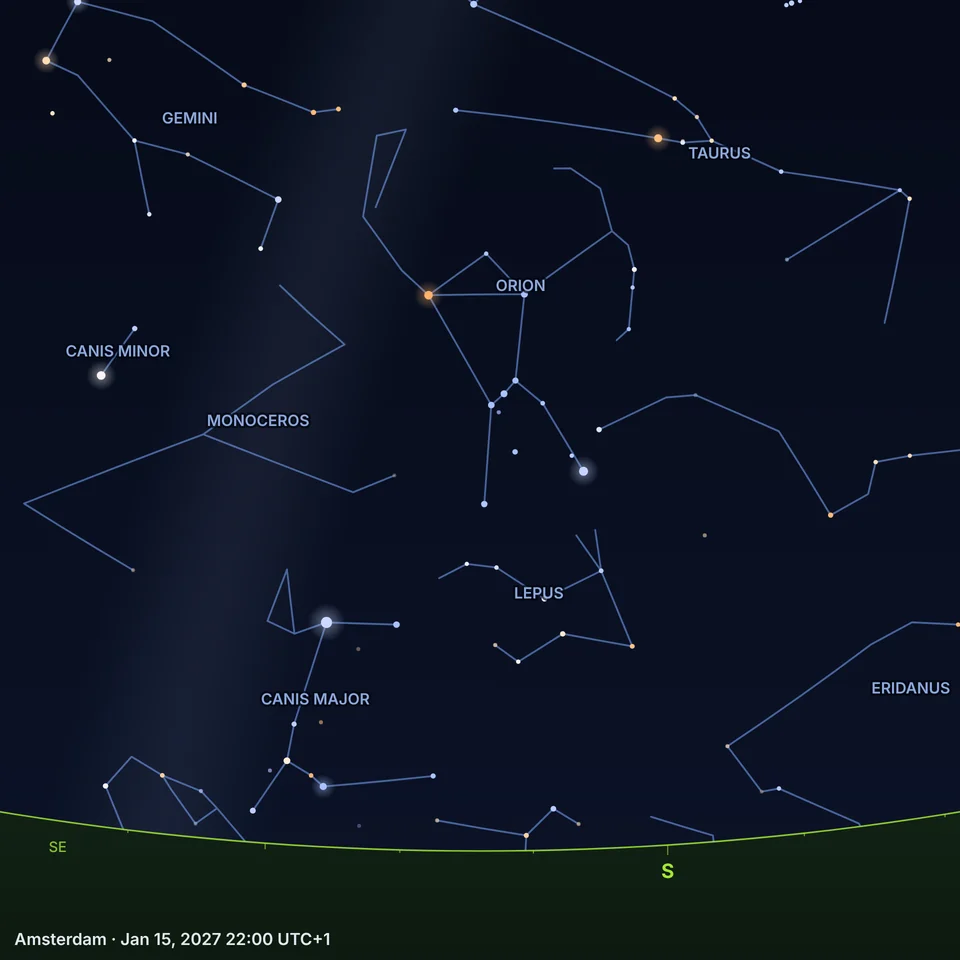
See the night sky for any place, date and time: the bright stars, the 88 constellations with their lines and names, the Moon and its phase, the planets and the Milky Way. Watch the sky turn, tap a star for its name and distance, and compare the sky from the North Pole, the equator and Sydney.
Solar System
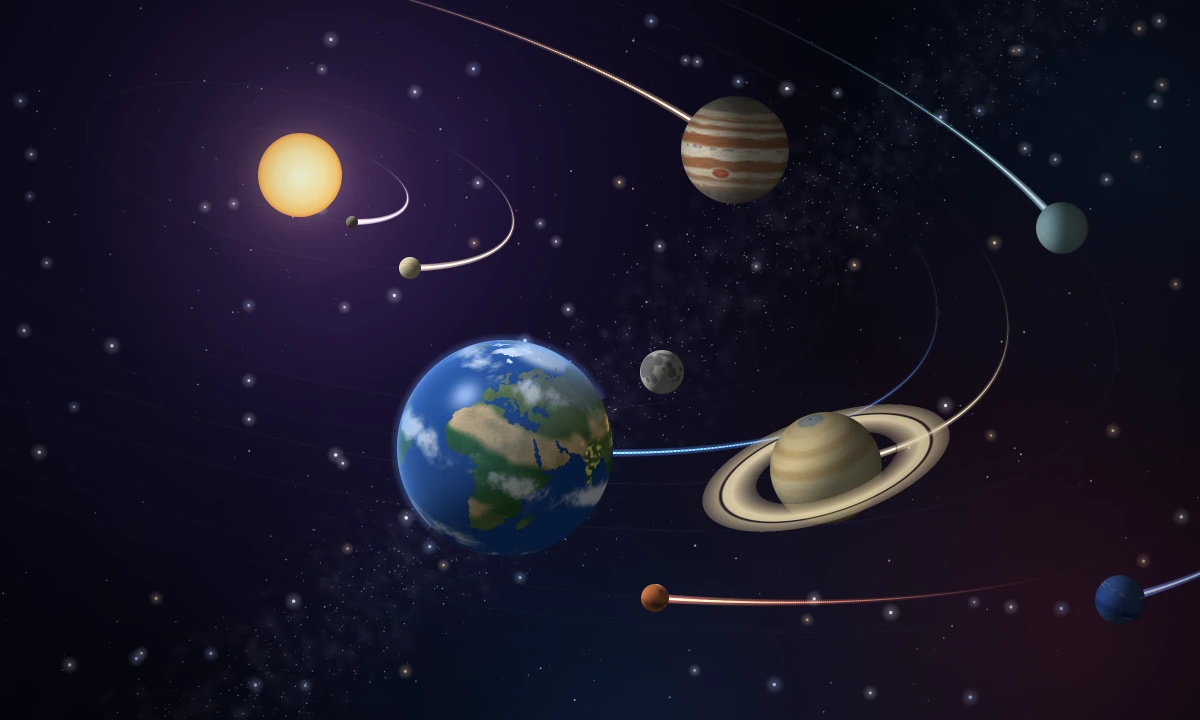
Fly through the solar system in 3D in your browser. The sun, eight planets, their largest moons, the dwarf planets, and the Kuiper belt move on their real, tilted orbits under Newton's gravity.
Gravity shapes the solar system
How does gravity shape the solar system? Eight planets and their moons on tilted orbits, the dwarf planets and Kuiper belt, and Jupiter's Galilean moons.
Ready to try it?
Open PictorX in your browser — no install, no credit card required to start.
Open the exoplanet transit simulator