
Gravity shapes the solar system
The solar system is the sun and everything its gravity holds: eight planets and their moons, the dwarf planets, and countless small bodies of rock and ice. PictorX moves them with Newton's law of gravitation on their real, tilted orbits and draws each one as it looks up close.
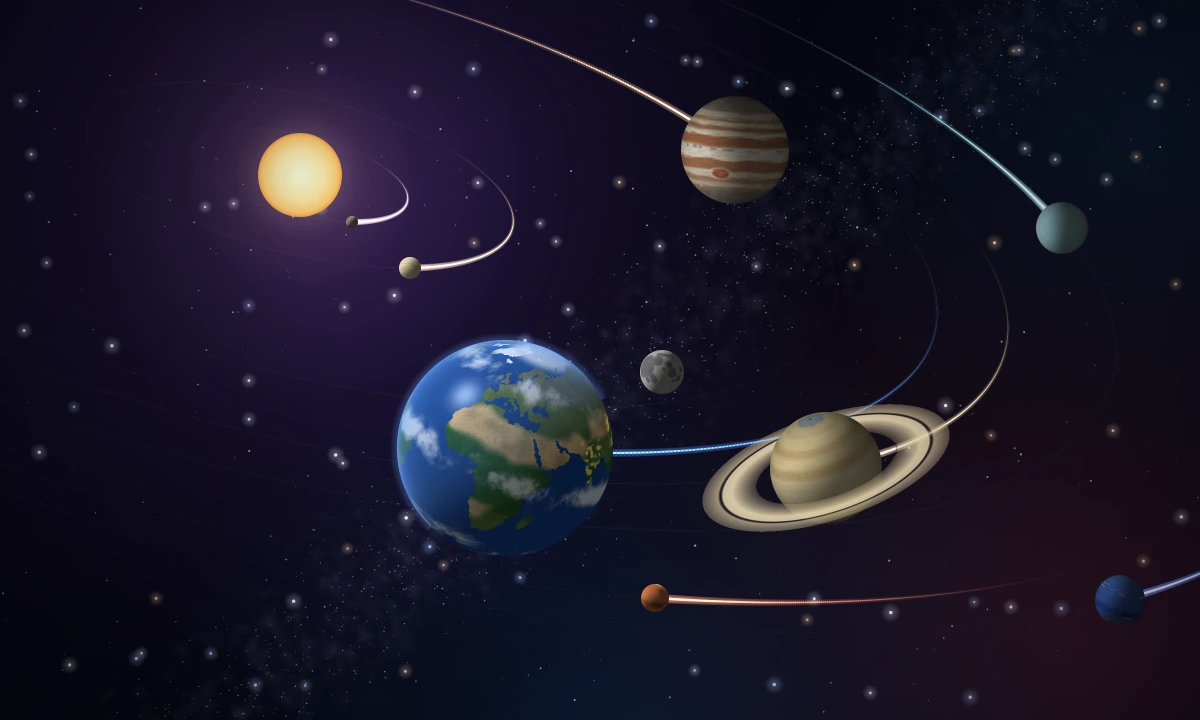
A solar system in miniature
The app's sun has mass 1000, and every planet, moon, and dwarf planet keeps its real mass compared with it, so Jupiter, at 1, has about the real ratio of 1 to 1047. The planets keep their real order and tilts, and the dwarf planets their real orbits, but the distances are squeezed so Mercury and Neptune share the screen: Neptune is 4.5 times as far out as Earth instead of 30. Each body is pulled by every other one with Newton's law, so the orbits come from the same rule that holds the real ones. The faint dust between Mars and Jupiter is the asteroid belt: 1,500 asteroids, too small to pull on anything and too many to compute, so each simply keeps to a fixed ellipse round the sun. Their orbits are stretched and tilted like the real ones, so the belt is a thick ring, and they skip the Kirkwood gaps that Jupiter's pull keeps clear. Three spacecraft fly among them as small icons: the Parker Solar Probe, which dives to within 6.9 million km of the sun, closer than anything else ever built, on an orbit reaching out to Venus; the James Webb Space Telescope, circling the L2 point 1.5 million km beyond Earth, drawn 18 times farther out, just beyond the Moon; and Voyager 1, the most distant spacecraft, 171 AU out and leaving at 3.6 AU a year, so far away that an arrow at the edge points to it. They have no mass and keep to their real paths by formula, since Webb holds its balance point only by firing its thrusters.
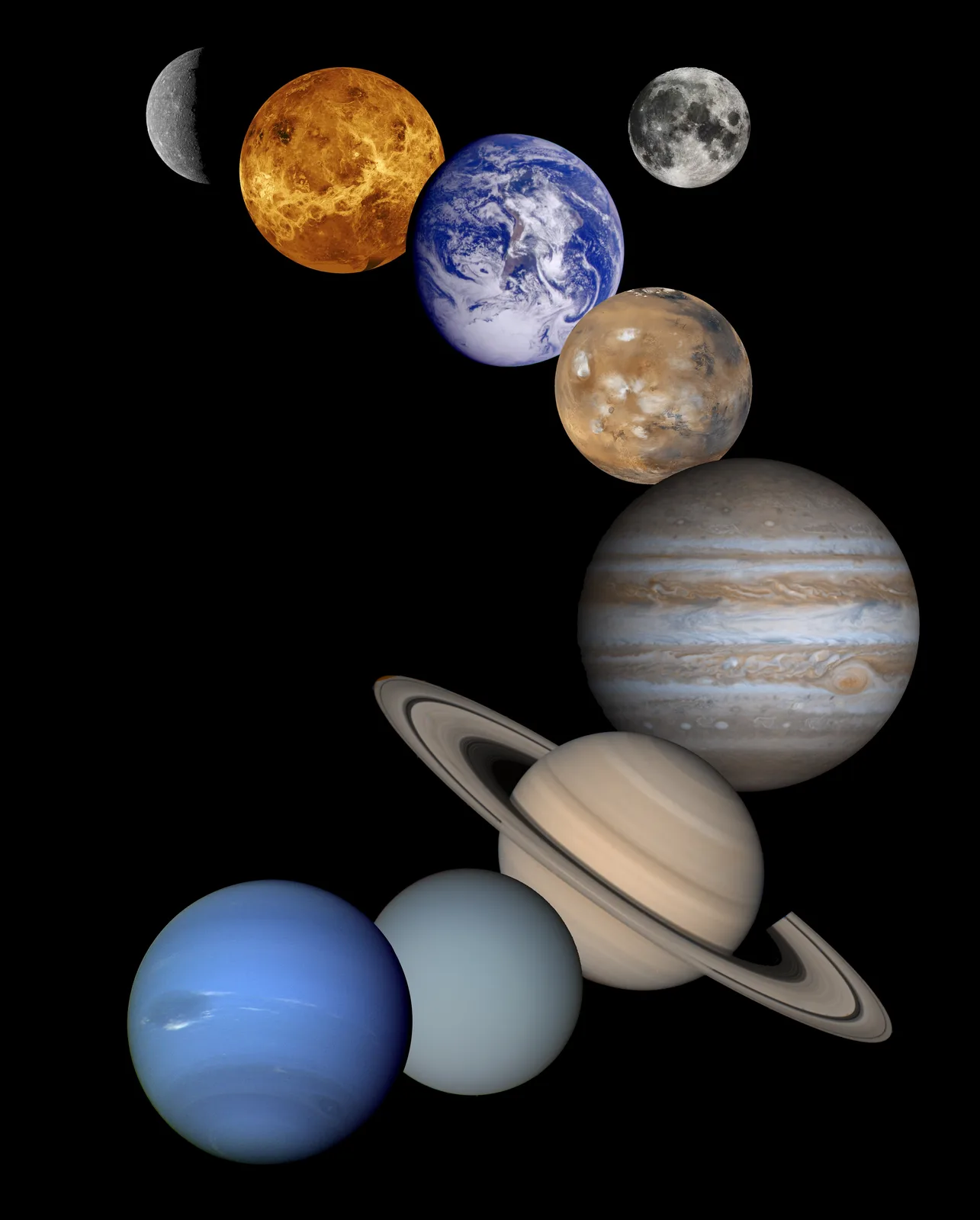
Where the favorites take you
Each favorite flies the camera to a place in the same running solar system, and the bodies keep moving. The whole solar system and the inner planets are seen at a slant. Earth and Moon, Mars, Jupiter, Saturn, Uranus, Neptune, and Pluto and Charon fly with that body, framed so its moons fit. Kuiper belt looks down on the outer solar system and runs fifteen times faster, so Neptune goes round in under a minute. Randomize flies close up to a body picked at random.

Orbits in three dimensions
The planets do not orbit in one flat plane. Each orbit is tilted a little against Earth's, the plane called the ecliptic: Mercury's by 7°, Venus's by 3.4°, Saturn's by 2.5°, and the others by less than 2°. The mini solar system uses these real tilts, and its Moon circles Earth on an orbit tilted 5.1°, like the real one. The inclination i in the readout is that tilt. Drag the picture to turn it, or choose Edge-on under View to see the orbits from the side. Zoom in close on any of the eight planets or the Moon to see a globe turning on its real tilted axis: Earth with its real coastlines, clouds, ice caps, and city lights on the night side, and Mars with its dark markings and white polar caps. Venus shows only the top of its thick, pale yellow clouds, which race round it backwards in four Earth days. Jupiter shows its belts and zones and the Great Red Spot, and Saturn its softer bands, the hexagon round its north pole, and the shadow of its rings. Uranus, tipped on its side, is a pale cyan ball with a bright haze over one pole, and Neptune a deeper blue with white clouds and the Great Dark Spot that Voyager 2 saw in 1989. Their days are far longer than real, measured against their years, so the turning is easy to follow. Two keep their real days: grey, cratered Mercury, which turns three times for every two trips round the sun, and the Moon, which turns once for each trip round Earth, so it always shows Earth the same face, with its dark maria and the bright rays of Tycho. Saturn's largest moon, Titan, is a ball of orange haze, the smog of its thick nitrogen air, rimmed by a thin blue layer, and it too always turns the same face to its planet. Uranus's moons look as Voyager 2 saw them in 1986: grey Miranda, patched with coronae, great ovals banded light and dark, one with a bright chevron; Titania, crowded with craters and split by long canyons; and darker Oberon, whose largest craters have dark floors inside bright rays. Triton, Neptune's largest moon, looks as Voyager 2 saw it in 1989: a faintly pink cap of nitrogen frost over its south pole, streaked dark by the plumes of its geysers, and beyond it greyer ground, dimpled like the skin of a cantaloupe, with smooth plains flooded long ago by icy lava. Mars's two small moons are no balls: Phobos, 27 km long, is a dark lump crowded with craters and scored with parallel grooves, with the great crater Stickney at one end; Deimos, half its size, is smoother, its craters softened by dust. Both keep their long ends pointed at Mars. Zoom in close on the sun to see its surface: brightest in the middle, dimmer and redder toward the edge, where only its cooler upper gas is seen, finely mottled, with a few groups of sunspots that drift across as it turns once in 25 days. Saturn's rings follow Cassini's measurements: the dim, see-through C ring, the bright B ring, the dark Cassini Division and the A ring with the Encke gap, finely grooved up close. Saturn's shadow falls across them, and seen from their unlit side the dense B ring goes dim while sunlight glows through the thinner rings. Up close, Jupiter's clouds churn as Juno and Hubble show them: dark hot spots along the North Equatorial Belt trail blue-grey festoons, the Great Red Spot, shrunk to about 16,000 km, spirals in its pale hollow beside Oval BA and a string of white ovals, and blue-grey storms crowd its poles. Up close, Uranus's bright polar cap shows a darker lane round its edge and a few small storms beyond it, and its narrow, dark rings appear as faint hairlines, the ε ring the brightest, as the James Webb Space Telescope sees them. Neptune's blue is its true colour, a soft azure only a little deeper than Uranus, as Voyager 2's pictures show once their heightened contrast is undone. Up close, its high white clouds cast faint shadows, a bright vortex crowns its south pole, and faint, dusty rings circle it, the Adams ring with brighter arcs that go round with it. Up close, Mercury shows what the MESSENGER probe mapped: the vast Caloris basin, its smooth, pale floor ringed by mountains, smooth plains across the far north, long cliffs where the planet shrank as it cooled, and bright, bluish hollows where rock has boiled away. Venus's clouds look almost featureless to the eye, so their markings are drawn faintly: the dark Y that ultraviolet cameras see, bow-shaped streaks, mottled cells round the equator and a bright collar round each pole. Up close, the Moon's maria run together with ragged shores, each lava flow a slightly different shade, a touch bluer where it is rich in titanium, as in Mare Tranquillitatis; Plato and Grimaldi have dark floors, and the rings of Mare Orientale make a bullseye on its western edge.
Dwarf planets and the Kuiper belt
Astronomers counted Pluto as the ninth planet from its discovery in 1930 until 2006, when the International Astronomical Union classed it as a dwarf planet. It lies in the Kuiper belt, the region of icy bodies beyond Neptune's orbit. Kuiper belt objects are small bodies of ice and rock, left over from the early solar system. In the mini solar system Pluto follows its real orbit: eccentricity 0.25, tilted 17°, with its perihelion just inside Neptune's orbit. It goes round twice for every three turns of Neptune, and that 3 : 2 resonance keeps the two far apart. Pluto's largest moon, Charon, has its real mass, an eighth of Pluto's, so the two circle a point between them, and its real orbit plane, nearly upright. The real Charon goes round every 6.4 days, far too fast to compute here, so it is set wider, going round about 50 times a Pluto year, and like the Moon it is drawn 60 times farther out. The other named dwarf planets keep their real orbits from JPL and start where they were on 9 June 2026: Ceres in the asteroid belt, with its distance squeezed like the planets', Haumea and Makemake in the Kuiper belt, and Eris, which swings out to 97 AU on an orbit tilted 44°. Around them circle 160 Kuiper belt objects, made up to match the real belt. Most keep to near-circles 42 to 48 AU from the sun, some steeply tilted, and a quarter, the plutinos, share Pluto's resonance. Beyond Neptune the picture keeps Neptune's scale, so these orbits keep their real periods compared with Neptune's. Zoom in close on Pluto and Charon to see them as New Horizons did in 2015: Pluto's bright heart, with the icy plain of Sputnik Planitia, and the dark red Cthulhu region, and grey Charon with a reddish cap over its north pole. The two always keep the same faces turned to each other. The other dwarf planets can be seen up close too: dark, cratered Ceres as the Dawn probe saw it, with the bright salt spots in Occator crater; Haumea, an egg of ice with a dark red spot, spinning every 3.9 hours inside a thin ring; reddish-brown Makemake; and Eris, almost white, one of the brightest bodies in the solar system. The Kuiper belt objects are drawn as the real ones look: grey to deep red, and dark. Zoom in close on one to see a small, lumpy world, or two lobes stuck together, like Arrokoth, which New Horizons flew past in 2019.
The Galilean moons of Jupiter
Galileo Galilei first saw Jupiter's four largest moons in 1610, and together they hold nearly all the mass of Jupiter's moon system. Io is the most volcanically active body in the solar system, heated by Jupiter's tides. Europa's smooth, icy crust likely hides an ocean of liquid water. Ganymede is the largest moon in the solar system, bigger than the planet Mercury, and the only moon known to make its own magnetic field. Callisto has an ancient, heavily cratered surface of ice and rock, and perhaps an ocean beneath it. In the mini solar system they have their real masses and orbit in Jupiter's equator. The real ones go round in 1.8 to 16.7 days, far too fast to compute here, so they are set wider but keep their real spacing: Io still goes round twice for each turn of Europa and four times for each turn of Ganymede, the Laplace resonance. They are drawn 14 times farther out. Zoom in close to see them as the Galileo probe did: Io yellow with sulfur, red-brown at the poles and dotted with dark volcanoes, some ringed in red; Europa's bright ice crossed by reddish cracks; Ganymede's dark old regions among paler grooved ground, with frost over its poles; and dark Callisto, crowded with craters round the ringed basin Valhalla. Each keeps one face toward Jupiter.
Frequently asked questions
Is the sun's mass realistic?
In the mini solar system the sun is 1000 and Jupiter is 1. The real Jupiter is about 1/1047 of the sun, so that ratio is close. The Moon has 1/81 of Earth's mass and orbits 1/389 of Earth's distance from the sun, like the real one. That is too close to see beside Earth, so it is drawn 60 times farther out. Mars has its two small moons, Phobos and Deimos, with their real masses, on Mars's equator, tilted 26.7° to Earth's orbit. The real ones go round in 7.7 and 30 hours, far too fast to compute here, so they are set wider but keep their real spacing, so Phobos still goes round four times for each turn of Deimos, and both are drawn 120 times farther out. Saturn's largest moon, Titan, the only moon with a thick atmosphere, has its real mass and circles in Saturn's equator, the plane of its rings. The real one goes round every 16 days, so it too is set wider, and it is drawn 12 times farther out. Neptune's largest moon, Triton, goes round backwards, against Neptune's spin, and was likely captured from the Kuiper belt. It has its real mass and an orbit tilted 130° to Earth's, as the real one has, but the real Triton goes round every 5.9 days, so it too is set wider, and it is drawn 30 times farther out. Uranus lies on its side, so its moons Miranda, Titania, and Oberon circle it on a nearly upright plane, 98° to Earth's orbit. They have their real masses. Titania and Oberon keep their real spacing, Oberon a third farther out; the real ones go round in 8.7 and 13.5 days, so they are set wider too. Miranda, the innermost, goes round in just 1.4 days, so it sits closer to Titania than the real one does. All three are drawn 50 times farther out.
Do the planets start where they are today?
The dwarf planets do: they start where they were on 9 June 2026, from JPL's orbital elements. The planets start at set places round the sun, on near-circles, so the picture shows how they move rather than tonight's sky.
Does PictorX upload the simulation?
No. It runs on a canvas in your browser. Save downloads a PNG, and Edit opens that image in the PictorX editor.
Why is Pluto not a planet anymore?
In 2006 the International Astronomical Union defined a planet as a body that orbits the sun, is massive enough for its own gravity to make it round, and has cleared the neighborhood around its orbit. Pluto meets the first two but shares its zone with the Kuiper belt objects, so it is now a dwarf planet. In the app it follows Newton's law like every other body.
Related tools
Solar System
Fly through the solar system in 3D in your browser. The sun, eight planets, their largest moons, the dwarf planets, and the Kuiper belt move on their real, tilted orbits under Newton's gravity.
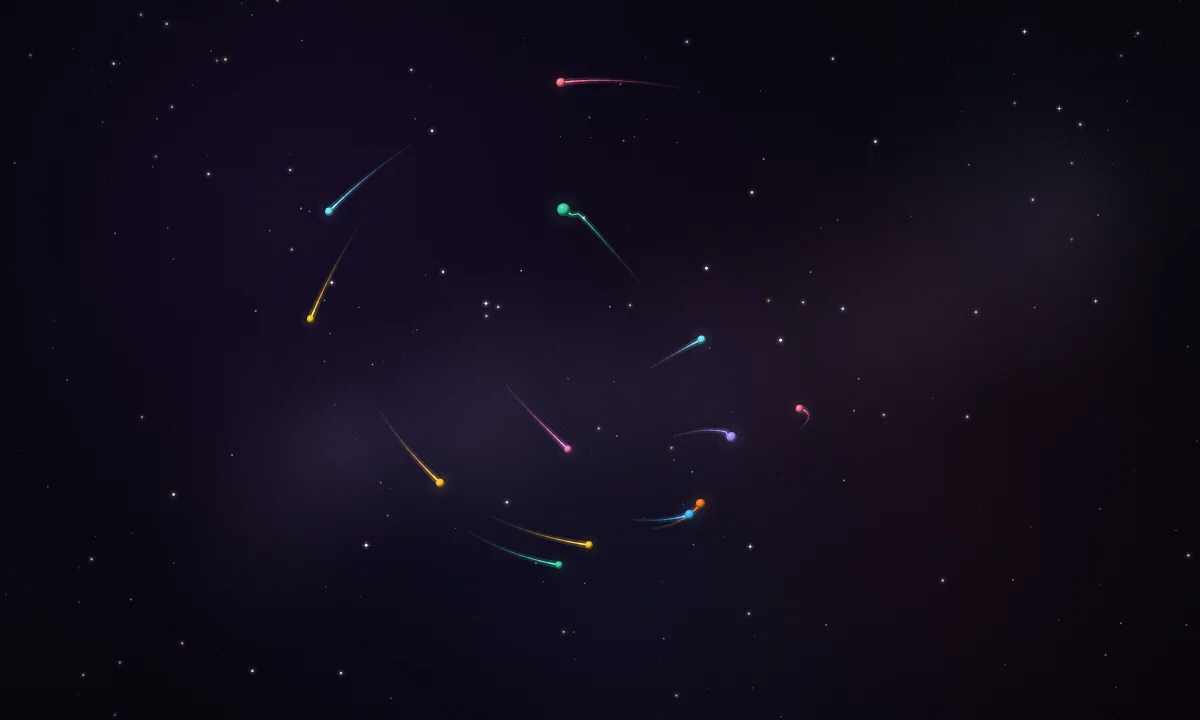
N-Body System
Watch Newton's gravity move stars, planets, and moons in 3D in your browser. Turn the view, and see stable orbits, resonances, slingshots, Trojans, and a chaotic cluster.
Gravity between many bodies
How Newton's law of gravitation turns a handful of masses into orbits, resonances, Lagrange points, slingshots, and chaos.
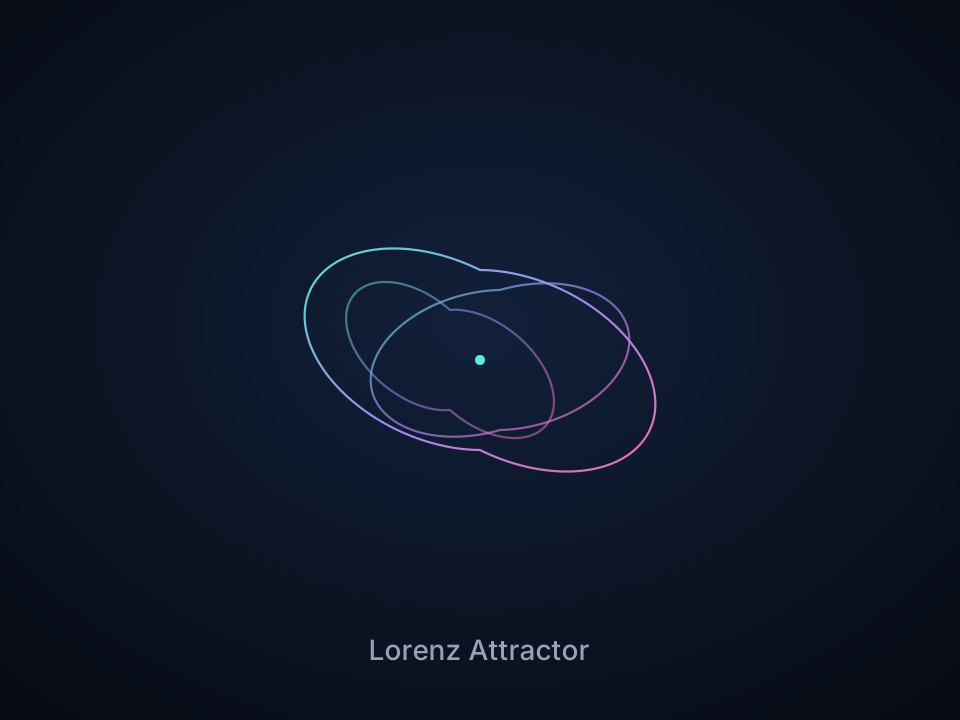
Lorenz Attractor
Interactive Lorenz attractor: tune a, b, f, rotate in 3D, try neon/ink/smoke looks, and save a PNG.
Double Pendulum
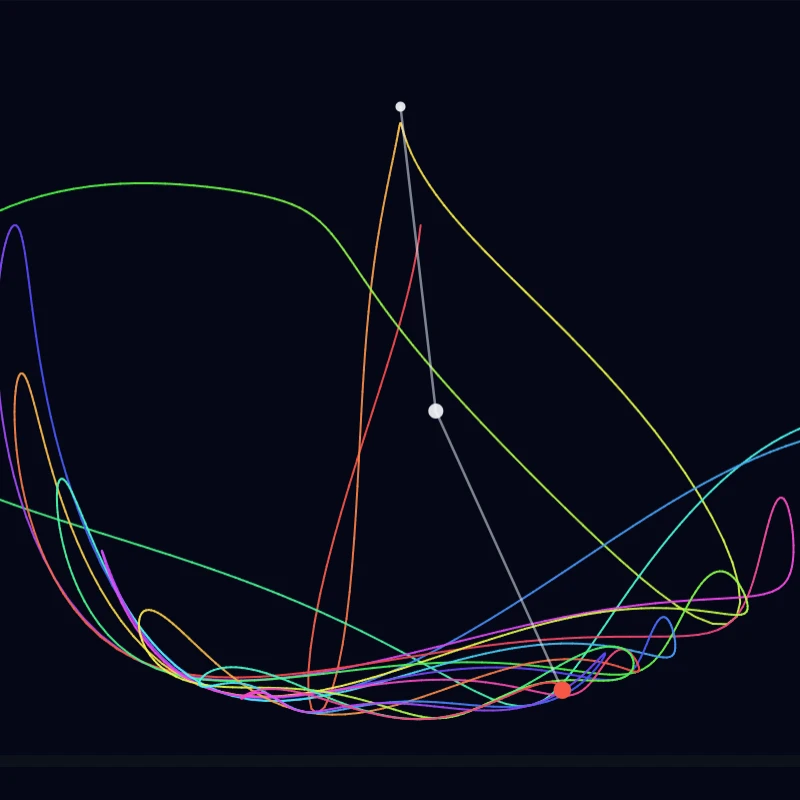
Simulate a classical double pendulum in your browser. Paint chaotic tip trails, long-exposure paths, or distort a soft field—then save a PNG.
Buffon's Needle
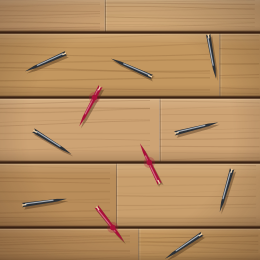
Drop needles on a lined floor in your browser. Count the crossings and watch Buffon's 1777 experiment estimate π.
Ready to try it?
Open PictorX in your browser — no install, no credit card required to start.
Try Solar System