
About Baccarat - history, rules and odds
Baccarat has the reputation of a game for high rollers in evening dress, yet it is one of the simplest games in the casino: you only choose a bet, and the cards do the rest. It also has one of the lowest house edges. This page tells where it comes from, how a hand is played and what the numbers say.
Where it comes from
Baccarat is usually traced to 15th-century Italy, where a game called baccara, meaning zero, was played with tarot cards; the name fits a game in which tens and court cards count nothing. It reached France and became a favourite of the nobility, and in the 19th century two French forms were played: chemin de fer, in which the players take turns as the banker, and baccarat banque, with a fixed bank.
The version played in most casinos today, punto banco, took shape in Latin America and Cuba and came to Las Vegas in the late 1950s. In punto banco the house banks every hand and the drawing is fixed by rules, so the players only bet. In Macau and Singapore it became the most played casino game of all, bringing in far more money than any other table game.
How the cards count
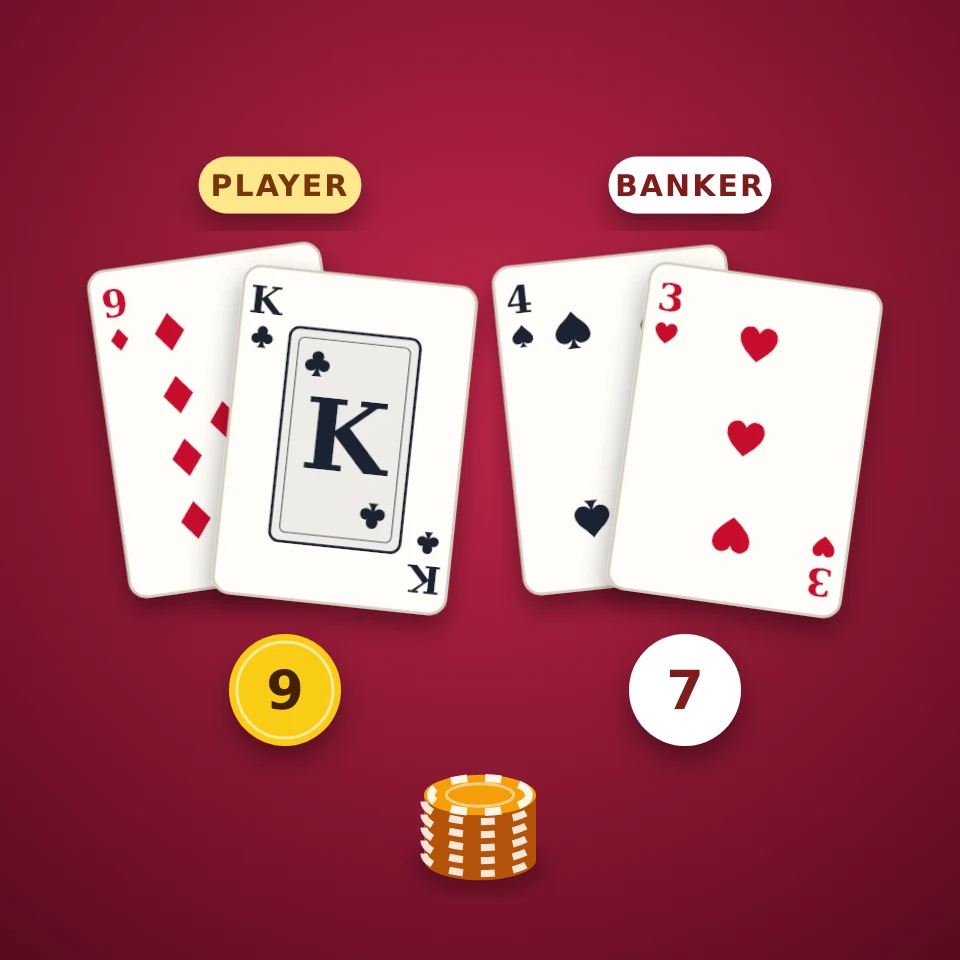
Aces count 1, the cards from 2 to 9 count their number, and tens, jacks, queens and kings count 0. A hand's total is the last digit of the sum: a 9 and a 6 make 15, which counts as 5. So a hand can never go over 9, and the highest total is 9. Two hands are dealt, called Player and Banker, two cards each. These names do not mean that anyone at the table plays them; you may bet on either.
The third-card rules
If either hand has 8 or 9 with its first two cards, that is a natural, and both hands stand. Otherwise the Player draws a third card on a total of 0 to 5 and stands on 6 or 7.
The Banker then follows a table. If the Player stood, the Banker draws on 0 to 5 and stands on 6 or 7, just like the Player. If the Player drew, it depends on the Player's third card: the Banker always draws on 0, 1 or 2; on 3 unless the Player's third card was an 8; on 4 if it was 2 to 7; on 5 if it was 4 to 7; on 6 if it was 6 or 7; and the Banker always stands on 7. The hand closer to 9 wins, and equal totals are a tie.
The bets and the house edge
Because the Banker draws with knowledge of the Player's third card, the Banker wins a little more often: in an 8 deck shoe about 45.86% of the hands, against 44.62% for the Player, with ties in the other 9.52%. Player pays 1 to 1, a house edge of 1.24%. Banker would favour the player at even money, so it pays 1 to 1 less 5% commission, a house edge of 1.06%, the lowest of the main bets. Tie pays 8 to 1 and has an edge of about 14.4%; on a tie, Player and Banker bets push.
Many casinos now offer no-commission baccarat: Banker pays even money, except half when it wins with a total of 6. That is simpler but costs more, an edge of about 1.46%. The side bets on a Player Pair or Banker Pair pay 11 to 1 with an edge of about 10% to 11%.
The roads
Baccarat tables show the history of the shoe on scoreboards called roads. The bead plate fills columns of six with one mark per hand: Banker, Player or Tie. The big road shows streaks: each run of Banker or Player wins goes down a column, a change of winner starts a new column, ties are drawn as a stroke across the last win, and a run longer than six turns right along the bottom row, the dragon tail. Asian casinos add derived roads such as the big eye boy, small road and cockroach pig.
Many players follow the roads closely, betting on streaks or on a choppy pattern, but the cards have no memory. The roads record what happened; they do not change the odds of the next hand.
Why baccarat is so popular
The game is quick, needs no skill and offers a bet with an edge close to 1%. It also has style: James Bond plays chemin de fer in the first novel, Casino Royale, and in Dr. No he first appears on screen at a baccarat table. In Asia the game is tied to luck and numbers, the squeeze, in which a player bends up a card slowly to reveal it, is part of the ritual, and the roads give every shoe its story.
Playing on PictorX
Open Baccarat and put play chips on Player, Banker, Tie or the pairs. Point at a box to see what it pays and its house edge, press Deal and watch the cards come out of the shoe, with the third cards drawn by the rules. Choose 6 or 8 decks and commission or no commission, and follow the shoe on the bead plate and the big road. Your chips and the shoe with its roads are kept in your browser, and the shoe is shuffled with your browser's cryptographic random number generator.
Frequently asked questions
Is there a strategy for baccarat?
Only in the choice of bet: the drawing is fixed by rules, so there are no decisions during a hand. Bet on Banker for the lowest house edge, avoid the Tie bet, and remember that no betting system or road pattern changes the odds.
Why does the Banker win more often?
Because the Banker's drawing rules take the Player's third card into account, while the Player's rules cannot see the Banker's cards. That small advantage is why the casino charges a 5% commission on winning Banker bets.
What is the difference between baccarat and chemin de fer?
In chemin de fer the players take turns as the banker, bet against each other, and the player and banker may choose whether to draw in some cases. In punto banco, the version in most casinos, the house banks every hand and every draw is fixed.
Can you count cards in baccarat?
In theory a few side bets can be beaten by tracking the cards, but for Player, Banker and Tie the effect of the cards removed is so small that counting gives no real advantage.
Related tools
Baccarat - Player or Banker, closest to 9
Play baccarat in your browser with play chips: bet on Player, Banker, Tie or the pairs, watch the third-card rules play out from an 8 deck shoe, and follow the bead plate and the big road.
About Blackjack - history, rules and strategy
Where blackjack comes from, how a round works, what soft hands and the dealer's rules mean, why 6:5 and insurance are poor deals, and how basic strategy cuts the house edge.
About Roulette - history, bets and odds
Where roulette comes from, how the European, French and American wheels differ, what every bet pays, where the house edge comes from, and why no betting system beats it.
About Craps - history, rules and odds
Where craps comes from, how the come-out roll and the point work, what every bet pays, why the odds bet has no house edge, and which bets to avoid.
How Higher or Lower works
How the card game Higher or Lower works: the rules, its place in TV game shows, the chance behind every guess, how counting the cards left changes the odds, and the best simple strategy.
Ready to try it?
Open PictorX in your browser — no install, no credit card required to start.
Play Baccarat