
About Craps - history, rules and odds
Craps is the casino's loudest game: one shooter, two dice and a table full of players cheering for the same roll. Behind the busy layout is a simple game with some of the best odds in the casino, and some of the worst. This page tells where it comes from, how a round works and what the numbers say.
Where it comes from
Craps grew out of hazard, an English dice game played since the Middle Ages, in which the caster called a main number and then tried to roll it again. In hazard a roll of 2 or 3 was called crabs, and when French settlers brought the game to New Orleans around 1800, the word became craps. There it was simplified into a game in which 7 is always the main number.
For a long time players bet against each other, and the game could be cheated with loaded dice. Around 1907 the dice maker John H. Winn introduced the Don't Pass bet, so players could bet with or against the dice, and let the house take a small edge on both. That is the bank craps played in casinos today. Street craps, with players betting among themselves, never went away.
How a round works
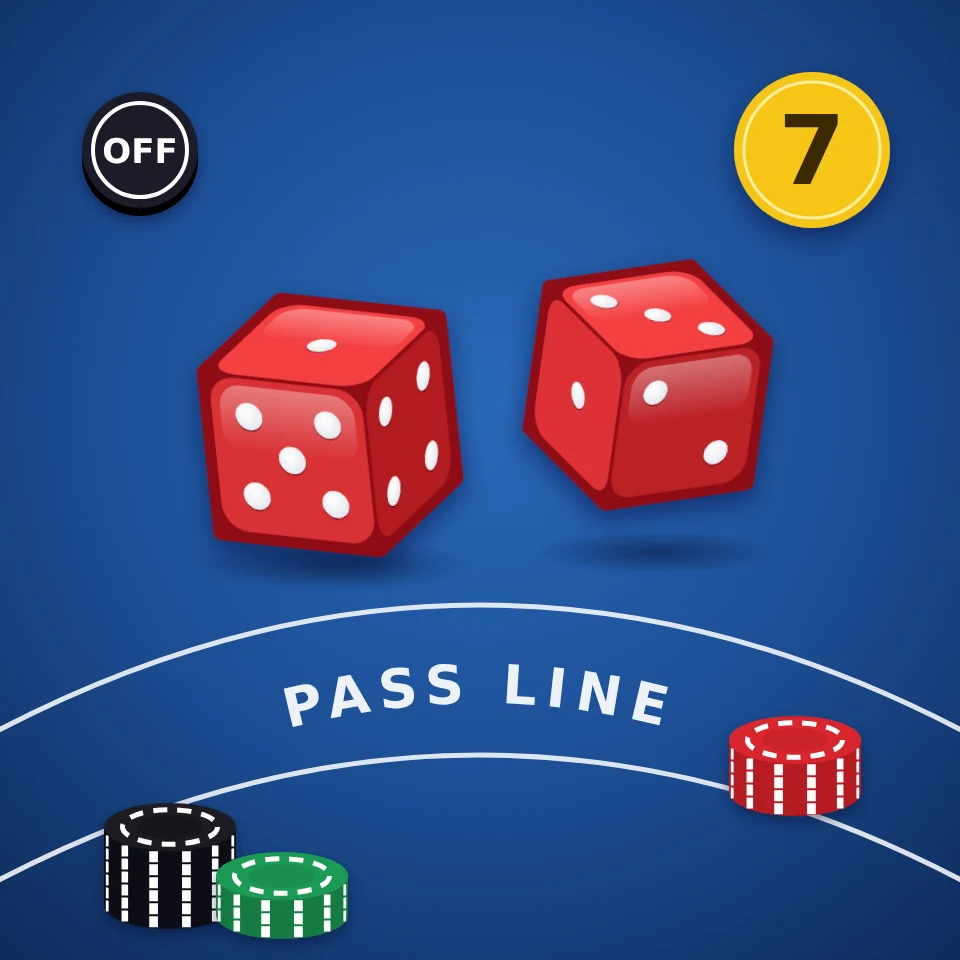
One player, the shooter, throws two dice. The first roll is the come-out roll: a 7 or 11 is a natural and wins the Pass Line, and 2, 3 or 12 is craps and loses it. Any other total, 4, 5, 6, 8, 9 or 10, becomes the point, and the dealer puts the puck on that number with the ON side up.
Now the shooter keeps rolling. If the point comes again before a 7, the Pass Line wins and a new come-out roll starts. If a 7 comes first, that is a seven out: the Pass Line loses and the dice go to the next shooter. All other rolls do not decide the line, but they decide many other bets on the table.
The odds of two dice
Two dice can fall in 36 ways, and the totals are not equally likely. A 7 can be made in six ways, more than any other total, a 6 or 8 in five ways, a 5 or 9 in four, a 4 or 10 in three, a 3 or 11 in two, and a 2 or 12 in just one. That is why 7 is the number that ends a round, and why a point of 6 or 8 is made more often than a point of 4 or 10.
Add it up and the Pass Line wins 244 times out of 495, slightly less than half: a house edge of 1.41%. Don't Pass, with 12 as a push, has an edge of 1.36%.
Odds: the bet without a house edge
Once a point is set, you can put extra chips behind your Pass Line bet. This odds bet pays exactly the true odds of the point coming before a 7: 2 to 1 on 4 and 10, 3 to 2 on 5 and 9, and 6 to 5 on 6 and 8. The casino has no edge on it at all, which is why it is not marked on the layout. Casinos limit how much odds you may take, often 3, 4 and 5 times the line bet on 4 and 10, 5 and 9, and 6 and 8. Players on Don't Pass can lay odds, risking more to win less, also at true odds.
Come, place and the Field
A Come bet is a Pass Line bet made after the point is set: the next roll is its own come-out, and it travels to the next number rolled, which it then needs again before a 7. Place bets let you pick a number yourself: 6 and 8 pay 7 to 6, with an edge of 1.52%, 5 and 9 pay 7 to 5 at 4%, and 4 and 10 pay 9 to 5 at 6.67%. The Field is a one-roll bet on 2, 3, 4, 9, 10, 11 or 12; it looks like many numbers, but the missing 5, 6, 7 and 8 come more often, so the house keeps 2.78% even with 12 paying triple.
Hardways and proposition bets
The middle of the table holds the proposition bets, decided by a single roll, and the hardways. A hardway wins when a number comes as a pair, such as Hard 8 for two fours, before it comes the easy way or a 7 is rolled; Hard 6 and Hard 8 pay 9 to 1 at an edge of 9.09%, Hard 4 and 10 pay 7 to 1 at 11.11%. Any 7 pays 4 to 1 but carries an edge of 16.67%, the worst bet in the casino. Aces and Boxcars pay 30 to 1 at 13.89%, and Ace-Deuce and Yo-leven 15 to 1 at 11.11%. They are fun on a single roll and expensive over an evening.
Playing on PictorX
Open Craps and you stand at a full table with play chips. Point at any box and the line above the dice tells what it pays and its house edge, so you can see at a glance how the bets compare; Hint lights up the best bet for the moment, the Pass Line on the come-out and full odds once there is a point. Choose the odds limit, roll the dice, and follow the point on the puck and the last rolls next to the dice. The chips, the bets and the point are kept in your browser, and every roll is drawn with your browser's cryptographic random number generator.
Frequently asked questions
What does seven out mean?
It is a 7 rolled after a point is set, before the point came again. The Pass Line, the odds behind it, the place bets and the Come bets on their numbers lose, Don't Pass wins, and the dice go to the next shooter.
Is betting Don't Pass bad manners?
Some players see it as betting against the shooter and the rest of the table, so Don't players tend to cheer quietly. It is a perfectly fair bet, with a slightly lower house edge than the Pass Line.
Can a shooter control the dice?
Some players believe that setting the dice and throwing them softly changes the odds. The dice must hit the back wall of the table, which scatters them, and casinos check that they bounce, so there is no proof that dice control works.
Why is 7 so important in craps?
Because it is the most likely total of two dice: six of the 36 ways the dice can fall add up to 7. It wins on the come-out roll and ends the round once a point is set.
Related tools
Craps - roll the dice at a full table
Play craps in your browser with play chips: bet the Pass Line or Don't Pass, take odds, add Come, place, Field, hardway and one-roll bets, and roll the dice. Every box shows what it pays and its house edge.
About Roulette - history, bets and odds
Where roulette comes from, how the European, French and American wheels differ, what every bet pays, where the house edge comes from, and why no betting system beats it.
About Blackjack - history, rules and strategy
Where blackjack comes from, how a round works, what soft hands and the dealer's rules mean, why 6:5 and insurance are poor deals, and how basic strategy cuts the house edge.
Dice probability
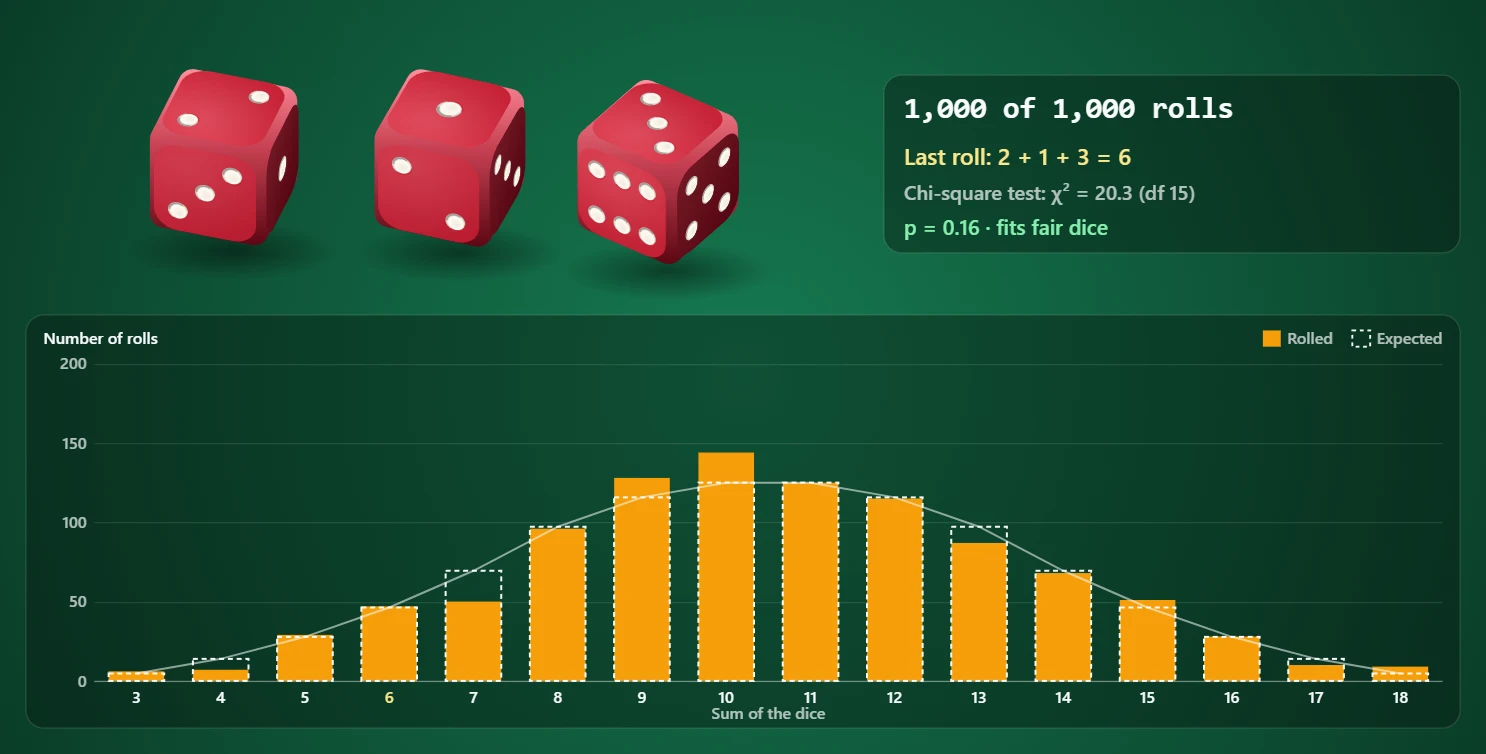
What are the odds when rolling dice? Each face's 1/6 chance, the ways to roll each sum, expected vs observed results, the bell curve and a chi-square test.
About Yahtzee - the dice game of luck and choices
How do you play Yahtzee? Five dice and three rolls, the 13 boxes, the upper bonus, Yahtzee bonuses, the Joker rules and strategy tips to raise your score.
Ready to try it?
Open PictorX in your browser — no install, no credit card required to start.
Play Craps