
About Blackjack - history, rules and strategy
Blackjack is the most popular card game in casinos, and the one where your decisions matter most: with good play the house keeps only a small edge. This page tells where the game comes from, how the rules work and how to play each hand.
Where it comes from
Blackjack grew out of the old European game of twenty-one: Miguel de Cervantes already describes a game called veintiuna in a story from the early 1600s, and the French played vingt-et-un in the 18th century. The game travelled to America, where some gambling houses paid a bonus for an ace of spades together with a black jack. The bonus disappeared, but the name stayed. Blackjack spread through the casinos after Nevada legalised gambling in 1931.
How a round works
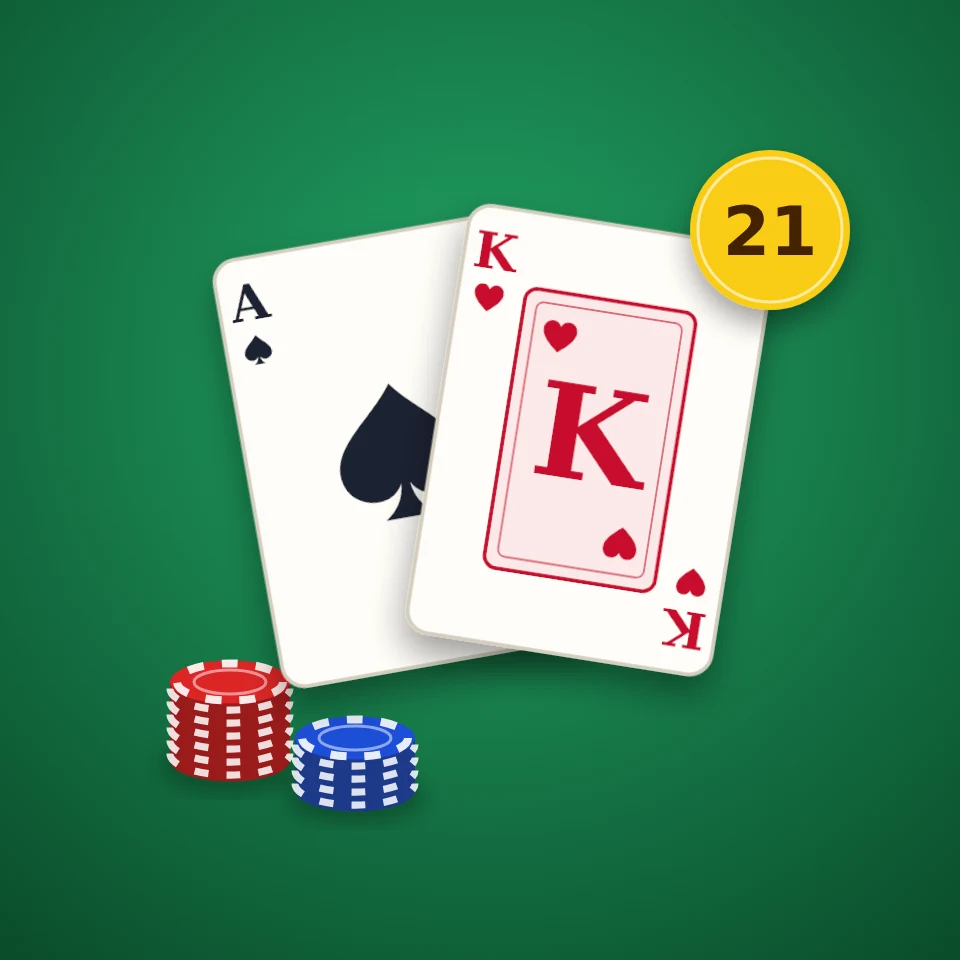
You place a bet, and you and the dealer each get two cards; one of the dealer's cards stays face down, the hole card. Number cards count their number, jacks, queens and kings count 10, and an ace counts 1 or 11, whichever is better. You then take cards (hit) or keep your hand (stand) and try to get closer to 21 than the dealer without going over. Over 21 is a bust and loses at once, even if the dealer busts later.
Soft hands, doubling and splitting
A hand with an ace counted as 11 is soft: ace and six is a soft 17 and cannot bust with one more card. Doubling down doubles your bet for exactly one more card, best on 10 or 11. A pair can be split into two hands, each with its own bet; most casinos let you split again up to four hands, but split aces get just one card each, and 21 after a split counts as 21, not as blackjack.
The dealer's rules
The dealer has no choices. Under American rules the dealer checks the hole card for blackjack when showing an ace or a ten, so you never lose a double or a split to a hidden blackjack. Then the dealer draws until reaching at least 17. Some tables let the dealer stand on soft 17, others make the dealer hit it; standing on soft 17 is better for the player, and the table felt usually says which rule applies.
Payouts and the house edge
A win pays even money, and a blackjack, an ace and a ten-card as the first two cards, traditionally pays 3 to 2: 15 on a bet of 10. Many tables now pay only 6 to 5, which gives 12 on the same bet and raises the house edge by well over a whole percentage point, more than any other common rule change. The casino's edge comes from one rule above all: when you bust, you lose, even if the dealer busts too. With basic strategy and good rules the house edge is around half a percent.
Basic strategy
In 1956 four mathematicians, Roger Baldwin, Wilbert Cantey, Herbert Maisel and James McDermott, published the best play for every hand, worked out with desk calculators. Computers later refined it into basic strategy: a chart of what to do for each of your hands against each dealer card. A few rules cover most of it. Stand on hard 17 and above. Stand on 13 to 16 when the dealer shows 2 to 6, and hit when the dealer shows 7 or higher. Double on 11 and usually on 10. Always split aces and eights, never split tens or fives. The Hint button in the game shows the basic-strategy play for the rules you chose.
Insurance and card counting
When the dealer shows an ace you may take insurance: a side bet of half your stake that pays 2 to 1 if the dealer has blackjack. In a full deck only 16 of the 52 cards are worth ten, so the dealer has blackjack less than a third of the time, and insurance loses money in the long run. In 1962 the mathematician Edward Thorp showed in his book Beat the Dealer that a player who keeps track of the cards already dealt can tell when the rest of the shoe favours the player. That is why casinos deal from shoes of six or eight decks and shuffle long before the end.
Frequently asked questions
Is blackjack a game of luck or skill?
Both. Each hand depends on the cards, but your decisions change the odds more than in any other casino game. Played by basic strategy, the house edge is small; played by hunches, it is several times larger.
Should I ever take insurance or even money?
Not with basic strategy. Even money on your blackjack against a dealer ace is the same bet as insurance. It only pays off for a card counter who knows that many ten-value cards are left.
Why does the dealer win ties sometimes?
The dealer does not win ties: equal totals are a push and your bet comes back. The dealer's real advantage is that you play first, so when you bust you lose before the dealer draws.
Does the number of decks matter?
A little. Fewer decks are slightly better for the player, because blackjacks and good doubles come up a bit more often, and the strategy changes in a few close cases. Rules such as 3:2 against 6:5 or the soft 17 rule matter more.
Related tools
Blackjack
Play blackjack free in your browser: bet with chips, hit, stand, double, split and take insurance against the dealer. Choose 1 to 8 decks, 3:2 or 6:5 and the soft 17 rule, and let Hint show the basic-strategy play.

Hi-Lo card counting
Learn Hi-Lo card counting at a blackjack table in your browser: +1, 0 or −1 for every card, the running count, the true count and the bet. Practise the count, count down a deck, or play a million rounds.
Hi-Lo card counting
How does Hi-Lo card counting work? The +1, 0 and −1 values, the running and true count, why tens and aces help the player, the edge and whether it is legal.
About FreeCell - history, rules and strategy
Where FreeCell comes from, how the free cells and columns work, why almost every deal can be won, what the game numbers are and how to plan your moves.
About Hearts - history, rules and strategy
Where the card game Hearts comes from, from Reversis to Black Lady and the Hearts that came with Windows, how passing and scoring work, what shooting the moon is and how to play well.
Ready to try it?
Open PictorX in your browser — no install, no credit card required to start.
Play Blackjack