
Zeno's paradoxes
Two and a half thousand years ago Zeno of Elea argued that nothing can move: before you reach the door you must reach the halfway point, then half of the rest, and so on forever. Achilles can never overtake a tortoise, and a flying arrow is motionless at every instant. Step through the arguments one move at a time, then let the steps run in their real time and watch the runner arrive, because infinitely many steps can fit into a finite time. Choose a paradox. Step adds the next of Zeno's infinitely many steps; Play runs them, either one per beat, which never ends, or each in its own time, which ends exactly when the runner arrives. For Achilles, set the tortoise's head start and both speeds. For the arrow, choose the moment to freeze it and press Step to halve the time interval: the average speeds over shorter and shorter intervals close in on the speed at that instant.
How it works
- Choose a paradox: the dichotomy, Achilles and the tortoise, or the arrow.
- Press Step to take the next of Zeno's steps, or Play, with each step taking the same time or its real time.
- Read the tiles, the chart of the sums against their limit and the table of steps, and change the head start, speeds or the frozen moment.
Infinitely many steps, one finite total
The dichotomy splits a run into halves: 1/2 of the way, then 1/4, then 1/8, without end. Zeno concluded that the runner can never finish, because there is always another step to take. Yet the sum 1/2 + 1/4 + 1/8 + … is exactly 1: after n steps 1 − 1/2ⁿ is covered, and the gap 1/2ⁿ becomes smaller than any distance you care to name. At a steady speed each step also takes half as long as the one before, so all of them together take a finite time. Play the steps one per beat and the runner seems to crawl forever; play them in their real time and the runner arrives on schedule.
Achilles, the tortoise and the arrow
Give the tortoise a head start of 10 m and let Achilles run ten times as fast. When he reaches its starting point, it has crept 1 m further; when he covers that metre, it has gone 10 cm more, and so on. The gaps shrink by the same factor each time, a geometric series, and the times add up to 10/9 of a second: that is when, and where, he draws level. The arrow paradox is different: at a single instant the arrow does not move, so how can it fly? The answer is that speed at an instant is a limit, the value that the average speed over an interval approaches as the interval shrinks to zero.
Frequently asked questions
How can infinitely many numbers add up to a finite number?
When they shrink fast enough. In a geometric series a + ar + ar² + … each term is r times the one before, and if r is between −1 and 1 the partial sums approach a / (1 − r). For 1/2 + 1/4 + … that is (1/2) / (1 − 1/2) = 1. Not every shrinking series converges: 1 + 1/2 + 1/3 + 1/4 + … grows without limit, very slowly.
When does Achilles catch the tortoise?
With head start d, Achilles' speed va and the tortoise's speed vt, he catches it after d / (va − vt) seconds, at a distance of d · va / (va − vt) from his start. The app also adds up Zeno's steps one by one and shows that their total time approaches exactly this value.
Did calculus solve Zeno's paradoxes?
It solved the mathematical side. The rigorous theory of limits and convergent series, developed by Cauchy, Weierstrass and others in the 19th century, shows precisely how infinitely many steps can have a finite sum and how speed at an instant is defined. Some philosophers argue that the deeper question, whether completing infinitely many tasks makes sense physically, is a separate matter.
What does the arrow chart show?
The average speed of the arrow over shorter and shorter intervals starting at the frozen moment, against the exact speed at that moment. Each time the interval is halved, the average speed gets closer to the speed at the instant, which is how a derivative is defined.
Is anything sent to a server?
No. All calculations and drawings run in your browser, and your last settings stay in this browser's local storage.
Related tools
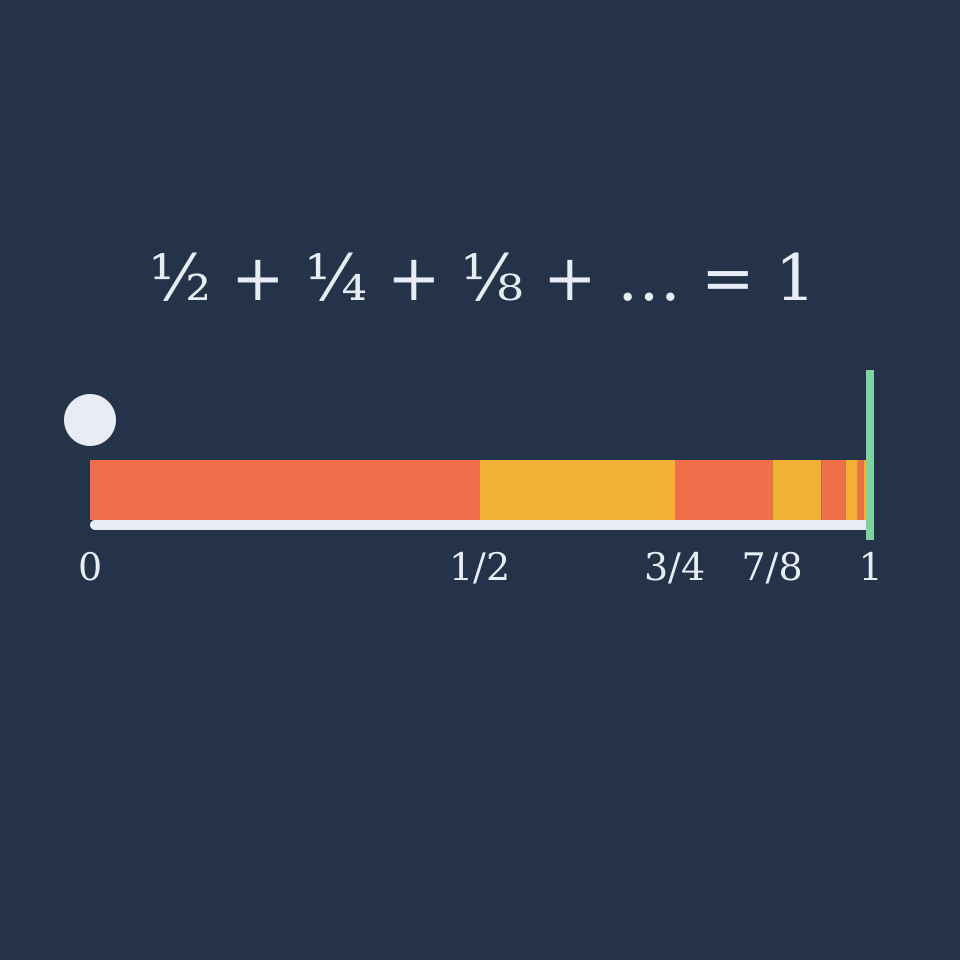
Zeno's paradoxes explained
What Zeno of Elea argued about motion, why infinitely many steps can take a finite time, how geometric series and limits answer the dichotomy, Achilles and the arrow, and what remains debated.
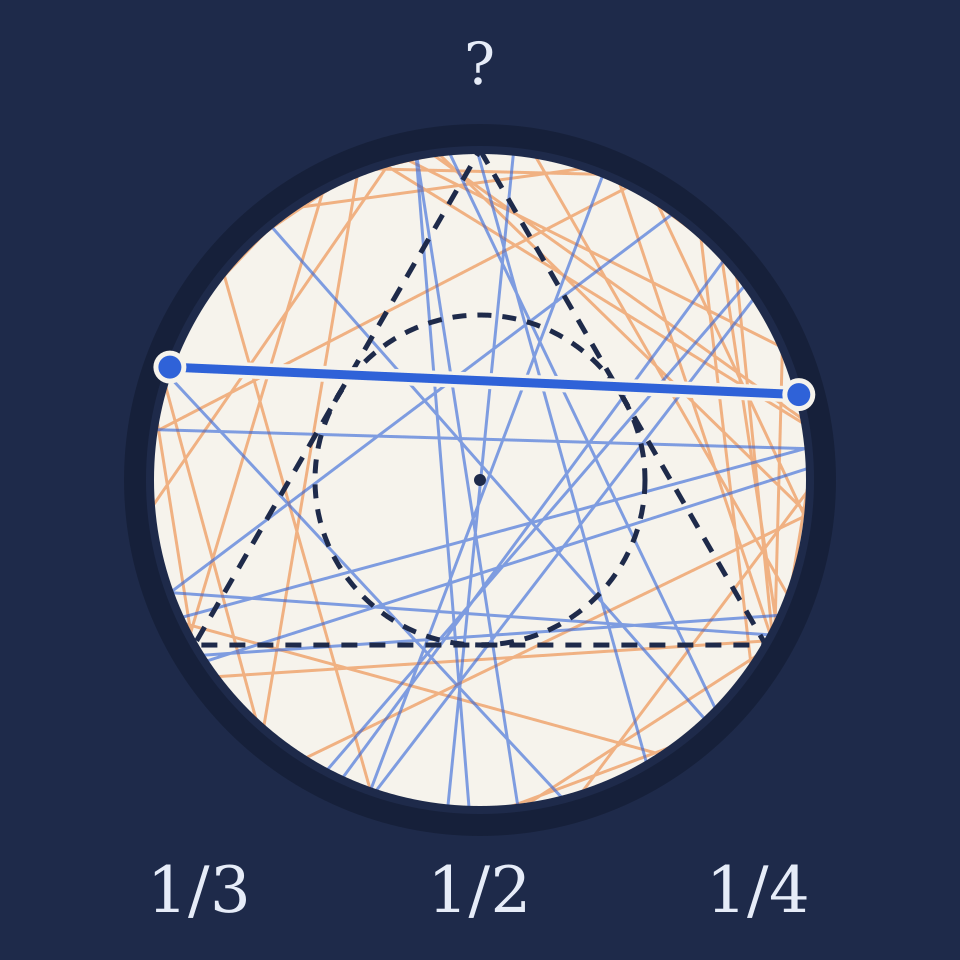
Bertrand's paradox
Draw random chords of a circle four ways and watch the share longer than the triangle's side settle at 1/3, 1/2 or 1/4. See the midpoints, the theory curve, and Jaynes's straws.

Two envelopes paradox
See why switching envelopes is not always better. Open one amount, compare the tempting 1.25 times average with the correct expectation, and run 10,000 pairs.

The birthday paradox
In a group of 23 people the chance that two share a birthday is 50.7%, and with 57 people it is 99%. See all 253 pairs, the calendar and the curve, and test thousands of random groups in your browser.
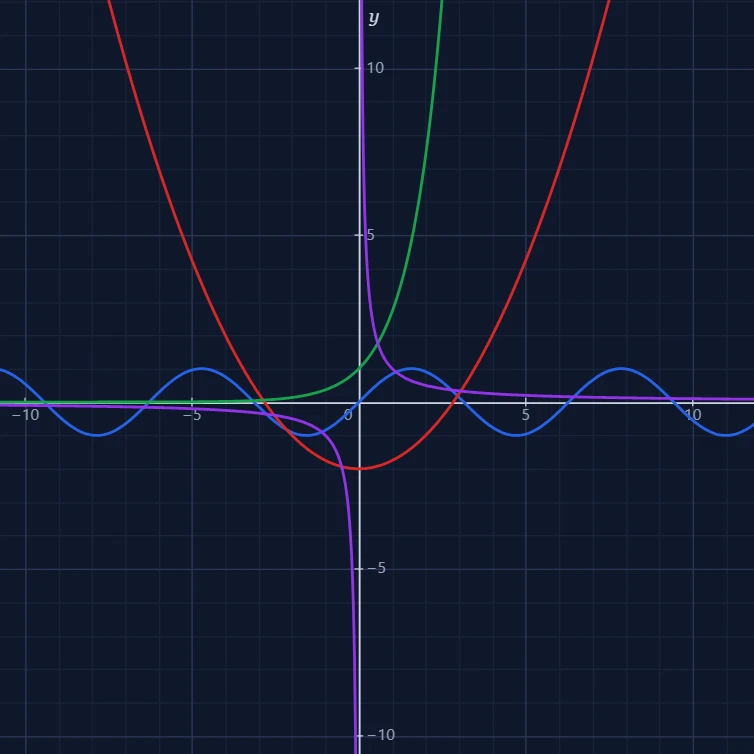
Function plotter
A free online function plotter: draw x², sin x, ln x, 1/x and your own formulas on an interactive grid. Pan, zoom, trace x and y, and save the graph as a PNG.
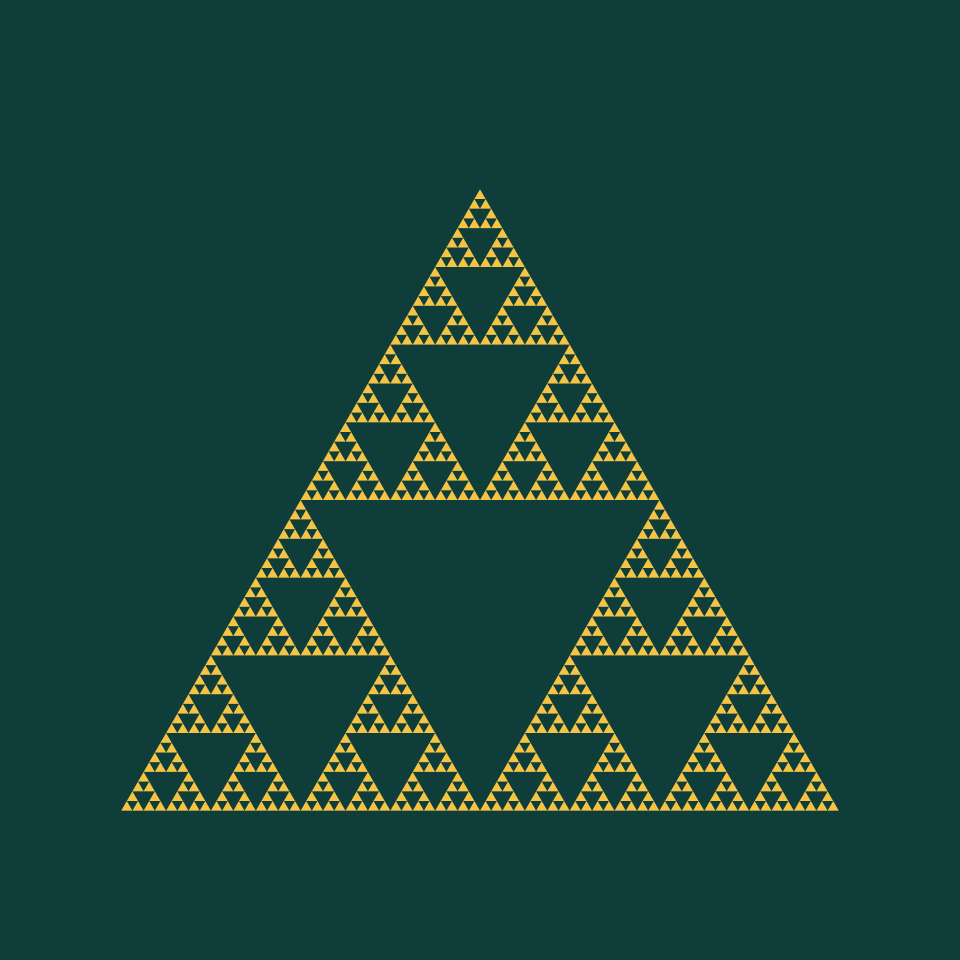
Sierpiński triangle builder
Build the Sierpiński triangle by removing middles, by the chaos game or from Pascal's triangle mod 2. Try other corners, jumps and rules, and see area, triangles and the fractal dimension 1.585.
Ready to try it?
Open PictorX in your browser — no install, no credit card required to start.
Go to Editor