
Zeno's paradoxes explained
Around 450 BC, in the Greek colony of Elea in southern Italy, the philosopher Zeno set out to defend his teacher Parmenides, who held that change and motion are illusions. His arguments were so simple and so hard to refute that they puzzled thinkers for more than two thousand years, and they forced mathematics to say precisely what infinity, a sum and a moment of time really are.
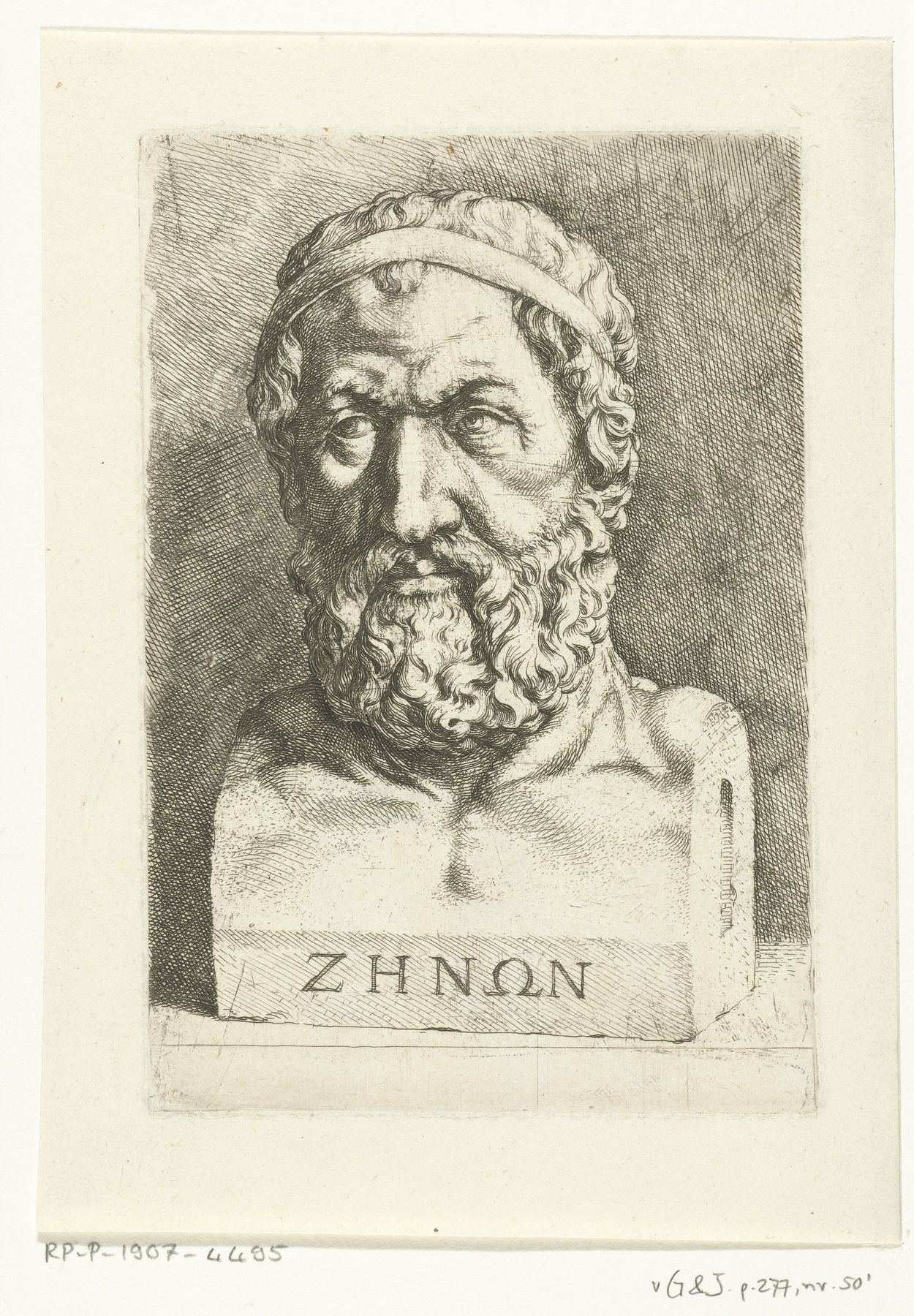
Who was Zeno?
Zeno of Elea lived in the 5th century BC. None of his writings survive; we know his arguments mainly through Aristotle's Physics and through Plato, who describes Zeno visiting Athens with Parmenides. Zeno is said to have written forty paradoxes. The four about motion are the most famous: the dichotomy, Achilles and the tortoise, the arrow and the stadium. Aristotle called him the inventor of dialectic, arguing by drawing absurd conclusions from an opponent's assumptions.
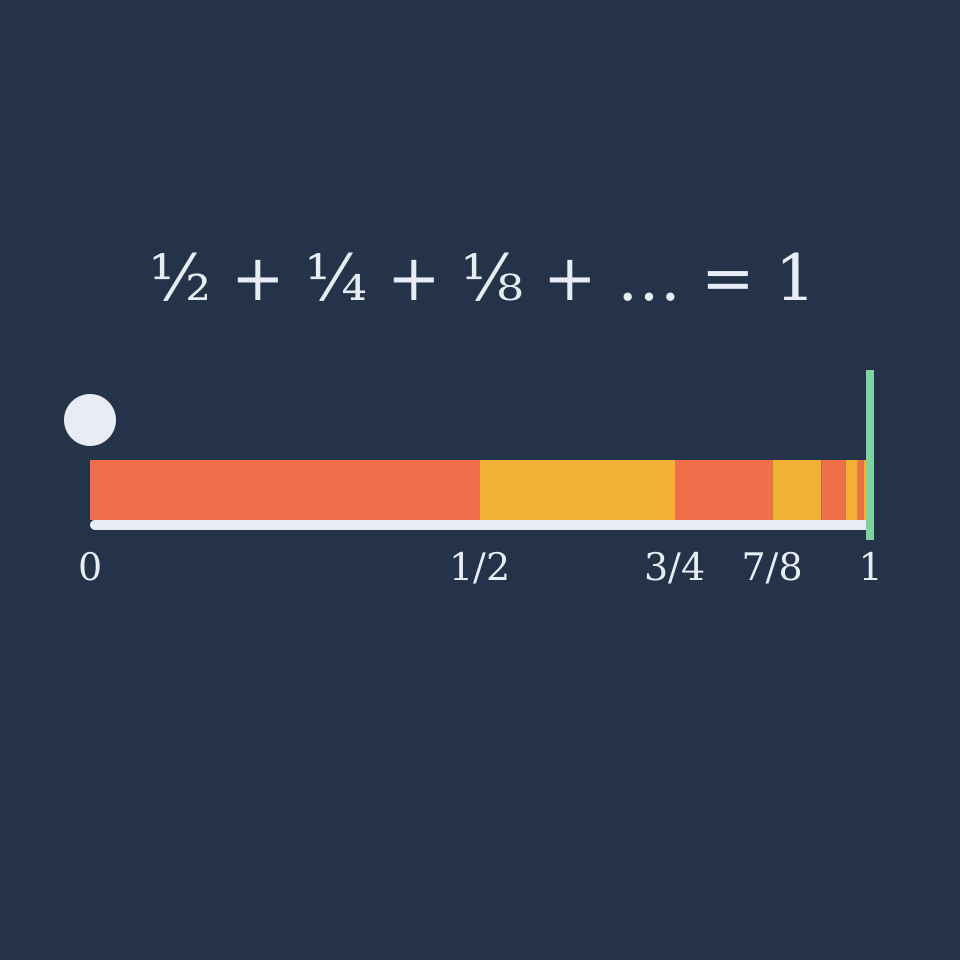
The dichotomy
To walk to a wall you must first walk half the way. Then you must walk half of the remaining distance, then half of what remains after that, and so on: an endless list of tasks. Zeno argued that no one can complete infinitely many tasks, so no one can reach the wall, or even start, since before walking half the way you must walk a quarter, and before that an eighth. The distances are 1/2, 1/4, 1/8, …, and the times at a steady pace shrink in the same proportion.
Achilles and the tortoise
The swift hero Achilles races a tortoise that starts some way ahead. By the time Achilles reaches the tortoise's starting point, the tortoise has moved a little further. By the time he reaches that new point, it has moved again, and so it seems to go on forever: Achilles must always first reach the place the tortoise has just left. The argument has the same structure as the dichotomy, but it makes the paradox vivid, because everyone knows that the faster runner wins.
Geometric series
The mathematical answer is that an infinite sum can be finite. In a geometric series each term is the previous one multiplied by a fixed ratio r. The sum of the first n terms of a + ar + ar² + … is a(1 − rⁿ) / (1 − r), and when r is smaller than 1 the term rⁿ vanishes as n grows, leaving a / (1 − r). Archimedes already summed such a series, 1 + 1/4 + 1/16 + … = 4/3, to find the area of a parabola segment around 250 BC. For Achilles running ten times as fast as a tortoise with a 10 m head start, the times are 1 s, 0.1 s, 0.01 s, …, adding up to 10/9 s.
The arrow
Zeno's arrow argument goes the other way: it slices time into instants instead of distance into parts. At any instant the arrow occupies a space exactly its own size and does not move within that instant. Time is made of instants, so the arrow never moves. The modern answer is that speed is not defined at an instant by distance over time, which would be zero divided by zero, but as a limit: the average speed over an interval from t to t + Δt approaches a definite value as Δt shrinks. That value is the derivative of position, the idea at the heart of the calculus of Newton and Leibniz.
Limits made precise
For a long time mathematicians used infinitely small quantities without a clear definition, and the philosopher George Berkeley mocked them as ghosts of departed quantities. In the 19th century Augustin-Louis Cauchy and Karl Weierstrass gave limits a precise meaning: a sequence approaches L if, for any tolerance however small, all terms from some point on stay within that tolerance of L. With that definition, 1 − 1/2ⁿ approaches 1 and the paradoxes lose their mathematical force.
What remains debated
Some philosophers say that summing a series answers how far and how long, but not how a runner can actually complete an infinite sequence of tasks, a so-called supertask. Others reply that the steps are just a way of describing one continuous run, not separate actions. Physics adds its own twist: in quantum mechanics, the quantum Zeno effect describes how watching an unstable system often enough can stop it from changing, a real effect named after the arrow.
Explore it
Open Zeno's paradoxes to take the dichotomy one halving at a time, race Achilles against a tortoise with any head start and speeds, and freeze the arrow at any moment of its flight. Play the steps one per beat to feel Zeno's endless regress, then in their real time to see the runner arrive, and follow the partial sums and average speeds as they approach their limits.
Frequently asked questions
What is the stadium paradox?
Zeno's fourth paradox of motion imagines three rows of bodies, one at rest and two moving past it in opposite directions at the same speed. A body in a moving row passes two bodies of the other moving row in the time it passes one body of the resting row, which Zeno took to show that half a time equals its double. It is usually read as an argument against time and space being made of indivisible smallest units.
Was Zeno serious?
He was defending Parmenides' view that reality is one and unchanging by showing that the common sense belief in motion and plurality leads to contradictions. Whether he believed motion was impossible, or only wanted to show that his opponents' assumptions were as troublesome as his teacher's, is debated.
Do the paradoxes matter outside philosophy?
They pushed mathematics towards rigorous ideas of infinity, limits and continuity, which underlie calculus, physics and engineering. Every time software computes a sum of a series or a speed from positions, it uses the answers to Zeno's questions.
Does every shrinking sequence of steps add up to a finite total?
No. The steps must shrink fast enough. Steps of 1, 1/2, 1/3, 1/4, … get smaller and smaller, but their sum, the harmonic series, grows without limit. A runner taking those steps would never stop moving forward and would eventually pass any finish line.
Related tools
Zeno's paradoxes
Step through Zeno's dichotomy, race Achilles against the tortoise and freeze the flying arrow. See infinitely many steps add up to a finite total, and speed emerge as a limit.
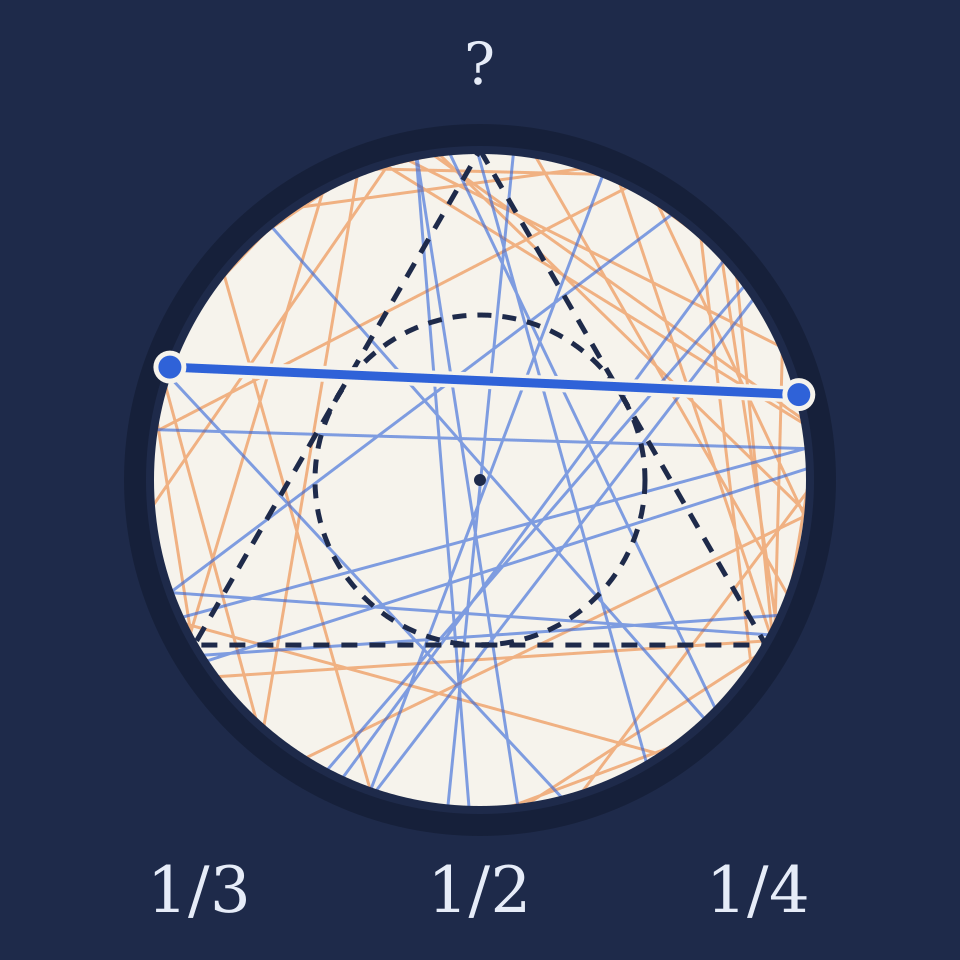
Bertrand's paradox
Draw random chords of a circle four ways and watch the share longer than the triangle's side settle at 1/3, 1/2 or 1/4. See the midpoints, the theory curve, and Jaynes's straws.
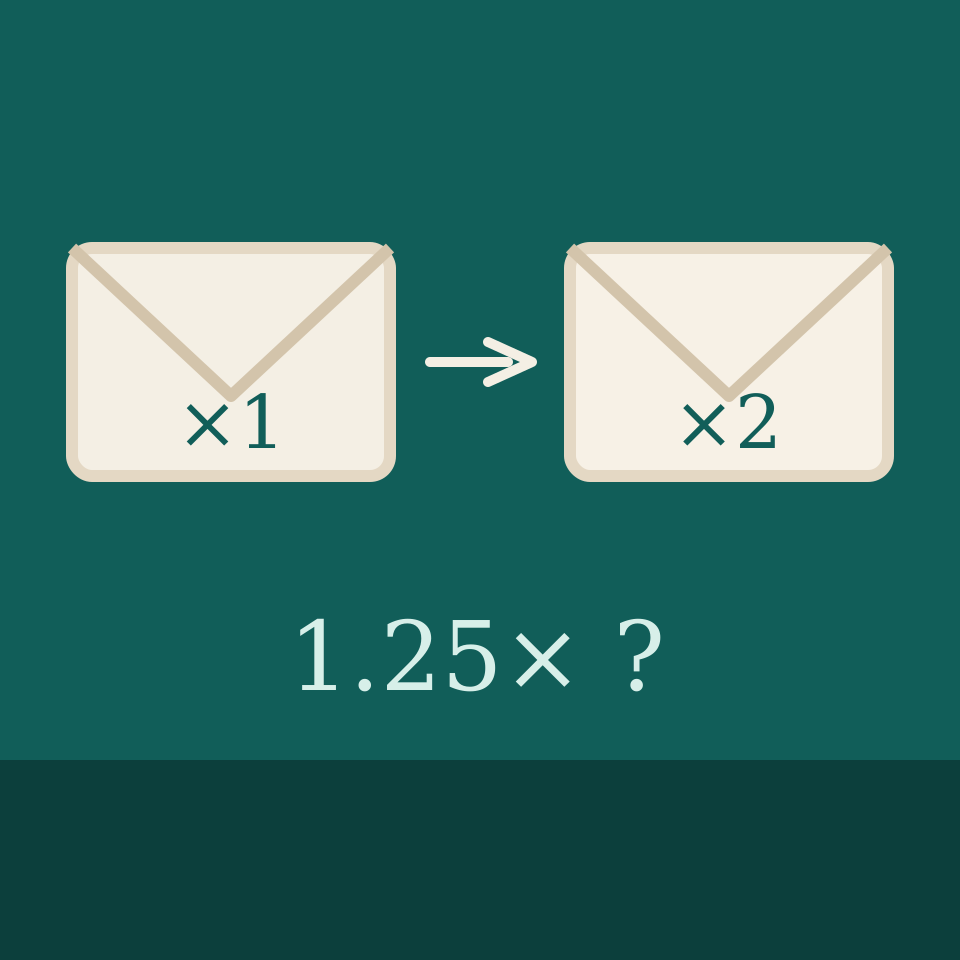
Two envelopes paradox
See why switching envelopes is not always better. Open one amount, compare the tempting 1.25 times average with the correct expectation, and run 10,000 pairs.
Function plotter
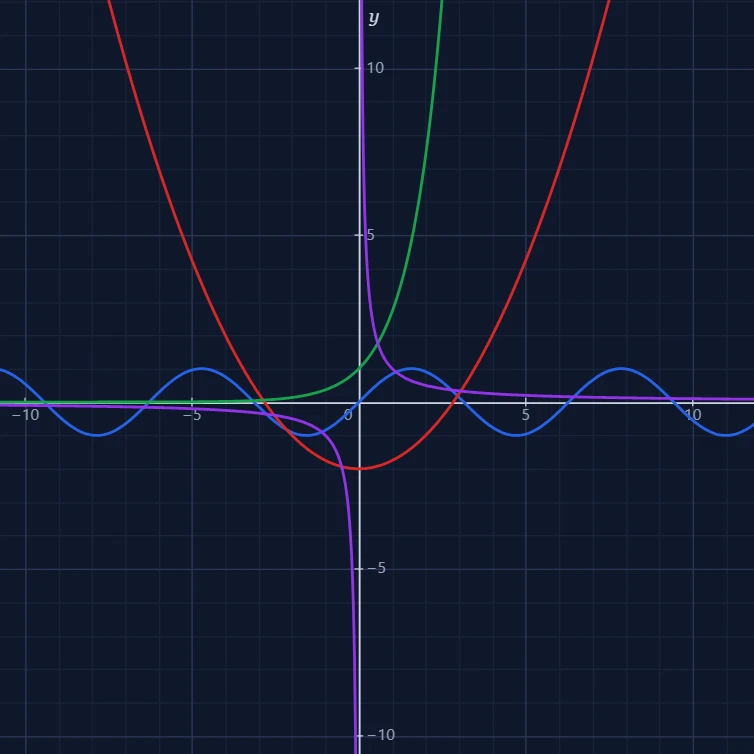
A free online function plotter: draw x², sin x, ln x, 1/x and your own formulas on an interactive grid. Pan, zoom, trace x and y, and save the graph as a PNG.
Sierpiński triangle builder
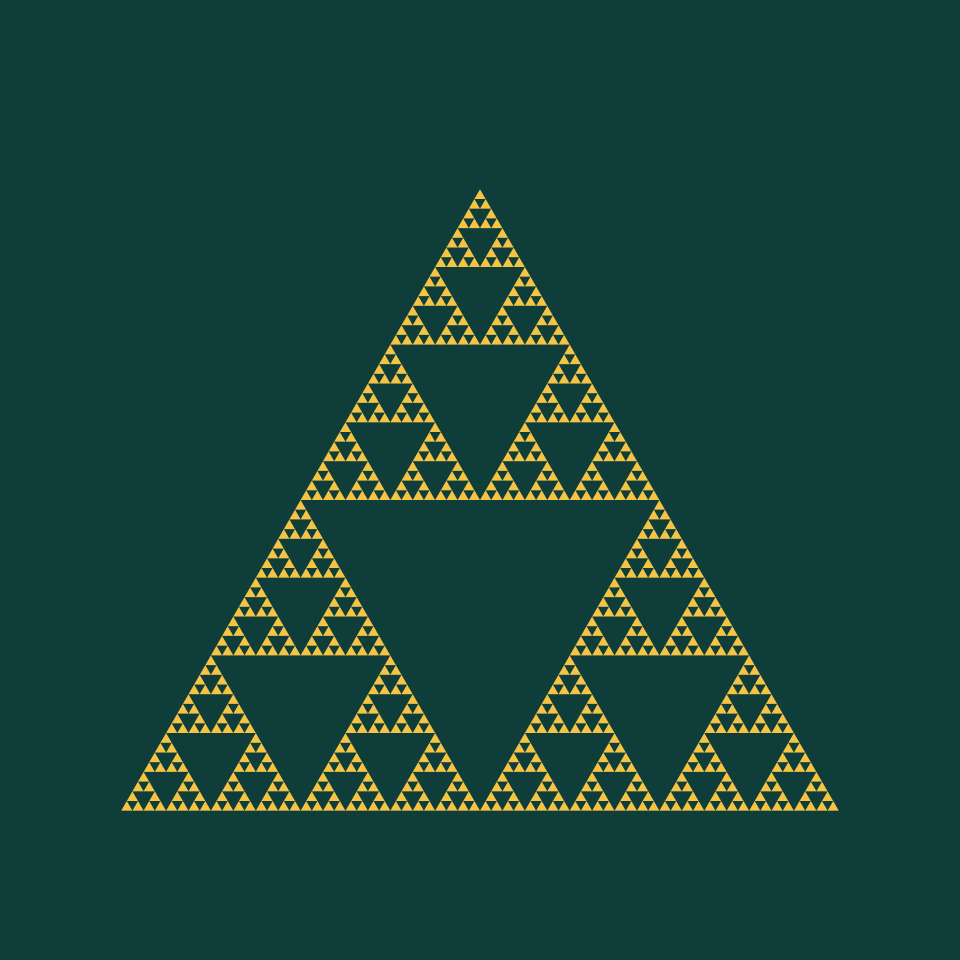
Build the Sierpiński triangle by removing middles, by the chaos game or from Pascal's triangle mod 2. Try other corners, jumps and rules, and see area, triangles and the fractal dimension 1.585.
Ready to try it?
Open PictorX in your browser — no install, no credit card required to start.
Open Zeno's paradoxes