
Time dilation and the twin paradox
Moving clocks run slow. At everyday speeds the effect is far too small to notice, but near the speed of light it becomes enormous: a twin who flies to Alpha Centauri at 80 % of the speed of light and back comes home more than four years younger than the twin who stayed on Earth. Here you can fly the trip yourself, watch both clocks, and see in a spacetime diagram why the two twins do not age alike, even though each sees the other's clock running slow. Pick an example, or set the speed (a fraction of the speed of light c) and the distance yourself. One twin stays on Earth, the other flies to a star and back. Play runs the trip, Step and Back move by a few years, Reset starts again, and you can drag on the spacetime diagram to pick a moment. In the diagram time goes up and distance to the right, so light travels at 45°: Earth's worldline goes straight up, the traveller's goes out and back. Each twin sends a light signal every year of their own time. The purple lines are the traveller's "now", the moments on Earth the traveller calls simultaneous; they jump at the turnaround. The tiles give the Lorentz factor γ, both twins' times, the difference in their ages and the distance the traveller measures. The light clocks show why a moving clock runs slow: its photon has a longer, slanted path. Try the muon falling through the atmosphere, the 1 g rocket and the GPS satellite, whose clock gains 38 microseconds a day. With Sound on, each clock ticks once a year, Earth's at a higher pitch; Record films it with the sound.
How it works
- Pick an example, such as Alpha Centauri at 0.8c, or set the speed and the distance yourself, and press Play to fly the trip.
- Watch the tiles and the clocks: the Lorentz factor γ, Earth's time, the traveller's time, the difference in their ages and the distance the traveller measures, shortened by γ.
- Follow the spacetime diagram: the light signals each twin sends once a year, and the purple lines of simultaneity that jump at the turnaround. Drag on the diagram to pick a moment.
- Try the 1 g rocket, the muon that reaches the ground only thanks to time dilation, and the GPS satellite whose clock gains 38 microseconds a day; switch Sound on to hear each clock tick and record a video.
Moving clocks run slow
A clock moving at speed v ticks slower, as seen from the frame it moves through, by the Lorentz factor γ = 1/√(1 − v²/c²). At 0.6c γ is 1.25, at 0.8c 1.67, at 0.99c about 7.1. The light clock shows why: a pulse of light bounces between two mirrors, and in the moving clock it must travel a longer, slanted path at the same speed c, so each tick takes γ times as long. Every process in the moving frame, atoms, hearts and ageing, slows down by the same factor, because the laws of physics are the same in every frame.
The twin paradox
One twin flies to Alpha Centauri, 4.37 light years away, at 0.8c and comes straight back. On Earth 10.9 years pass; the traveller's clock shows only 6.6 years, so the traveller comes home 4.4 years younger. The paradox: from the ship, Earth moves at 0.8c, so shouldn't Earth's clock run slow? The two twins are not equal: the traveller turns round, changing from one frame of motion to another, while the Earth twin stays in one. Of all paths between the departure and the return, the straight worldline of the twin who stays at home has the longest proper time.
Lines of simultaneity and the jump
Which moment on Earth is happening 'now' depends on how you move. In the spacetime diagram the traveller's 'now' is a tilted line, and its tilt is the speed. On the way out it meets Earth's worldline early; at the turnaround the tilt flips, and the traveller's 'now' on Earth jumps forward by 2vL/c², 7 years for Alpha Centauri at 0.8c. Nothing strange happens on Earth during those years; the traveller simply changes which events count as simultaneous. With an acceleration phase the lines sweep round instead of jumping.
Light signals and the Doppler effect
Suppose each twin sends a flash every year. The arrival of a flash is not a matter of opinion, and the flashes settle the paradox. On the way out the traveller receives Earth's flashes slowly, at √((1 − β)/(1 + β)) per year, one every three years at 0.8c, and on the way back fast, three a year: the relativistic Doppler effect. Earth receives the traveller's flashes slowly for most of the trip and fast only after the light from the turnaround arrives, late. Both twins agree on every flash counted, and on their ages when they meet again.
Frequently asked questions
What is time dilation?
The slowing of a moving clock as seen from the frame it moves through. A clock moving at speed v ticks once for every γ = 1/√(1 − v²/c²) ticks of the clocks at rest. It is not an illusion or a fault of the clocks: it has been measured with atomic clocks in aircraft and satellites, and with fast particles that live γ times longer than at rest.
How do I calculate the Lorentz factor?
γ = 1/√(1 − β²), where β = v/c is the speed as a fraction of the speed of light. At β = 0.8, β² = 0.64, 1 − β² = 0.36, √0.36 = 0.6 and γ = 1/0.6 = 1.667. A trip that takes 10 years on Earth then takes 10/1.667 = 6 years on the moving clock. γ only becomes large close to c: 2 at 0.866c, 7.1 at 0.99c, 22.4 at 0.999c.
Why is the travelling twin younger and not the other way round?
Because the situation is not symmetric. The Earth twin stays in one inertial frame the whole time; the traveller changes frame at the turnaround, and can feel it. In the spacetime diagram the two twins take different paths between the same two events, the departure and the reunion, and the straight path of the twin who stays has the longest proper time. Acceleration is not what slows the clock: with a quicker turnaround the difference stays almost the same.
Why do muons from cosmic rays reach the ground?
Muons are made about 15 km up when cosmic rays hit the air, and they live only 2.2 microseconds on average. Even at 0.995c they would cover only about 660 m in that time, so almost none should reach the ground. Their clocks run slow by γ ≈ 10, so in our frame they live about 22 microseconds, and about 10 % survive the 50-microsecond fall. In the muon's frame the atmosphere is contracted to 1.5 km instead. Both views give the same count at the ground.
Do GPS satellites need relativity?
Yes. A GPS satellite moves at 3.9 km/s, so special relativity slows its clock by about 7 microseconds a day; it is also 20,200 km up, where gravity is weaker, so general relativity speeds it up by about 46 microseconds a day. The net 38 microseconds a day would add a position error of about 11 km a day, so the satellites' clocks are set to tick slightly slow before launch. On the space station the speed wins, and its clocks lose about 25 microseconds a day.
Can I use the picture?
Yes. Save gives a PNG at the size you choose, and the pencil opens the picture in the PictorX photo editor with the background, the grid, each worldline, the simultaneity lines, the light signals, the trip, the ship, the clocks, the light clocks and the labels on layers of their own, and the caption as editable text. In the editor itself it is under Apps ▸ Science ▸ Physics ▸ Time Dilation & Twin Paradox, where you pick the example, the trip, the speed, the distance and the moment. Everything runs in your browser.
Time Dilation & Twin Paradox: how do I record a video?
Press the red Record button in the playback bar: it films what the stage shows. Press it again to stop, and the video is saved to your device. Recording is free; you only need to sign in. Without a subscription the video carries a small PictorX logo in a corner. The button beside Record opens the video options: the shape (as shown, square, story 9:16 or wide 16:9), the length (until you stop, or 5, 10, 15 or 30 seconds for social media) and the file: MP4, WebM or an animated GIF. For the sound, choose the app's own sounds or one of three music tracks: calm, bright or beat.
Related tools
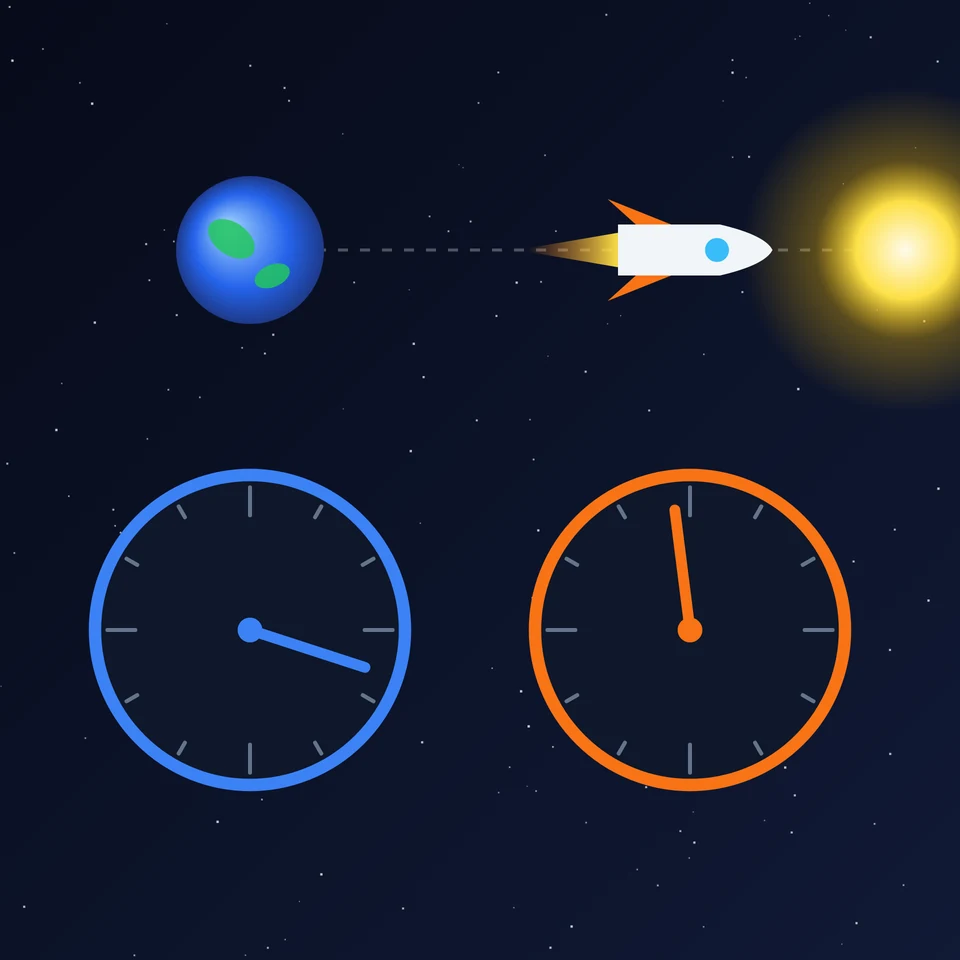
Time dilation and the twin paradox explained
How time dilation works: the light clock and the Lorentz factor, the twin paradox and why the traveller comes home younger, the relativity of simultaneity, the relativistic Doppler effect, muons from cosmic rays, atomic clocks on aircraft and the relativity inside GPS.
The Doppler effect: hear the pitch change
Watch and hear the Doppler effect: an ambulance, a train, a race car or a jet passes and its wavefronts crowd together in front and spread out behind. Hear the siren drop in pitch as it passes, push past Mach 1 for the Mach cone and the sonic boom, with real speeds of sound and frequencies.
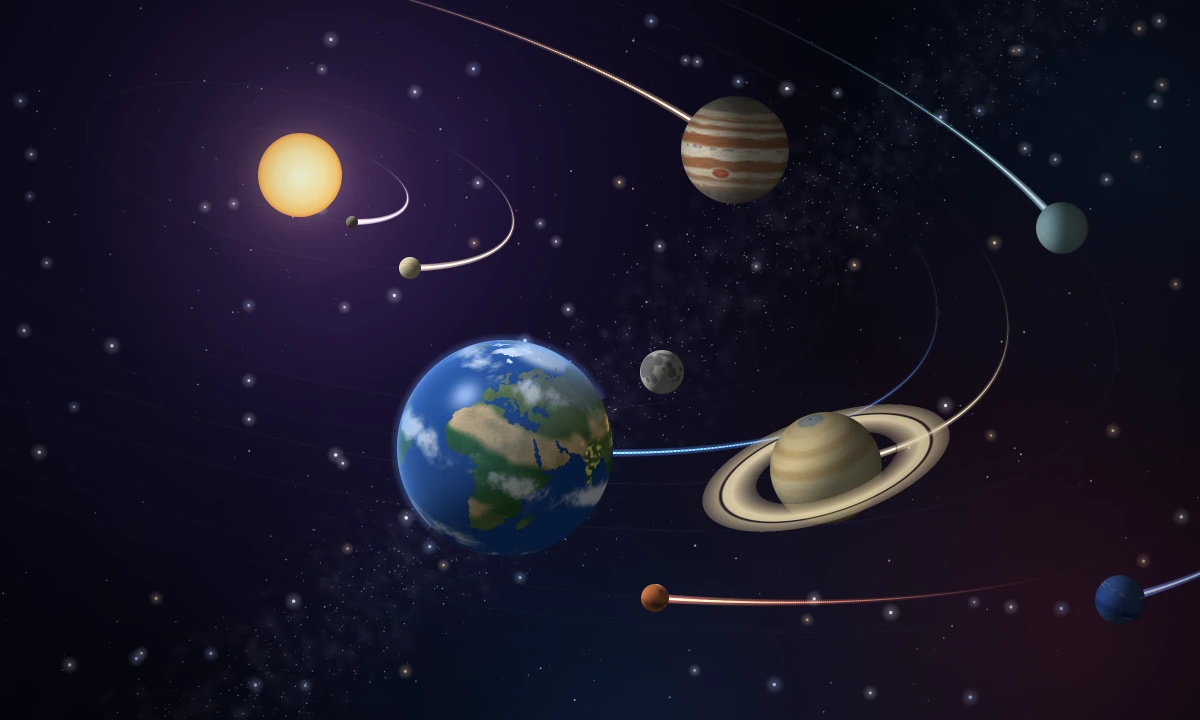
Solar System
Fly through the solar system in 3D in your browser. The sun, eight planets, their largest moons, the dwarf planets, and the Kuiper belt move on their real, tilted orbits under Newton's gravity.
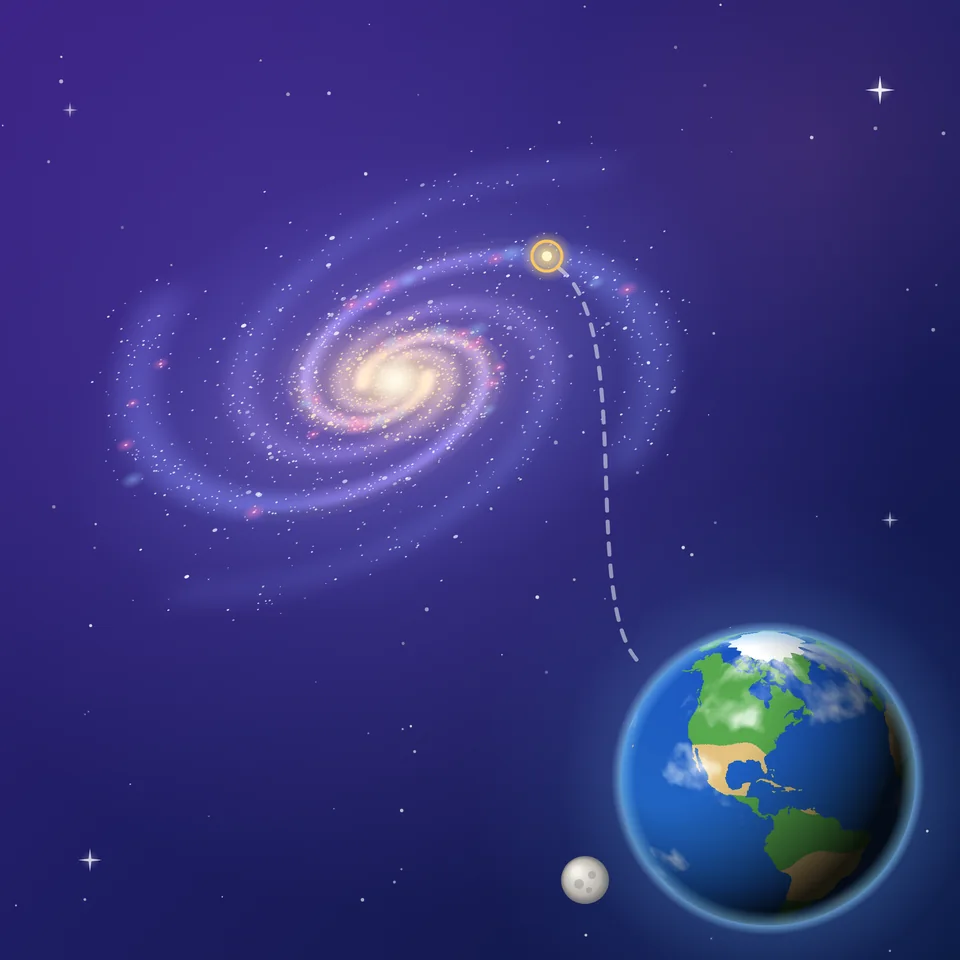
Lost in the Universe - could you find your way home?
A free space game and science app: you are lost somewhere in the universe. Follow the cosmic web, Laniakea, the Virgo Cluster and the Milky Way back home to Earth.
Ready to try it?
Open PictorX in your browser — no install, no credit card required to start.
Go to Editor