
Time dilation and the twin paradox explained
In 1905 Albert Einstein showed that time does not pass at the same rate for everyone: a clock that moves runs slow compared with clocks at rest. The effect is tiny at the speeds of everyday life but huge near the speed of light, and it leads to the most famous puzzle of relativity, the twin paradox. This page explains where time dilation comes from, how to calculate it, why the travelling twin really comes home younger, and where it is measured every day, from cosmic-ray muons to the GPS in your phone.
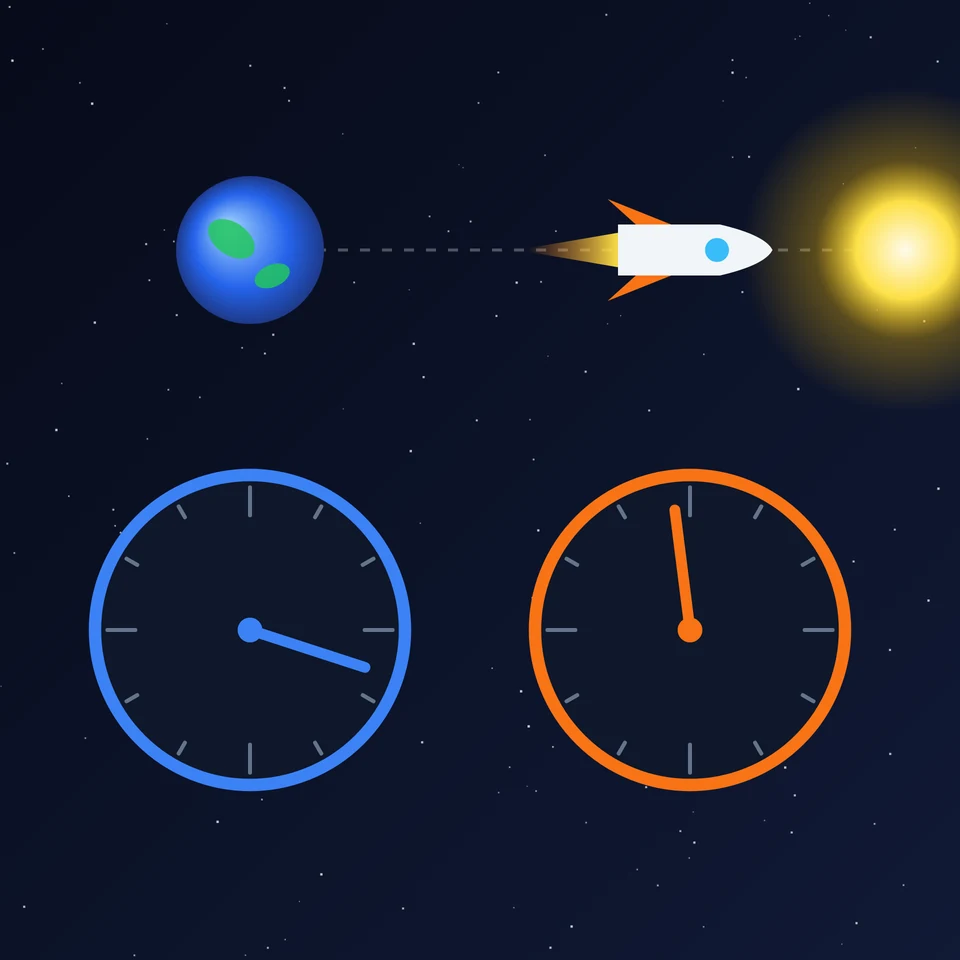
Einstein's two postulates
Special relativity rests on two ideas. First, the laws of physics are the same for everyone moving at a constant velocity: no experiment inside a smoothly moving train can tell you how fast it is going. Second, light in a vacuum always travels at the same speed, c = 299,792,458 m/s, whoever measures it and however the source moves. The second sounds harmless, but together with the first it means that time and distance must depend on motion, because otherwise two observers moving relative to each other could not both measure the same speed for the same flash of light.
The light clock
Imagine a clock made of two mirrors a distance d apart, with a pulse of light bouncing between them; each round trip is a tick. At rest a tick takes 2d/c. Now let the clock move sideways at speed v. Seen from the ground, the light travels along a slanted zigzag, longer than 2d, and it still moves at c, so each tick takes longer. Pythagoras gives the factor: the moving clock ticks γ = 1/√(1 − v²/c²) times slower. Every other clock in the moving frame, mechanical, atomic or biological, must keep in step with the light clock, or the traveller could tell that they were moving.
The Lorentz factor
The factor γ is almost exactly 1 at everyday speeds: for an airliner at 250 m/s it differs from 1 by a third of a millionth of a millionth. It is 1.25 at 60 % of the speed of light, 1.67 at 80 %, 2 at 86.6 %, 7.1 at 99 % and 22.4 at 99.9 %, and it grows without limit as v approaches c. The same factor shortens moving objects along their motion (length contraction): for the traveller at 0.8c, the 4.37 light years to Alpha Centauri are only 2.62 light years, which is why the traveller covers them in 3.3 years of their own time without moving faster than light.
The twin paradox
Paul Langevin posed the puzzle in 1911, with a traveller in a cannonball. One twin flies to a star and back at high speed; the other stays at home. On return the traveller is younger: at 0.8c to Alpha Centauri, 10.9 years pass on Earth and 6.6 years on the ship. The apparent paradox is that each twin sees the other moving, so each should see the other's clock run slow. But the twins are not symmetric: the traveller turns round and feels it, while the Earth twin stays in one inertial frame. In a spacetime diagram they take different paths between the same two events, and proper time, the time a clock carried along a path shows, is greatest on the straight path.
Simultaneity is relative
Two events that are simultaneous for one observer are not simultaneous for another moving relative to the first. In a spacetime diagram, with time going up, distance across and light at 45°, a moving observer's lines of simultaneity are tilted by their speed. On the way out the traveller's 'now' on Earth lags behind; at the turnaround the traveller switches to the frame of the return trip, the line of simultaneity swings to the other side, and the moment the traveller calls 'now' on Earth jumps ahead by 2vL/c². In the traveller's account, this jump is where the Earth twin's extra years come from.
Light signals settle it
Opinions about 'now' differ, but the arrival of a flash of light does not. If each twin sends a signal every year, the traveller receives Earth's signals at a rate of √((1 − β)/(1 + β)) per year on the way out and √((1 + β)/(1 − β)) on the way back, the relativistic Doppler effect: at 0.8c one every three years, then three a year. The Earth twin receives the traveller's slow signals until the light of the turnaround arrives, long after the turnaround itself, and fast ones only for a short time at the end. Counting the signals, both twins agree exactly on how old each of them is when they meet again.
Measured, not imagined
Cosmic rays make muons about 15 km up, and a muon decays with a mean life of 2.2 microseconds: without time dilation hardly any would reach the ground, yet a steady rain of them does, as Bruno Rossi and David Hall measured in 1941. Particle accelerators keep muons circling at γ ≈ 29, and they live 29 times longer. In 1971 Joseph Hafele and Richard Keating flew caesium clocks around the world on airliners and found them off by tens to hundreds of nanoseconds, as relativity predicts, and optical clocks now show the difference for speeds of a few metres per second and a change in height of 33 cm.
Relativity in your pocket: GPS
The GPS satellites orbit 20,200 km up at 3.9 km/s. Their speed slows their clocks by about 7.2 microseconds a day (special relativity), and their height, where gravity is weaker, speeds them up by about 45.7 microseconds a day (general relativity): a net gain of 38.5 microseconds a day. Light travels 11.5 km in that time, so a receiver that ignored it would drift off by kilometres within a day. The satellite clocks are therefore built to tick slow by 4.465 parts in 10¹⁰. For the space station, only 410 km up and faster, the speed wins, and its clocks lose about 25 microseconds a day.
Frequently asked questions
Does the traveller feel time pass slowly?
No. On board everything seems normal: the traveller's watch, heartbeat and thoughts all run at their usual pace, because they are all slowed together. Only when the twins compare clocks, or watch each other's signals, does the difference show.
Is it the acceleration that makes the traveller younger?
Not directly. The age difference comes from the different lengths of the two paths through spacetime, and almost all of it builds up while the ship coasts. Acceleration is what makes the paths different and tells the twins apart, but a sharper turnaround changes the result very little. The simulator's acceleration phase lets you check: a 1 g rocket to Alpha Centauri and back returns 4.8 years younger.
Could you travel to the future this way?
In principle, yes: a traveller at 0.99c ages one year while about seven pass on Earth, and a rocket accelerating at a steady 1 g could cross the galaxy within a human lifetime of ship time. It is a one-way journey into the future, and the energy it needs is far beyond any technology we have.
How does the simulator compute the trip?
Exactly, with special relativity in units where the speed of light is 1 light year per year. At a constant speed the ship's clock runs at 1/γ; during an acceleration phase the ship moves along a hyperbola with a constant proper acceleration. The lines of simultaneity, the signals and their arrival times are worked out from the worldlines, so every number in the tiles is the real one.
Related tools
Time dilation and the twin paradox
Send a twin to Alpha Centauri at 0.8c and watch the traveller come home younger. An interactive twin paradox with the Lorentz factor, a Minkowski spacetime diagram, light signals and lines of simultaneity, a light clock, muons that reach the ground and GPS satellite clocks.
The Doppler effect: hear the pitch change
Watch and hear the Doppler effect: an ambulance, a train, a race car or a jet passes and its wavefronts crowd together in front and spread out behind. Hear the siren drop in pitch as it passes, push past Mach 1 for the Mach cone and the sonic boom, with real speeds of sound and frequencies.
The Doppler effect explained
How the Doppler effect works: why a passing siren drops in pitch, the formulas for a moving source and a moving listener, Christian Doppler and Buys Ballot's trumpeters on a train, the speed of sound, the Mach cone and the sonic boom, and Doppler radar, ultrasound and the redshift of galaxies.
Solar System
Fly through the solar system in 3D in your browser. The sun, eight planets, their largest moons, the dwarf planets, and the Kuiper belt move on their real, tilted orbits under Newton's gravity.
Ready to try it?
Open PictorX in your browser — no install, no credit card required to start.
Open the twin paradox simulator