
Pattern
Colors
Picture
Penrose Tiling Maker
Create a Penrose tiling in your browser: two shapes that cover the plane without gaps and without ever repeating. Choose the thick and thin rhombs or Conway's kites and darts, set the tile size, color the tiles and add the arcs that run through them as endless curves, then save a PNG, an SVG or a coloring page. Pick an example, or rhombs or kites and darts, set the tile size and turn the tiling, color it by shape, direction, rings or at random, and add Penrose's arcs. Save a PNG or an SVG, or open it in the editor with each kind of tile, the outlines and the arcs on layers of their own.
How it works
- Pick an example such as Sunset rhombs, Ocean kites and darts, Penrose arcs or Gold medallion, or choose Rhombs (P3) or Kites and darts (P2).
- Set the tile size and turn the tiling, fill the picture or make a round medallion, and switch on the arcs.
- Color the tiles by shape, direction, rings or at random in one of the palettes, then save a PNG or SVG, or open the tiling in the PictorX editor with each kind of tile, the outlines and the arcs on layers of their own.
Two tiles that never repeat
Roger Penrose found in the 1970s that two shapes can cover the plane only without repeating: the thick and thin rhombs, or the kite and the dart. However far you look, no part of the tiling is a copy shifted from another, yet it is full of five-fold stars and suns, and the ratio of the two tiles is the golden ratio. Quasicrystals, found by Dan Shechtman in 1982, have the same order in their atoms.
Built by deflation
The maker starts from a wheel of ten golden triangles and cuts every triangle by the golden ratio into smaller ones, generation after generation, the way Penrose tilings are defined. Two mirrored triangles make each tile, so the tiling is exact at every size, and it is drawn only where the picture shows it.
Colors, arcs and SVG
Color the tiles by shape, by the direction they point, in rings round the middle or at random, in palettes from sunset and ocean to marble, neon and gold on black. Arcs draws Penrose's and Conway's markings, which join into smooth endless curves. Save a PNG, an SVG for printing, laser cutting or fabric, or a black and white coloring page.
Frequently asked questions
What is a Penrose tiling?
A tiling of the plane by two shapes that never repeats: no part of it matches another part shifted along. Roger Penrose found such sets of tiles in the 1970s, the thick and thin rhombs (P3) and the kite and the dart (P2). The tilings have five-fold stars everywhere, and the golden ratio in their proportions.
What is the difference between rhombs and kites and darts?
They are two versions of the same tiling. Rhombs uses a thick rhomb of 72° and a thin rhomb of 36°; Kites and darts uses Conway's kite and dart, which together make the same rhomb. Every kites-and-darts tiling can be cut into a rhomb tiling and back.
What are the arcs?
Penrose marked his tiles with arcs so that they can only be laid without repeating. When the arcs of neighbouring tiles meet they join into smooth curves that run through the whole tiling: on rhombs two families of curves, on kites and darts Conway's worms and circles.
Can I use the tiling for printing or fabric?
Yes. Save an SVG to print it at any size, or a PNG of 2400 pixels. Coloring page gives black lines on white to print and color in.
Can I keep editing the tiling?
Yes. The pencil opens it in the PictorX editor with the background, each kind of tile, the outlines and the arcs on layers of their own, so you can recolor the thin rhombs or hide the outlines. In the editor, Apps ▸ Geometry ▸ Penrose Tiling Maker adds a tiling to any design.
Related tools
Tessellation maker
Cover the plane with regular and Archimedean tessellations. Tune scale, colours, and warp square edges Escher-style — then save a PNG.
Tessellation
What is a tessellation? How shapes tile the plane with no gaps or overlaps, the three regular tilings, all eight Archimedean tilings, and edge pairing.
Islamic Pattern Maker
Make Islamic geometric patterns online: Alhambra stars, rosettes, girih, muqarnas and zellige, or star patterns of interlaced bands in six-, eight- and twelve-fold symmetry. Save a PNG or SVG.
Mandala Maker
Make a mandala online for free: rings of petals, leaves, hearts, dots and stars around a center, in colors, soft shading, gold lines, neon or as a coloring page. Edit every ring, draw with symmetry, save a PNG or SVG.
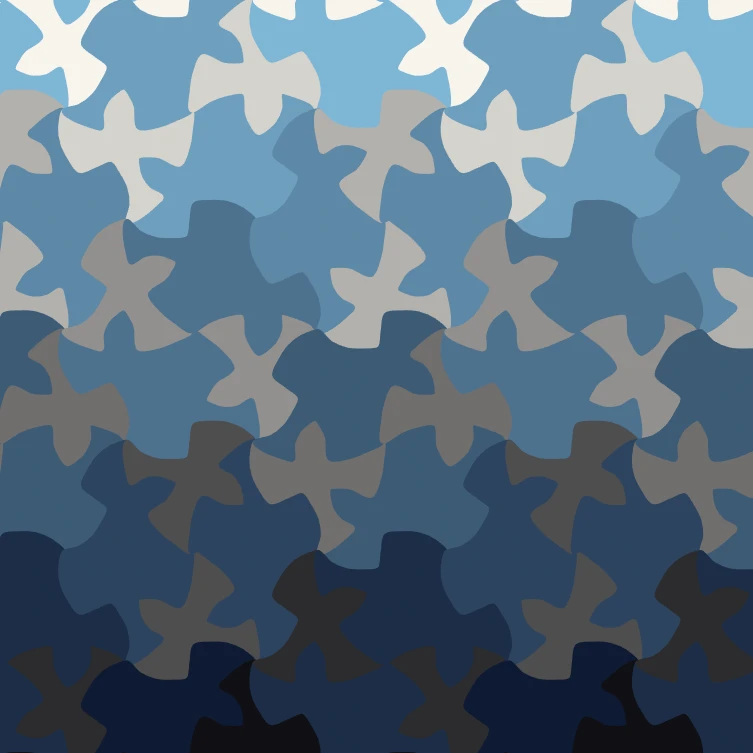
M.C. Escher tessellation maker
Make M.C. Escher-style tessellations online: interlocking lizards, birds, fish, Pegasus and more. Reshape the motif, recolour it and save PNG or SVG.
Ready to try it?
Open PictorX in your browser — no install, no credit card required to start.
Go to Editor