
The Koch snowflake explained
The Koch snowflake is one of the first fractals ever described and still one of the most surprising: a shape you can draw with a ruler, with a border that is infinitely long around an area you can write down exactly. It was meant as a mathematical monster, a curve without a tangent anywhere, and ended up as the picture that explains why a coastline has no true length.
The construction
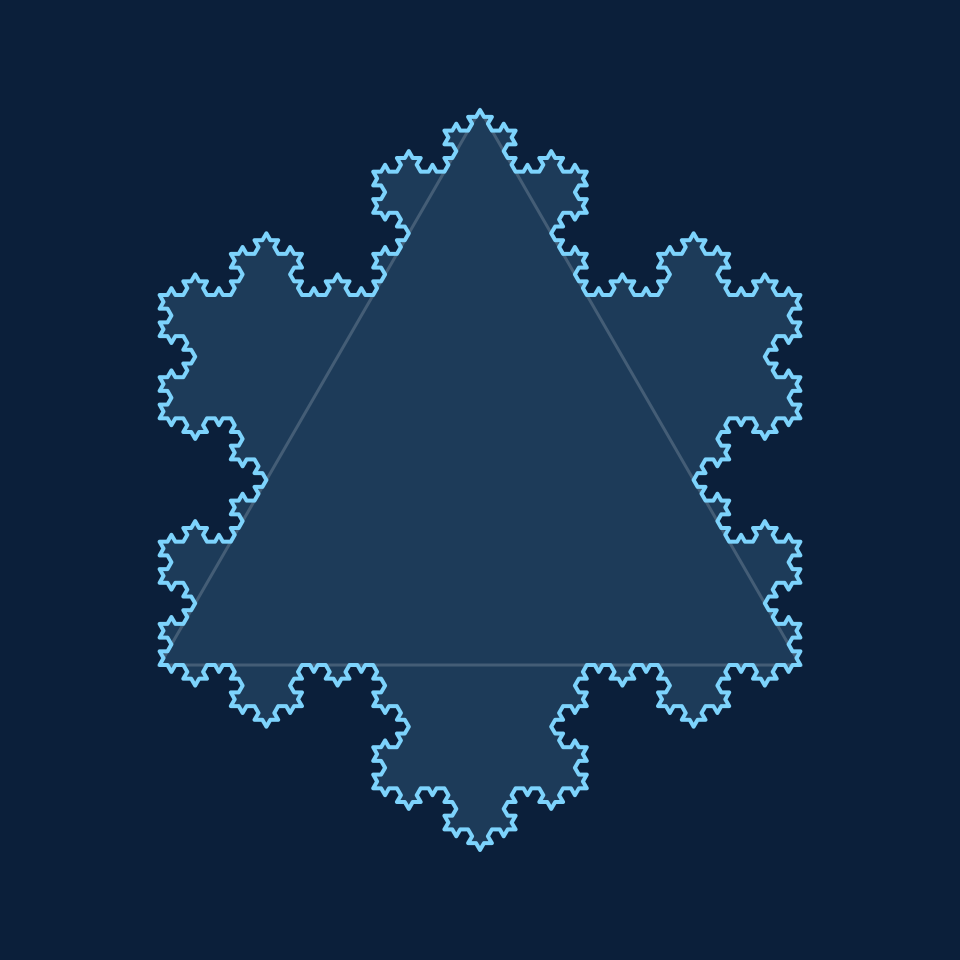
Start with an equilateral triangle. Cut each side into three equal parts, build a smaller equilateral triangle on the middle part, and remove the base of that new triangle. The triangle has become a six-pointed star with 12 sides. Do the same to each of those sides, then to the 48 sides that result, and keep going forever. A single side treated this way is the Koch curve; three of them joined in a triangle make the Koch snowflake.
A curve without a tangent
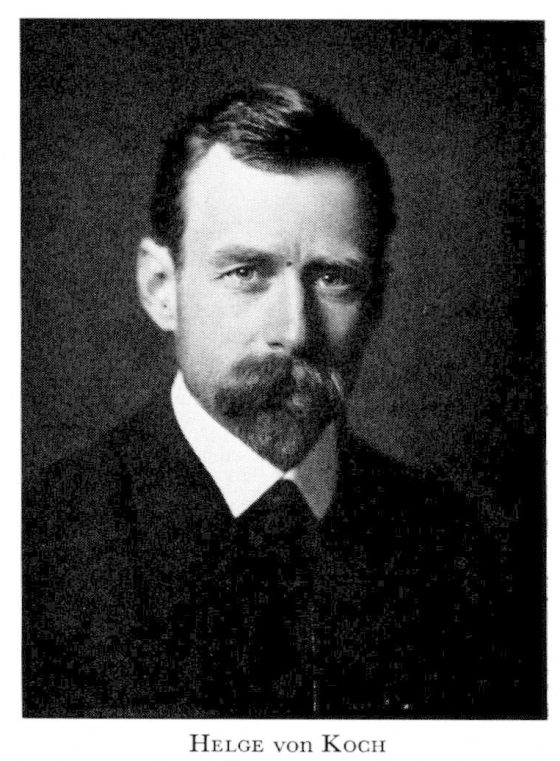
The Swedish mathematician Helge von Koch published the curve in 1904. Mathematicians of the time had just learned, from Karl Weierstrass, that a curve can be continuous everywhere and yet smooth nowhere, but Weierstrass's example was a formula. Koch wanted a construction anyone could see. At every point of his curve there are bumps on bumps at every scale, so there is no direction the curve is heading in, no tangent line, anywhere.
The perimeter grows without limit
Each round replaces every segment by 4 segments a third as long, so the total length is multiplied by 4/3. After n rounds the perimeter is (4/3)ⁿ times the triangle's: about 3.2 times after 4 rounds, 17.8 times after 10 and 3,000 times after 28. There is no limit. Between any two points on the finished curve, however close, the curve is infinitely long.
The area stays finite
The first round adds three triangles, each 1/9 of the original. Every later round adds four times as many triangles, each 1/9 the size, so each round adds 4/9 of what the round before added. That is a geometric series, and it adds up: the snowflake's area is 1 + 3/9 · 1/(1 − 4/9) = 8/5 of the triangle's. Point the bumps inwards and you get the anti-snowflake, whose area settles at 2/5 of the triangle instead.
Fractal dimension
The Koch curve is made of 4 copies of itself, each a third of its size. Scaling a line by a third leaves 3 copies and a square 9, or 3¹ and 3²; the exponent is the dimension. For the Koch curve 3^d = 4, so d = log 4 / log 3 ≈ 1.262. It is a measure of how much the curve crowds the plane: more than a line, far less than a surface. Felix Hausdorff's definition of dimension from 1918 gives the same number.
Relatives of the snowflake
Change the bump and other curves appear. In 1905 Ernesto Cesàro studied bumps with other angles: the steeper the spike, the longer each piece and the higher the dimension, log 4 / log(2 + 2 cos θ), until at 90° the curve fills a triangle. Replacing the triangle bump with a square one gives the quadratic Koch curve, with dimension log 5 / log 3 ≈ 1.465. Hermann Minkowski's sausage goes up one square and down another, which doubles the length every round but never changes the area, and has dimension exactly 3/2.
Coastlines and nature
In 1967 Benoît Mandelbrot asked how long the coast of Britain is, and answered that it depends on the length of the ruler: a shorter ruler follows more bays and headlands and measures a longer coast, just as each round of the Koch curve does. Real coastlines behave like curves with a dimension between 1 and 2; the west coast of Britain is close to 1.25, almost exactly the Koch curve's. Koch-like shapes are also used for compact antennas, because a long wire folded into a small fractal outline picks up a wide range of frequencies.

Explore it
Open the Koch snowflake generator to grow the snowflake level by level and watch every bump fold up out of the segment beneath it. Point the bumps inwards for the anti-snowflake, change the angle for Cesàro's curves, start from a square or a single line, or switch to the square bump and the Minkowski sausage. The tiles count the segments and follow the length, the area and the fractal dimension.
Frequently asked questions
Is a real snowflake a Koch snowflake?
No. Real snow crystals are six-sided and often branch into smaller copies of their arms, which gives them a fractal look, but they stop after a few levels and do not follow Koch's rule. The Koch snowflake got its name from its six-fold, crinkled outline.
How long is the Koch snowflake?
Infinitely long. After n rounds the perimeter is 3 · (4/3)ⁿ times the side of the triangle, and that number grows without limit. Any piece of the curve between two different points is infinitely long too.
What is the area of the Koch snowflake?
Exactly 8/5 of the starting triangle. For a triangle with side s that is 2√3 s² / 5, or about 0.693 s².
How many levels can the generator draw?
Up to 7 levels for the snowflake, which gives 49,152 segments, and up to 8 for a single Koch curve. Beyond that the new bumps are smaller than a pixel. Square bumps and the Minkowski sausage multiply the segments faster, so they stop a level or two earlier.
Related tools
Koch snowflake generator
Grow the Koch snowflake level by level and see its perimeter grow by 4/3 each time while the area settles at 8/5. Try the anti-snowflake, Cesàro angles, square bumps and the Minkowski sausage.
Sierpiński triangle builder
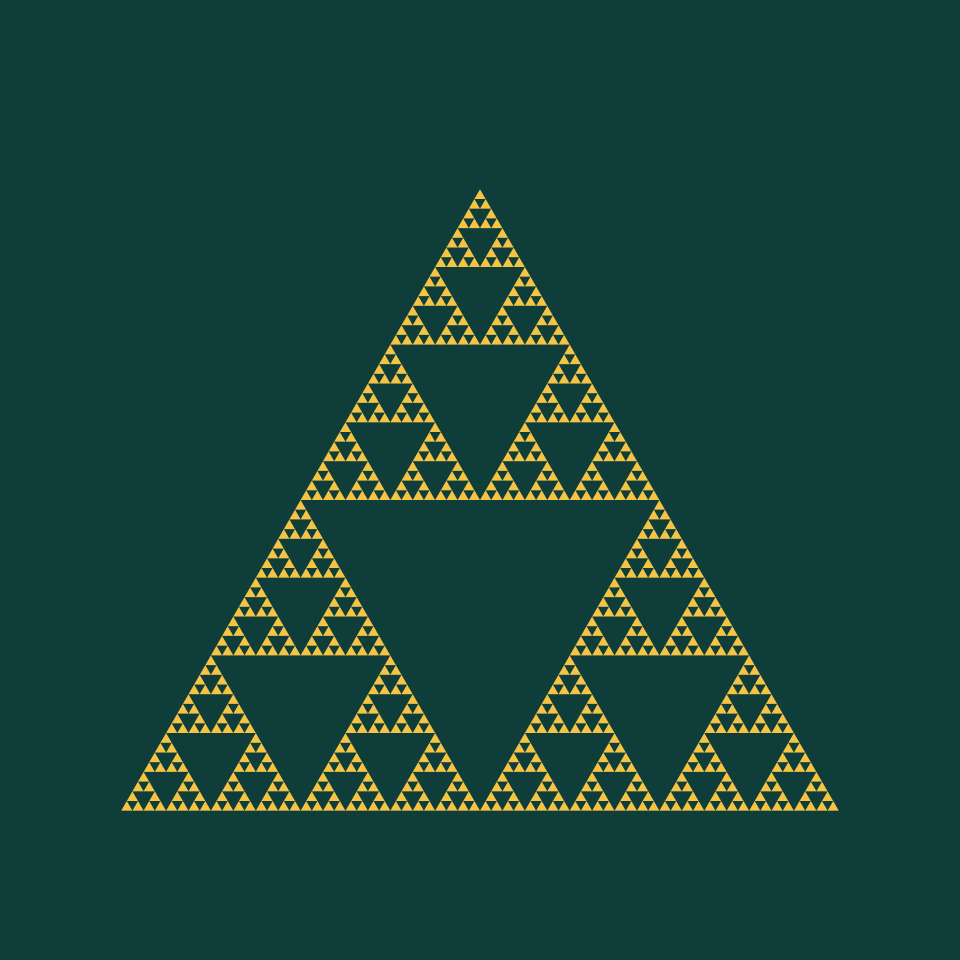
Build the Sierpiński triangle by removing middles, by the chaos game or from Pascal's triangle mod 2. Try other corners, jumps and rules, and see area, triangles and the fractal dimension 1.585.

Barnsley Fern
Grow the Barnsley Fern in your browser. Watch the chaos game, zoom into any leaflet, and compare the black spleenwort with mutant varieties.
Nature Generator
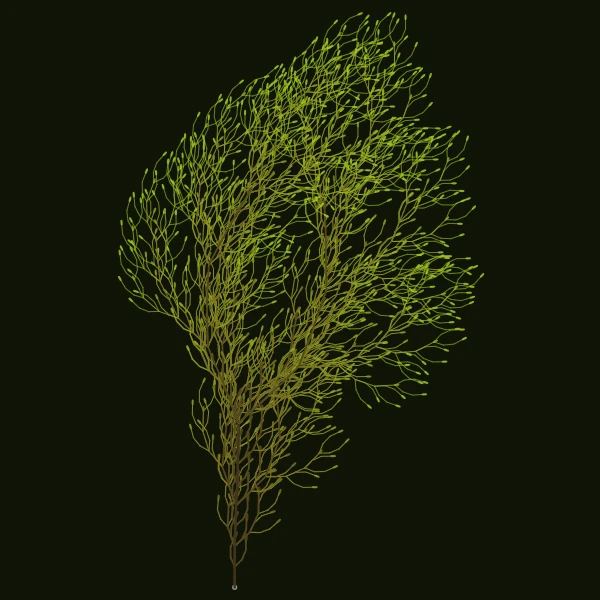
Grow trees, ferns, coral, and ice crystals from L-system DNA. Pause, randomize, and save a PNG in your browser.
Fractal generator: zoom into Mandelbrot, Julia and Newton fractals
Free online fractal generator: zoom about 5 trillion times into the Mandelbrot set, Julia and Newton fractals, jump to 64 famous spots and save a PNG.
Ready to try it?
Open PictorX in your browser — no install, no credit card required to start.
Open the Koch snowflake generator