
Tides explained
Tides are the slow breathing of the oceans, a rise and fall that most coasts feel twice a day. This page explains where they come from: why the Moon's gravity raises two bulges and not one, why the Moon beats the far heavier Sun, how the Sun turns tides into spring and neap tides, why high water is later each day and the two daily tides are often unequal, why real harbours have such different tides, how tide tables predict them, and how the tides are slowly braking the Earth and pushing the Moon away.
Gravity that changes across the Earth
Isaac Newton explained the tides in 1687 with his law of gravitation. The Moon's pull falls with the square of the distance, so across the Earth's diameter it changes: at the point facing the Moon it is about 3.4 % stronger than at the Earth's centre, at the far side about 3.3 % weaker. The pull at the centre accelerates the whole Earth and only keeps it moving round the common centre of mass. What matters for the tides is the difference between the pull at each place and the pull at the centre, the tidal force. For a body of mass M at distance d it is about 2GMR/d³ at the points under and opposite the body and half that, pointing inward, round the sides: about one ten-millionth of the Earth's gravity for the Moon, too little to lift you but enough, acting on whole oceans, to move them.
Two bulges and the barycentre
The tidal force points towards the Moon on the near side and away from it on the far side, so the water is drawn into two bulges. A common explanation calls the far bulge a centrifugal effect of the Earth swinging round the Earth–Moon barycentre; that point, the centre of mass of the pair, lies about 4,670 km from the Earth's centre, inside the Earth. The Earth does move round it once a month, but without turning as it does so, so every part of the Earth moves on a circle of the same size and feels the same acceleration, exactly the Moon's pull at the centre. Subtracting that from the pull at each place gives the tidal force: the two descriptions say the same thing, and neither needs an extra force on the far side.
The equilibrium tide and why the Moon wins
If the Earth were covered by a deep ocean that could follow the force at once, the water would take the shape Newton calculated, the equilibrium tide: a height of (M/M⊕)(R/d)³ R (3 cos²ψ − 1)/2 at an angle ψ from the body, a range of about 54 cm for the Moon and 25 cm for the Sun. The tidal force grows with the mass but falls with the cube of the distance. The Sun is 27 million times heavier than the Moon and 390 times farther away, and 390³ is about 59 million, so the Sun's tide is only 27/59, about 0.46, of the Moon's: the Moon wins by a factor of about 2.2. As the Moon's distance changes between perigee and apogee, its tidal force changes by about 40 %.
Spring and neap tides
The Sun's tide adds to the Moon's when the three bodies are in line, at new and full moon (syzygy), and the two partly cancel when they are at right angles, at the quarters (quadrature). The difference between the two tides' periods, 12 hours 25 minutes for the Moon and 12 hours for the Sun, makes them drift in and out of step every 14.77 days: spring tides and neap tides. On the North Sea coast spring tides are about 1.6 times the neap range. Because the oceans need time to respond, the spring tide often comes one or two days after new or full moon, the age of the tide. The largest tides of all come when a spring tide coincides with perigee, a few times a year.
The tidal day, the lunitidal interval and the diurnal inequality
The Earth turns once in 24 hours relative to the Sun, but in that time the Moon moves about 12° further east, so a place returns under the Moon after about 24 hours 50 minutes, the tidal or lunar day. High water does not usually come when the Moon passes overhead but some hours later, a delay fixed for each harbour: the lunitidal interval. The Moon's path also swings up to between 18° and 28.6° north and south of the equator over a month, depending on the 18.6-year cycle of its orbit. When it is far from the equator the bulges are tilted, and away from the equator the two daily high tides differ: the higher and lower high water of the diurnal inequality. In some seas the once-daily part wins and there is only one high tide a day.
Real oceans: tidal waves in basins
Real oceans cannot follow the equilibrium bulges, which would have to race round the equator at about 1,670 km an hour while a long wave in an ocean 4 km deep travels at only about 700 km an hour. Pierre-Simon Laplace showed in 1775 that the tides are forced waves in the ocean basins. Turned by the Earth's rotation, the tide swings round amphidromic points, where there is almost no tide, and grows towards the coasts; it is amplified where a bay resonates with the tide. In the Bay of Fundy the natural period of the bay and the Gulf of Maine, about 13 hours, is close to the 12.42 hours of the lunar tide, and the range reaches 16 m. Enclosed seas with narrow entrances, such as the Mediterranean and the Baltic, have tides of only some centimetres to a few tens of centimetres.
Harmonic constituents and tide tables
Because the tide is driven by the regular motions of the Moon and the Sun, it can be written as a sum of cosine waves whose frequencies are known exactly: the harmonic constituents. Arthur Doodson listed hundreds in 1921 from combinations of the Earth's rotation and the mean longitudes of the Moon, the Sun and the lunar perigee. The largest are M2 (the principal lunar, period 12.42 h), S2 (principal solar, 12.00 h), N2 (the larger lunar elliptic, 12.66 h, from the Moon's changing distance), K1 (lunisolar diurnal, 23.93 h) and O1 (principal lunar diurnal, 25.82 h). For each harbour, a year of measurements gives each constituent's amplitude and phase lag, and the sum predicts the tide for years ahead. Lord Kelvin built a machine of pulleys that added the constituents in 1872; the ratio (K1 + O1)/(M2 + S2) tells whether a tide is semidiurnal, mixed or diurnal.
Tidal friction, a longer day and a receding Moon
The Earth turns much faster than the Moon goes round it, and friction in the shallow seas carries the bulges a little ahead of the line to the Moon, by about 3°. The Moon's pull on the leading bulge acts against the Earth's spin and slows it: tides lengthen the day by about 2.3 milliseconds a century, and 400 million years ago, coral growth rings show, a year had about 400 days. The bulge in turn pulls the Moon forward along its orbit, so it gains energy and spirals outward: laser ranging to reflectors left by the Apollo astronauts measures 3.8 cm a year. The Earth's tides on the Moon long ago slowed it until it turned once per orbit, which is why it always shows us the same face: tidal locking.
Frequently asked questions
Is the far-side bulge caused by centrifugal force?
Only in a manner of speaking. In a frame moving with the Earth's centre round the Earth–Moon barycentre there is a uniform centrifugal acceleration, the same everywhere on Earth and equal to the Moon's pull at the centre. Adding it to the Moon's pull at each place gives the tidal force, which is the honest way to say it: the far bulge exists because the Moon pulls the far side less than it pulls the centre. The Earth's own daily spin is not involved.
Does the Moon also raise tides in the solid Earth?
Yes. The ground under your feet rises and falls by up to about 30 to 50 cm twice a day, but because everything around you moves with it you do not notice. The Earth's body tide is measured by GPS and gravimeters and must be corrected for in precise surveying and in particle accelerators such as CERN's, whose circumference changes by about a millimetre with the tides.
How are tides predicted?
From harmonic analysis. A tide gauge records the water level for at least a month, better a year; the record is fitted with dozens of constituents of known frequency to find each one's amplitude and phase at that place. The prediction then adds the constituents for any future date, with small corrections for the 18.6-year cycle of the Moon's orbit. The weather can still shift the water by a metre or more: a storm surge is not part of the astronomical tide.
Will the Moon keep moving away?
Slowly, yes. Tidal friction moves it outward by about 3.8 cm a year and lengthens the day. In the far future the Earth would turn once in a month of about 47 days, always showing the Moon the same face, but the Sun will grow into a red giant long before that happens. The present rate of recession is unusually high, because today's oceans happen to be close to resonance with the tide.
Related tools
Tides: the Moon, the Sun and the sea
See why the Moon and the Sun raise two tidal bulges, when spring and neap tides come, why high water is 50 minutes later each day and why the two daily tides differ, with a harbour, a boat and a tide graph built from the M2, S2, N2, K1 and O1 constituents for the North Sea, the Bay of Fundy, the Gulf of Mexico and the Mediterranean.
Moon phases for any date
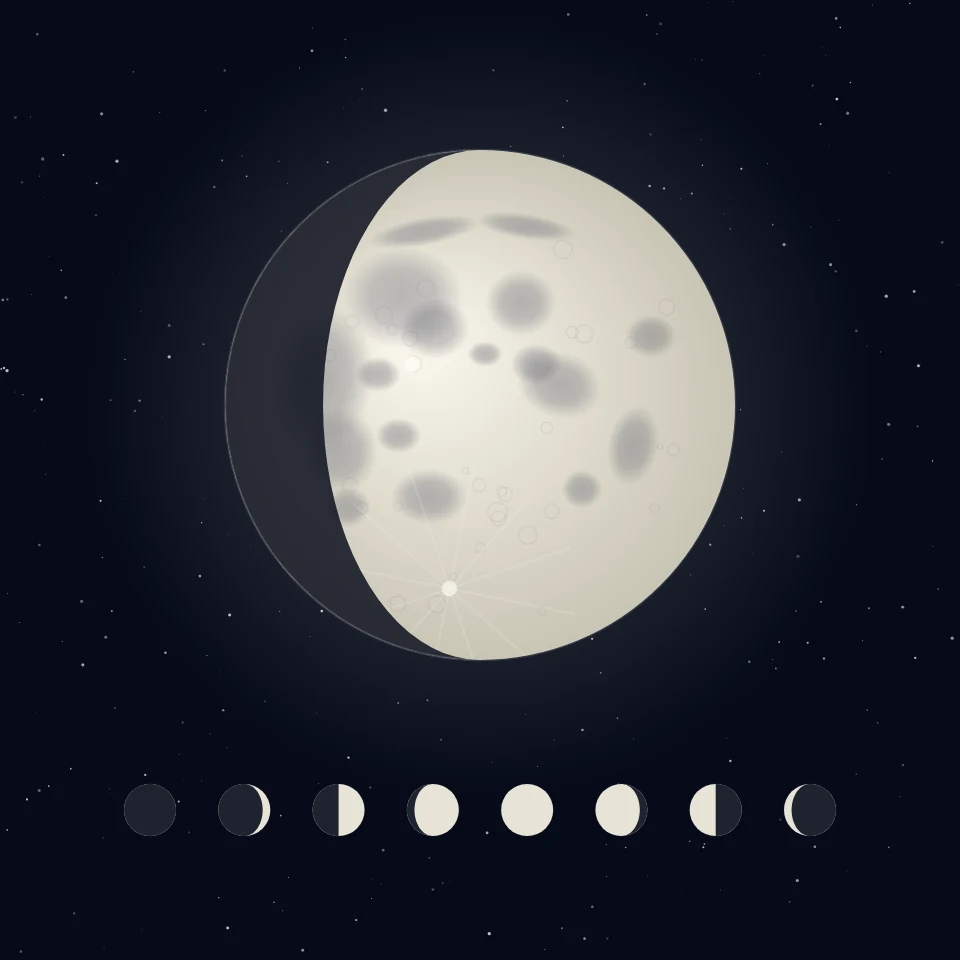
See tonight's Moon or the Moon on any date: the phase and its name, how much is lit, the Moon's age, moonrise and the next full and new moon. An interactive Sun–Earth–Moon model shows why the Moon has phases, the synodic and sidereal month and when eclipses happen.
The phases of the Moon explained
Why the Moon has phases, the eight phases and the shape of the terminator, how much of the Moon is lit, the synodic and sidereal month, when the Moon rises and sets, why it is upside down in the southern hemisphere, earthshine, eclipses and how the phase is computed for any date.
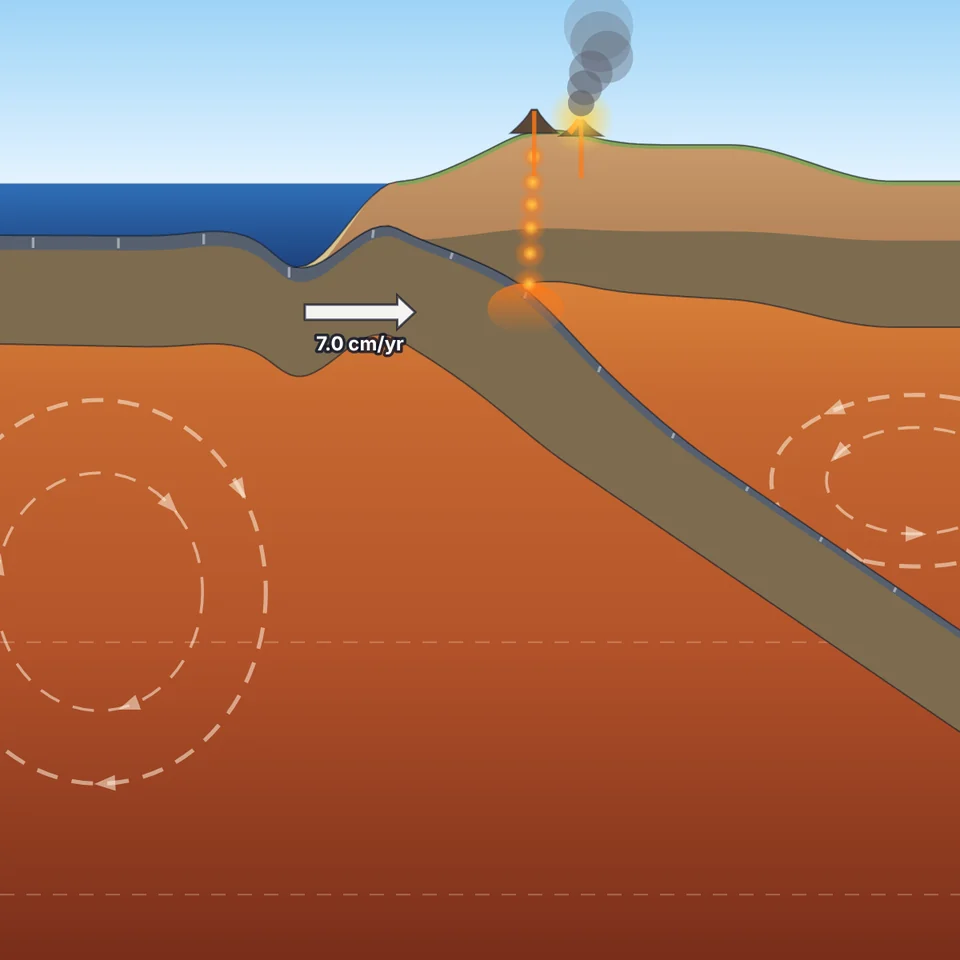
Plate tectonics and plate boundaries
See plate tectonics at work: a mid-ocean ridge with its magnetic stripes, subduction under the Andes and Japan with trenches, earthquakes and volcanoes, the collision that built the Himalaya, the San Andreas Fault's stick-slip earthquakes and the continents drifting from Pangaea to today, at real speeds in centimetres a year.
Ready to try it?
Open PictorX in your browser — no install, no credit card required to start.
Open the tides simulator