
About Texas Hold'em - history, rules and odds
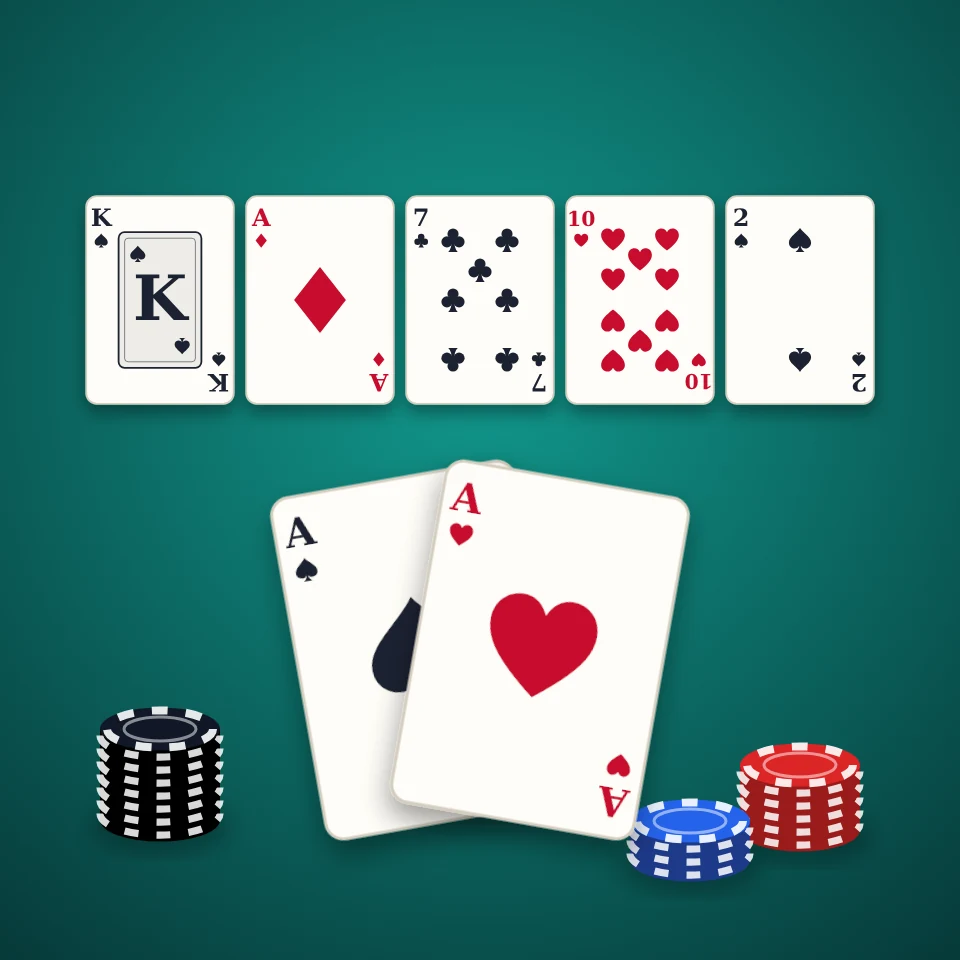
Texas Hold'em is the best-known form of poker: each player gets two cards of their own, five cards are shared in the middle, and the best five-card hand wins, unless everyone else has folded first. This page tells where the game comes from, how a hand goes, how the hands rank and how to work out your odds.
Where it comes from
As the story is usually told, Texas Hold'em was first played in Robstown, Texas, early in the 20th century, and in 2007 the Texas Legislature recognised Robstown as the birthplace of the game. It spread among Texan card players, and in 1967 a group of them, among them Doyle Brunson, Amarillo Slim and Crandell Addington, brought it to Las Vegas. The game's big break came with the World Series of Poker, started by Benny Binion at his Horseshoe casino in 1970: from 1971 its main event, the championship, has been played as no-limit Texas Hold'em. In 2003 Chris Moneymaker, an amateur who had qualified through an online tournament, won the main event, and the televised win set off a worldwide poker boom.
How a hand goes
Each player gets two cards face down, the hole cards. Then there are four betting rounds. Preflop, the player left of the big blind acts first. The flop then puts three shared cards face up in the middle, the turn a fourth and the river a fifth, each followed by a betting round that starts with the first player still in, left of the dealer button. In a betting round you may check when nobody has bet, or fold, call or raise when someone has. A hand ends when all players but one have folded, who then wins the pot without showing their cards, or at the showdown after the river, where the best five-card hand made from your two cards and the five on the board wins. You may use both, one or none of your own cards.
Hand rankings
From best to worst: a royal flush (ace, king, queen, jack and ten of one suit); a straight flush (five in a row of one suit); four of a kind; a full house (three of a kind with a pair, named "kings over nines"); a flush (five of one suit); a straight (five in a row; the ace counts high in ten-jack-queen-king-ace and low in ace-two-three-four-five); three of a kind; two pair; one pair; and high card. Suits never rank. When two hands are of the same kind, the ranks decide, and then the remaining cards, the kickers, one by one: a pair of aces with a king beats a pair of aces with a queen. Only five cards count, so a sixth card never breaks a tie, and exactly equal hands split the pot.
Blinds, the button and position
Instead of everyone paying an ante, the two players left of the dealer button post forced bets before the cards are dealt: the small blind and the big blind, usually twice as much. The button moves one seat to the left after every hand, so everyone pays the blinds in turn. With only two players, the button posts the small blind and acts first before the flop, last after it. The later you act, the better your position: you see what the others do before you decide. That is why good players play more hands from the button and the seats just before it, and fewer from early positions.
No-limit betting, all-ins and side pots
In no-limit hold'em you may bet any amount up to all your chips at any time. The smallest bet is the big blind, and a raise must be at least as big as the last bet or raise in the same round. A player who cannot match a bet may still call all-in for what they have, but can only win from each other player as much as they put in themselves. The chips the others bet beyond that go into a side pot that only they can win. A bet that nobody calls goes back to the player who made it, and when a pot cannot be split evenly, the odd chip goes to the first winner left of the button.
Odds: outs and the rule of 2 and 4
Outs are the cards still unseen that would improve your hand to a likely winner. A flush draw has 9 outs, the remaining cards of its suit, and an open-ended straight draw has 8. The rule of 2 and 4 turns outs into a quick estimate: on the flop, with two cards to come, multiply your outs by 4; on the turn, with one card to come, multiply them by 2. Nine outs on the flop give about 36%, close to the exact 35% for a flush draw to hit by the river. Compare that with the pot odds: when calling 10 to win a pot of 30, you need to win at least a quarter of the time. The Hint button in the game counts your outs and estimates your chance to win against random hands.
Starting hands
There are 1,326 ways to be dealt two cards, which come down to 169 different starting hands once suits that do not matter are set aside: 13 pairs, 78 suited and 78 offsuit combinations. You are dealt a pair about once in 17 hands and a pair of aces once in 221. Pairs, high cards together and suited connectors play best; small unsuited cards far apart, such as seven-two, are the weakest. Players have long sorted the starting hands into groups, such as the eight groups David Sklansky and Mason Malmuth published, and the computer players in this game use such groups before the flop.
Frequently asked questions
Is a flush better than a straight?
Yes. A flush beats a straight, and a full house beats a flush. Five cards of one suit are harder to get than five in a row.
Can the ace be low in a straight?
Yes, in ace-two-three-four-five, the lowest straight, called the wheel. The ace cannot turn the corner, so queen-king-ace-two-three is not a straight.
What happens if two players have the same hand?
The best five cards are compared rank by rank, kickers included. If they are exactly equal, for example when the five cards on the board are the best hand for both, the pot is split.
Do I have to show my cards?
Only at the showdown, to claim the pot. If everyone else folds, you win without showing your hand.
What is the difference between no-limit and limit hold'em?
In limit hold'em every bet and raise is a fixed amount, with a cap on the number of raises per round. In no-limit you may bet any amount up to all your chips, which makes bluffing and big all-ins part of the game.
Related tools
Texas Hold'em
Play no-limit Texas Hold'em free in your browser against 1 to 5 computer players, for play chips only. Fold, call, bet and raise with an amount slider, see side pots and showdowns, and let Hint count your outs and odds.
About Blackjack - history, rules and strategy
Where blackjack comes from, how a round works, what soft hands and the dealer's rules mean, why 6:5 and insurance are poor deals, and how basic strategy cuts the house edge.
Blackjack
Play blackjack free in your browser: bet with chips, hit, stand, double, split and take insurance against the dealer. Choose 1 to 8 decks, 3:2 or 6:5 and the soft 17 rule, and let Hint show the basic-strategy play.
About Hearts - history, rules and strategy
Where the card game Hearts comes from, from Reversis to Black Lady and the Hearts that came with Windows, how passing and scoring work, what shooting the moon is and how to play well.
Ready to try it?
Open PictorX in your browser — no install, no credit card required to start.
Play Texas Hold'em