
The Pomodoro Technique explained
In the late 1980s an Italian student named Francesco Cirillo struggled to study. He picked up a kitchen timer shaped like a tomato, pomodoro in Italian, and challenged himself to focus for just one short block. That small experiment became one of the best-known time management methods in the world.
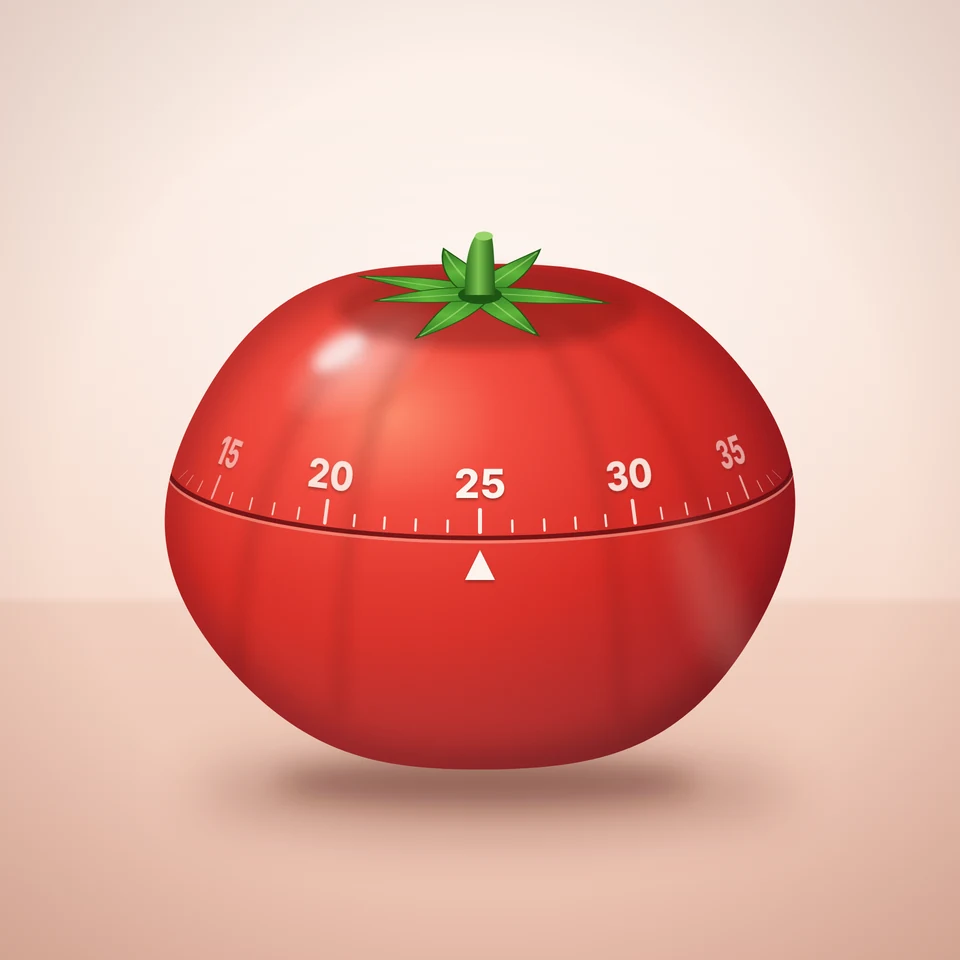
Francesco Cirillo and the tomato timer
Cirillo was a university student in Rome who felt he got very little done despite long hours with his books. He asked himself a simple question: can I really study for ten minutes without drifting off? Using a red plastic kitchen timer shaped like a tomato, he started timing short blocks of work and gradually settled on 25 minutes followed by a short break. He kept refining the method while working as a developer and consultant, wrote it up in 2006 and later published a book. The name stuck: each block of focused work is simply called a pomodoro.
How the technique works
The classic method has five steps. Choose one task. Set the timer for 25 minutes. Work on that task only until the timer rings, then mark the pomodoro as done. Take a short break of three to five minutes. After four pomodoros, take a longer break of 15 to 30 minutes. If something urgent comes up, either deal with it and restart the pomodoro, or write it down and get back to it later. A pomodoro is indivisible: it either counts in full or not at all.
Why it works
Starting is often the hardest part, and 25 minutes feels small enough to begin even a task you dread. The ticking clock adds a gentle sense of urgency without the pressure of a deadline, so you stop polishing and keep moving. Because you commit to one task, you avoid the hidden cost of switching between tasks and checking messages. Regular breaks let attention recover before it fades, which keeps the quality of your work steadier through the day. Finally, counting pomodoros turns vague effort into a clear number, so you learn how long tasks really take and can plan more honestly.
Handling interruptions and adjusting the rhythm
Cirillo suggests a simple routine for interruptions from other people: inform them you are busy, negotiate a time, schedule it and call them back once your pomodoro is over. Internal distractions, such as a sudden idea or an urge to check email, go on a quick note so your mind can let go. The 25 and 5 minute rhythm is a starting point, not a law. Some people prefer 50 minutes of focus for deep work or 15 minutes for tasks they find hard to start. Try a length for a few days, watch your statistics and adjust the timer settings until the rhythm fits you.
Frequently asked questions
Do I have to use 25 minutes?
No. 25 minutes is the classic length and a good place to start, but you can set focus, short break and long break lengths yourself in the settings. Keep the lengths the same for a while so your session counts stay comparable.
What should I do during a break?
Step away from the task. Stand up, stretch, drink some water or look out of the window. Avoid starting something that pulls you in, such as email or social media, because it makes the next pomodoro harder to start.
Does the timer keep running in a background tab?
Yes. It counts down to a fixed end time rather than adding up ticks, so the time stays correct even when the browser slows hidden tabs. The signal may sound a moment late in some browsers, but the next phase always starts from the right time.
Related tools
Pomodoro timer
A free Pomodoro timer: 25 minutes of focus, 5-minute breaks and a long break after four sessions, with a progress ring, sound signals, notifications and daily stats.

To-do list
A free, minimalist to-do list: add tasks with Enter, tick them off, filter by status, tag and priority, sort by due date and keep several lists, all stored in your browser.

Calculator
A free online calculator with a basic and a scientific mode: trigonometry, logarithms, powers, roots, factorials, memory and history, with the correct order of operations.

Hourly rate calculator
A free hourly rate calculator for freelancers and employees: hourly rate to estimated net monthly income, target income to required rate, and salary to hourly wage, with a breakdown chart.
Ready to try it?
Open PictorX in your browser — no install, no credit card required to start.
Open the Pomodoro timer