
How half-life works
A half-life is the time in which half of a large number of unstable atoms decays. It is a fixed property of each isotope that heat, pressure and chemistry barely touch, which makes radioactive decay one of the most predictable processes in nature, even though each single atom decays at random. Here is how it works and how to calculate with it.
Why decay halves
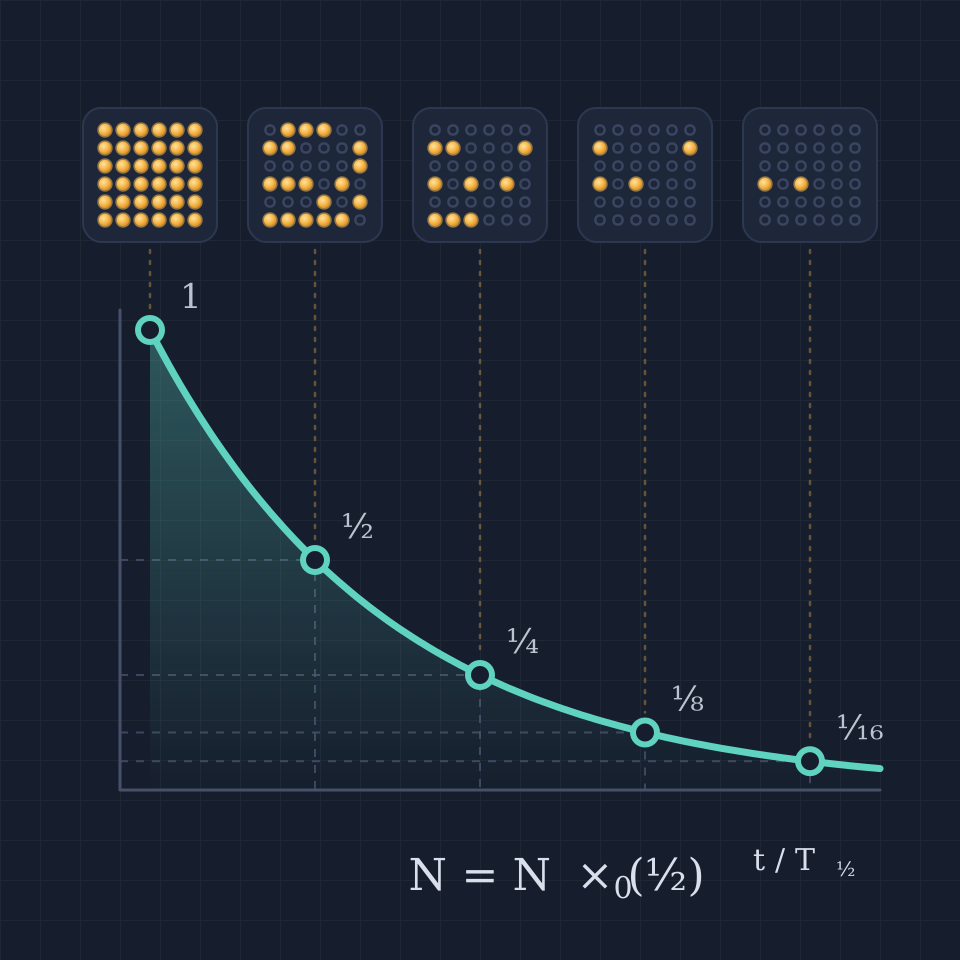
Every unstable nucleus of an isotope has the same small chance to decay in each second, whatever its age. So the number that decays per second is proportional to the number still there, and the amount falls by the same fraction in every equal stretch of time. That is exponential decay: after one half-life half is left, after two a quarter, after three an eighth, and after ten about 0.1%.
The formulas
The amount left after a time t is N = N₀ × (1/2)^(t / T½). Solved for the other values: N₀ = N × 2^(t / T½), t = T½ × log₂(N₀ / N) and T½ = t / log₂(N₀ / N). Iodine-131 has a half-life of 8.02 days, so of 40 mg, 40 × 0.5^(20 / 8.02) = 7.1 mg is left after 20 days. And when 12.5% of a sample is left, three half-lives have passed, because 1/2 × 1/2 × 1/2 = 1/8.
Decay constant, activity and mean lifetime
Physicists often use the decay constant λ = ln 2 / T½ ≈ 0.693 / T½, with which N = N₀ × e^(−λt). The activity, the number of decays per second, is A = λN, measured in becquerel, so it halves with the amount. The mean lifetime τ = 1 / λ ≈ 1.443 × T½ is the average time an atom exists before it decays. For cobalt-60, with a half-life of 5.27 years, λ ≈ 0.132 per year and τ ≈ 7.6 years.
Carbon-14 dating
Living things take up carbon from the air, so while they live, their share of carbon-14 matches that of the atmosphere. After death the carbon-14 decays with a half-life of about 5,730 years. If a piece of wood holds 25% of the carbon-14 of living wood, two half-lives have passed: about 11,460 years. Laboratories report conventional ages with the older Libby half-life of 5,568 years and convert them with calibration curves that correct for changes in atmospheric carbon-14. The method reaches back about 50,000 years, after which too little is left to measure.
Half-lives of common isotopes
Half-lives range from fractions of a second to billions of years. Fluorine-18, used in PET scans, has a half-life of 110 minutes; technetium-99m, the most used medical tracer, 6 hours; radon-222, a natural gas from the ground, 3.8 days; iodine-131 8 days; strontium-90 and caesium-137, from nuclear fission, about 30 years; plutonium-239 24,110 years; and uranium-238 4.47 billion years, about the age of the Earth. A short half-life means intense radiation that is soon over, a long one weak radiation that lasts.
Frequently asked questions
Does a sample ever decay completely?
In the formula the amount only approaches zero, but atoms can be counted: once only a few are left, each decays at its own random moment, so in practice everything is gone after enough half-lives. After 10 half-lives about 0.1% is left, after 20 about one millionth.
Can heat or pressure change a half-life?
Under normal conditions, no. Decay happens in the nucleus, which is shielded from chemical and physical conditions. Only exotic cases change it measurably: the electron capture of beryllium-7 varies by a fraction of a percent with its chemical surroundings, and fully ionised atoms in stars can decay very differently.
What is the difference between half-life and mean lifetime?
The half-life is the time in which half of the atoms decay; the mean lifetime is the average time an atom exists. Because some atoms survive much longer than most, the mean lifetime is longer: 1 / ln 2, about 1.443 times the half-life.
Related tools
Half-life calculator
A free half-life calculator: work out the amount left, the initial amount, the elapsed time or the half-life of radioactive decay, with isotope presets, a decay curve and the calculation written out.
Statistics calculator
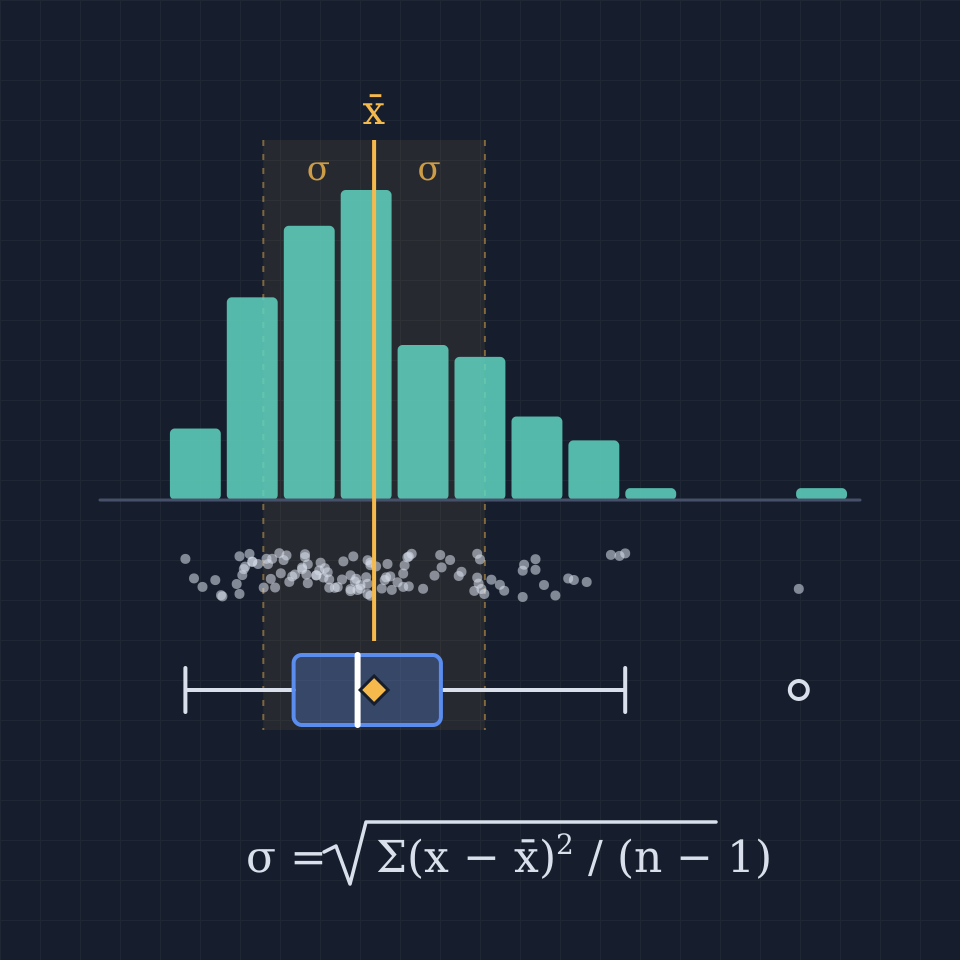
A free online statistics calculator: paste numbers and get the mean, median, mode, variance, standard deviation, quartiles and a histogram instantly.
Function plotter
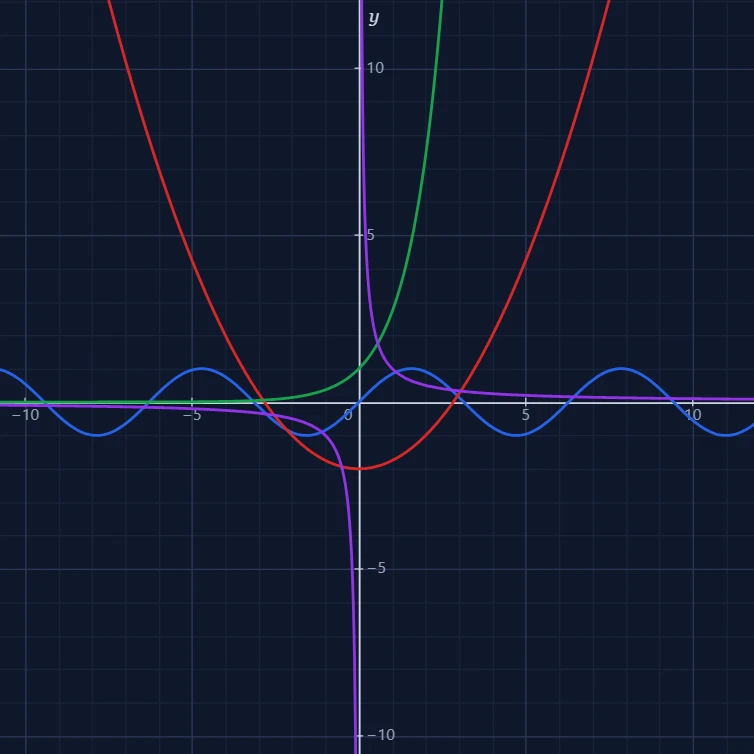
A free online function plotter: draw x², sin x, ln x, 1/x and your own formulas on an interactive grid. Pan, zoom, trace x and y, and save the graph as a PNG.
Unit converter
A free online unit converter for length, weight, temperature, speed, area, volume, time, pressure, energy and computer data - bytes to gigabytes and GB to GiB.
Ready to try it?
Open PictorX in your browser — no install, no credit card required to start.
Open the half-life calculator