
Atomic orbitals explained
Atoms are mostly empty space with a tiny nucleus, yet their electrons have shapes: spheres, dumbbells, cloverleaves. This page explains where those shapes come from: the Schrödinger equation of the hydrogen atom, the wavefunction and its probability, the quantum numbers that label every orbital, the radial and angular parts that make the shapes, the nodes and phases, the energy levels, and how chemists mix orbitals into hybrids.
From orbits to orbitals
In 1913 Niels Bohr pictured the electron of hydrogen circling the nucleus on fixed orbits, which explained its spectrum but little else. In 1926 Erwin Schrödinger wrote down the wave equation that replaced the orbits. Its solutions for an electron bound to a nucleus are standing waves in three dimensions, the orbitals. An orbital does not describe a path at all: the electron has no definite position until it is measured, and the orbital gives the probability of each result. Bohr's energies survived exactly, and his radius, a₀ = 52.9 pm, became the most probable distance of the 1s electron.
The wavefunction and its probability
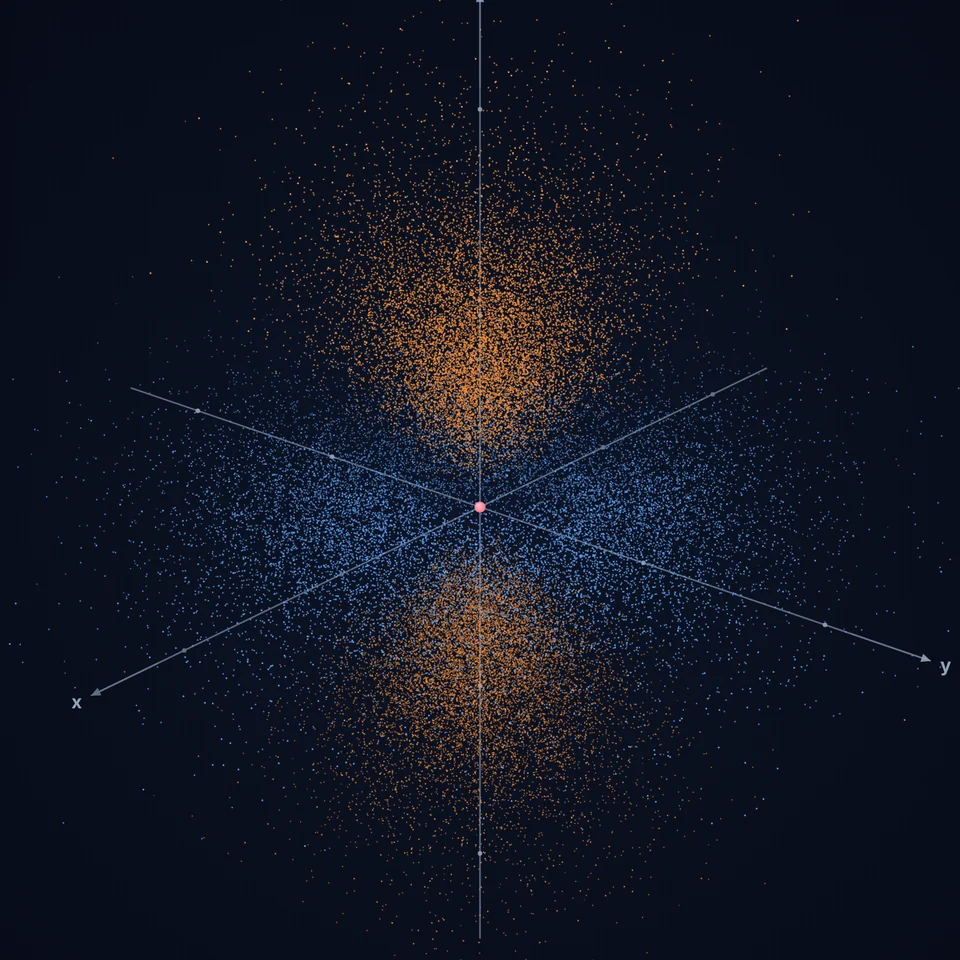
The wavefunction ψ(x, y, z) is a number at every point in space. Max Born realised that its square, |ψ|², is a probability density: the probability of finding the electron in a tiny volume dV around a point is |ψ|² dV, and the probabilities over all space add up to one. A cloud of dots drawn at random with that density, as in the app, is what many measurements of the electron's position would show. Because the density never quite reaches zero far from the nucleus, an orbital has no edge; textbook drawings show a boundary surface that encloses 90 % of the probability.
Quantum numbers
For one electron the Schrödinger equation separates into a radial part and an angular part, and the conditions for the waves to fit together give three quantum numbers. The principal quantum number n = 1, 2, 3 ... sets the shell and the energy. The angular momentum quantum number l runs from 0 to n − 1 and is written with the letters s, p, d, f, g, h for l = 0 to 5; it fixes the orbital angular momentum, √(l(l+1)) ħ. The magnetic quantum number m runs from −l to +l and gives the angular momentum about one axis. A shell n therefore has n² orbitals: one s, three p, five d, seven f. With the electron's spin each orbital holds two electrons, which is why the shells hold 2, 8, 18 and 32 electrons.
Radial functions and the radial probability
The radial part R_nl(r) is a polynomial times a falling exponential, e^(−Zr/na₀), with the associated Laguerre polynomials giving its wiggles. Its n − l − 1 zeros are the radial nodes, spheres around the nucleus. The probability of finding the electron between r and r + dr, in any direction, is P(r) dr = r²R² dr: the factor r² comes from the area of the sphere, so P(r) is zero at the nucleus even for s orbitals, whose density is largest there. The peak of P(r) is the most probable radius, n² a₀/Z for the orbital with l = n − 1, and the average distance is ⟨r⟩ = (3n² − l(l+1)) a₀/2Z.
Shapes: the spherical harmonics
The angular part Y_lm(θ, φ) is a spherical harmonic, the same family of functions that describes the vibrations of a sphere. An s orbital has a constant angular part and is round. The p orbitals are proportional to x/r, y/r and z/r: two lobes along one axis. The five d orbitals are proportional to xy, xz, yz, x² − y² and 3z² − r²: four lobes in a plane, except dz², which has two lobes and a ring. The seven f orbitals have six or eight lobes. The complex harmonics with a definite m are combined in pairs into these real orbitals, which have the same energies and point along the axes, the form chemists use.
Nodes and phases
A nodal surface is where the wavefunction passes through zero. An orbital has n − l − 1 radial nodes and l angular nodes, n − 1 in all: the angular nodes are |m| planes through the z axis and l − |m| cones, one of which can be the xy plane. On the two sides of a node ψ has opposite signs. The signs have no physical meaning for a lone orbital, since the density |ψ|² is the same, but they decide how orbitals combine: where two lobes of the same sign overlap, the waves add and the electrons build up between the nuclei in a bond; with opposite signs they cancel, giving an antibonding orbital with a node between the atoms.
Energy levels and hydrogen-like ions
For hydrogen the energy depends only on n: E_n = −13.6 eV/n², so the 2s and 2p orbitals have the same energy. A jump from n = 2 to n = 1 releases 10.2 eV, a photon of 121.6 nm, the Lyman-α line. A nucleus of charge Z pulls the electron Z times closer and binds it Z² times more strongly: E_n = −13.6 eV × Z²/n², so He⁺ has a 1s energy of −54.4 eV and orbitals half the size. In atoms with several electrons the inner electrons shield the nucleus and the energies depend on l too, s below p below d, which sets the order in which the periodic table fills, but the shapes of the orbitals stay much the same.
Hybrid orbitals and superpositions
Because the Schrödinger equation is linear, any sum of solutions with the same energy is again a solution. Mixing one 2s and three 2p orbitals gives four sp³ hybrids pointing to the corners of a tetrahedron, 109.5° apart, the shape of the bonds of carbon in methane and diamond; sp² hybrids lie at 120° in a plane, as in ethene and graphite, and sp hybrids point in opposite directions, as in ethyne. Mixing orbitals of different energies gives a superposition that is not stationary: its cloud moves, oscillating at the frequency ΔE/h. For 1s and 2p that is 2.47 × 10¹⁵ Hz, and the swinging charge is what emits or absorbs light of that frequency when the atom jumps between the two levels.
How the app draws orbitals
The app evaluates the exact wavefunctions: normalised radial functions from the associated Laguerre polynomials and real spherical harmonics from the associated Legendre functions, for n up to 6 and Z up to 10. The cloud is drawn by Monte Carlo sampling: a distance from the cumulative radial probability, a direction by rejection sampling from |Y|², and for hybrids and superpositions a further acceptance step, so every dot follows |ψ|² exactly and the same seed gives the same cloud. The surface is found by marching tetrahedra on a grid, at the density that encloses the chosen share of the probability, and the slice colours ψ in a plane with its zero lines.
Frequently asked questions
Is the electron really a cloud?
The cloud is a picture of probabilities, not of a smeared-out electron. Each measurement of the position finds the electron at one point, and the orbital says how likely each point is; the dots of the app are many such possible results. Between measurements quantum mechanics gives the electron no definite position, only the wavefunction.
Why do 2s and 2p have the same energy in hydrogen?
In hydrogen the energy depends only on the principal quantum number n, a consequence of a special symmetry of the 1/r Coulomb force. In atoms with more electrons, an s electron penetrates the inner shells and feels more of the nuclear charge than a p electron, so 2s lies below 2p. That splitting is why the periodic table fills s before p and 4s before 3d.
What is the difference between an orbit and an orbital?
An orbit is a definite path, like a planet's around the Sun, which Bohr assumed for the electron. An orbital is a wavefunction: it gives the electron's energy and the probability of finding it at each place, but no path. The Bohr radius appears in both, as the radius of Bohr's first orbit and as the most probable distance of the 1s electron.
Why do chemists use px and dxy instead of the m values?
The orbitals with a definite m are complex functions that wind around the z axis. Combining m and −m in pairs gives real functions with the same energy that point along x, y and z, which match the geometry of molecules and bonds. The app draws these real orbitals; for a free atom both sets describe the same states.
Related tools
3D electron orbitals: the shapes of the hydrogen atom
Explore the real orbitals of the hydrogen atom in 3D: s, p, d and f orbitals up to n = 6 as a cloud of points drawn from |ψ|², a surface or a slice, with the phases, the nodal planes and spheres, the radial probability with the most probable radius, the energy levels, sp³ hybrids and a superposition that oscillates.
Bohr model of the atom
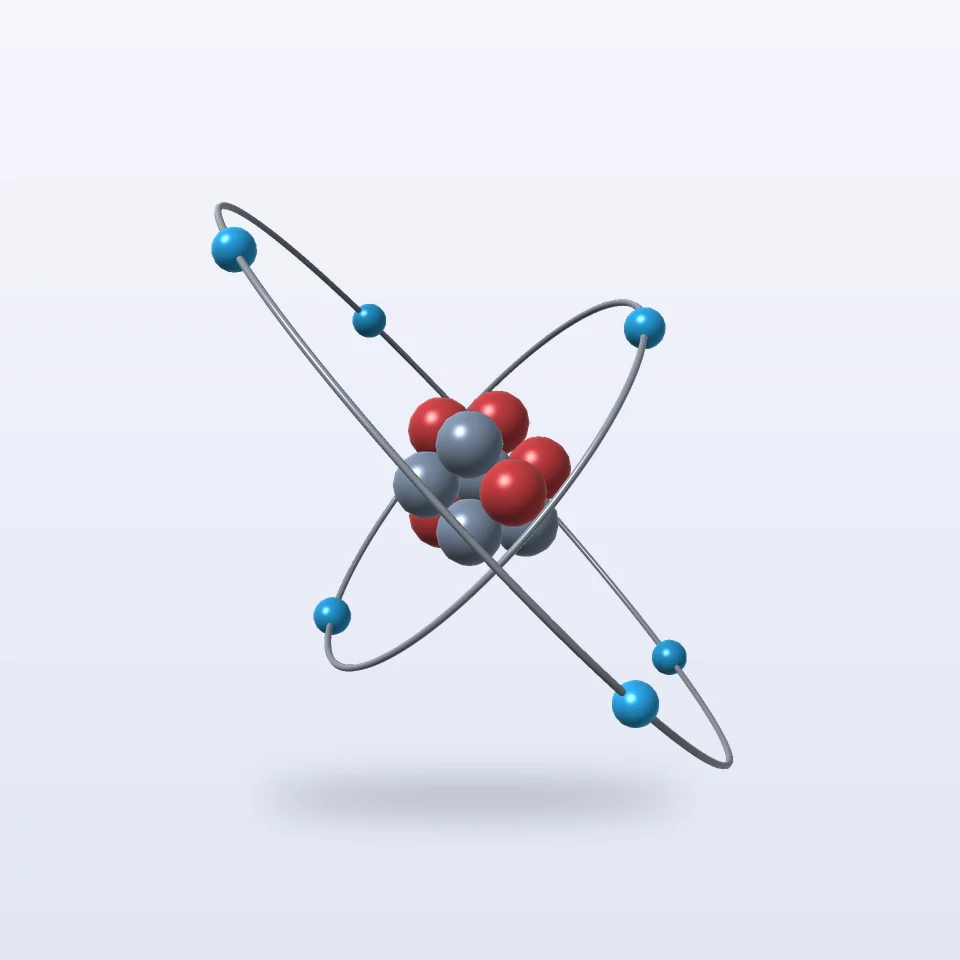
Build a Bohr model of any of the 118 elements in 3D: a nucleus of protons and neutrons with the electrons circling on their shells. Make ions, compare even spacing with Bohr's n² ratio, and read the electrons per shell and the valence electrons.
The Bohr model explained
How Niels Bohr's 1913 model of the atom works, why electrons sit in shells, how the jumps between orbits explain the spectrum of hydrogen, how shells fill across the periodic table, and how quantum mechanics replaced the orbits with orbitals.
Atom Builder: Bohr diagrams of every element
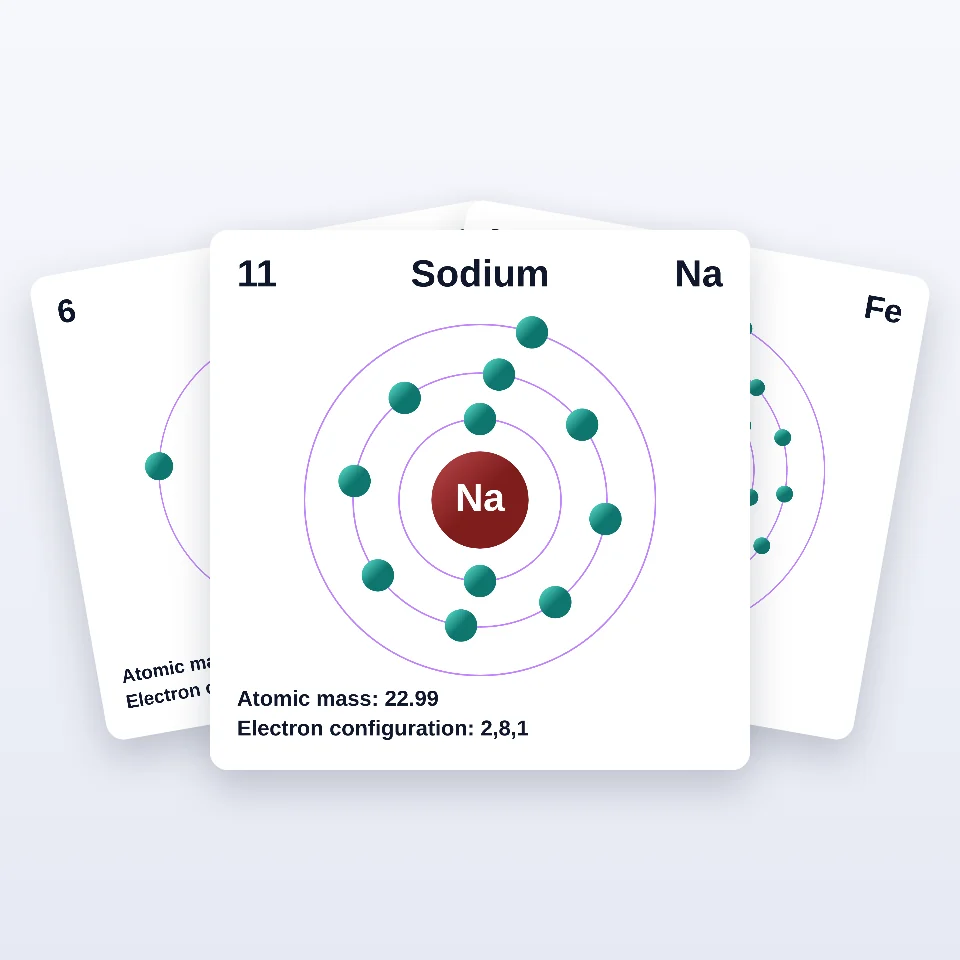
Make a Bohr diagram of any of the 118 elements or its ions: the nucleus, every shell with its electrons, the atomic number, name and symbol, the atomic mass and the electron configuration on one card. Pick the colours, save it, or edit it with every part on a layer of its own.
Ready to try it?
Open PictorX in your browser — no install, no credit card required to start.
Open the 3D orbital viewer