
Electric fields explained
Rub a balloon on your hair and it pulls the hair after it from a distance, without touching. Physicists explain this action at a distance with the electric field: every charge fills the space around it with a field, and other charges feel a force from the field where they are. This page explains Coulomb's law, what field lines and equipotentials show, how the fields of many charges add up, what Gauss's law says about the lines, how capacitors make a uniform field, and how a charge moves when it is set free.
Electric charge
Charge comes in two kinds, which Benjamin Franklin named positive and negative around 1747. Protons carry a positive charge and electrons an equal negative one, e = 1.602 × 10⁻¹⁹ coulombs, so ordinary matter is neutral; rubbing moves a few electrons from one surface to another and leaves both charged. Charge is conserved: it can be moved about but never made or destroyed on its own. A coulomb is a great deal of charge. The charges in the app are a few nanocoulombs, billionths of a coulomb, yet a single nanocoulomb is more than six billion electrons.
Coulomb's law
Charles-Augustin de Coulomb, a French military engineer, measured the force between small charged spheres with a torsion balance and published the result in 1785: the force is proportional to each of the two charges and falls with the square of the distance between them, F = k q₁ q₂ / r². The constant k = 1 / (4π ε₀) ≈ 8.99 × 10⁹ N m²/C², where ε₀ is the permittivity of free space. The force is enormous compared with gravity: two protons repel each other about 10³⁶ times more strongly than they attract each other by gravity. Only because positive and negative charges cancel so precisely do we not notice it every day.
The electric field
Instead of saying that one charge acts on another across empty space, Michael Faraday in the 1830s, and James Clerk Maxwell after him, described each charge as filling the space around it with a field. The electric field E at a point is the force on a small test charge placed there, divided by the test charge: E = F / q, in newtons per coulomb or, what is the same, volts per metre. A point charge makes a field E = kq / r², pointing straight away from a positive charge and straight towards a negative one. The fields of several charges simply add as vectors, the principle of superposition, which is how the app finds the field at every point.
Field lines
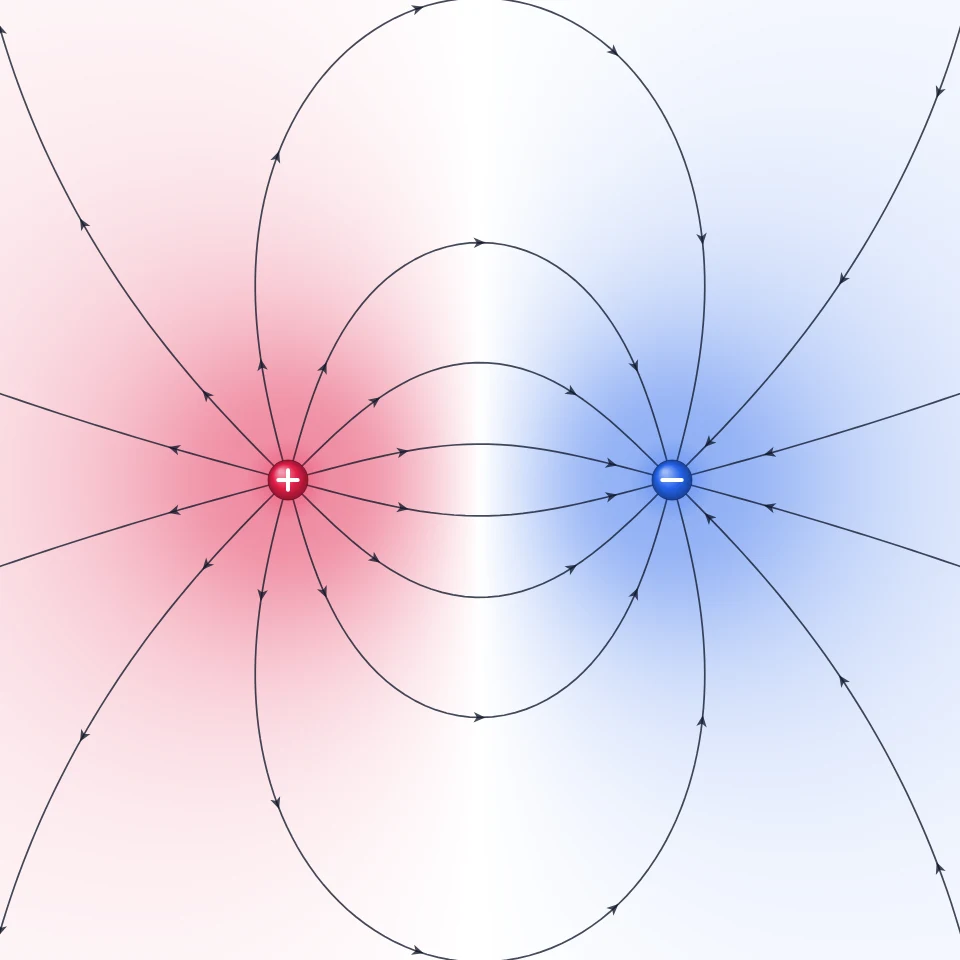
Faraday drew the field as lines of force, and they remain the clearest way to see it. A field line points along the field at every point; the lines begin on positive charges and end on negative ones (or run off to infinity), never cross, and are close together where the field is strong. The lines of a dipole loop from the positive charge round to the negative one; those of two like charges bend away from each other, leaving a point between them where the field is zero. To draw them, the app follows the field in small steps with a Runge–Kutta method that makes its steps shorter where the lines bend sharply, as near the charges.
Gauss's law
Carl Friedrich Gauss put Faraday's picture into an equation: the total flux of the electric field out of any closed surface equals the charge inside divided by ε₀. In terms of lines, the number of lines leaving a closed surface is proportional to the net charge within it, so a charge of 4 nC has twice as many lines as one of 2 nC, and a surface around a whole dipole has as many lines going in as coming out. The app starts lines on each charge in proportion to its charge. Strictly, the spacing of the lines shows the strength of the field in three dimensions; in a flat drawing of a plane through the charges it does so only roughly.
Potential and equipotentials
The electric potential V is the potential energy per unit charge, in volts: a charge q at a point with potential V has the energy qV, and moving it through a potential difference ΔV takes the work q ΔV. For a point charge V = kq / r, positive near positive charges and negative near negative ones, and again the contributions of all the charges add up. Equipotentials join points of the same potential, like contour lines on a map of hills (positive charges) and hollows (negative charges). The field points downhill, at right angles to the equipotentials, and is strongest where they crowd together: E = −dV/ds.
Capacitors and uniform fields
Two parallel plates with equal and opposite charges, a capacitor, make a nearly uniform field between them: the field lines run straight across and the equipotentials are evenly spaced, so the potential falls steadily from one plate to the other and E = ΔV / d. The app's parallel plates are two rows of point charges, which already gives a field that is almost the same everywhere between them, with the lines bulging out at the edges (the fringing field). Uniform fields steer the electron beam of an oscilloscope tube and the droplets of an ink-jet printer, and in 1909 Robert Millikan used one to hold charged oil drops still and measure the charge of the electron.
How a charge moves in a field
Set free, a charge accelerates along the field (against it, if it is negative) with a = qE / m. Its energy is shared between motion and position: ½ m v² + qV stays constant, so a positive charge speeds up as it falls to a lower potential. Because of its inertia it does not follow a curved field line but swings outward from it, and near a charge of the opposite sign it can sweep round in a curve much like a planet round the Sun, since both forces fall with the square of the distance. In a thick liquid the drag soon balances the electric force and the charge drifts along the field line at a speed in proportion to the field; this is the principle of electrophoresis, which sorts DNA fragments in a gel by their charge and size.
Frequently asked questions
Why can two field lines never cross?
At any point the field has a single direction, the direction of the force on a test charge there. If two lines crossed, the field would point two ways at once at the crossing, which is impossible. Lines can only meet where the field is zero, at a point like the one between two like charges, or at a charge itself.
What is a dipole?
A pair of equal and opposite charges a small distance apart. Many molecules are dipoles, water being the best known: its oxygen end is slightly negative and its hydrogen end slightly positive, which helps it dissolve salt. Far away, a dipole's field falls with the cube of the distance rather than the square, because the fields of its two charges nearly cancel.
Why is the field inside a metal zero?
A metal has electrons that are free to move. In a field they drift until the charges they leave behind make a field that exactly cancels the outside one, which takes a tiny fraction of a second; after that the field inside is zero and the whole metal is at one potential. That is why a car or an aeroplane struck by lightning protects the people inside, and why a Faraday cage of wire mesh shields what it encloses.
How is the potential different from the potential energy?
The potential belongs to a point in space: it is the energy each coulomb of charge would have there, in volts. The potential energy belongs to a particular charge at that point: U = qV, in joules. A 1 nC test charge at a point where V = 300 V has 0.3 µJ of potential energy; a −1 nC charge at the same point has −0.3 µJ. The app's tiles show both for the test charge.
Related tools
Electric field lines: Coulomb's law and equipotentials
Place positive and negative charges and see their electric field: field lines, equipotential lines, field vectors and a potential map, drawn from Coulomb's law. Drag the charges, measure the field with a test charge and let it go to watch it move.
Circuit builder: Ohm's law and Kirchhoff's laws
Build electric circuits online with batteries, resistors, bulbs, switches, fuses, ammeters and voltmeters, and watch the current flow. Check Ohm's law V = IR, compare series and parallel circuits, balance a Wheatstone bridge and see what a short circuit does.
Electric circuits explained
How electric circuits work: voltage, current and resistance, Ohm's law, Kirchhoff's current and voltage laws, series and parallel circuits, power and energy, meters, short circuits and fuses, the Wheatstone bridge and how circuit simulators solve a circuit.
Wave interference explained
How waves interfere: the principle of superposition, constructive and destructive interference, path difference and nodal lines, the ripple tank, Young's double slit and its fringe spacing, Huygens' principle and single-slit diffraction, gratings, phased arrays and noise-cancelling headphones.
Ready to try it?
Open PictorX in your browser — no install, no credit card required to start.
Open the electric field simulator