
Selected part
Tap a part on the board to select it.
Batteries
View
Circuit builder: Ohm's law and Kirchhoff's laws
Why do bulbs in a row glow dimly while the same bulbs side by side shine at full brightness? What does a fuse do, and why does a short circuit make a battery hot? Build the circuit and see for yourself. Drag batteries, resistors, bulbs, switches, fuses, ammeters and voltmeters onto the board, connect them with wires and the circuit is solved at once: the bulbs light up with their real power, the meters read, and moving arrows show the current going round. Every number follows from Ohm's law and Kirchhoff's two laws, the same rules engineers use for every circuit. Build a circuit on the board. Drag a battery, a resistor, a bulb, a switch, a fuse or a meter from the tray onto a line of the grid, or tap one in the tray and then tap where it goes; drag from dot to dot to draw wires. Drag a part to move it, or back to the tray to remove it. Tap a switch to open or close it, and tap any part to select it and change its value under the board. Undo and Redo (Ctrl+Z, Ctrl+Y) step through your changes. Play runs the current: the arrows move faster where more current flows, and the energy each part uses adds up. The tiles show Ohm's law, V = I R, for the selected part, or for the whole circuit when nothing is selected. With Sound on, switches click, fuses pop and a short circuit sizzles; Record films it with the sound.
How it works
- Pick an example, such as bulbs in series or in parallel, or start from the empty board. Drag a part from the tray onto a line of the grid, and drag from dot to dot to draw wires.
- Tap a switch to open or close it. Tap any part to select it: the tiles show its voltage, current, resistance and power, and the slider under the board changes its value.
- Press Play to watch the current go round: the arrows move faster where more current flows, and the ammeters show that it splits and joins at every junction.
- Close the switch in the fuse example to short-circuit the bulb and watch the fuse blow. Undo puts everything back.
Ohm's law: V = I R
In 1827 the German physicist Georg Simon Ohm published the rule that bears his name: the current through a conductor is proportional to the voltage across it, I = V / R. The constant R is the resistance, measured in ohms (Ω). A 100 Ω resistor on a 6 V battery therefore carries 6 / 100 = 0.06 A, or 60 mA. Select a resistor in the app and the tiles show its voltage, its current and their ratio, which stays the same whatever battery you use. The power it turns into heat is P = V I = I² R.
Series and parallel
Parts in series sit one after another on a single path, so the same current flows through all of them and their voltages add up to the battery's; their resistances simply add, R = R₁ + R₂ + …. Parts in parallel sit side by side between the same two points, so they share the same voltage and their currents add up; their combined resistance is smaller than the smallest one, 1/R = 1/R₁ + 1/R₂ + …. That is why three bulbs in series on a 6 V battery get 2 V each and glow at a ninth of their power, while three bulbs in parallel each get the full 6 V.
Kirchhoff's two laws
In 1845 Gustav Kirchhoff, then a 21-year-old student, put circuits on a firm footing with two rules. The current law: at every junction the currents flowing in add up to the currents flowing out, because charge is not created or lost. The voltage law: around any closed loop the voltages add up to zero, because energy is conserved. Together with Ohm's law they decide every current and voltage in a circuit, however tangled. The app solves them by nodal analysis, the method inside circuit simulators such as SPICE.
Short circuits, fuses and internal resistance
A short circuit is a path with almost no resistance between the terminals of a battery. Ohm's law then asks for a huge current, limited only by the battery's own internal resistance; the battery heats up and the wires can melt. A fuse is a thin wire that melts when the current goes above its rating, breaking the circuit before anything else is damaged. In the app a fuse blows above its rating, a short-circuited battery glows hot, and a battery with internal resistance shows its terminal voltage falling as it delivers more current.
Frequently asked questions
What is Ohm's law?
Ohm's law says that the current through a resistor is proportional to the voltage across it: V = I R, where V is the voltage in volts, I the current in amperes and R the resistance in ohms. Double the voltage and the current doubles. It holds for metals at a steady temperature; a bulb's filament gets hotter and its resistance rises, and parts such as diodes do not follow it at all. In this app every resistor and bulb keeps its resistance, so the law holds exactly.
Why are bulbs in series dimmer than bulbs in parallel?
In series the bulbs share the battery's voltage: three identical bulbs on 6 V get 2 V each, so each carries a third of the current and uses a ninth of the power it would on its own. In parallel every bulb is connected straight across the battery and gets the full 6 V, so each shines at full brightness, but the battery has to supply three times the current. Try both examples and compare the ammeters.
What is the difference between an ammeter and a voltmeter?
An ammeter measures the current through a wire, so it goes in series, in the path of the current, and has almost no resistance. A voltmeter measures the voltage between two points, so it goes in parallel, across the part being measured, and lets almost no current through. In the app both are ideal. A meter connected the wrong way round shows a negative reading; select it and press Turn round.
What happens in a short circuit?
A short circuit joins the two terminals of a battery with a path of almost no resistance. The current is then limited only by the battery's internal resistance, so it becomes very large and the battery and the wires heat up quickly; real batteries can leak, catch fire or explode. Fuses and circuit breakers stop the current before that happens. In the app a short-circuited battery glows hot and the picture warns; in the fuse example closing the switch shorts the bulb and the fuse blows.
Which way does current flow?
Conventional current flows from the positive terminal of a battery, through the circuit, to the negative terminal. This direction was chosen in the 18th century, long before anyone knew what carries the current. In metal wires it is actually electrons, which are negative and drift the other way, from − to +, and very slowly: about a tenth of a millimetre a second in a copper wire 1 mm thick carrying 1 A. The app can show either.
Can I use the picture?
Yes. Save gives a PNG at the size you choose, and the pencil opens the circuit in the PictorX photo editor with the board, the wires, the current, each kind of part, the labels and the warnings on layers of their own, and the example's name as editable text. In the editor itself it is under Apps ▸ Science ▸ Physics ▸ Circuit Builder, where you pick the example, the look and the current, or paste a circuit. Everything runs in your browser.
Circuit Builder: how do I record a video?
Press the red Record button in the playback bar: it films what the stage shows. Press it again to stop, and the video is saved to your device. Recording is free; you only need to sign in. Without a subscription the video carries a small PictorX logo in a corner. The button beside Record opens the video options: the shape (as shown, square, story 9:16 or wide 16:9), the length (until you stop, or 5, 10, 15 or 30 seconds for social media) and the file: MP4, WebM or an animated GIF. For the sound, choose the app's own sounds or one of three music tracks: calm, bright or beat.
Related tools
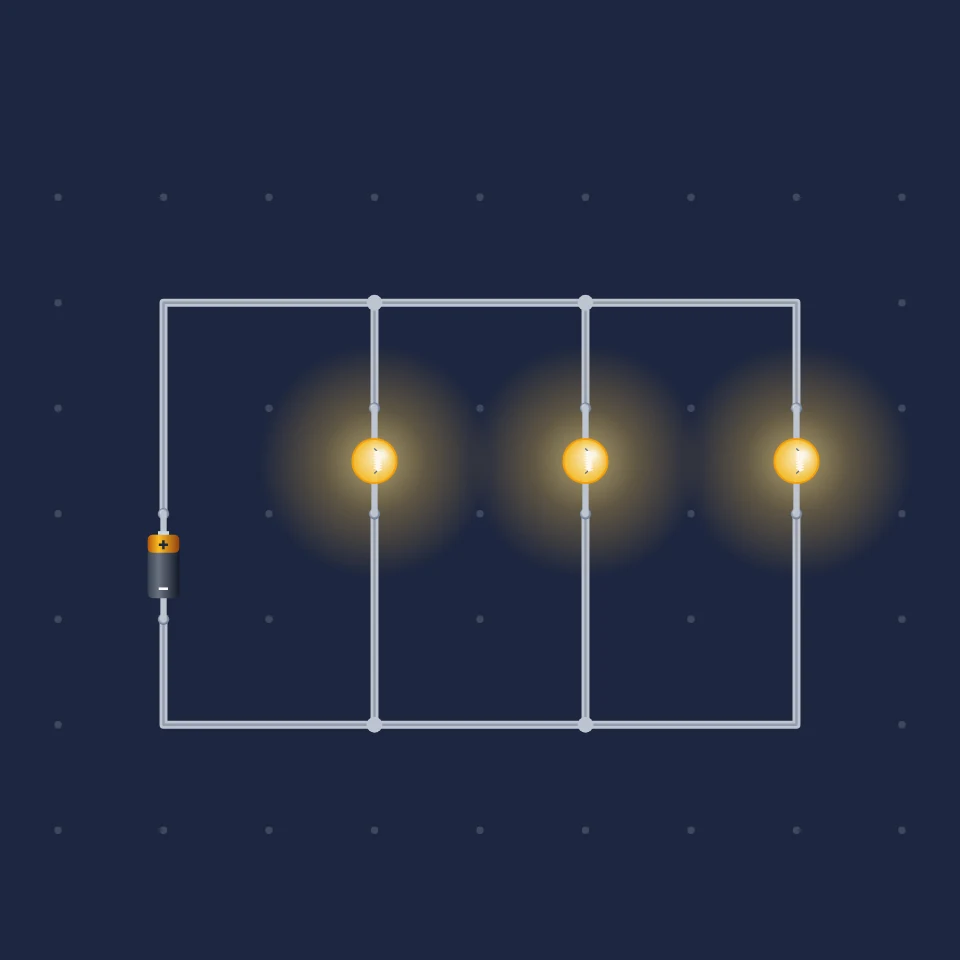
Electric circuits explained
How electric circuits work: voltage, current and resistance, Ohm's law, Kirchhoff's current and voltage laws, series and parallel circuits, power and energy, meters, short circuits and fuses, the Wheatstone bridge and how circuit simulators solve a circuit.
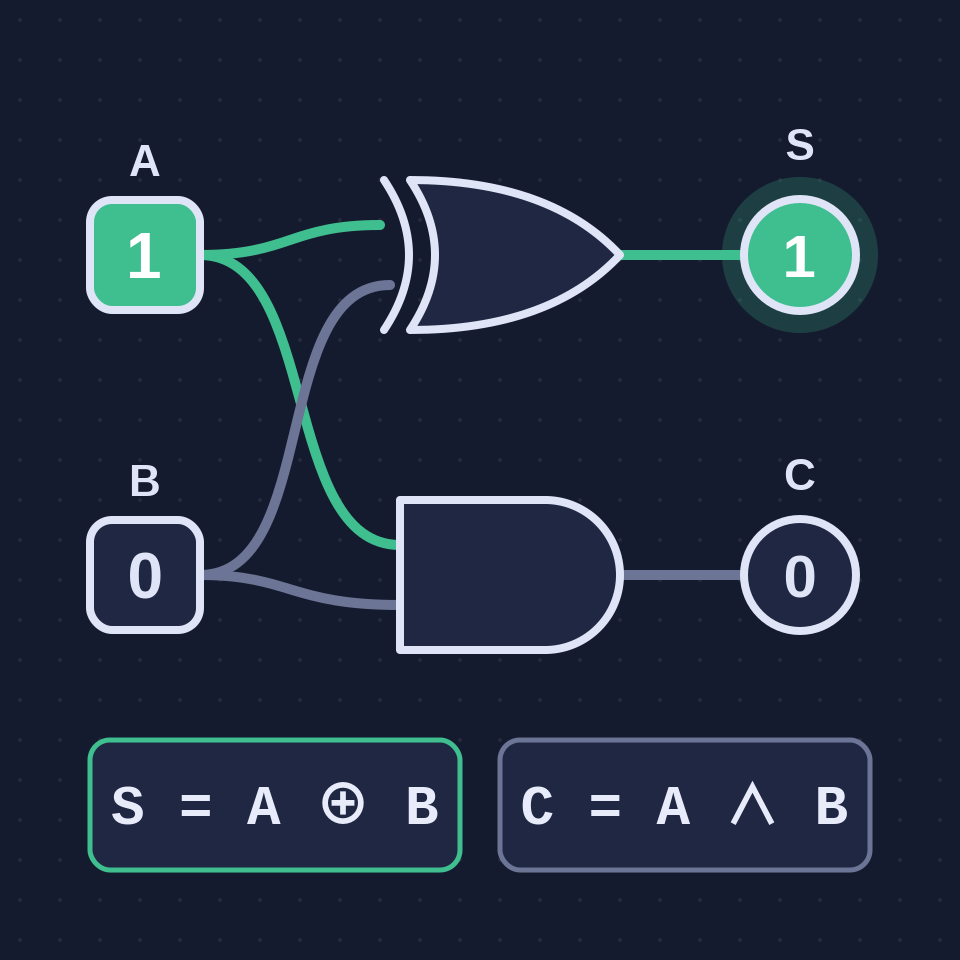
Logic circuit simulator
Build digital circuits from AND, OR, NOT, NAND, NOR, XOR and XNOR gates in your browser. Switch the inputs, watch the signals run through the wires, and get the truth table and the formula of every output. With adders, a multiplexer, latches and a flip-flop to explore.
Wave interference in a ripple tank
A ripple tank in your browser: two sources make nodal lines, a plane wave passes a double slit, a single slit or a diffraction grating, and the pattern lands on a screen. Water ripples, sound and light with real wavelengths and frequencies, a probe you can hear and a phased array that steers its beam.
Logic gates explained
How logic gates work and what they build: AND, OR, NOT, NAND, NOR, XOR and XNOR, why NAND is universal, how gates add numbers, choose between signals and remember a bit, and what latches, flip-flops and clocks do.
Ready to try it?
Open PictorX in your browser — no install, no credit card required to start.
Go to Editor