
Electric circuits explained
Every torch, phone charger and car runs on the same few ideas: a battery pushes charge round a closed loop, the parts in the loop resist it, and the current that flows depends on both. This page explains voltage, current and resistance, the laws of Ohm and Kirchhoff that connect them, how series and parallel circuits differ, where the energy goes, how meters, switches and fuses work, what makes a short circuit dangerous, and how a computer solves a circuit of any size.
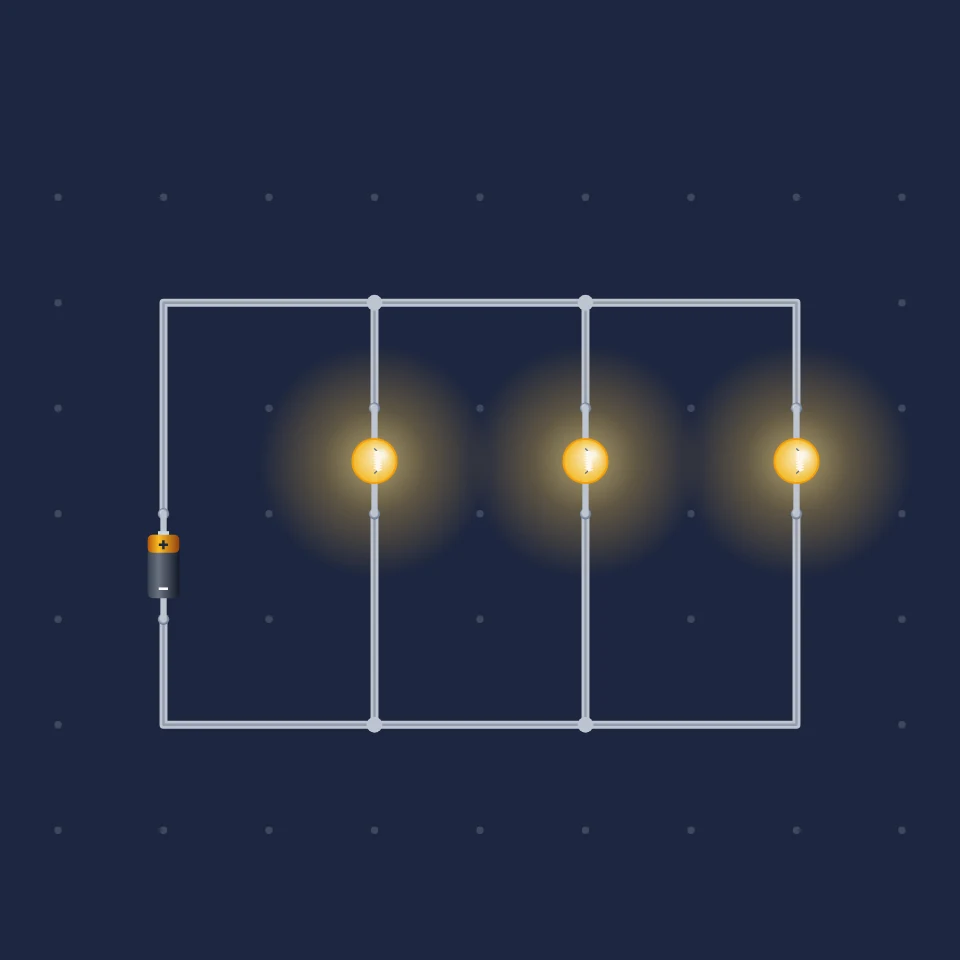
Voltage, current and resistance
Current is the flow of electric charge, measured in amperes: one ampere is one coulomb of charge passing a point each second. Voltage, measured in volts, is the push behind it, the energy each coulomb gains from a battery or gives up in a lamp: one volt is one joule per coulomb. Resistance, measured in ohms, says how hard it is to push a current through something. A copper wire has almost none, a resistor a chosen amount, and air or plastic so much that, at ordinary voltages, no current flows at all. A circuit only works when the path is closed: open a switch anywhere in the loop and the current stops everywhere.
Ohm's law
Georg Simon Ohm, a schoolteacher in Cologne, measured how the current in wires of different lengths depended on the voltage of his batteries and in 1827 published the result: the current is proportional to the voltage, I = V / R. His work was received coldly at first but won him the Royal Society's Copley Medal in 1841, and the unit of resistance is named after him. The law holds for metals at a steady temperature. A lamp's tungsten filament is about ten times more resistive white-hot than cold, and parts such as diodes and transistors do not follow it at all, but in every case the ratio V / I is still called the resistance.
Kirchhoff's current and voltage laws
Gustav Kirchhoff was a 21-year-old student in Königsberg when he published his two circuit laws in 1845. The current law, or junction rule, says that the currents flowing into any junction add up to those flowing out, since charge cannot pile up in a wire. The voltage law, or loop rule, says that the voltages around any closed loop add up to zero, since a charge that goes round once ends where it started, with the same energy. In the app's mixed example, 30 mA leaves the battery, splits into 10 mA and 20 mA, and joins again: the ammeters show the current law at work.
Series and parallel circuits
Resistors in series carry the same current and share the voltage in proportion to their resistances; their total is R = R₁ + R₂ + …. This is the voltage divider used in countless circuits: 9 V across 1 kΩ and 2 kΩ in series splits into 3 V and 6 V. Resistors in parallel share the same voltage and split the current in inverse proportion to their resistances, so the total resistance falls with every branch added: 1/R = 1/R₁ + 1/R₂ + …. Houses are wired in parallel so that every lamp gets the full mains voltage and can be switched on its own; old Christmas lights were wired in series, which is why one broken bulb put out the whole string.
Power and energy
A part with a voltage V across it and a current I through it turns electrical energy into heat, light or motion at the rate P = V I, measured in watts; with Ohm's law this is also I² R and V² / R. Over a time t the energy is E = P t, in joules. A 6 V, 3 W bulb carries half an ampere and has a resistance of 12 Ω. Put two of them in series on 6 V and each gets 3 V and a quarter of its power; the brightness of the bulbs in the app follows their power in just this way. Electricity bills count kilowatt-hours: one kilowatt-hour is 3.6 million joules.
Batteries, internal resistance and short circuits
A battery's chemistry gives each coulomb a fixed amount of energy, its electromotive force E, but the charge also has to get through the battery's own materials, its internal resistance r. The voltage at its terminals is therefore V = E − I r, falling as the current grows. Join the terminals with a wire and the only thing limiting the current is r: a short circuit. A single AA cell can then deliver several amperes and a car battery hundreds, enough to melt tools and start fires. A fuse, a thin wire that melts when the current goes above its rating, or a circuit breaker, which trips, cuts the circuit before the damage is done.
Measuring: meters and the Wheatstone bridge
An ammeter goes in series with the part it measures and should have almost no resistance, so that it does not change the current; a voltmeter goes across the part and should draw almost no current. Early meters were galvanometers, a coil turning a needle in a magnet's field. For precise resistances, Samuel Hunter Christie described in 1833, and Charles Wheatstone made famous in 1843, a bridge of four resistors with a meter across the middle: when the ratios on the two sides are equal, no current flows through the meter, and an unknown resistance can be read from the other three. The app's bridge starts balanced: change any resistor and the meter springs to life.
How a computer solves a circuit
For a small circuit Kirchhoff's laws can be applied by hand, loop by loop. Circuit simulators do it systematically: they give every junction an unknown voltage, write the current law at each one with Ohm's law for every branch, add an equation for every voltage source, and solve the whole system of linear equations at once. This modified nodal analysis, described by Chung-Wen Ho, Albert Ruehli and Pierce Brennan in 1975, is the heart of SPICE, the simulator that Laurence Nagel and colleagues released at Berkeley in 1973 and whose descendants still check almost every chip before it is made. The circuit builder uses the same method, re-solving the board after every change.
Frequently asked questions
Why does a bird on a power line not get a shock?
Because both its feet are on the same wire, at the same voltage. Current only flows through something when there is a voltage across it, and the voltage between the bird's feet, a few centimetres of thick wire apart, is tiny. If the bird touched a second wire or a grounded pole at the same time, the full voltage would be across its body. The same idea explains why a voltmeter across a plain wire in the app reads almost nothing.
How fast does electricity travel?
The signal travels very fast, at a large fraction of the speed of light, because the electric field along the wire pushes all the electrons at almost the same moment. The electrons themselves drift slowly: in a copper wire 1 mm thick carrying 1 A they move at about a tenth of a millimetre a second. A light comes on as soon as the switch is closed because the wire is already full of electrons, like a pipe full of water.
What do the coloured bands on a resistor mean?
They give its resistance. In the common four-band code the first two bands are digits, the third is the power of ten to multiply by, and the fourth is the tolerance, gold for ±5 %. The colours run black 0, brown 1, red 2, orange 3, yellow 4, green 5, blue 6, violet 7, grey 8 and white 9, so brown, black, brown and gold is 10 × 10 = 100 Ω. Resistors come in standard values such as the E24 series (1.0, 1.1, 1.2, 1.3, 1.5 … 9.1 in every decade); the app uses them and paints the right bands on every resistor.
What do switches have to do with computers?
In 1937 Claude Shannon showed in his master's thesis that circuits of switches can carry out Boolean logic: two switches in series light a lamp only if both are closed (AND), two in parallel if either is (OR). Replace the switches by relays, valves or transistors switched by other circuits and you have the logic gates every computer is built from. The app's AND and OR example shows the idea with real switches; the Logic Circuit Simulator takes it further with gates.
Related tools
Circuit builder: Ohm's law and Kirchhoff's laws
Build electric circuits online with batteries, resistors, bulbs, switches, fuses, ammeters and voltmeters, and watch the current flow. Check Ohm's law V = IR, compare series and parallel circuits, balance a Wheatstone bridge and see what a short circuit does.
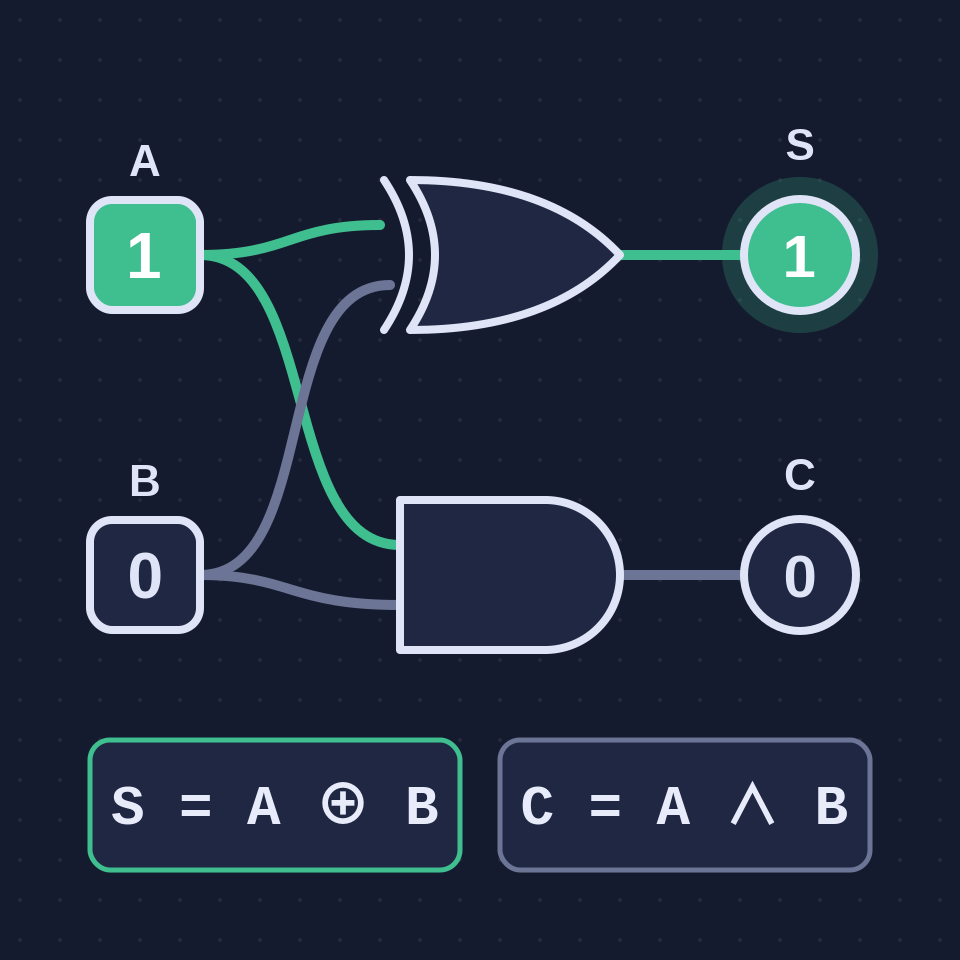
Logic circuit simulator
Build digital circuits from AND, OR, NOT, NAND, NOR, XOR and XNOR gates in your browser. Switch the inputs, watch the signals run through the wires, and get the truth table and the formula of every output. With adders, a multiplexer, latches and a flip-flop to explore.
Logic gates explained
How logic gates work and what they build: AND, OR, NOT, NAND, NOR, XOR and XNOR, why NAND is universal, how gates add numbers, choose between signals and remember a bit, and what latches, flip-flops and clocks do.
Wave interference explained
How waves interfere: the principle of superposition, constructive and destructive interference, path difference and nodal lines, the ripple tank, Young's double slit and its fringe spacing, Huygens' principle and single-slit diffraction, gratings, phased arrays and noise-cancelling headphones.
Ready to try it?
Open PictorX in your browser — no install, no credit card required to start.
Open the circuit builder