
Diffusion-limited aggregation explained
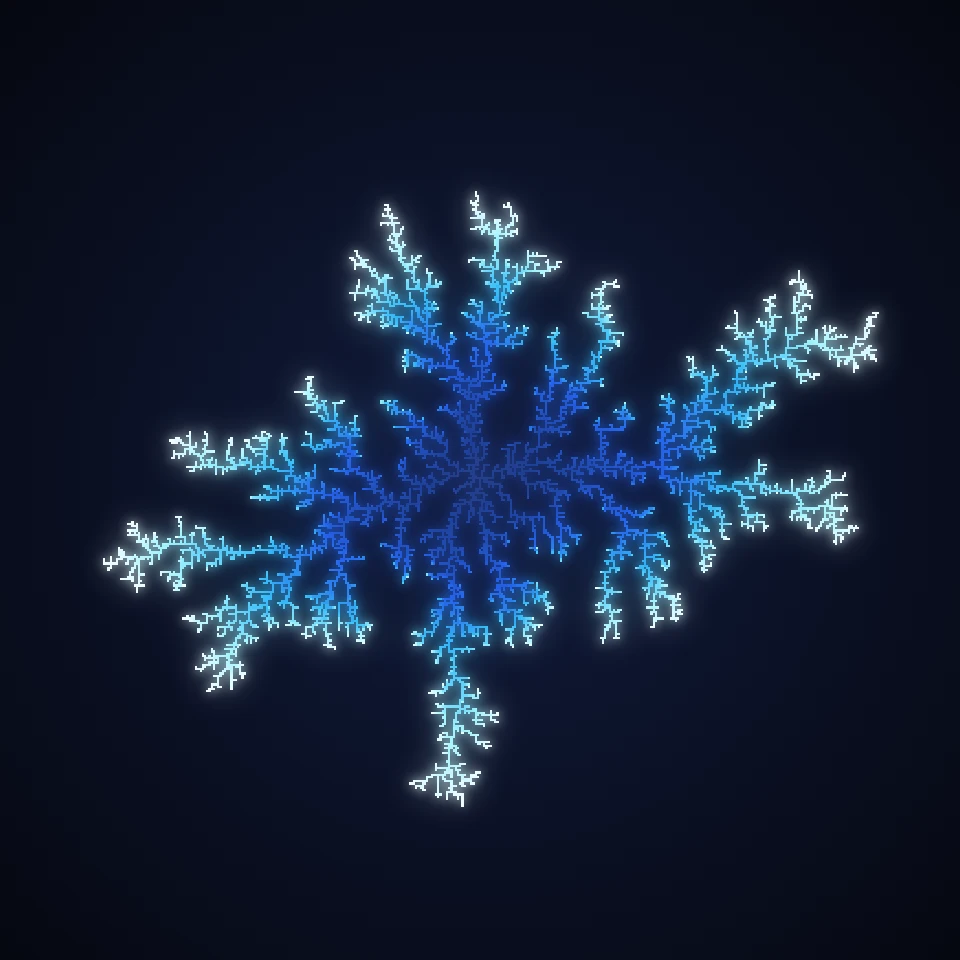
Let particles wander about at random, one at a time, and let each one stick the moment it touches a growing cluster. Nothing in that rule says branch, yet the cluster grows into a delicate tree of branches that split again and again, like frost on a window or a bolt of lightning. This is diffusion-limited aggregation, one of the simplest ways to grow a fractal.
The rule: wander, touch, stick
Put one particle, the seed, in the middle of a grid. Release a second particle far away and let it take random steps: left, right, up or down, each with the same chance. Sooner or later it either wanders off, and is replaced by a new one, or it lands next to the seed, and there it stops for good. Then the next particle sets off. That is the whole model, published by Thomas Witten and Leonard Sander in 1981. The random steps are diffusion, the way a speck of dust drifts in water, and the growth is limited by how fast that diffusion brings new particles in, hence the name.
Why the tips win
A wandering particle is far more likely to bump into a branch that sticks out than to find its way deep into a gap between two branches: on its way in it almost always touches one of the tips first. So the tips grow fastest, which makes them stick out even further, which makes them catch even more. Small random bumps are amplified into new branches, and the fjords between the branches are screened off and stay nearly empty. That instability is why the cluster branches at every scale instead of growing into a round blob.
A fractal with dimension 1.71
Count the particles inside a circle of radius r around the seed. For a filled disc the count grows like r², for a line like r¹. For a diffusion-limited aggregate it grows like r^1.71: double the size and you hold about 3.3 times as many particles, not 4. The number 1.71 is the cluster's fractal dimension, and it is the same for every cluster grown this way in a plane, whatever the random steps did. The simulator measures it from the radius of gyration as the cluster grows, or by counting the boxes the cluster touches at smaller and smaller box sizes. A finite cluster usually comes out a little below 1.71.
Seeds, stickiness and neighbours
Grow the cluster from a line instead of a point and you get a forest of competing trees, as frost grows from the edge of a window: the tallest trees catch most of the particles and the short ones stop growing. Grow it from a ring and it reaches inwards. Make particles less sticky, so they bounce off a few times before they stay, and they get a chance to reach deeper, so the branches grow thicker and the cluster denser. Letting particles stick to corner neighbours as well as side neighbours makes the branches thinner and more open. The square grid also leaves a trace: very large clusters grow a little faster along the axes.
Where it appears in nature
The same branching shows up wherever growth is driven by something that diffuses. Zinc or copper deposited from a solution by electrolysis grows in DLA trees, and so do the black manganese dendrites that look like fossil ferns on limestone. Frost and many snow crystals branch for the same reason, and so do mineral veins, bacterial colonies on a poor medium, and coral in still water. When air or water is pushed into a thick fluid between two glass plates it forms the same fingers (viscous fingering), and an electric discharge burns a Lichtenberg figure with the shape of a DLA cluster into wood or acrylic. Lightning branches in a related way.
The mathematics behind it
Where a random walker first touches the cluster is described by the harmonic measure: the chance of arriving at each point of the cluster's edge, which is the same as the electric field at the surface of a charged object of that shape. Tips have a strong field and fjords almost none. Growth driven by such a field is called Laplacian growth, and it links DLA to viscous fingering and to the dielectric breakdown model of lightning. Despite its simple rule, there is still no exact theory that explains the value 1.71; it comes from simulations, and from Harry Kesten's proof that the cluster's arms cannot grow faster than a certain rate.
How the simulator is so fast
A plain random walk wastes almost all of its steps far from the cluster. The simulator lets a walker that is far away jump: if no particle lies within a distance d, the walk is bound to cross a circle of radius d before it touches anything, and where it crosses is equally likely in every direction, so the walker can jump straight to a random point on that circle. A grid of empty blocks tells how far the walker can safely jump, even close to the cluster. Walkers that wander too far are sent back to start, and every run uses its own seeded random numbers, so the same settings always grow the same cluster.
Explore it
Open the diffusion-limited aggregation simulator and press Grow to watch a cluster grow particle by particle, with the walkers wandering in. Try the ground and the ring as seeds, lower the stickiness, and switch to 8 neighbours. Read the size, the fractal dimension and the number of random steps in the tiles. The pencil opens the picture in the photo editor with the glow, the seed and the cluster on layers of their own.
Frequently asked questions
What is diffusion-limited aggregation?
A model of growth in which particles move by random walk until they touch a cluster and then stick to it for good. Thomas Witten and Leonard Sander introduced it in 1981. The cluster it grows, often called a Brownian tree, is a branching fractal.
Why does a DLA cluster branch?
Because random walkers almost always touch a tip before they can reach the gaps between the branches. The tips grow fastest, stick out further and catch even more, while the gaps are screened off. Small irregularities grow into new branches, at every scale.
What is the fractal dimension of diffusion-limited aggregation?
About 1.71 in a plane: the number of particles within a distance r of the seed grows like r^1.71. In three dimensions it is about 2.5. The value comes from simulations; there is no exact formula for it.
Where does diffusion-limited aggregation occur in nature?
In metal deposited by electrolysis, manganese dendrites on rock, frost and snow crystals, mineral veins, bacterial colonies, viscous fingering between glass plates, Lichtenberg figures burned by electric discharges, and in a related form in lightning.
What does stickiness change?
With a stickiness below 100% a particle that touches the cluster may move on instead of sticking. It then gets the chance to reach deeper into the gaps before it stays, so the branches become thicker and the cluster denser, though it still branches at large scales.
Related tools
Diffusion-limited aggregation simulator
Watch random walkers stick to a growing cluster and form a branching fractal like frost, coral or lightning. Grow it from a point, the ground or a ring, change the stickiness, and measure its fractal dimension.
Random walk
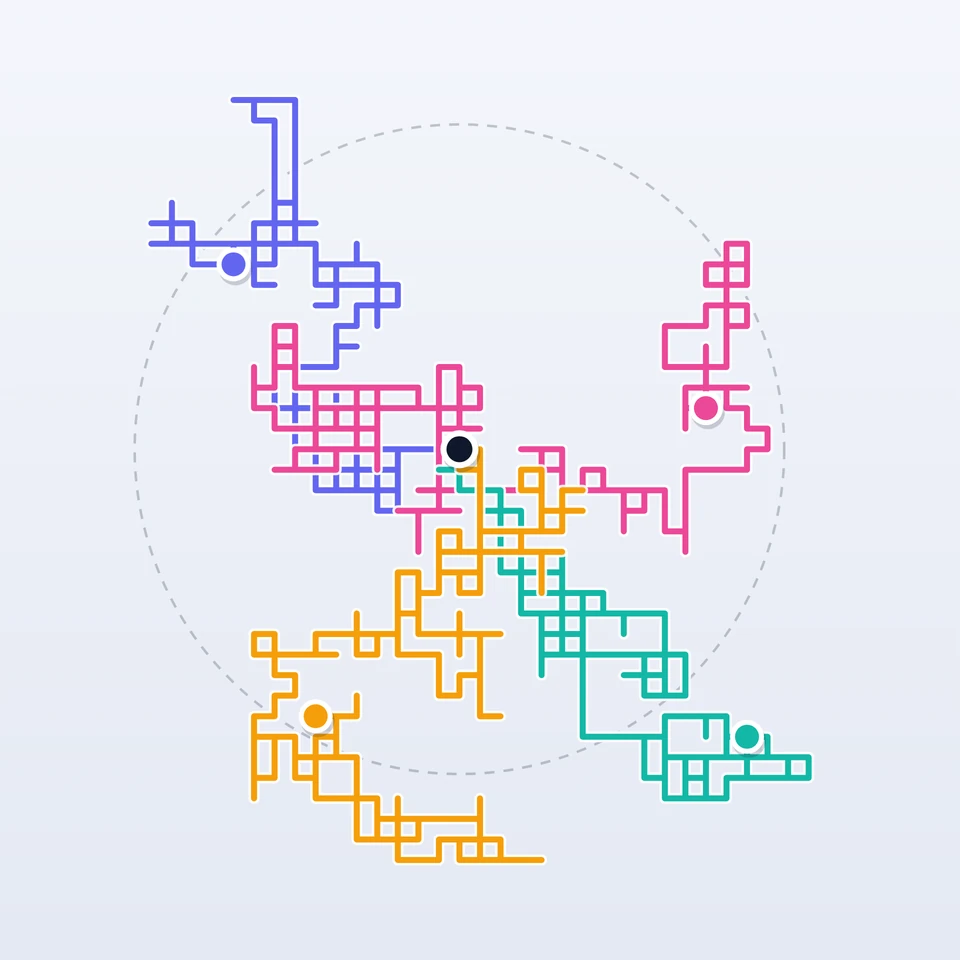
Simulate up to 5,000 random walkers taking steps left, right, up or down and see how far they end up from the start. Compare the mean distance, the variance and the √N rule with theory, watch the Rayleigh curve form and count the walkers that come home.
Sandpile Fractal
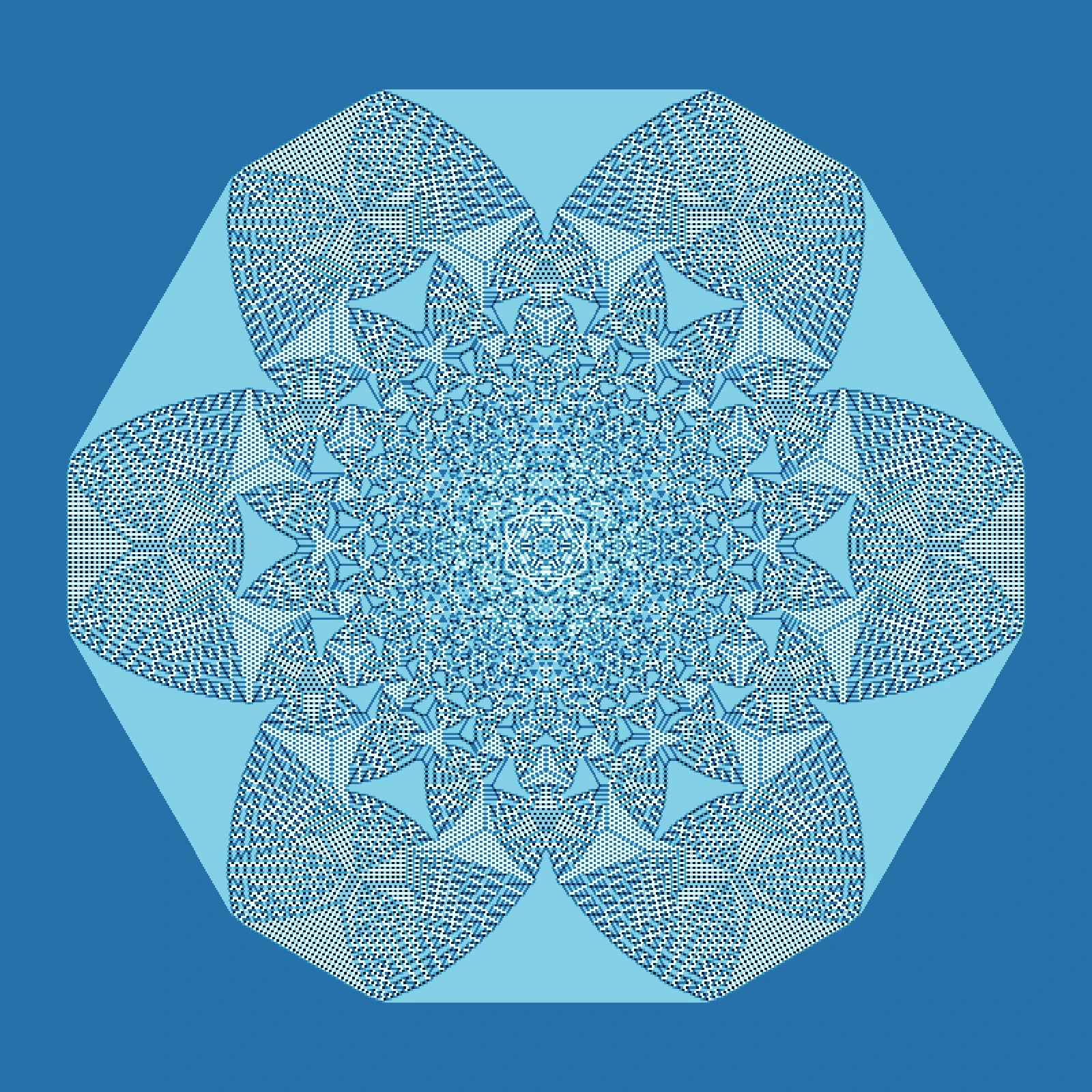
Drop up to a million grains of sand on one cell and watch them topple into a fractal. Square, diagonal and triangular lattices, the identity of the sandpile group, and avalanches.
Percolation
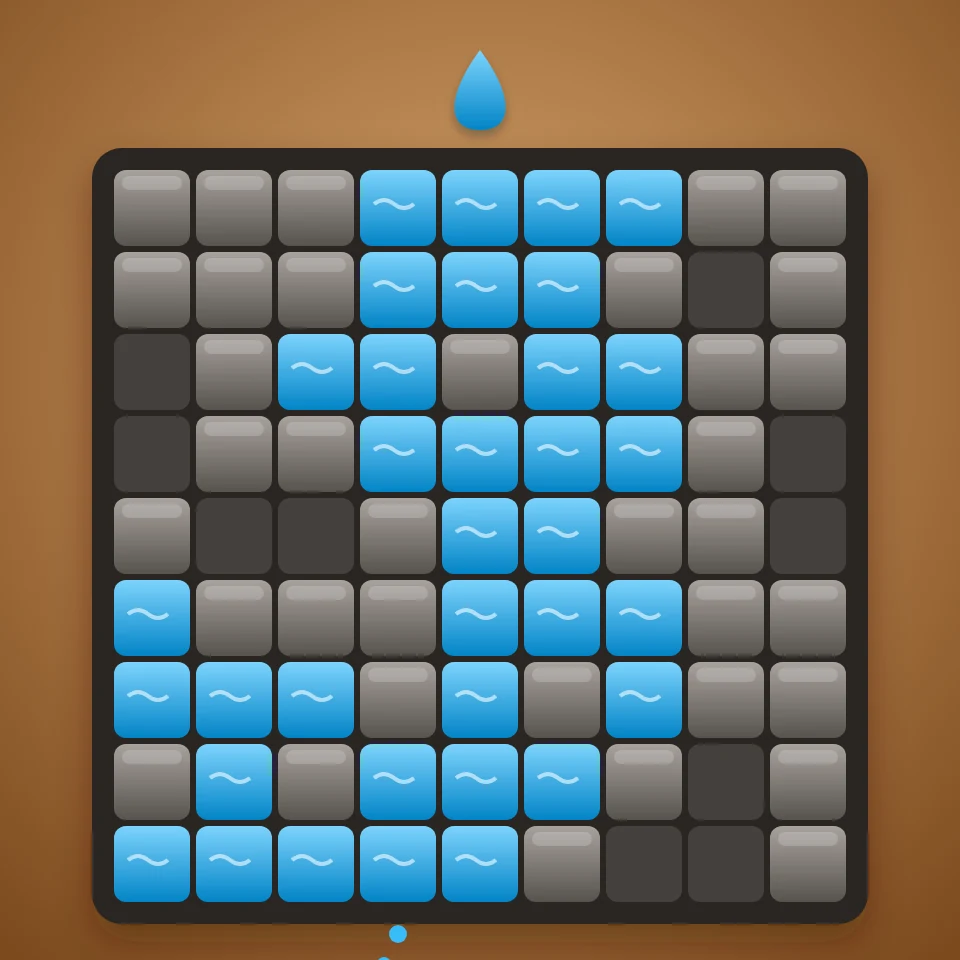
Fill a grid at random and find from which share of filled cells a path joins the top to the bottom. Watch water flow through the clusters, see this grid's exact threshold and the chance curve from 200 grids against the theory's 59.27%.
Fractal generator: zoom into Mandelbrot, Julia and Newton fractals
Free online fractal generator: zoom about 5 trillion times into the Mandelbrot set, Julia and Newton fractals, jump to 64 famous spots and save a PNG.
Ready to try it?
Open PictorX in your browser — no install, no credit card required to start.
Open the diffusion-limited aggregation simulator