
Conic sections explained
The ancient Greeks studied the curves you get by slicing a cone, long before anyone knew that planets move along them. This page explains how one cut gives four different curves, how a single number, the eccentricity, describes their shape, why the foci and directrices exist, how two spheres prove the famous string construction, and how the same curves turn up in equations, mirrors and orbits.
The cone and the cut
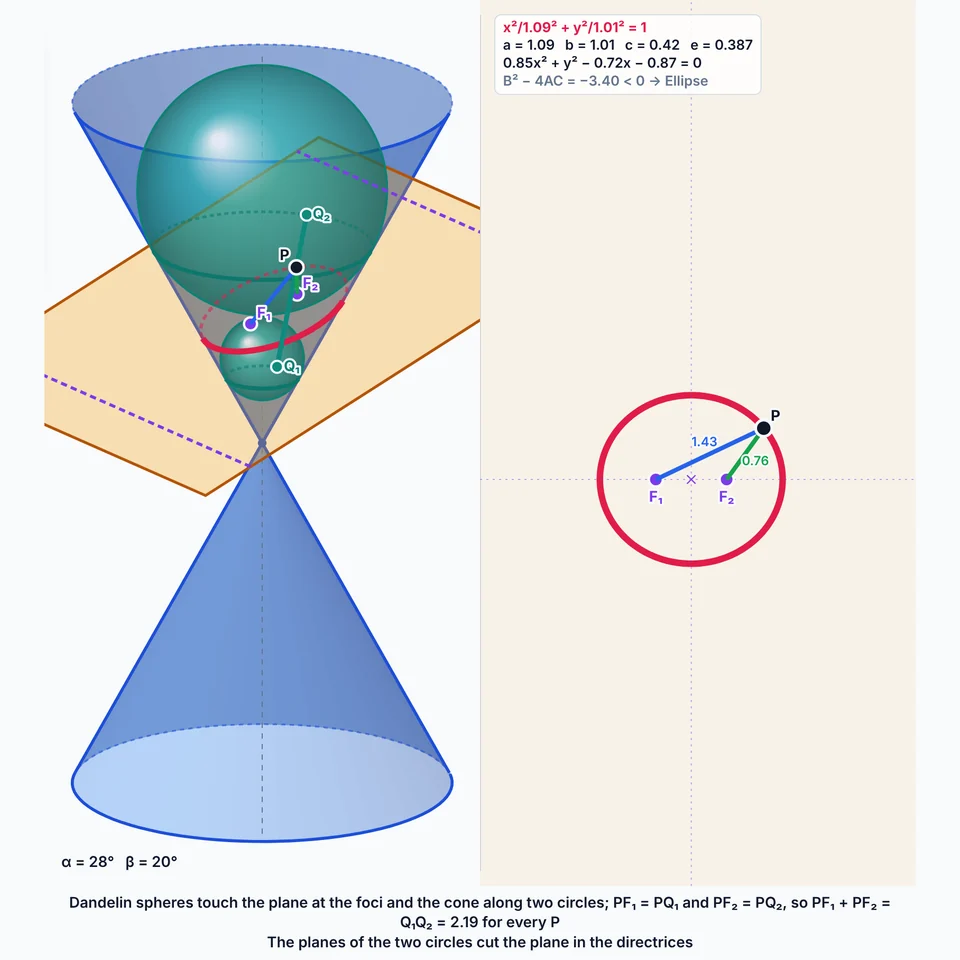
Take a line through a fixed point, the apex, and turn it round an axis through that point at a constant angle α: it sweeps out a double cone, two nappes meeting at the apex, and each position of the line is a generator. A plane that misses the apex meets the cone in a curve. If the plane is perpendicular to the axis the curve is a circle. Tilt it by β from the horizontal: as long as β is less than the slope angle 90° − α of the generators, the plane crosses every generator on one nappe and the curve is closed, an ellipse. At β = 90° − α the plane is parallel to one generator, which it never meets, and the curve, a parabola, runs off to infinity. For larger β the plane cuts both nappes and the curve has two branches, a hyperbola. A plane through the apex gives the degenerate conics: a single point, a single line (when it touches the cone along a generator) or two lines crossing at the apex.
A short history
Menaechmus, around 350 BC, found the conics while trying to double the cube, cutting cones of different angles with a plane perpendicular to a generator. Apollonius of Perga, about a century later, showed that all of them can be cut from a single double cone by tilting the plane, and gave them their names: ellipse (falling short), parabola (alongside) and hyperbola (exceeding), after the way an area compares with a square in their defining relations. Pappus described the focus and directrix, and nearly two thousand years later Kepler found that Mars moves on an ellipse with the Sun at a focus, and Newton explained why.
Eccentricity and the shape of a conic
Every conic has an eccentricity e: e = 0 for a circle, 0 < e < 1 for an ellipse, e = 1 for a parabola and e > 1 for a hyperbola. For the cut of a cone of half-angle α by a plane tilted by β, e = sin β / cos α. The distance δ of the plane from the apex only scales the curve: the semi-latus rectum, the half-width of the curve through its focus, is ℓ = δ·tan α, and the polar equation round a focus is r = ℓ / (1 + e·cos θ). So the shape is set by e alone, and conics with the same eccentricity are similar, like all circles or all parabolas.
Foci and directrices
Apart from the circle, every conic is the set of points P whose distance to a fixed point F, the focus, is e times their distance to a fixed line D, the directrix: PF = e·PD. An ellipse and a hyperbola have two foci and two directrices, a parabola one of each. From this definition follow the classical ones: for an ellipse the sum of the distances to the two foci is constant, PF₁ + PF₂ = 2a, which is why a loop of string round two pins draws one (the gardener's ellipse); for a hyperbola the difference is constant, |PF₁ − PF₂| = 2a; and a parabola is the set of points as far from the focus as from the directrix.
The Dandelin spheres
Why does the cut of a cone have foci at all? In 1822 Germinal Pierre Dandelin gave a beautiful answer. Place a sphere inside the cone so that it touches the cone along a circle and also touches the cutting plane; there are two such spheres, on either side of the plane. Where they touch the plane are the foci. Take any point P on the curve and the generator through P, which meets the two circles at Q₁ and Q₂. All tangent segments from a point to a sphere have the same length, so PF₁ = PQ₁ and PF₂ = PQ₂, and PF₁ + PF₂ = Q₁Q₂, the distance between the circles along the cone, which does not depend on P. For a hyperbola the spheres lie in opposite nappes and the difference is constant. The plane of each circle of contact cuts the cutting plane in a directrix, and the ratio PF/PD works out as sin β / cos α.
Equations: standard and general form
Placed with its centre at the origin and its axis along x, an ellipse is x²/a² + y²/b² = 1 with a ≥ b and c² = a² − b², a hyperbola is x²/a² − y²/b² = 1 with c² = a² + b² and the asymptotes y = ±(b/a)x, and a parabola with its vertex at the origin is y² = 4px, with the focus at (p, 0). In every case e = c/a. Conversely every equation of second degree, Ax² + Bxy + Cy² + Dx + Ey + F = 0, describes a conic (possibly degenerate or empty), and the discriminant B² − 4AC decides which: negative for an ellipse, zero for a parabola, positive for a hyperbola. With the origin at a focus, the curve of the app is (1 − e²)x² + y² − 2eℓx − ℓ² = 0, whose discriminant is 4(e² − 1).
Reflections
The tangent to an ellipse makes equal angles with the lines to the two foci, so light or sound leaving one focus is reflected to the other, and since every path has the same length 2a, all of it arrives at once. That is the whispering gallery effect of elliptical rooms, and lithotripters use it to focus shock waves on kidney stones. A parabolic mirror reflects rays parallel to its axis into the focus, which is why satellite dishes, radio telescopes and solar furnaces are paraboloids, and why a lamp at the focus of a headlight sends out a parallel beam. A hyperbolic mirror reflects rays aimed at one focus towards the other, which the Cassegrain telescope uses.
Orbits and how the app works
Newton proved that a body moving under an inverse-square force, such as gravity, travels on a conic with the attracting body at a focus. Planets move on ellipses with small e (Earth 0.017, Mars 0.093), Halley's Comet on a long ellipse with e = 0.967, and a body faster than escape speed, such as the interstellar visitor ʻOumuamua with e ≈ 1.2, on a hyperbola. The body sweeps equal areas in equal times (Kepler's second law); the app solves Kepler's equation E − e·sin E = M, its hyperbolic form or Barker's equation for every e to place it. The 3D view is an orthographic projection of the cone and the plane; the curve, the foci, the directrices and the Dandelin spheres are computed exactly from α, β and the offset, in units of a fifth of the drawn cone's height.
Frequently asked questions
Why is a circle not given a directrix?
For a circle e = 0, and the rule PF = e·PD would put every point at the focus. Seen as a limit, as e shrinks towards 0 the directrix moves off to infinity while the curve becomes a circle round the focus. In the cone picture, a level plane is parallel to the planes of the circles where the Dandelin spheres touch, so they never meet it and there is no directrix line.
Is the cut of a cone really an ellipse and not an egg shape?
Yes. It is tempting to think the cut should be fatter at the end farther from the apex, where the cone is wider, but it is exactly symmetric: the Dandelin spheres prove that the sum of the distances to the two foci is constant, which is the definition of an ellipse. What is not symmetric is its position: the centre of the ellipse is not where the cone's axis meets the plane but a little towards the end farther from the apex.
What happens to the hyperbola when the plane passes through the apex?
The two branches move together as the plane approaches the apex and, when it passes through it, collapse onto their asymptotes: two straight lines crossing at the apex, a degenerate hyperbola. In the same way an ellipse shrinks to a point and a parabola to a single line along the generator the plane touches.
How do comets and planets relate to the eccentricity?
Under the Sun's gravity every orbit is a conic with the Sun at a focus, and its eccentricity depends on the body's energy. A negative total energy gives a bound ellipse (planets, periodic comets), exactly zero energy a parabola (escape speed), and positive energy a hyperbola: the body passes once and leaves the Solar System. The app's comet example uses e = 0.967, close to Halley's Comet.
Related tools
Cut a cone, get a conic
Cut a double cone with a plane in 3D and see the circle, ellipse, parabola or hyperbola in its own plane. Tilt through every type, read the eccentricity e = sin β / cos α and the equation, watch the Dandelin spheres prove the focal property, draw with string and pins, bounce rays to a focus and fly a Kepler orbit.
Compass and straightedge constructions explained
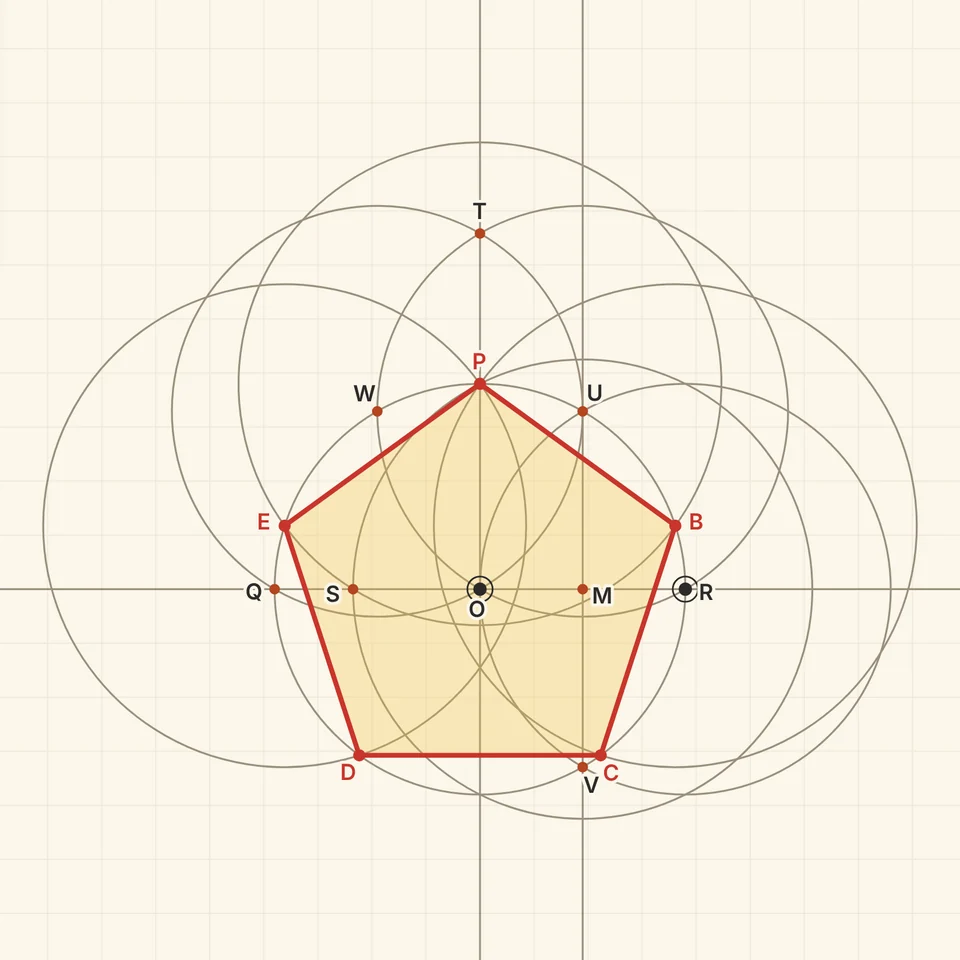
How geometry is done with only a compass and a straightedge: Euclid's postulates and the collapsing compass, the classic constructions of bisectors, perpendiculars, parallels and regular polygons, constructible lengths such as √2 and the golden ratio, Gauss's 17-gon, and why angle trisection, doubling the cube and squaring the circle are impossible.
Gravity shapes the solar system
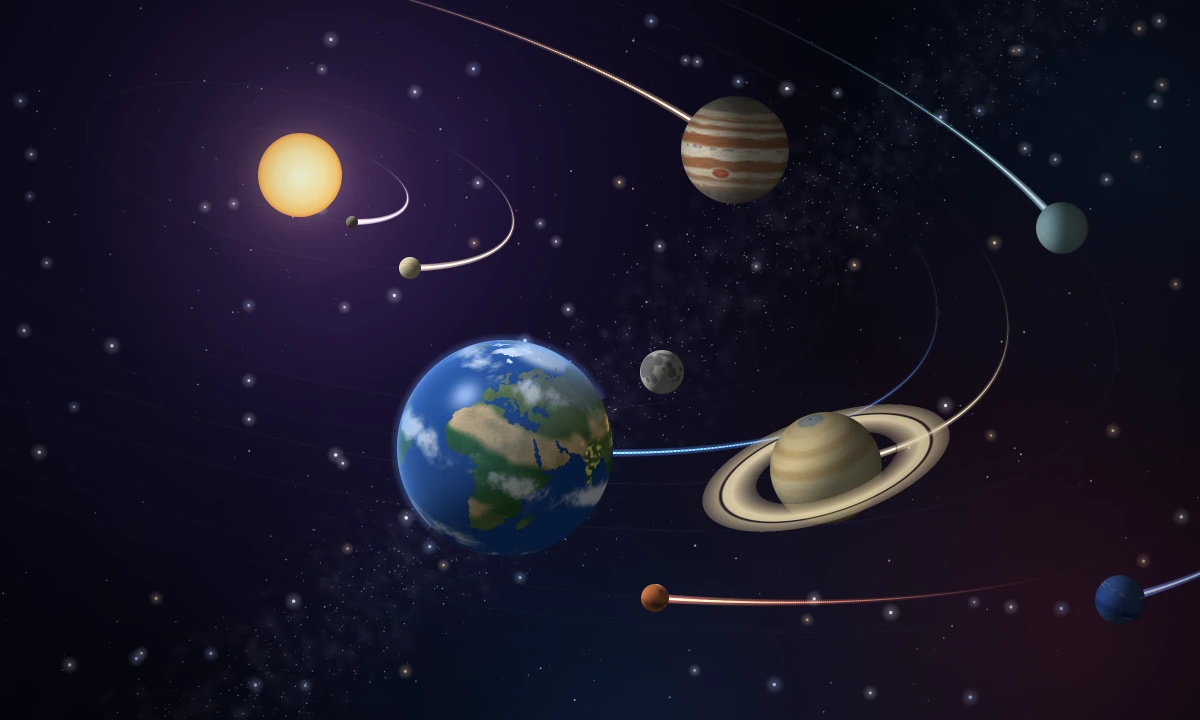
How does gravity shape the solar system? Eight planets and their moons on tilted orbits, the dwarf planets and Kuiper belt, and Jupiter's Galilean moons.
Linear transformations explained
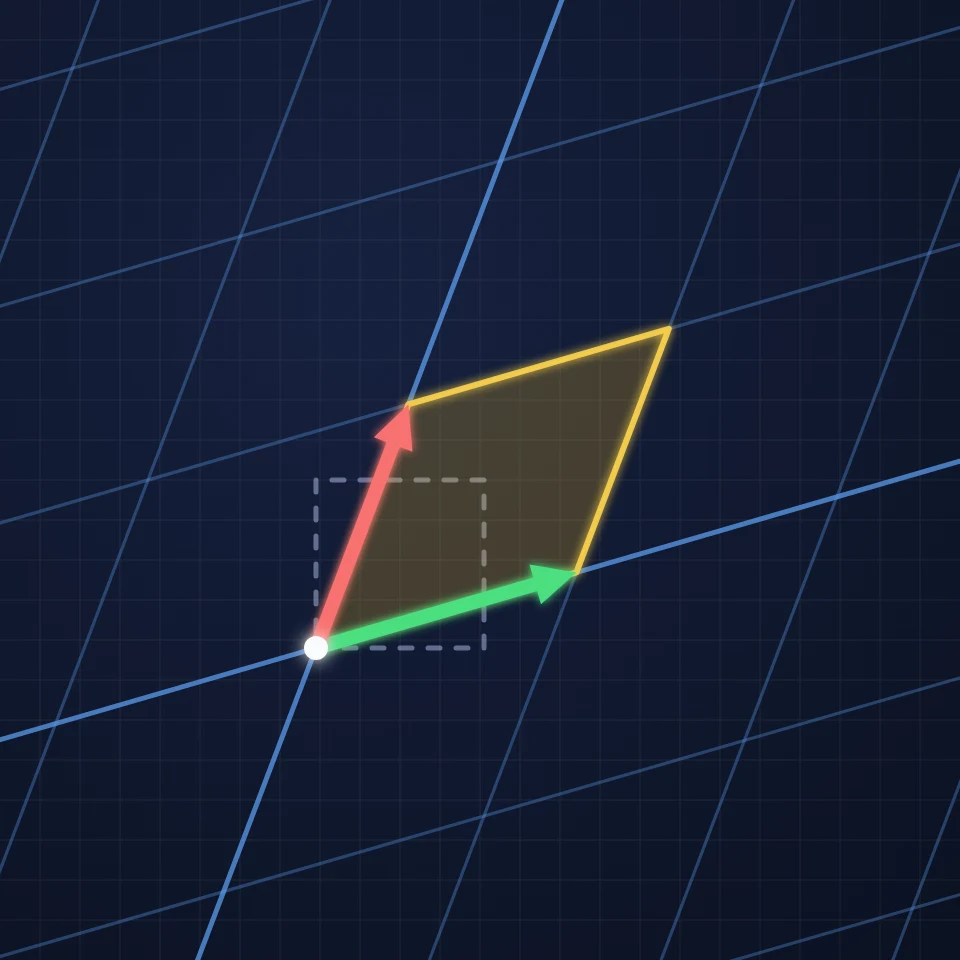
How a 2×2 matrix moves the plane: why its columns are the images of the basis vectors, why the determinant is a signed area, what singular matrices, eigenvalues and complex eigenvalues mean geometrically, how inverses and products of matrices work, and how the polar and singular value decompositions split any matrix into rotations and stretches.
Ready to try it?
Open PictorX in your browser — no install, no credit card required to start.
Open the conic sections app