
Standing waves and harmonics: see and hear a vibrating string
Pluck a guitar string and it sings one note, yet it vibrates in many ways at once: as a whole, in halves, in thirds and so on, each a standing wave with its own frequency, a harmonic. Here you can watch a string on a sonometer, a flute's open pipe and a clarinet's closed pipe vibrate in slow motion, see the two travelling waves that add up to each standing wave, find its nodes and antinodes, change the length, the tension and the mass of the string, and hear the note and its harmonics, alone or mixed into the sound of a real instrument. A string fixed at both ends, a pipe open at both ends or a pipe closed at one end vibrates in its harmonics, slowed down so you can watch it. Press Play to run it in slow motion, Step and Back to move by a 24th of a period, Reset to start again. Pick an example or a system, a harmonic and a tone: one harmonic, plucked, struck, bowed, blown or your own mix. The orange and cyan curves are the two waves travelling right and left whose sum is the standing wave; N marks its nodes, where nothing moves, and A its antinodes. In a pipe the dots are the air's particles, squeezed where the pipe turns blue and thinned where it turns red. Change the length, the tension (the weight) and the mass per metre of the string, or the air's temperature in a pipe, and watch the frequency follow. Pull the string and let go to pluck it there, click a bar of the spectrum to pick that harmonic, drag the bars to mix your own sound, click a pipe to blow into it. Switch Sound on to hear the real note and its harmonics; Record films it with the sound.
How it works
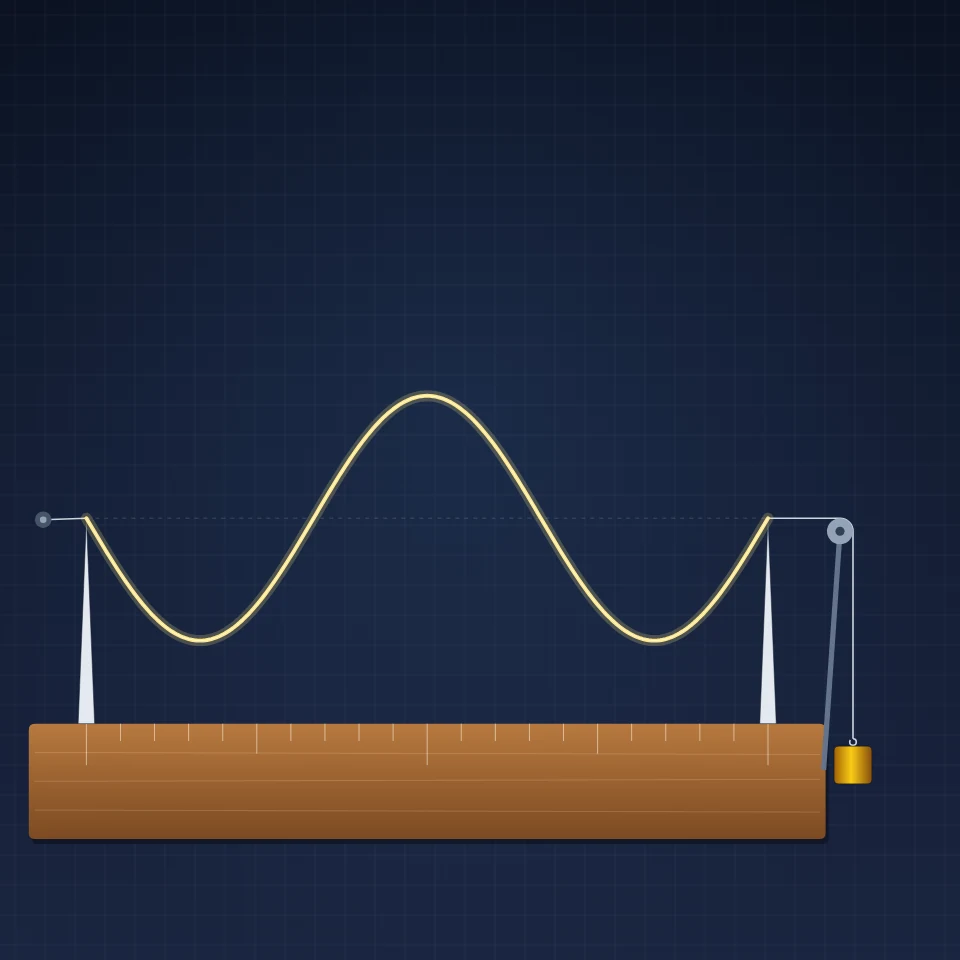
- Press Play: the string vibrates in its third harmonic in slow motion. The orange and cyan curves are two waves travelling in opposite directions; their sum is the standing wave, which never moves along the string. N marks the nodes, where the string stays still, and A the antinodes.
- Change the harmonic, or click a bar of the spectrum: harmonic n has n loops and n times the frequency of the fundamental. Lengthen the string, loosen it or make it heavier and the note falls, as Mersenne's laws say.
- Pick the guitar, the violin, the cello or the piano: a pluck, a bow or a hammer sets many harmonics going at once. Pull the string yourself and let go to pluck it anywhere, or drag the bars to mix your own sound. Switch Sound on to hear the note.
- Choose a flute's open pipe or a clarinet's closed pipe: the dots are the air's particles, squeezed where the pipe turns blue. A closed pipe has only the odd harmonics and sounds an octave lower than an open pipe of the same length.
What a standing wave is
A wave sent along a string is reflected at the fixed end and comes back upside down. The wave going out and the wave coming back pass through each other: where they add up the string swings strongly, where they cancel it does not move at all. If the length fits a whole number of half wavelengths, the pattern stays in place: a standing wave, y = 2A sin(kx) cos(ωt), the sum of A sin(kx − ωt) and A sin(kx + ωt). Its still points are the nodes, half a wavelength apart, and halfway between them are the antinodes, where the swing is largest.
Harmonics of a string and Mersenne's laws
A string of length L fixed at both ends fits half a wavelength, two halves, three halves and so on: λn = 2L/n. Waves travel along it at v = √(T/μ), where T is the tension and μ the mass per metre, so its frequencies are fn = nv/2L: the fundamental f1 and its whole multiples, the harmonic series. Halve the length and the note rises an octave; quadruple the tension for the same octave; a string four times heavier sounds an octave lower. Marin Mersenne published these three laws in 1636. A guitar's low E string, 64.8 cm long at 78 N with 6.8 g per metre, sounds 82.4 Hz.
Open and closed pipes
In a pipe the air itself vibrates back and forth along the pipe. At an open end the air moves freely: a displacement antinode, where the pressure stays at that of the room. At a closed end the air cannot move: a displacement node, where the pressure swings most. A pipe open at both ends, like a flute, therefore has the same harmonics as a string, fn = nc/2L. A pipe closed at one end, like a clarinet or a stopped organ pipe, fits only a quarter wavelength, three quarters and so on: fn = nc/4L with n odd. It sounds an octave lower than an open pipe of the same length and lacks the even harmonics, which gives the clarinet its hollow sound.
Pluck, bow or blow: the harmonics make the timbre
A real instrument vibrates in many harmonics at once, and their mix is what makes a violin sound different from a flute playing the same note. A string plucked at a point is a triangle at first, made of harmonics with amplitudes sin(nπp)/n²: plucking at a fifth of the length silences the fifth harmonic, and plucking near the bridge sounds bright. A bowed string moves in Helmholtz motion, a kink running round the string, with a sawtooth sound that contains every harmonic at 1/n. A piano's hammer strikes at about an eighth of the string, which keeps the eighth harmonic out.
Frequently asked questions
What is a standing wave?
A wave pattern that stays in one place: it forms when two identical waves travel through each other in opposite directions, usually a wave and its reflection. At some points, the nodes, they always cancel; at the antinodes between them they add up to the largest swing. A vibrating guitar string, the air in an organ pipe and the microwaves in an oven all form standing waves.
What are harmonics?
The frequencies at which a string or an air column can vibrate as a standing wave. For a string or an open pipe they are whole multiples of the lowest, the fundamental: f, 2f, 3f, 4f and so on, and the n-th harmonic has n loops between the ends. The harmonics above the fundamental are also called overtones; the second harmonic is the first overtone.
How do I calculate the frequency of a vibrating string?
Use fn = (n/2L) √(T/μ), where L is the vibrating length, T the tension in newtons and μ the mass per metre in kg/m. For a string 1 m long with 1 g per metre (0.001 kg/m) at 48.4 N, the wave speed is √48 400 = 220 m/s, the fundamental 110 Hz (the note A2) and the third harmonic 330 Hz.
Why does a closed pipe have only odd harmonics?
Because its closed end must be a node of the air's motion and its open end an antinode, so the pipe holds an odd number of quarter wavelengths: L = λ/4, 3λ/4, 5λ/4 and so on. That gives f = c/4L, 3c/4L, 5c/4L: only the odd multiples of a fundamental that is half that of an open pipe of the same length. The low notes of the clarinet are the best-known example.
What are nodes and antinodes?
Nodes are the points of a standing wave that never move: a string's fixed ends and the points between them, half a wavelength apart. Antinodes, halfway between the nodes, swing the most. In a pipe the nodes of the air's motion are the antinodes of its pressure and the other way round, so an open end is a displacement antinode and a pressure node.
Can I use the picture?
Yes. Save gives a PNG at the size you choose, and the pencil opens the picture in the PictorX photo editor with the instrument, the air's pressure, the travelling waves, the wave, the nodes, the spectrum, the sound wave and the labels on layers of their own, and the caption as editable text. In the editor itself it is under Apps ▸ Science ▸ Physics ▸ Standing Waves & Harmonics, where you pick the example, the harmonic, the tone and the moment of the period. Everything runs in your browser.
Standing Waves & Harmonics: how do I record a video?
Press the red Record button in the playback bar: it films what the stage shows. Press it again to stop, and the video is saved to your device. Recording is free; you only need to sign in. Without a subscription the video carries a small PictorX logo in a corner. The button beside Record opens the video options: the shape (as shown, square, story 9:16 or wide 16:9), the length (until you stop, or 5, 10, 15 or 30 seconds for social media) and the file: MP4, WebM or an animated GIF. For the sound, choose the app's own sounds or one of three music tracks: calm, bright or beat.
Related tools
Standing waves and harmonics explained
How a standing wave forms from two travelling waves, why a string's harmonics are whole multiples of its fundamental, Mersenne's laws, open and closed pipes, Pythagoras's monochord, plucked and bowed strings, Fourier and timbre, and standing waves from microwave ovens to atoms.
Wave interference in a ripple tank
A ripple tank in your browser: two sources make nodal lines, a plane wave passes a double slit, a single slit or a diffraction grating, and the pattern lands on a screen. Water ripples, sound and light with real wavelengths and frequencies, a probe you can hear and a phased array that steers its beam.
The Doppler effect: hear the pitch change
Watch and hear the Doppler effect: an ambulance, a train, a race car or a jet passes and its wavefronts crowd together in front and spread out behind. Hear the siren drop in pitch as it passes, push past Mach 1 for the Mach cone and the sonic boom, with real speeds of sound and frequencies.
Pendulum wave
Fifteen pendulums, each a little shorter than the last. Let them go together and watch them drift into waves, split into rows, and swing in step again.
Ready to try it?
Open PictorX in your browser — no install, no credit card required to start.
Go to Editor