
Standing waves and harmonics explained
Every string and wind instrument works the same way: it traps waves between its ends so that they pile up into standing waves, which can only vibrate at certain frequencies, its harmonics. This page explains how a standing wave forms from two travelling waves, why a string's harmonics are whole multiples of its lowest note, what decides that note, how open and closed pipes differ, and how the mix of harmonics gives every instrument its own voice.
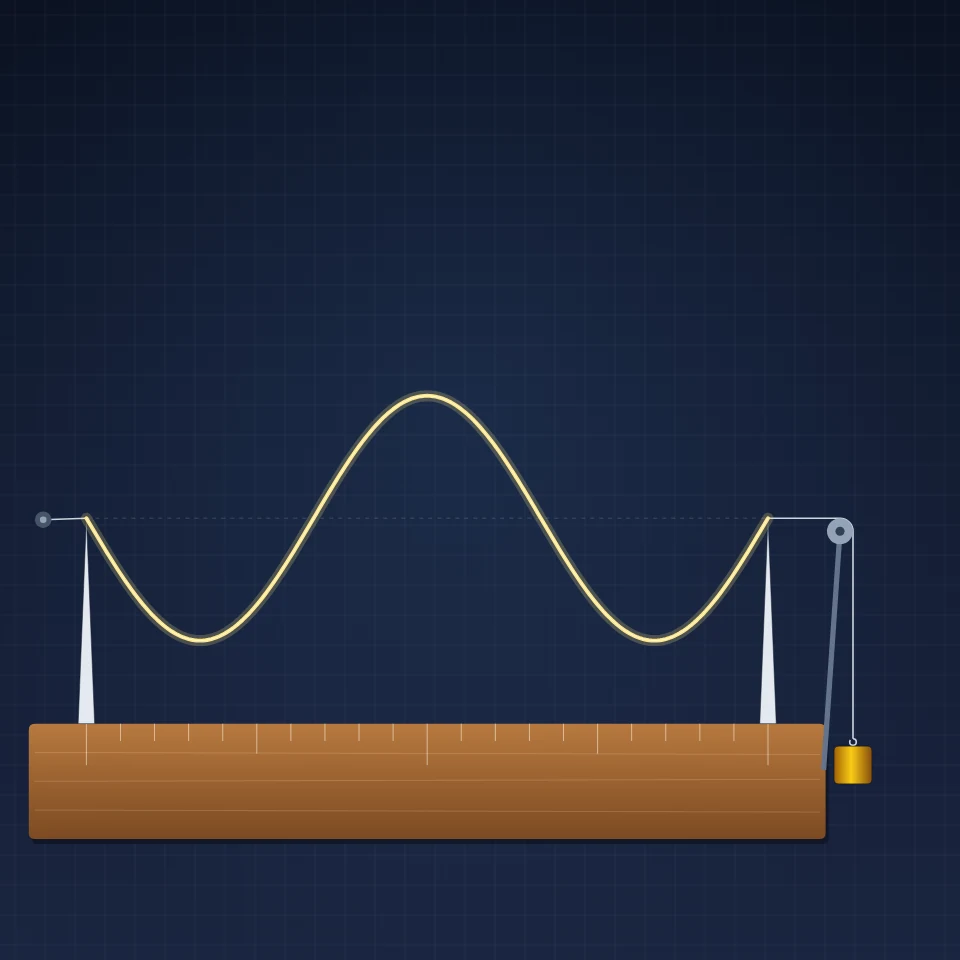
Two waves make a standing wave
Send a pulse along a rope tied to a wall and it comes back upside down. Shake the rope steadily and the waves going out pass through the waves coming back. Because waves simply add, the rope's displacement is the sum of the two: A sin(kx − ωt) + A sin(kx + ωt) = 2A sin(kx) cos(ωt). The result no longer travels. Every point swings up and down in step, with an amplitude 2A sin(kx) that depends on where it is: zero at the nodes, largest at the antinodes. The nodes are half a wavelength apart, and the energy stays trapped between them instead of flowing along the rope.
Only some frequencies fit
A string fixed at both ends must have a node at each end, so it can only hold a whole number of half wavelengths: L = nλ/2. Since the wave's speed v is set by the string, the allowed frequencies are fn = nv/2L. The lowest, n = 1, is the fundamental; the others are its whole multiples, the harmonic series: for a 110 Hz string, 220, 330, 440, 550 Hz and so on. These are the string's resonances. Drive it at any other frequency and the reflected waves do not line up, so the vibration stays small.
Mersenne's laws: length, tension and mass
The speed of a wave on a string is v = √(T/μ): a tighter string pulls back harder, a heavier one responds more slowly. With f1 = (1/2L) √(T/μ), the pitch rises as the string is shortened (a guitarist's fret), tightened (a tuning peg) or made lighter (the thin strings of a guitar). The French friar Marin Mersenne set out these three laws in his Harmonie universelle of 1636 and was the first to work out the frequency of a vibrating string. A piano's A4 string, 39 cm of steel wire with 6.4 g per metre, needs a tension of about 750 N, the weight of 76 kg, to sound 440 Hz.
Pythagoras and the harmonic series
According to legend, Pythagoras found with a monochord, a single string stretched over a sounding box, that strings whose lengths are in simple ratios sound well together: half the length gives the octave (2:1), two thirds the fifth (3:2), three quarters the fourth (4:3). Those are the ratios of the first harmonics, which are present in every note a string plays; that is why notes an octave or a fifth apart blend so well. The harmonic series is also the scale of a bugle or an alphorn, which have no valves and play only the harmonics of their tube. Equal temperament, the tuning of a piano, puts its fifth 2 cents below the pure 3:2 of the third harmonic.
Air columns: open and closed pipes
In a wind instrument the air in the tube vibrates along its length, a sound wave bouncing between the ends. At an open end the pressure must stay at that of the room, a pressure node, and the air moves most; at a closed end the air cannot move, a displacement node, and the pressure swings most. A pipe open at both ends, like a flute or an open organ pipe, has the same harmonic series as a string: fn = nc/2L, with c = 343 m/s at 20 °C. A pipe closed at one end holds an odd number of quarter wavelengths: fn = nc/4L, n = 1, 3, 5 … A stopped organ pipe 1.31 m long sounds the same 65 Hz C as an open pipe 2.62 m long. Real pipes sound a little lower than this, as if lengthened by about 0.6 of their radius at each open end.
Pluck, bow, strike: why instruments sound different
A real string never vibrates in one harmonic alone. A finger pulls it into a triangle, and when released it moves as the sum of all the harmonics that make up that triangle, with amplitudes falling as 1/n²: Fourier's theorem says every shape can be built this way. Where it is plucked decides which harmonics are there: pluck a string at a third of its length and the third, sixth and ninth harmonics are missing, since they would need a node where the finger was (Thomas Young, 1800). A violin bow drags the string along until it slips back, again and again; Hermann von Helmholtz saw in the 1860s that this makes a sharp kink run round the string, with a sawtooth sound that holds every harmonic. The mix of harmonics, and how it changes in time, is the instrument's timbre: the reason a clarinet, a violin and a flute playing the same note never sound alike.
Hearing harmonics
The ear does something like a Fourier analysis: the cochlea separates a sound into its frequencies, and the brain fuses a harmonic series into a single note at the pitch of the fundamental. It does so even when the fundamental itself is missing, which is why a small phone speaker that cannot play 82 Hz still lets you hear a bass guitar's low E: its harmonics at 165, 247 and 330 Hz imply it. Players use harmonics on purpose too: touching a string lightly at its middle forces a node there and leaves only the even harmonics, the octave harmonic of guitarists and violinists.
Standing waves everywhere
Standing waves are not only for music. Microwaves bounce between the walls of a microwave oven and form standing waves, with hot spots about 6 cm apart at the antinodes, which is why the food turns on a plate. A wine glass rings at its own standing wave, and a singer who matches it can shatter it. Bridges and buildings have harmonics that engineers keep away from the rhythm of footsteps and wind. Chladni figures, sand on a vibrating plate, gather on the nodal lines of a standing wave in two dimensions. And in quantum mechanics an electron in an atom is a standing wave too: only whole numbers of wavelengths fit, which is why its energy comes in levels.
Frequently asked questions
What is the difference between a harmonic and an overtone?
Harmonics are numbered from the fundamental: the fundamental is the first harmonic, twice its frequency the second, and so on. Overtones are numbered from the first tone above the fundamental, so the second harmonic is the first overtone. In a closed pipe, which has only the odd harmonics, the first overtone is the third harmonic. Overtones need not be harmonic at all: those of a drum or a bell are not whole multiples of the fundamental.
Why does a shorter string sound higher?
Because a shorter string fits shorter waves. The fundamental is half a wavelength over the whole string, λ = 2L, and the wave's speed is set by the tension and the mass per metre, so the frequency f = v/λ = v/2L doubles when the length is halved. A guitar's frets shorten the vibrating string by about 5.6 % each, which raises the note by a semitone.
What happens to the pitch when the temperature changes?
In a wind instrument the speed of sound rises with the temperature, c = 331.3 √(1 + T/273.15) m/s, so a flute or an organ pipe goes sharp in a warm room, by about 3 cents per degree Celsius; this is why orchestras tune after warming up. A string goes the other way: as it warms it expands and slackens, so its tension and its pitch drop.
Can I hear the harmonics in the app?
Yes. Switch Sound on and press Play: a single harmonic plays as a pure tone at its real frequency, and a pluck, a bow or a breath plays the whole mix of harmonics shown in the spectrum, so you can hear the timbre change as you pick another tone, move the pluck point or drag the bars. Plucked and struck strings ring out each time the picture comes round to its start; bowed strings and blown pipes sound on. Record films the picture with the sound.
Related tools
Standing waves and harmonics: see and hear a vibrating string
Watch a string and air columns vibrate in their harmonics: the standing wave, the two travelling waves that make it, nodes and antinodes, f = nv/2L, Mersenne's laws, open and closed pipes. Pluck, bow or blow, mix the harmonics and hear the real note.
Wave interference in a ripple tank
A ripple tank in your browser: two sources make nodal lines, a plane wave passes a double slit, a single slit or a diffraction grating, and the pattern lands on a screen. Water ripples, sound and light with real wavelengths and frequencies, a probe you can hear and a phased array that steers its beam.
Wave interference explained
How waves interfere: the principle of superposition, constructive and destructive interference, path difference and nodal lines, the ripple tank, Young's double slit and its fringe spacing, Huygens' principle and single-slit diffraction, gratings, phased arrays and noise-cancelling headphones.
The Doppler effect: hear the pitch change
Watch and hear the Doppler effect: an ambulance, a train, a race car or a jet passes and its wavefronts crowd together in front and spread out behind. Hear the siren drop in pitch as it passes, push past Mach 1 for the Mach cone and the sonic boom, with real speeds of sound and frequencies.
Ready to try it?
Open PictorX in your browser — no install, no credit card required to start.
Open the standing waves simulator