
Punnett square genetics
Every offspring gets one copy of each gene from its mother and one from its father, and which copy it gets is down to chance. A Punnett square lays out every way the parents' egg cells and sperm or pollen can meet, so you can read off the chances of each genotype and of how the offspring will look. Here you can cross Mendel's peas, snapdragons, cats, fruit flies and people for one, two or three genes, see dominance, codominance and sex-linked traits at work, and then breed a real litter to watch chance scatter it around the expected ratio. A Punnett square for one, two or three genes. The mother's gametes run down the side and the father's across the top; every square is one equally likely offspring, coloured by how it looks, with its genotype. Pick an example or an organism, tick the genes to cross and choose each parent's genotype, or click a genotype in the picture to change it. Press Breed to raise a litter one offspring at a time, One more and One back to step, Reset to start the litter again; the chart compares the litter with the expected ratio and the χ² test says whether the difference is down to chance. Hover over a square, a bar or an offspring to see all of its phenotype. Switch Sound on to hear a note for every offspring, one per phenotype; Record films it with the sound.
How it works
- Pick an example, such as Mendel's peas with one, two or three genes, pink snapdragons, blood groups, colour blindness, tortoiseshell cats or Morgan's white-eyed flies, or choose an organism and tick the genes you want to cross.
- Set each parent's genotype in the table, or click a genotype in the picture to change it. The mother's gametes appear down the side of the square and the father's across the top, and every square shows one equally likely offspring, its genotype and how it looks.
- Read the phenotype and genotype ratios in the tiles and the chart. Press Breed to raise a litter one offspring at a time: each one gets a random gamete from each parent, and its square lights up as it is born.
- Watch the litter's bars approach the expected ones, and let the χ² test tell you whether the difference is just chance. Make the litter bigger or smaller, hover over a phenotype to find all its squares, and save the picture or open it in the editor with every part on a layer of its own.
Genes, alleles, genotypes and phenotypes
A gene comes in versions called alleles, such as R for round peas and r for wrinkled ones. Every pea plant has two copies of the gene, one from each parent: its genotype is RR, Rr or rr. What you see, its phenotype, depends on how the alleles behave together. R is dominant and r recessive, so Rr peas are just as round as RR ones, and only rr peas are wrinkled. An organism with two identical alleles is homozygous, one with two different ones heterozygous.
Mendel's laws and the 9 : 3 : 3 : 1 ratio
Gregor Mendel crossed tens of thousands of pea plants in his monastery garden in Brno between 1856 and 1863. He found that the two alleles of a gene separate when eggs and pollen are made, so that each gamete carries just one (the law of segregation), and that different genes are sorted independently of each other (the law of independent assortment). Crossing two Rr plants therefore gives RR, Rr and rr in the ratio 1 : 2 : 1, and round and wrinkled peas 3 : 1. With two genes the square has 16 squares and the four phenotypes come out 9 : 3 : 3 : 1; with three it has 64, with 27 genotypes and eight phenotypes in the ratio 27 : 9 : 9 : 9 : 3 : 3 : 3 : 1.
Beyond dominant and recessive
Many genes do not follow the simple rule. In snapdragons a red and a white allele give pink flowers, a blend called incomplete dominance, so crossing two pink plants gives red, pink and white in the ratio 1 : 2 : 1. In codominance both alleles show side by side: a person with the Iᴬ and Iᴮ alleles has blood group AB, and a roan animal has red and white hairs mixed. The ABO gene also shows that a gene can have more than two alleles in a population, even though each person carries only two.
Sex-linked inheritance
Genes on the X chromosome are inherited differently, because females have two X chromosomes and males one X and one Y. A son gets his only X from his mother, so a recessive allele on it, such as the one for red-green colour blindness, always shows in him. That is why about 8 % of men of European descent are colour-blind but only about 0.5 % of women. Thomas Hunt Morgan found the first sex-linked gene in 1910 in fruit flies with white eyes, and the orange gene of cats, which sits on the X too, explains why tortoiseshell cats are almost always female.
Frequently asked questions
How do you draw a Punnett square?
Write the gametes each parent can make: a parent with genotype Rr makes R and r gametes in equal numbers, and one with RrYy makes RY, Ry, rY and ry. Put the mother's gametes down the side and the father's across the top, and fill each square with the alleles of its row and column. Every square is equally likely, so counting the squares with each genotype or phenotype gives their probabilities: for Rr × Rr, one square in four is rr.
Why is the dihybrid ratio 9 : 3 : 3 : 1?
Because the two genes are inherited independently, so their probabilities multiply. For each gene a cross of two heterozygotes gives the dominant phenotype with probability 3/4 and the recessive one with probability 1/4. Both dominant: 3/4 × 3/4 = 9/16; one dominant and one recessive: 3/4 × 1/4 = 3/16, in two ways; both recessive: 1/16. Mendel counted 315 round yellow, 108 round green, 101 wrinkled yellow and 32 wrinkled green peas, very close to 9 : 3 : 3 : 1.
What is the difference between incomplete dominance and codominance?
In incomplete dominance the heterozygote is in between the two homozygotes, like pink snapdragons from a red and a white allele. In codominance it shows both phenotypes at once, side by side, like blood group AB, where the red blood cells carry both the A and the B antigen, or a roan coat of red and white hairs. In both cases the heterozygote can be told apart from the homozygotes, so the genotype and phenotype ratios are the same, 1 : 2 : 1.
Why are tortoiseshell cats almost always female?
The gene for orange fur is on the X chromosome. A female with one orange and one black allele has patches of both colours, because in each patch of skin one of her two X chromosomes is switched off at random, a process called X-inactivation. A male has only one X, so he is either orange or not. The rare male tortoiseshells, about one in three thousand, usually have an extra X chromosome (XXY) and are almost always sterile.
What does the χ² test tell me?
Even with exact Mendelian odds, a litter rarely matches the ratio exactly, just as ten coin tosses rarely give five heads. Pearson's χ² test adds up the squared differences between the counts and the expected numbers, each divided by the expected number, and the p-value says how often chance alone would give a difference at least that big. A p-value above 0.05 is usually taken to mean that the litter fits the ratio. The test needs at least about five expected offspring of each phenotype to be reliable.
Can I use the picture?
Yes. Save gives a PNG at the size you choose, and the pencil opens the picture in the PictorX photo editor with the offspring squares, the grid, the parents' gametes, the parents, the litter and the ratio chart on layers of their own, and the cross and its summary as editable text. In the editor itself it is under Apps ▸ Science ▸ Biology ▸ Punnett Square, where you pick the example or type the parents' genotypes. Everything runs in your browser.
Punnett Square Genetics: how do I record a video?
Press the red Record button in the playback bar: it films what the stage shows. Press it again to stop, and the video is saved to your device. Recording is free; you only need to sign in. Without a subscription the video carries a small PictorX logo in a corner. The button beside Record opens the video options: the shape (as shown, square, story 9:16 or wide 16:9), the length (until you stop, or 5, 10, 15 or 30 seconds for social media) and the file: MP4, WebM or an animated GIF. For the sound, choose the app's own sounds or one of three music tracks: calm, bright or beat.
Related tools
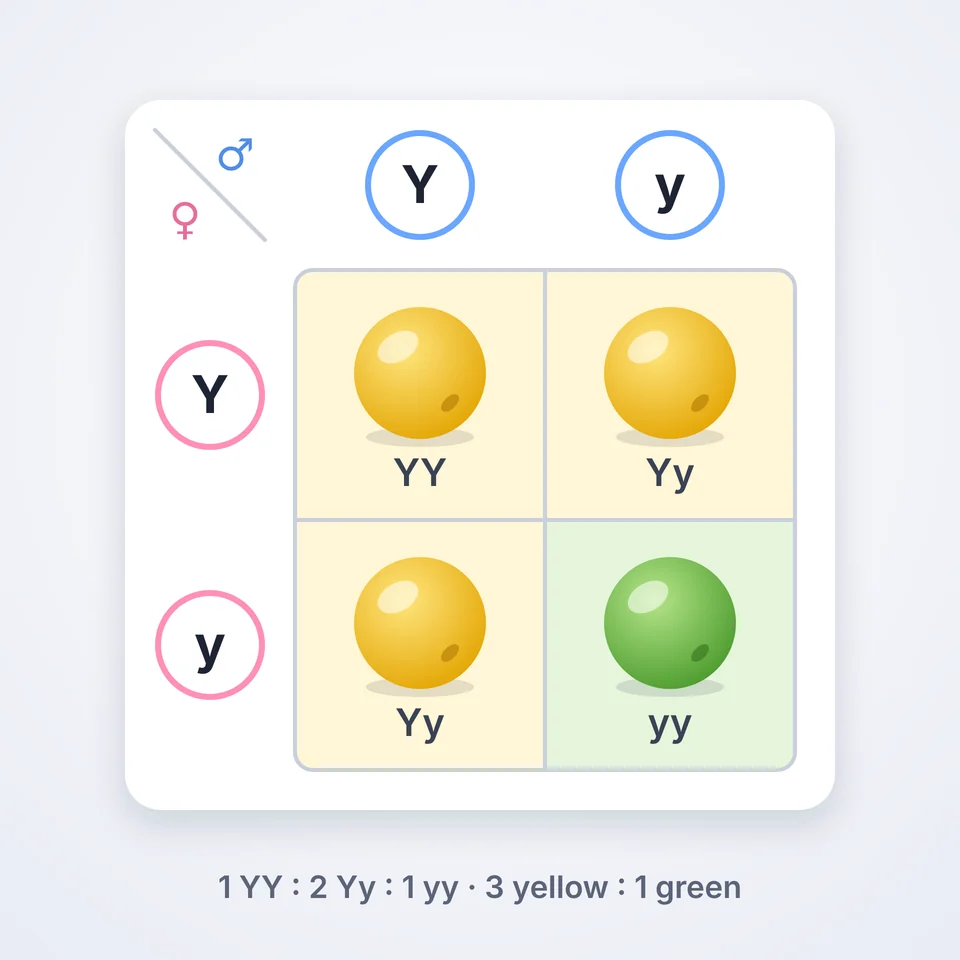
Punnett squares explained
How Punnett squares work: Mendel's peas and his laws of segregation and independent assortment, genotypes and phenotypes, 3 : 1 and 9 : 3 : 3 : 1 ratios, incomplete dominance, codominance and blood groups, X-linked genes from colour blindness to tortoiseshell cats, and testing a litter with the χ² test.
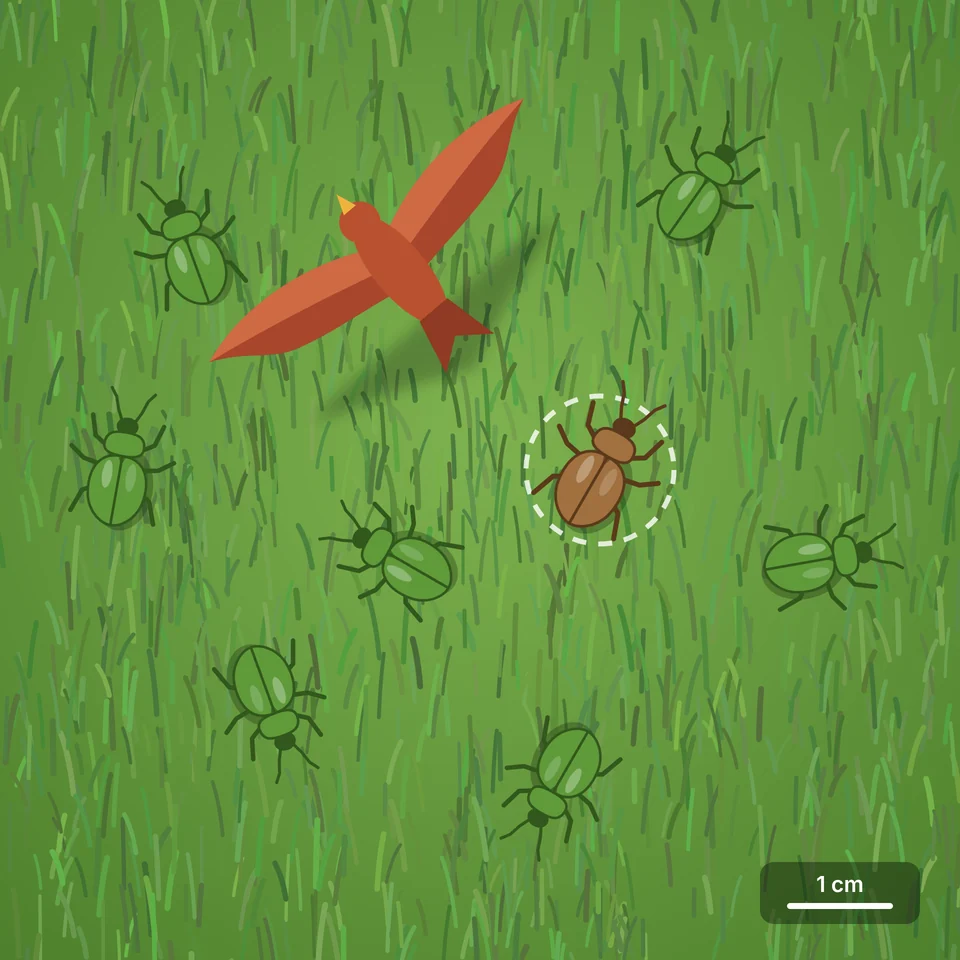
Natural selection simulator
Watch evolution by natural selection: birds catch the beetles that stand out, food is limited, and the young inherit colour, size and speed with mutations. Replay the peppered moth and the beach mice, change the habitat during a run and see genetic drift.
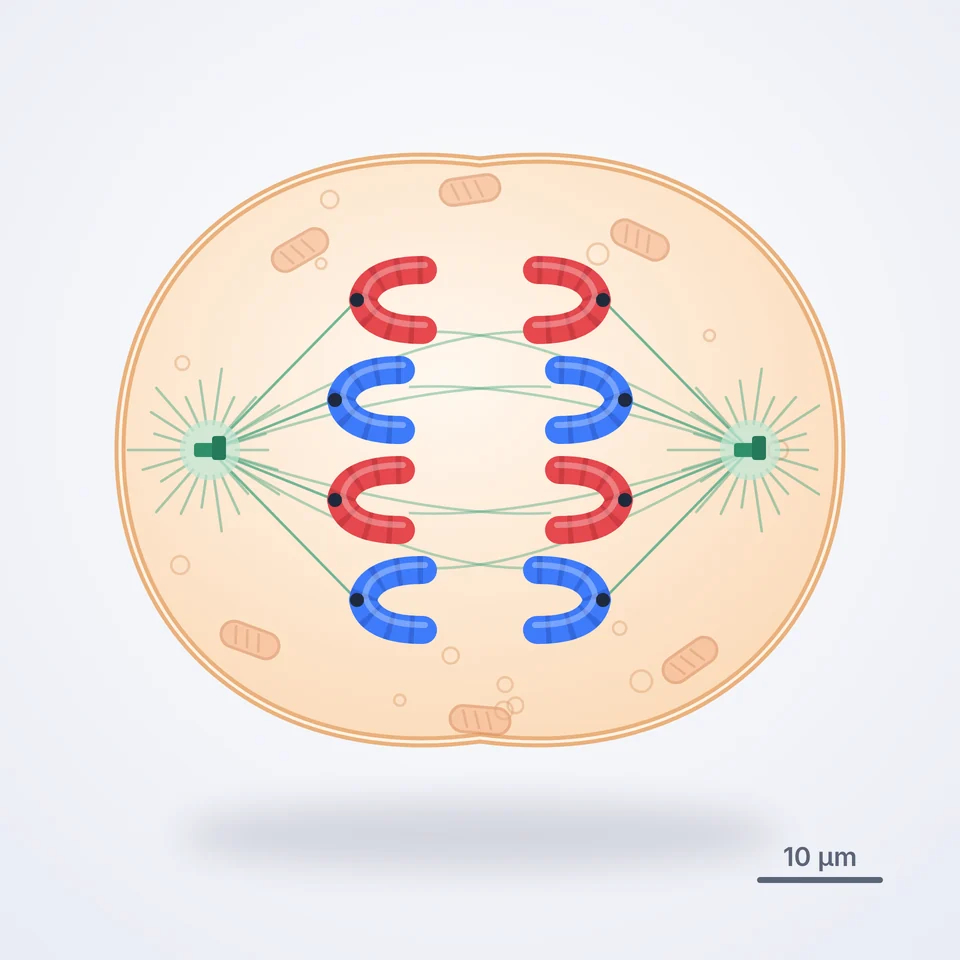
Cell division: mitosis and meiosis
Watch mitosis and meiosis phase by phase: interphase, prophase, metaphase, anaphase, telophase and cytokinesis, with real chromosomes, the spindle, crossing over and nondisjunction. Play, step or scrub through every phase and save the picture.
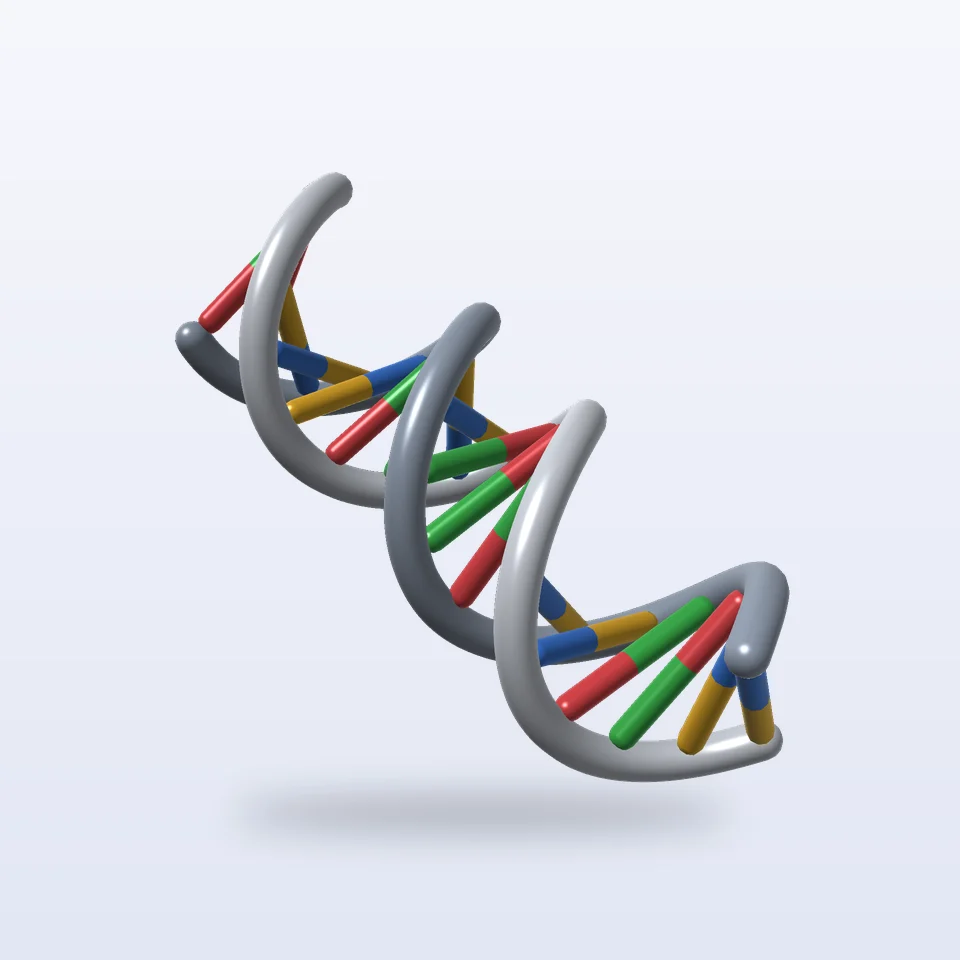
DNA double helix
Type a DNA sequence and turn it as a double helix in 3D: the complementary strand fills in by base pairing, A with T and G with C. Compare B-, A- and Z-DNA, unzip the helix like a replication fork, and read the GC content, length and melting temperature.
Ready to try it?
Open PictorX in your browser — no install, no credit card required to start.
Go to Editor