
Punnett squares explained
Why do two brown-eyed parents sometimes have a blue-eyed child, why are tortoiseshell cats nearly always female, and why do a quarter of the peas from two round-seeded plants come out wrinkled? The answers follow from a few simple rules of inheritance that Gregor Mendel found in his garden, and a Punnett square is the easiest way to apply them. This page explains where the square comes from, how to use it for one, two or three genes, what happens when alleles are not simply dominant or recessive, how genes on the X chromosome behave, and how to tell whether real offspring fit the expected ratio.
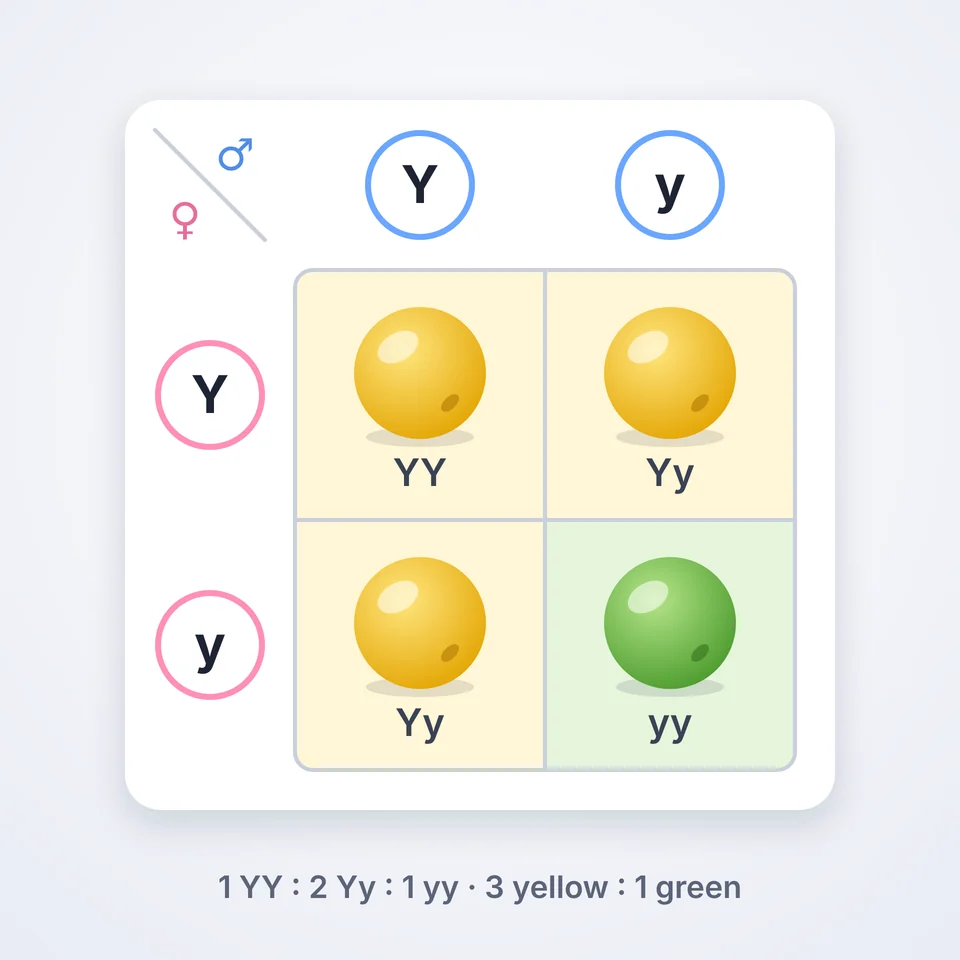
Mendel's peas
Between 1856 and 1863 Gregor Mendel, a friar at the Augustinian abbey of St Thomas in Brno, grew and crossed tens of thousands of pea plants. He chose seven traits that came in two clear forms, such as round or wrinkled seeds, yellow or green seeds and purple or white flowers, bred plants that came true for each, and counted their offspring. Crossing round with wrinkled gave only round peas in the first generation, but when those plants fertilised themselves the wrinkled form came back: 5,474 round to 1,850 wrinkled, almost exactly 3 : 1. He presented his work in 1865 and published it in 1866, but its importance was only seen in 1900, when Hugo de Vries, Carl Correns and Erich von Tschermak reached the same results.
Genes, alleles and the square
Mendel explained his numbers with hereditary factors, today called genes, that come in pairs. Each parent passes on one of its two copies, chosen at random, and the versions of a gene, its alleles, can be dominant (written with a capital letter, R) or recessive (r). William Bateson spread Mendel's ideas in English and coined the word genetics; his colleague Reginald Punnett, at Cambridge, drew the square that bears his name around 1905. It is a table of all the ways the gametes can meet: the egg cells of one parent along one side, the sperm or pollen of the other along the other, and an offspring in each square. Because every gamete is equally likely, every square is equally likely, and the ratios can simply be counted.
One, two and three genes
A monohybrid cross follows one gene: Rr × Rr gives a 2 × 2 square with RR, Rr and rr in the ratio 1 : 2 : 1 and the phenotypes 3 : 1. A dihybrid cross follows two: RrYy makes four kinds of gamete, the square has 16 squares, 9 genotypes and four phenotypes in the ratio 9 : 3 : 3 : 1. Mendel counted 315 round yellow, 108 round green, 101 wrinkled yellow and 32 wrinkled green peas. With three genes there are 8 kinds of gamete, 64 squares, 27 genotypes and 8 phenotypes in the ratio 27 : 9 : 9 : 9 : 3 : 3 : 3 : 1; in general n heterozygous genes give 2ⁿ gametes, 4ⁿ squares and 3ⁿ genotypes. Beyond that a square becomes unwieldy, and geneticists multiply the probabilities of each gene instead, the product rule, often drawn as a branch diagram. A test cross with a homozygous recessive parent (RrYy × rryy) shows the gametes of the other parent directly: 1 : 1 : 1 : 1.
Incomplete dominance and codominance
Not every heterozygote looks like one of its parents. In snapdragons, a red allele and a white one together give pink flowers: incomplete dominance. Crossing two pink plants gives red, pink and white offspring in the ratio 1 : 2 : 1, so the phenotypes match the genotypes. In codominance both alleles show in full: a roan cow or horse has red and white hairs side by side. The human ABO blood groups show both ideas at once. Karl Landsteiner discovered the groups in 1901, and Felix Bernstein showed in 1924 that they are made by three alleles of one gene: Iᴬ and Iᴮ are codominant, both dominant over i. A parent of group A with genotype Iᴬ i and one of group B with Iᴮ i can have children of all four groups, A, B, AB and O, each with a chance of one in four.
Genes on the X chromosome
In mammals and fruit flies, females have two X chromosomes and males an X and a Y, and the father decides the sex: his X makes a daughter, his Y a son. A gene on the X is therefore inherited unevenly. In 1910 Thomas Hunt Morgan found a fruit fly with white eyes instead of red ones in his laboratory at Columbia University. Crossed with red-eyed females, it gave only red-eyed offspring; crossed among themselves, these gave 2,459 red-eyed females, 1,011 red-eyed males and 782 white-eyed males, and not a single white-eyed female. The white gene was on the X: the first gene placed on a chromosome. Red-green colour blindness is inherited the same way. A carrier mother passes the allele to half her sons, who are colour-blind, and to half her daughters, who are carriers like her; John Dalton described his own colour blindness in 1794.
Tortoiseshell cats
The orange gene of cats sits on the X chromosome too, with an orange allele and one for black. A male, with one X, is orange or black. A female with both alleles is tortoiseshell, with patches of orange and black: early in her development each cell switches off one of its two X chromosomes at random, and every patch of skin descends from one cell. This X-inactivation was proposed by Mary Lyon in 1961. With white spotting as well the cat is a calico, and with the dilution gene black becomes blue-grey and orange cream. A tortoiseshell male is very rare, about one in three thousand, and usually has an extra X chromosome.
Chance and the χ² test
A Punnett square gives probabilities, not promises: a family of four children can easily have no child with the recessive phenotype, and a litter of a hundred rarely splits exactly 75 : 25. To decide whether real counts fit a ratio, geneticists use Karl Pearson's χ² test of 1900: χ² is the sum over the phenotypes of (observed − expected)² / expected, and its p-value is the chance of a difference at least as large from chance alone. Mendel's 556 dihybrid peas give χ² = 0.47 with three degrees of freedom, a p-value of about 0.93. In 1936 the statistician Ronald Fisher pointed out that Mendel's results as a whole were closer to the expected ratios than chance would usually allow, a puzzle that historians still discuss; nobody doubts that his laws are right.
Beyond the square
Mendel was lucky in his choice of traits: in most crosses the genes behave as if they were on different chromosomes. Genes that lie close together on one chromosome tend to stay together, which Bateson and Punnett noticed in sweet peas in 1905; the square with independent assortment then gives the wrong ratios, and the share of recombinant offspring measures the distance between the genes. One gene can also hide the effect of another (epistasis), many traits such as height depend on hundreds of genes and on the environment, and some alleles are lethal when homozygous. Punnett himself asked the mathematician G. H. Hardy why a dominant trait does not simply spread through a population; Hardy's answer of 1908, found independently by Wilhelm Weinberg, became the Hardy–Weinberg principle, the Punnett square of a whole population.
Frequently asked questions
Who invented the Punnett square?
Reginald Crundall Punnett, a geneticist at the University of Cambridge who worked with William Bateson, devised it around 1905 as a simple way to show all the combinations of gametes. Punnett also helped discover genetic linkage and used Mendel's rules to breed chickens whose chicks could be sexed by their colour on the day they hatched.
Can two parents with the dominant phenotype have a child with the recessive one?
Yes, if both are heterozygous carriers. Two Rr parents look dominant, but each passes on r half of the time, so each child has a one in four chance of being rr. That is how recessive traits, including inherited diseases such as cystic fibrosis, can skip generations and then reappear.
Why do the squares in a Punnett square all have the same probability?
Because each parent makes each kind of gamete equally often, and fertilisation picks one gamete from each parent at random. Each square then has a probability of 1/(number of mother's gametes) × 1/(number of father's gametes), and squares with the same genotype simply add up. If the genes are linked, or some gametes or offspring do not survive, the squares are no longer equally likely.
What is the difference between genotype and phenotype?
The genotype is the pair of alleles an organism carries, such as Rr; the phenotype is what can be observed, such as round seeds. Different genotypes can give the same phenotype (RR and Rr peas are both round), which is why a Punnett square has more genotypes than phenotypes when one allele is dominant. The two words were coined by the Danish botanist Wilhelm Johannsen, who also named the gene, in 1909.
Related tools
Punnett square genetics
Make a Punnett square for one, two or three genes: Mendel's peas, pink snapdragons, blood groups, colour blindness, tortoiseshell cats and Morgan's fruit flies. Dominant and recessive, incomplete dominance, codominance and X-linked traits, with the ratios, a litter and a χ² test.
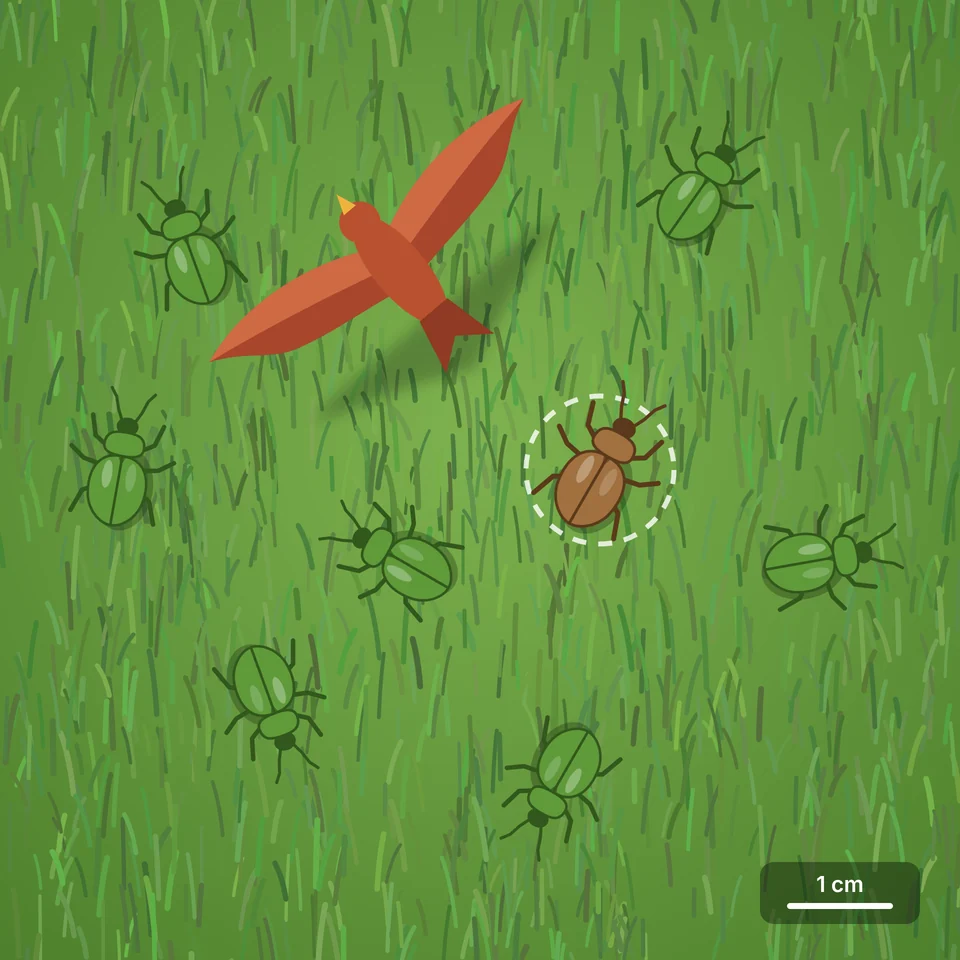
Natural selection simulator
Watch evolution by natural selection: birds catch the beetles that stand out, food is limited, and the young inherit colour, size and speed with mutations. Replay the peppered moth and the beach mice, change the habitat during a run and see genetic drift.
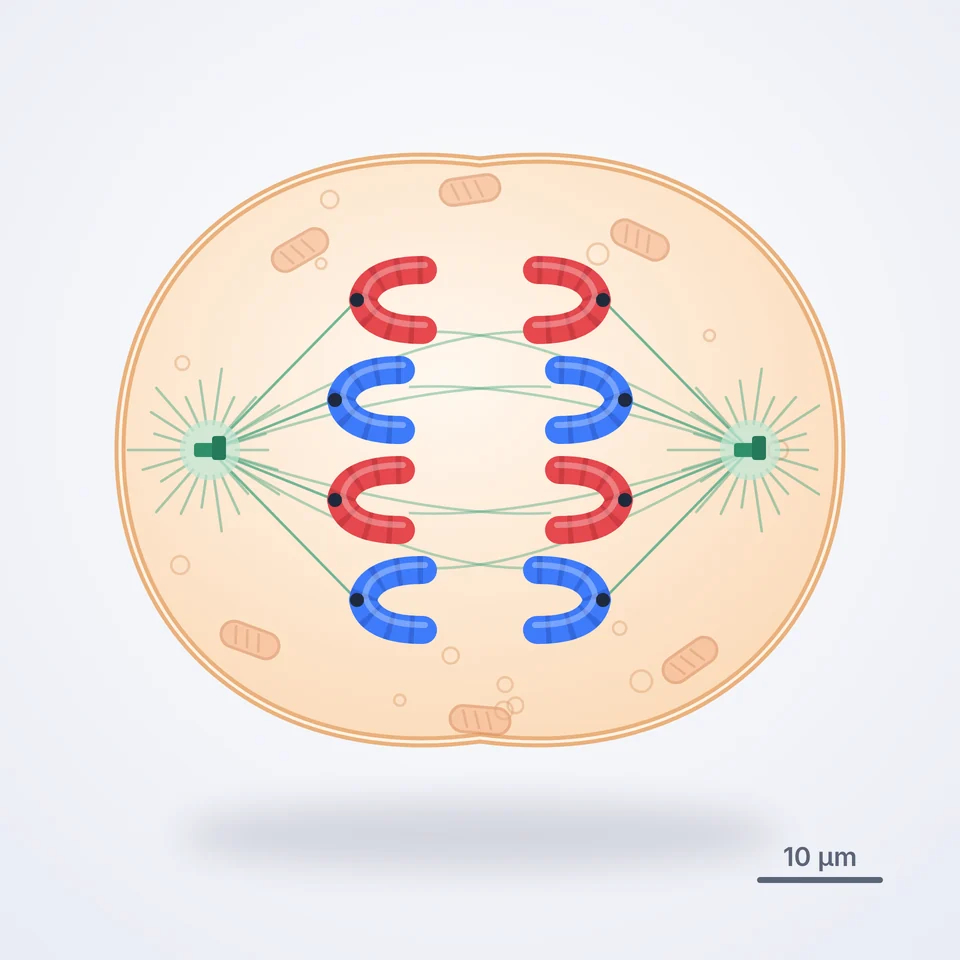
Cell division: mitosis and meiosis
Watch mitosis and meiosis phase by phase: interphase, prophase, metaphase, anaphase, telophase and cytokinesis, with real chromosomes, the spindle, crossing over and nondisjunction. Play, step or scrub through every phase and save the picture.
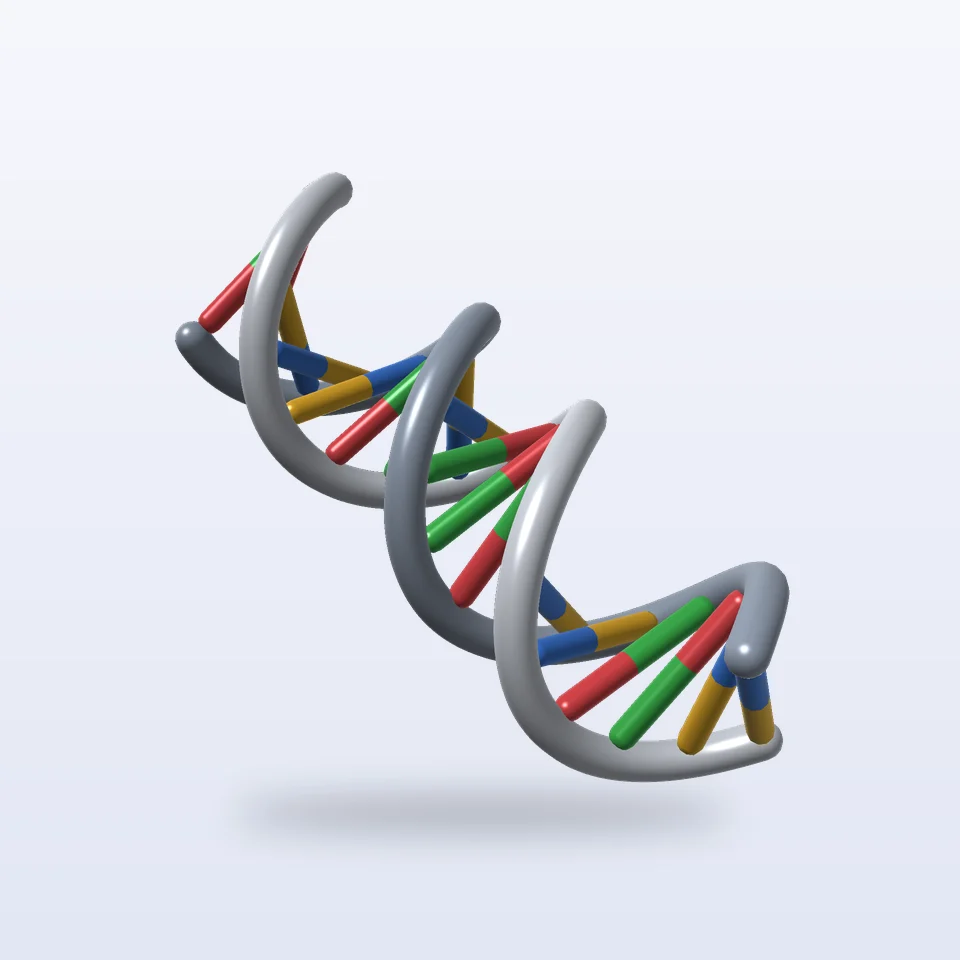
DNA double helix
Type a DNA sequence and turn it as a double helix in 3D: the complementary strand fills in by base pairing, A with T and G with C. Compare B-, A- and Z-DNA, unzip the helix like a replication fork, and read the GC content, length and melting temperature.
Ready to try it?
Open PictorX in your browser — no install, no credit card required to start.
Open the Punnett square