
The water cycle explained
The water on Earth is always on the move: from the sea into the air, across continents with the wind, down as rain and snow, through soils, rocks, plants and rivers and back to the sea. This page explains where the water is and how much moves, what powers the cycle, how clouds form and why mountains get rain on one side and none on the other, what happens to rain on the ground, how long water stays in each part of the cycle, and how a warmer climate changes it.
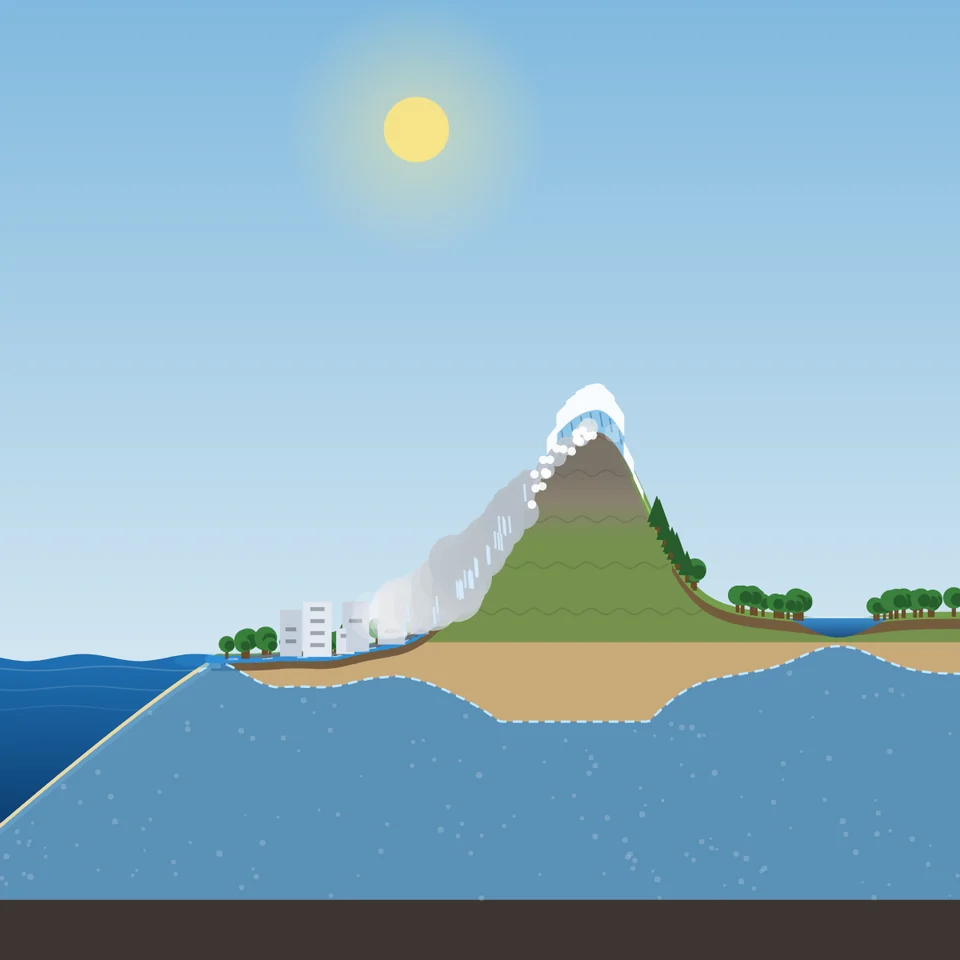
Where the water is
The Earth holds about 1.39 billion cubic kilometres of water. The oceans contain 1.34 billion of them, 96.5 %, as salt water. Only 2.5 % is fresh, and most of that is out of reach: about 24 million cubic kilometres are frozen in the ice sheets of Antarctica and Greenland and in glaciers, and about 23 million lie underground, roughly half of it fresh. Lakes hold about 176,000 cubic kilometres, the soil 16,500, the atmosphere about 13,000, rivers only about 2,000 and all living things about 1,100. These figures, from the Russian hydrologist Igor Shiklomanov, are estimates; others differ by a few per cent, especially for groundwater and ice.
A cycle driven by the Sun
Every year about 413,000 cubic kilometres of water evaporate from the oceans and about 73,000 from the land, the energy coming from sunlight: 2.45 megajoules for each kilogram of water, about 80 watts per square metre averaged over the Earth, a quarter of the sunlight the surface absorbs. About 373,000 cubic kilometres fall back on the oceans as rain and snow; the other 40,000 are blown over the continents, where 113,000 cubic kilometres fall in all, and the same 40,000 return to the sea in rivers and groundwater. These yearly flows, from Kevin Trenberth and colleagues (2007), balance: what evaporates comes down again, about 990 mm averaged over the whole planet. The heat taken up by evaporation is released where the vapour condenses, so the water cycle also carries heat from the tropics towards the poles and from the surface into the sky.
Evaporation and transpiration
Water evaporates when the air above it holds less vapour than air saturated at the water's temperature, and faster the stronger the wind: oceanographers write it as E = ρ C_E U (q_s(T_sea) − q_air), the bulk formula. How much vapour saturated air holds depends steeply on its temperature: the saturation vapour pressure, about 6.1 hPa at 0 °C, 23 hPa at 20 °C and 42 hPa at 30 °C, grows by about 7 % for every degree, the Clausius–Clapeyron relation, written in practice with the Magnus formula e_s = 6.11 exp(17.6 T / (T + 243)) hPa. On land, most of the water returns to the air through plants: roots take it from the soil and leaves release it through their stomata, a large tree hundreds of litres on a hot day. Transpiration makes up about 60 % of the evapotranspiration from the continents. When the soil is moist it is limited by energy, which the Priestley–Taylor formula estimates from the net radiation; when the soil dries out the plants close their pores and it falls.
Clouds: cooling to the dew point
Rising air expands as the pressure falls and cools without exchanging heat with its surroundings, by 9.8 °C for every kilometre: the dry adiabatic lapse rate. Its vapour content does not change, so it reaches saturation at a definite height, the lifting condensation level, about 125 m above the ground for every degree between the temperature and the dew point; there the vapour condenses on tiny particles of salt, dust or soot, the cloud condensation nuclei, and a cloud base forms. Above it the condensing vapour releases its latent heat, and the air cools more slowly: the moist adiabatic lapse rate, about 4 °C per km in warm, moist air near the ground and 6 to 7 °C per km in cold air. The average fall of temperature with height in the atmosphere, 6.5 °C per km, lies between the two. Air rises where wind is forced over mountains, where warm air slides over cold air at a front, where winds converge, and in convection over ground heated by the Sun, which builds cumulus clouds and, in moist, unstable air, thunderstorms many kilometres tall.
Rain, snow, mountains and rain shadows
A cloud droplet is about a hundredth of a millimetre across, a raindrop a hundred times larger, so a raindrop is about a million droplets. In warm clouds droplets grow by colliding and merging; in clouds colder than freezing, ice crystals grow at the expense of supercooled droplets (the Wegener–Bergeron–Findeisen process) and fall as snow, melting into rain if the air below is warm enough. On a mountain range facing a moist wind, the rising air rains out its water on the windward slopes: the Olympic Mountains in Washington get 3 to 4 metres a year on their western side and towns behind them less than half a metre; Mawsynram and Cherrapunji on the southern edge of the Khasi Hills in India, facing the monsoon, receive more than 11 metres. The air that crosses the crest has lost water and gained the latent heat of condensation, so as it descends and warms at the dry rate it reaches the foot of the lee side warmer and drier than at the same height on the windward side: the foehn of the Alps, the chinook of the Rocky Mountains, and a rain shadow behind the range.
On the ground: runoff, infiltration and groundwater
Soil takes up water at a limited rate, its infiltration capacity: more than 20 mm an hour for sand, 5 to 10 for loam, a few for clay, less when the soil is already wet or frozen. Rain falling faster than that runs off over the surface (Horton overland flow), and so does rain on soil that is already saturated. Forest soils, opened by roots and burrows and covered with litter, take up rain much faster than bare or trampled ground, which is why deforested slopes flood and erode. Roofs and roads take up none: in a natural landscape about a tenth of the rain runs off, in a city centre more than half. Water that soaks in is held by the soil until it is taken up by plants or drains down to the water table, the top of the saturated zone. Groundwater flows slowly through the pores and cracks of aquifers, from a few metres a year to a few metres a day, towards springs, rivers, lakes and the sea; between rains it keeps rivers flowing as baseflow. In mountains, snow stores the winter's precipitation and releases it in spring, and glaciers release water in summer and in dry years.
Residence times
The average time water stays in a reservoir is the amount stored divided by the flow through it. The atmosphere holds about 13,000 cubic kilometres and receives and loses about 486,000 a year, so a molecule of vapour stays only about 9 to 10 days before it falls again; that is why weather changes from day to day and why the air holds only enough water for a layer 25 mm deep. The oceans, 1.34 billion cubic kilometres losing 413,000 a year, keep their water for about 3,200 years on average. Rivers renew their water in a few weeks, the soil in one or two months, large lakes in decades, shallow groundwater in years to centuries and deep groundwater in more than 10,000 years, so water pumped from deep aquifers in deserts is fossil water that fell in a wetter climate. The ice of East Antarctica is up to hundreds of thousands of years old.
A warmer water cycle
Warmer air holds more vapour: about 7 % more for every degree, and measurements show the atmosphere's water vapour rising at about that rate. Global average evaporation and rainfall grow more slowly, about 1 to 3 % per degree, because evaporation needs energy that the surface can only gradually supply. But the heaviest downpours draw on the vapour already in the air and become heavier at close to 7 % per degree, while higher evaporation dries out soils faster between rains: wet regions and seasons tend to get wetter and dry ones drier. With the snow line about 150 m higher for every degree, more winter precipitation falls as rain, snowpacks melt earlier and rivers fed by snowmelt run lower in late summer. Glaciers outside the ice sheets lost about 270 billion tonnes of ice a year between 2000 and 2019, and their meltwater adds to the rising sea.
Frequently asked questions
Is the water we drink the same water the dinosaurs drank?
In a sense, yes. The amount of water on Earth has hardly changed for billions of years: a little is split by sunlight high in the atmosphere and lost to space, a little comes back from volcanoes, and the rest goes round the cycle again and again. A water molecule in your glass has very probably been in the sea, in clouds, in ice and in living things many times since the age of the dinosaurs. It has not stayed the same molecule throughout, though: water molecules constantly swap their hydrogen atoms with neighbouring molecules.
Why is the sea salty when rain is fresh?
Evaporation leaves the salt behind. Rain is nearly pure water, slightly acidic from dissolved carbon dioxide, and as it soaks through soil and rock it dissolves small amounts of minerals that rivers carry to the sea. There the water evaporates again but the salts stay, until they are removed by sediments and by reactions at the sea floor. Over hundreds of millions of years the oceans have settled at about 35 grams of salt in every litre.
What is the difference between humidity and the dew point?
Relative humidity is how much vapour the air holds compared with the most it could hold at its temperature; the dew point is the temperature to which the air would have to cool, keeping its vapour, to become saturated. When air cools, its relative humidity rises while its dew point stays the same, until the two temperatures meet and dew, fog or cloud forms. A rising parcel's dew point falls by only about 2 °C per kilometre while its temperature falls by 9.8, so they meet about 125 m higher for every degree of difference at the ground.
Where does the water in a river come from on a dry day?
Mostly from groundwater. Rain that soaked into the ground weeks, months or years before seeps out into the river bed wherever the water table is higher than the river, a flow called baseflow. In many rivers it makes up half or more of the water over a year, and nearly all of it in dry spells. Melting snow and glaciers add to it in mountain rivers in spring and summer. When groundwater is pumped faster than rain recharges it, the water table falls below the river and the river can run dry.
Related tools
The water cycle: from the sea to the sky and back
Follow water through a landscape: evaporation from the sea, transpiration from trees, clouds forming where rising air cools to its dew point, rain and snow on a mountain and the rain shadow behind it, runoff, infiltration, groundwater and the river back to the sea, with a monsoon, a drought, a warmer world and a city after a storm, and the planet's reservoirs and yearly flows in real numbers.
Tides: the Moon, the Sun and the sea
See why the Moon and the Sun raise two tidal bulges, when spring and neap tides come, why high water is 50 minutes later each day and why the two daily tides differ, with a harbour, a boat and a tide graph built from the M2, S2, N2, K1 and O1 constituents for the North Sea, the Bay of Fundy, the Gulf of Mexico and the Mediterranean.
Tides explained
How tides work: the tidal force as the difference of gravity across the Earth, why there are two bulges, the Earth–Moon barycentre, why the Moon wins over the Sun, spring and neap tides, the tidal day, diurnal inequality, real harbours and harmonic constituents, the Bay of Fundy, and how tidal friction slows the Earth and pushes the Moon away.
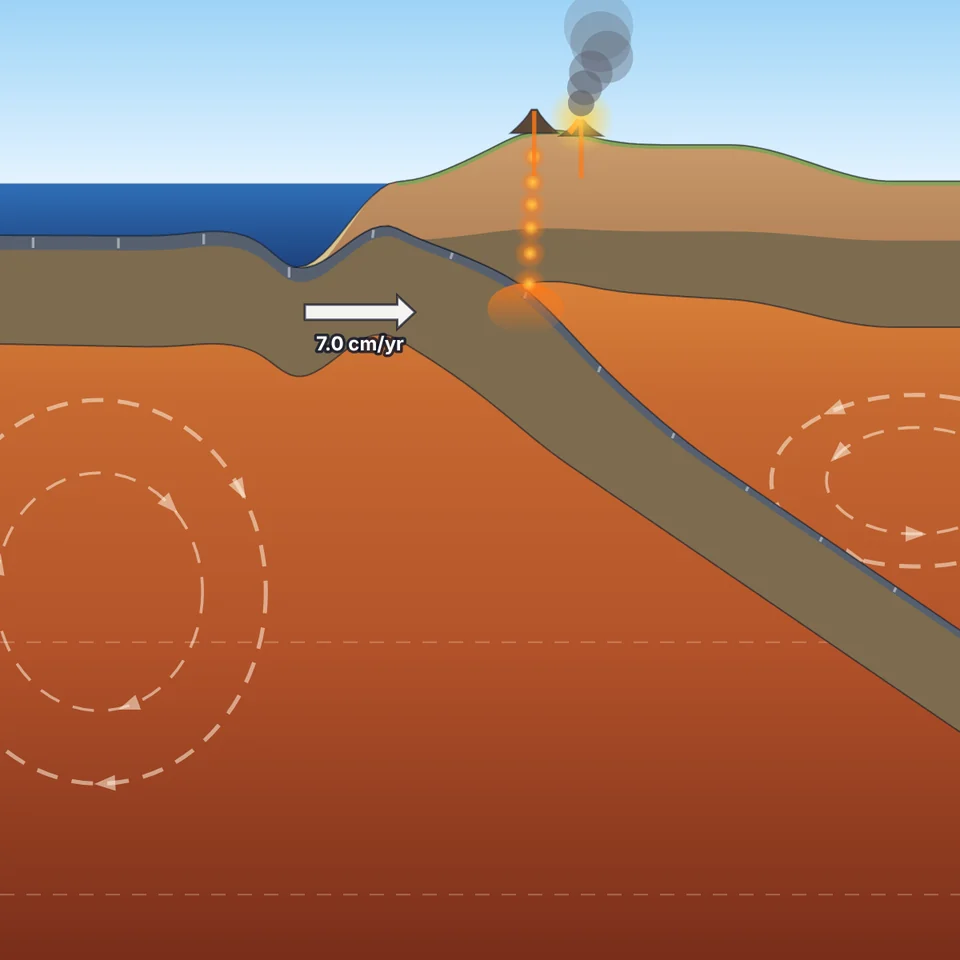
Plate tectonics and plate boundaries
See plate tectonics at work: a mid-ocean ridge with its magnetic stripes, subduction under the Andes and Japan with trenches, earthquakes and volcanoes, the collision that built the Himalaya, the San Andreas Fault's stick-slip earthquakes and the continents drifting from Pangaea to today, at real speeds in centimetres a year.
Ready to try it?
Open PictorX in your browser — no install, no credit card required to start.
Open the water cycle simulator