
Reaction rates explained
Some reactions are over in a flash, others take years. How fast a reaction goes depends on how often the molecules meet and on how many of those meetings bring enough energy to break bonds. This page explains collision theory and the activation energy, why the Maxwell–Boltzmann distribution makes rates so sensitive to temperature, how concentration, surface area and catalysts change the rate, how rate laws and half-lives describe it, why reversible reactions settle into equilibrium, and how the Arrhenius equation turns measured rates into an activation energy.
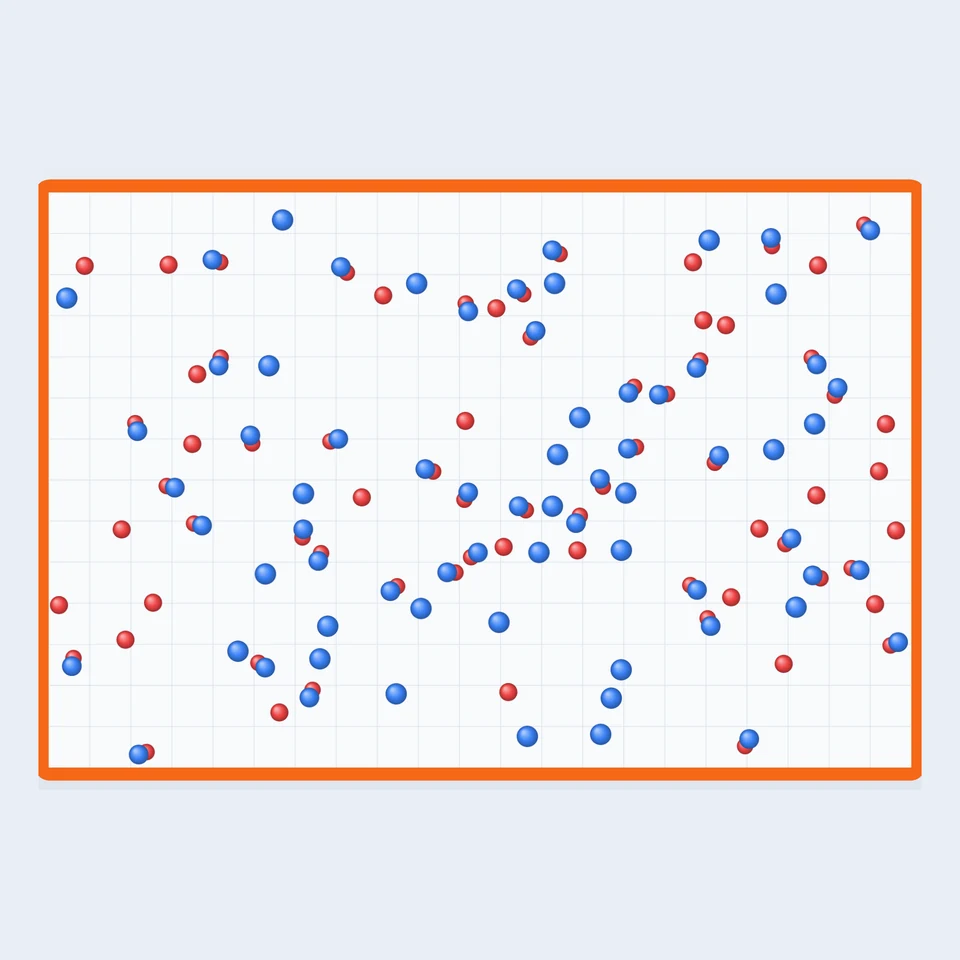
What a reaction rate is
The rate of a reaction is how fast a reactant is used up or a product forms: the change in its concentration per unit of time, for example in mol/L per second. It can be followed by anything that changes during the reaction: the volume of gas given off, the colour of the solution, its conductivity or pH, or the mass of a flask that loses carbon dioxide. Rates are rarely constant. As the reactants are used up the molecules meet less often and the reaction slows down, so the curve of a product against time rises steeply at first and then levels off. The initial rate, the slope at the very start, is what is usually compared between experiments, because the concentrations are then known exactly.
Collision theory and the activation energy
Molecules can only react when they meet. In a gas at room temperature and pressure a molecule collides several billion times a second, yet most reactions are far slower than that, because nearly all collisions are fruitless: the molecules bounce apart unchanged. A collision leads to reaction only if it brings enough energy to stretch and break the old bonds, at least the activation energy Ea, and if the molecules meet in a suitable orientation. On an energy profile the activation energy is the height of the hump between the reactants and the products; the arrangement at the top of the hump is called the transition state or activated complex. What counts is not the total kinetic energy of the pair but the part of it directed along the line joining their centres: a glancing blow, however fast, does not push the molecules into each other. Collision theory therefore writes the rate as the number of collisions per second times the share of collisions with at least Ea along the line of centres, times a steric factor p, the share with a suitable orientation, which is close to 1 for simple atoms and can be very small for complicated molecules.
The Maxwell–Boltzmann distribution
The molecules of a gas or a liquid do not all have the same energy. Collisions constantly pass energy from one to another, and the result is the Maxwell–Boltzmann distribution: many molecules near the average, fewer and fewer at higher energies, in a tail that falls off exponentially. The share of molecules, and of collisions, with an energy above Ea is proportional to the Boltzmann factor e^(−Ea/RT), where R = 8.314 J/(mol·K) is the gas constant and T the absolute temperature. At room temperature RT is about 2.5 kJ/mol, so with an activation energy of 50 kJ/mol only about two collisions in a billion are energetic enough. In two dimensions, as in the simulation, the distribution of kinetic energies is exactly e^(−E/RT)/RT, and the share of collisions with at least Ea along the line of centres is exactly e^(−Ea/RT); in three dimensions the curve first rises with energy before falling, but the line-of-centres share is the same. Heating shifts the whole distribution to higher energies, and because the tail is exponential, the part above Ea grows much faster than the average energy.
Temperature: the 10 degree rule
Since the share of energetic collisions is e^(−Ea/RT), the rate rises steeply with temperature. Between T and T + 10 K it changes by the factor e^(Ea/R × (1/T − 1/(T + 10))). For a typical activation energy of about 50 kJ/mol near room temperature this is close to 2, which is the origin of the rule of thumb that 10 °C doubles the rate; with 100 kJ/mol the factor is nearly 4. That is why food keeps longer in a fridge, why a fever speeds up the body's chemistry, and why food cooks so much faster in a pressure cooker at 120 °C. The molecules themselves move only about 1.7 % faster for each 10 K near room temperature: almost all of the effect comes from the energetic tail. Not every process follows the rule: enzymes stop working when the heat unfolds them, and reactions without a barrier hardly speed up at all.
Concentration, rate laws and half-life
The more molecules there are in a given volume, the more often they collide. For a reaction A + B → C that happens in a single step, every A meets B molecules at a rate proportional to the concentration of B, so the rate is rate = k[A][B], where k is the rate constant; doubling both concentrations makes it four times faster. The exponents in a rate law are the orders of the reaction, and for reactions with several steps they must be measured, since only the slowest step counts. The half-life is the time for half of a reactant to be used up. For a first-order reaction such as radioactive decay it is constant, ln 2 / k, whatever the starting amount; for a second-order reaction with equal starting concentrations it is 1 / (k[A]₀), so it grows as the reactants thin out. The simulation compares the counts it measures with the rate law of collision theory, drawn dashed, and gives the half-life measured or predicted.
Surface area and catalysts
When a solid reacts with a gas or a liquid, only the particles at its surface can be reached. Breaking the same mass into smaller pieces exposes more surface and speeds the reaction up: a powder reacts many times faster than a lump, which is why fine flour or coal dust in air can explode, and why medicines and sugar dissolve faster when ground. In the simulation one lump of 100 atoms offers about 21 nm of surface to the molecules around it and 100 separate grains about 300 nm, fourteen times as much. A catalyst speeds a reaction up without being used up by providing a different route with a lower activation energy, for example by holding the reactants on its surface in a good position or by forming a short-lived intermediate. The catalysed path on an energy profile has a lower hump, often two smaller humps with an intermediate between them. Because it lowers the barrier of the forward and the reverse reaction by the same amount, a catalyst makes a reaction reach equilibrium sooner but does not change where the equilibrium lies. Enzymes are the catalysts of living things, and catalytic converters, the Haber process and most of the chemical industry depend on catalysts.
Reversible reactions and equilibrium
Many reactions can also run backwards: the product C can fall apart into A and B again when it is hit hard enough. The barrier for the reverse reaction is the forward barrier minus the enthalpy change ΔH, so for an exothermic reaction (ΔH negative) it is higher. At first only the forward reaction happens; as C builds up, the reverse reaction speeds up and the forward one slows down, until both go at the same rate. From then on the amounts stay constant although molecules keep reacting in both directions: a dynamic equilibrium. Its position depends on the temperature. Heating speeds up the reaction with the higher barrier more, so it pushes an exothermic reaction back towards the reactants, as Le Chatelier's principle and the van 't Hoff equation say. The rates set how fast equilibrium is reached; the energies of reactants and products set where it lies.
The Arrhenius equation and plot
In 1889 Svante Arrhenius described how rate constants depend on temperature with the equation k = A e^(−Ea/RT). The pre-exponential factor A counts the collisions with the right orientation; in collision theory A = p × the collision frequency, which grows slowly with temperature, as √T, while the exponential factor grows quickly. Taking natural logarithms gives ln k = ln A − (Ea/R) × (1/T): plotted against 1/T, ln k lies on a straight line whose slope is −Ea/R. Measuring the rate constant at a few temperatures and drawing this Arrhenius plot is the standard way to find an activation energy. The simulation does exactly that: it runs the box at five temperatures, counts the collisions energetic enough to react at the starting concentrations and plots the measured rate constants with error bars of ±1/√n, n the number of reacting collisions counted, beside the line of collision theory. With a catalyst the line becomes flatter, because the activation energy is lower.
How the simulation works
The box is a two-dimensional gas of hard discs, a few hundred molecules about half a nanometre across. Each step of 0.05 picoseconds moves them, and every collision is resolved at the moment of contact with momentum and energy conserved, as in the app on ideal gases. When a reacting pair collides, the kinetic energy of their relative motion along the line of centres, ½μv², μ the reduced mass, is compared with the activation energy; if it is at least Ea, and with the chance given by the steric factor, the two become one product molecule at their centre of mass. With the units used, nanometres, picoseconds and atomic mass units, an energy per molecule reads directly in kJ/mol. The walls and an occasional new random velocity, as a solvent or an inert gas would give, keep the temperature and take up the heat of reaction, so that the speeds stay Maxwell–Boltzmann. The activation energies are smaller than most real ones, often 50 to 100 kJ/mol, because those would need billions of collisions for each reaction. The measured rates agree with collision theory once the contact value of hard discs, the slightly higher chance of finding a neighbour at contact in a crowded gas, is included.
Frequently asked questions
What is the difference between the rate and the rate constant?
The rate is how fast the concentrations change right now, and it falls as the reactants are used up. The rate constant k is the factor in the rate law, rate = k[A][B], that does not depend on the concentrations; it depends on the temperature, the activation energy and a catalyst. Comparing rate constants is how chemists compare reactions or conditions fairly.
Why do not all collisions lead to a reaction?
Most collisions are too gentle: the energy along the line of centres is less than the activation energy, so the molecules simply bounce apart. Others hit with enough energy but in the wrong orientation, with the reacting atoms facing away from each other. At room temperature and with a barrier of 50 kJ/mol only about two collisions in a billion succeed, which is why reactions that would otherwise be instantaneous take seconds, hours or years.
Does a catalyst change the activation energy or the enthalpy?
Only the activation energy. A catalyst opens another route over a lower barrier, but the reactants and the products are the same, so their energies, and the enthalpy change ΔH between them, stay the same. For the same reason a catalyst cannot shift an equilibrium: it speeds up the forward and the reverse reaction alike.
How do you find the activation energy from experiments?
Measure the rate constant, or the initial rate at the same concentrations, at several temperatures, and plot ln k against 1/T with T in kelvin. The points lie on a straight line whose slope is −Ea/R; multiply the slope by −8.314 J/(mol·K) to get Ea. With only two temperatures, Ea = R ln(k₂/k₁) / (1/T₁ − 1/T₂).
Related tools
Reaction rates: why heat, concentration and catalysts speed reactions up
Watch molecules collide and react: only collisions with at least the activation energy turn A and B into C. Change the temperature, the concentrations, a catalyst and the surface area of a solid, and see the rate, the Maxwell–Boltzmann distribution with the share above Ea, the energy profile, an equilibrium and the Arrhenius plot.
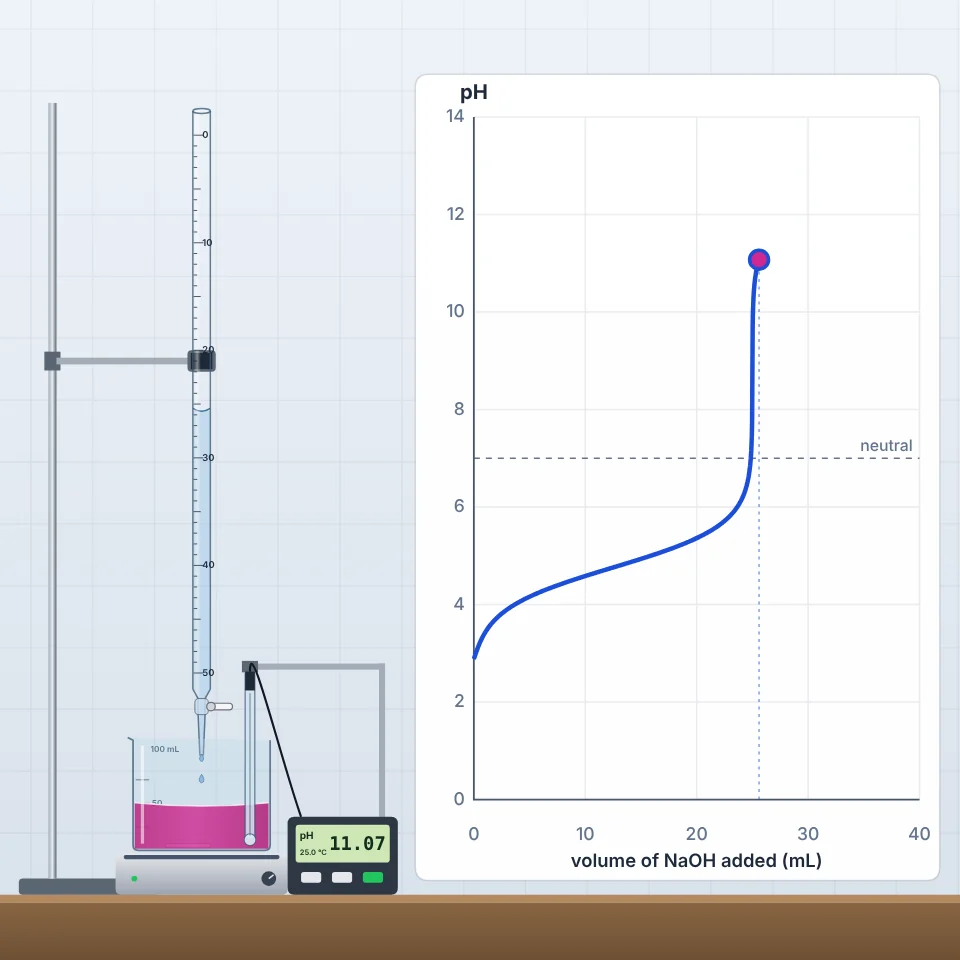
Acid–base titration: watch the pH jump
Titrate acids and bases drop by drop with a burette, a stirrer, a pH meter and indicators that change colour: the titration curve with its equivalence points, the half-equivalence point where pH = pKa and the buffer region, for HCl, acetic acid, ammonia, phosphoric acid and sodium carbonate, with the pH solved exactly.
Titration and pH explained
How acid–base titrations work: pH and the ionic product of water, strong and weak acids and bases, Ka and pKa, the exact pH from the charge balance, titration curves and equivalence points, buffers and the Henderson–Hasselbalch equation, polyprotic acids such as phosphoric and carbonic acid, how indicators change colour and how to choose one.
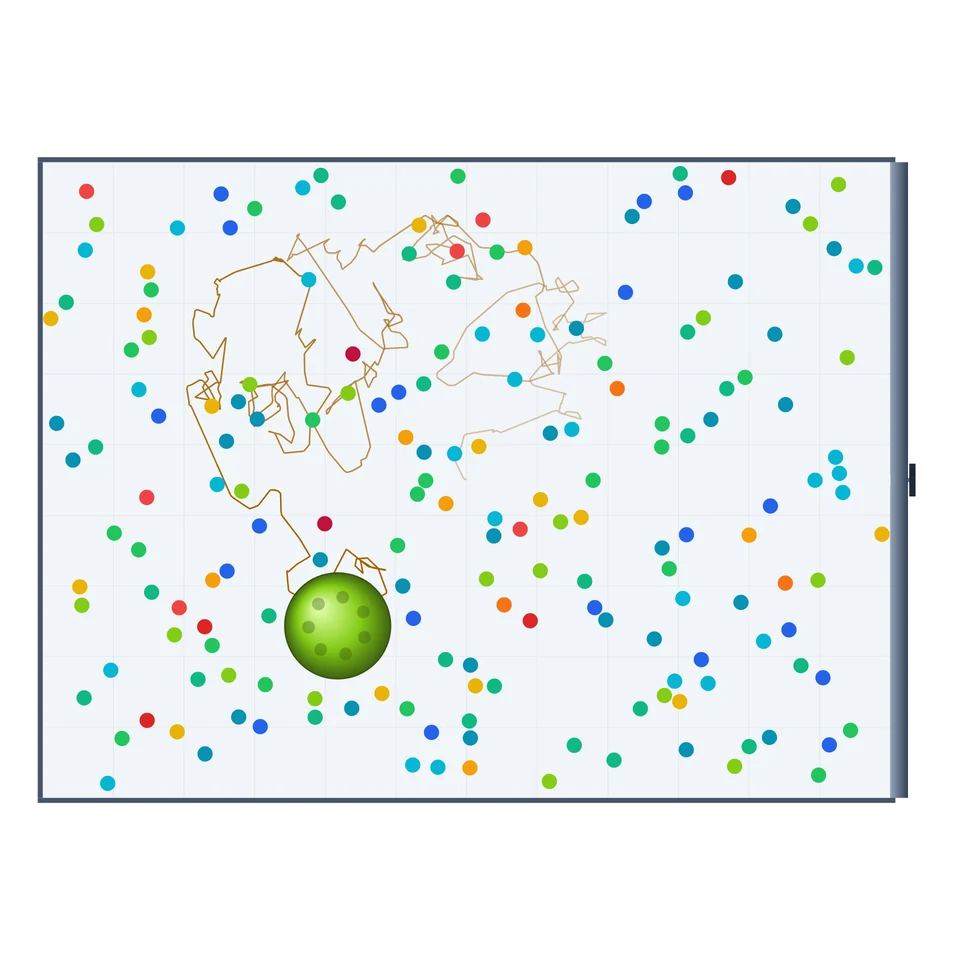
Ideal gas and Brownian motion: atoms in a box
Simulate a gas of bouncing atoms online: measure the pressure on the walls and check PV = NkT, compare the speeds with the Maxwell–Boltzmann distribution, compress the gas with a piston, heat it, mix two gases and watch Brownian motion and diffusion.
Ready to try it?
Open PictorX in your browser — no install, no credit card required to start.
Open the reaction rates simulator