
About Lost in the Universe - our cosmic address
If you were dropped somewhere in the universe, how would you find your way home? You would need an address, and astronomers have worked one out over the last hundred years: a planet, a star, an arm of a galaxy, a group of galaxies, a cluster, a supercluster and a thread of the cosmic web. This page walks through that address from the largest scale to the smallest, the same way the game does.
The cosmic web
On the largest scales the universe looks like a sponge. Hundreds of billions of galaxies lie along threads and sheets of matter, and between them are voids, bubbles of almost empty space hundreds of millions of light-years across. Where threads meet, galaxies crowd together in clusters and superclusters. Maps of millions of galaxies, made by surveys such as the Sloan Digital Sky Survey, show this pattern clearly, and computer simulations of gravity acting on dark matter grow the same web from the tiny ripples seen in the early universe.
Some of the walls are enormous. The Sloan Great Wall, found in 2003, is about 1.4 billion light-years long and lies about a billion light-years away.
Laniakea, our supercluster
In 2014 a team led by R. Brent Tully and Hélène Courtois mapped how thousands of nearby galaxies move, not just where they are. Beyond the expansion of the universe, each galaxy drifts along a current, and the currents divide space into basins, like rivers into watersheds. Our basin, about 520 million light-years across and holding some 100,000 galaxies, was named Laniakea, Hawaiian for "immeasurable heaven".
The currents of Laniakea all flow towards one region, the Great Attractor, near the Norma Cluster. It is hard to see from Earth, because it lies behind the dust and stars of our own Milky Way. Laniakea itself is drifting towards the Shapley Supercluster, the biggest concentration of galaxies in our part of the universe.
The Virgo Cluster and the Local Group
Inside Laniakea, the nearest big knot of galaxies is the Virgo Cluster, about 54 million light-years away, with more than 1,000 galaxies, perhaps 2,000. At its centre is the giant elliptical galaxy M87, whose black hole was the first ever photographed, by the Event Horizon Telescope in 2019.
Our own galaxy belongs to a much smaller family on the outskirts: the Local Group, about 10 million light-years across. It holds dozens of galaxies, most of them dwarfs, but only three spirals: Andromeda, the Milky Way and the smaller Triangulum Galaxy. Andromeda, 2.5 million light-years away, is the largest; the two big spirals are falling towards each other and may merge in several billion years.
The Milky Way and the Orion Spur
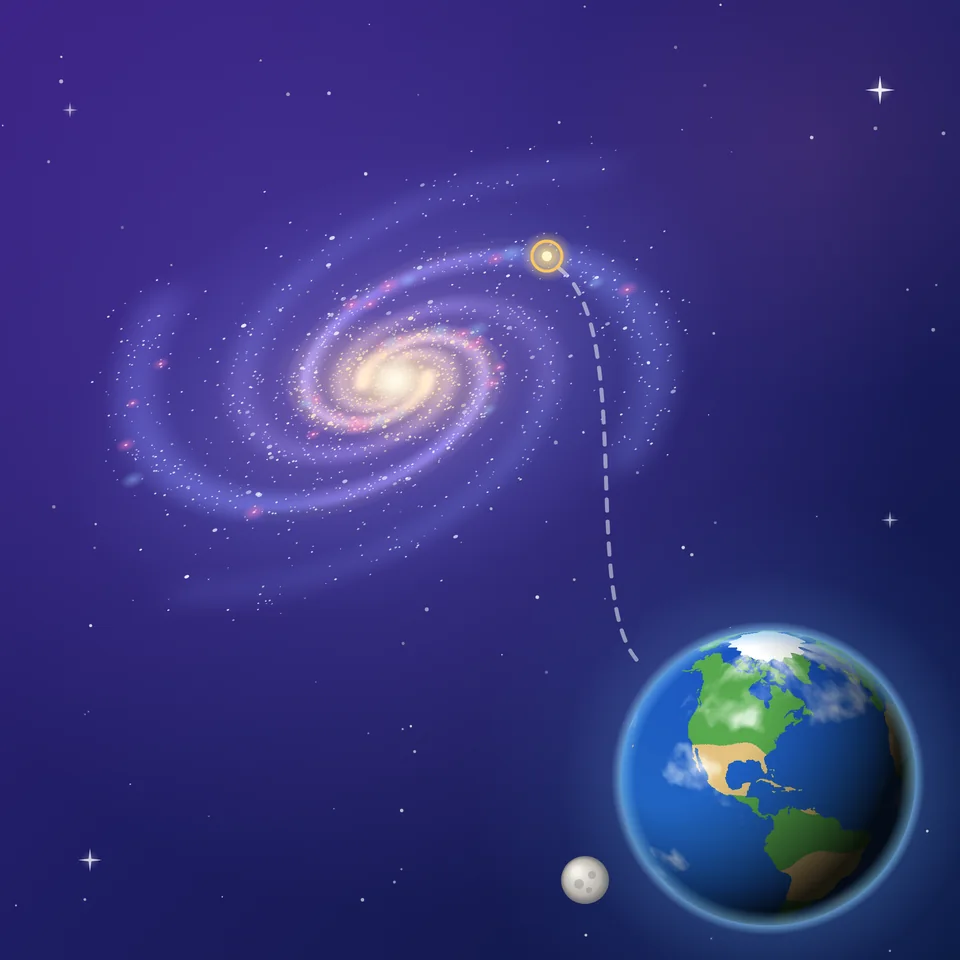
The Milky Way is a barred spiral about 100,000 light-years across, with 100 to 400 billion stars. Seen from above, two major arms, Scutum-Centaurus and Perseus, wind out from the ends of a central bar, with smaller arms in between. In the very centre sits Sagittarius A*, a black hole of about four million solar masses, photographed in 2022.
The Sun lies about 26,000 light-years from the centre, on the Orion Spur, a short arm about 10,000 light-years long and 3,500 wide between the Sagittarius-Carina Arm on the inside and the Perseus Arm on the outside. Many of the bright stars and nebulae in our sky, such as the Orion Nebula, belong to it. The Sun takes roughly 230 million years to go once around the galaxy.
The Sun and the pale blue dot
Among hundreds of billions of stars, the Sun is an ordinary one: a single yellow-white star of class G2, 4.6 billion years old, with a surface temperature of 5,772 kelvin. Many of its neighbours are different: Alpha Centauri, the nearest, is a system of three stars, Sirius is twice as heavy and much hotter, and most stars are small red dwarfs like Barnard's Star.
Count the Sun's planets outwards, Mercury, Venus, Earth, and the third is home, 150 million kilometres from the Sun, a distance light covers in about eight minutes and twenty seconds. In 1990 the Voyager 1 probe looked back from about six billion kilometres away and photographed Earth as a dot smaller than a pixel. Carl Sagan called it the pale blue dot.
Playing on PictorX
Lost in the Universe starts you at the cosmic web and gives you one clue per scale. Point at the objects and the scanner reads out what they are: the galaxy count of a cluster, the members of a group, the spectral class and temperature of a star, the distance and moons of a planet. Click the one the clue describes and the ship zooms in; a wrong jump costs fuel and tells you what you found instead. Play as a Cadet with names and tips, as a Navigator with measurements only, or as an Explorer with no scanner at all. Every object is real and every figure comes from current measurements; only the pictures are not to scale.
Frequently asked questions
What is Earth's full cosmic address?
Earth, the Solar System, the Orion Spur, the Milky Way, the Local Group, the Virgo Supercluster (the local part of Laniakea), the Laniakea Supercluster, and a thread of the cosmic web in the observable universe.
How do astronomers know the shape of the Milky Way if we are inside it?
By measuring the distances and motions of stars, gas clouds and young star clusters in every direction, using radio and infrared light that passes through the dust. Spacecraft such as Gaia have measured the positions of more than a billion stars. The arms are traced where young stars and glowing gas pile up.
Will Andromeda collide with the Milky Way?
The two galaxies are approaching each other at about 110 kilometres per second. Older studies expected a merger in about 4.5 billion years; newer measurements put the chance of a merger within the next 10 billion years at about one in two. Even if they merge, the stars are so far apart that they would hardly ever hit each other.
Why is the Great Attractor so hard to see?
It lies in the direction of the plane of the Milky Way, where the dust and stars of our own galaxy hide what is behind them, a region called the Zone of Avoidance. Astronomers found it from the way galaxies move towards it, and study it with X-rays and radio waves that pass through the dust.
Related tools
Lost in the Universe - could you find your way home?
A free space game and science app: you are lost somewhere in the universe. Follow the cosmic web, Laniakea, the Virgo Cluster and the Milky Way back home to Earth.
Solar System
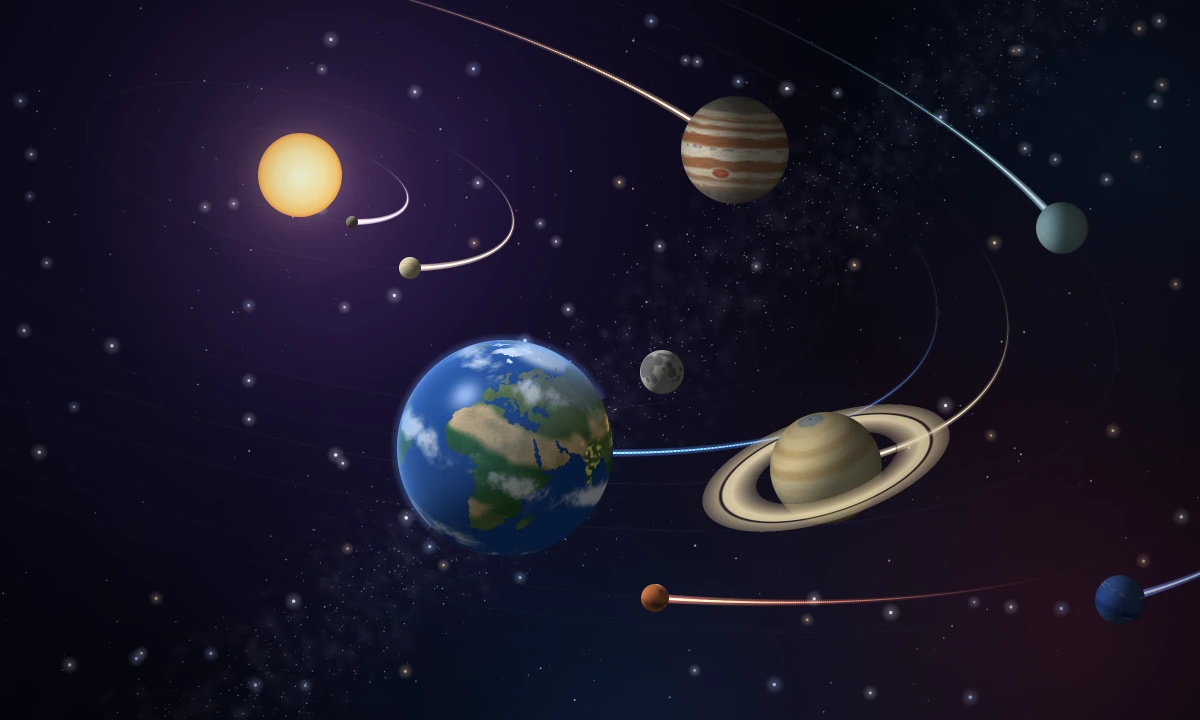
Fly through the solar system in 3D in your browser. The sun, eight planets, their largest moons, the dwarf planets, and the Kuiper belt move on their real, tilted orbits under Newton's gravity.
N-Body System
Watch Newton's gravity move stars, planets, and moons in 3D in your browser. Turn the view, and see stable orbits, resonances, slingshots, Trojans, and a chaotic cluster.
How a geography pin game scores distance
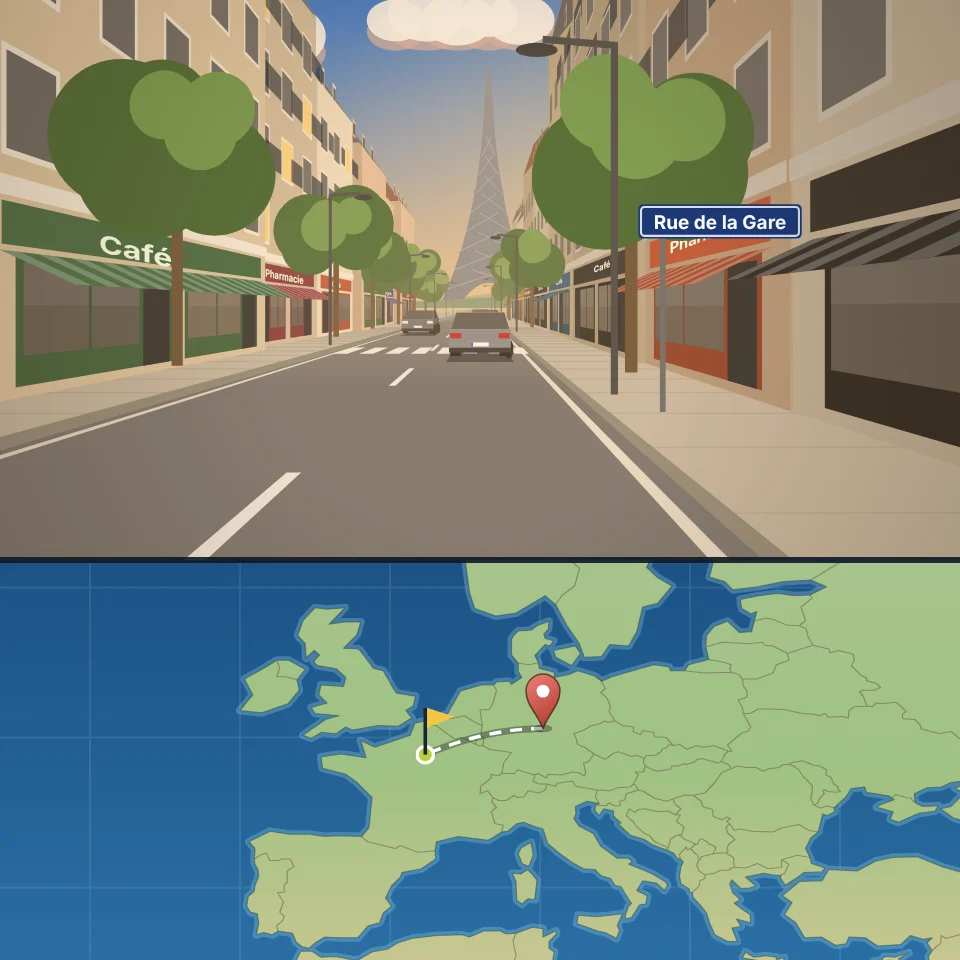
How Atlas Pin works: read a drawn street, drop a pin on the world map, and score by how far you are from the real place.
Ready to try it?
Open PictorX in your browser — no install, no credit card required to start.
Play Lost in the Universe